thepupil
-
Posts
5,001 -
Joined
-
Days Won
6
Content Type
Profiles
Forums
Events
Everything posted by thepupil
-
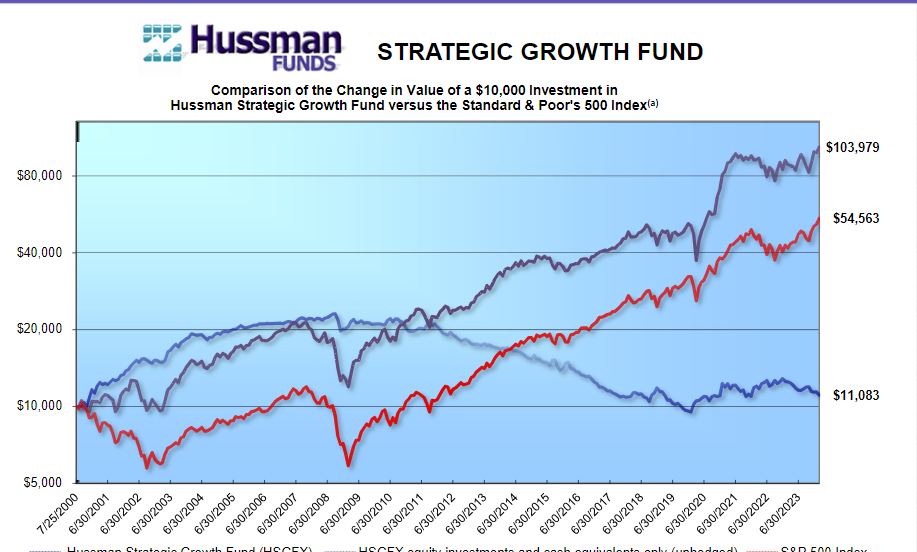
there it is...I don't have the underlying data, but crazy to me that he'd be a good mutual fund manager if he ran unhedged...given the unhinged overly intellectualized perma-bearism...typically those folks aren't good business analysts/stock pickers, but he, at least on an inception to date basis, appears to be.

-
He’s a strangely good stock picker. I theorize he’s super smart, knows his niche as permabear and just owns it. He can pick stocks that outperform and then hedges it all away. If he can maintain okay AUM…so be it. this is based on old stuff that he used to put out that his actual stocks OP’d the index, but based on recent results don’t think that can be true. So you have poor stock picking compounded by shorting a bull market…rough. can’t find the updated chart….I wouldn’t be surprised if lawyers made him take it down or if he didn’t update because it got less flattering
-
Again, I’ll just repeat that your data points seem far more cushy than the data or my anecdata suggests. almost every PhD I know also did 2-3+ years of some research or other low paying job b/w undergrad and grad to have a chance of getting into a competitive funded program. Combine with a couple years of post doc and your looking at 10-12 years before you get a job with real benefits and a salary >$60k…most people in my wife’s cohorts ended up in debt despite no tuition/stipend because making $25k in major metro isn’t cutting it. the idea of a 20 hour workweek is laughable to me. Another family member is a professor at a small podunk rural liberal arts college. She’s constantly grading papers and doing emails /admin work, honestly seems like she works 50 hours/week. She make $50k/year. It’s a labor of love for her. Perhaps your datapoints are people with PhD’s wher the private sector is more competitive like comp sci. even then,. They seem world’s away from my experience.
-
my reference points are people i went to undergrad w/ who graduated in 2009 and 2011 2009 Guy Magna Cum Laude, Engineering, Top 10 University 2013 PhD Civil Engineering, top 10 school 2014 - Present Associate Professor @ Large midwest university the average associate professor at this school, with his years of experience makes $90K. I made more than that in my first year after college. I have no idea in what world this dude is "grifting". 2011 girl, liberal arts top 10 university 2011-2013 teach for america 2014 - 2020 PhD, top 10 university 2020- 2023 postdoc same school 2023- present visiting assistant professor in rural new england at liberal arts college google tells me a "visting assistant professor" at this school makes $70K these are my direct touch points. people who graduated 13-15 years ago from a top 10 undergrad, who i doubt have hit $100K yet. my wife is in field w/ PhD's, she has one. the academic route pays far less and works harder than the non-academic route. she made like $20-$25K as a funded PhD for 5-6 years, $40K as postdoc (another 2 years). that's 7-8 years of post undergrad indentured servitude. if she went academic route she'd be making $90K in an expensive metro....like where's the grift? it's a grift by the institutions. they utilize like 10 eyars of free labor from the PhD's/ I
-
you must know more successful aspiring academics than i do. to me it seems like an almost reward-less grind pursued out of passion / desire for prestige rather than $$$ or work/life balance.
-
I completely disagree. I regard the academic career path as brutal. It's low pay, unstable (until it becomes gloriously so for the minority who make tenure track), political, and just generally shitty. To become one of those people getting paid an okay amount takes 7,10,15,20 years of PhD, adjunct, assistant, etc. I don't envy people in academia at all and do not regard it to be a grift. if anything, people chasing the dream of becoming a professor are the ones being grifted....The people I know who are trying to / have gotten there work harder for far less pay than people in corporate / tech / finance / medicine. do you know anyone in their 20's / 30's that's tried/is trying to become a professor?
-
as someone whose parents IRA owns a slug of $EQC bought w/i last year at a total loss of ~2% when the position was bought at nice discount to NAV and some of which bought for less than t-bills on b/s, I don't entirely mind his presence. I think $EQC is quite reasonable risk/reward here. https://x.com/thepupil11/status/1757430588745650685?s=20
-
High Quality Multi-family REITs - EQR, CPT, ESS, AVB
thepupil replied to thepupil's topic in General Discussion
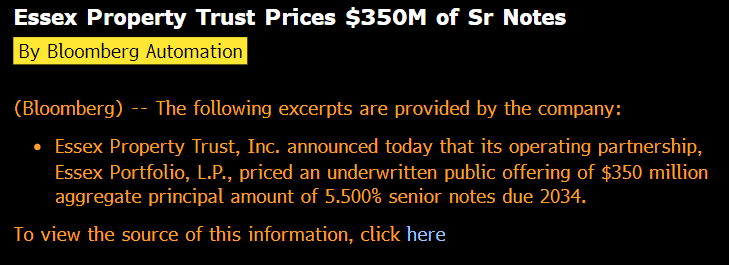
ESS just raised 10 yr money at 5.5%, 145 bps > 10 yr, very reasonable cost of debt for the high quality REITs
-
Why did so many smart investors miss making a killing on BRK stock?
thepupil replied to Viking's topic in Berkshire Hathaway
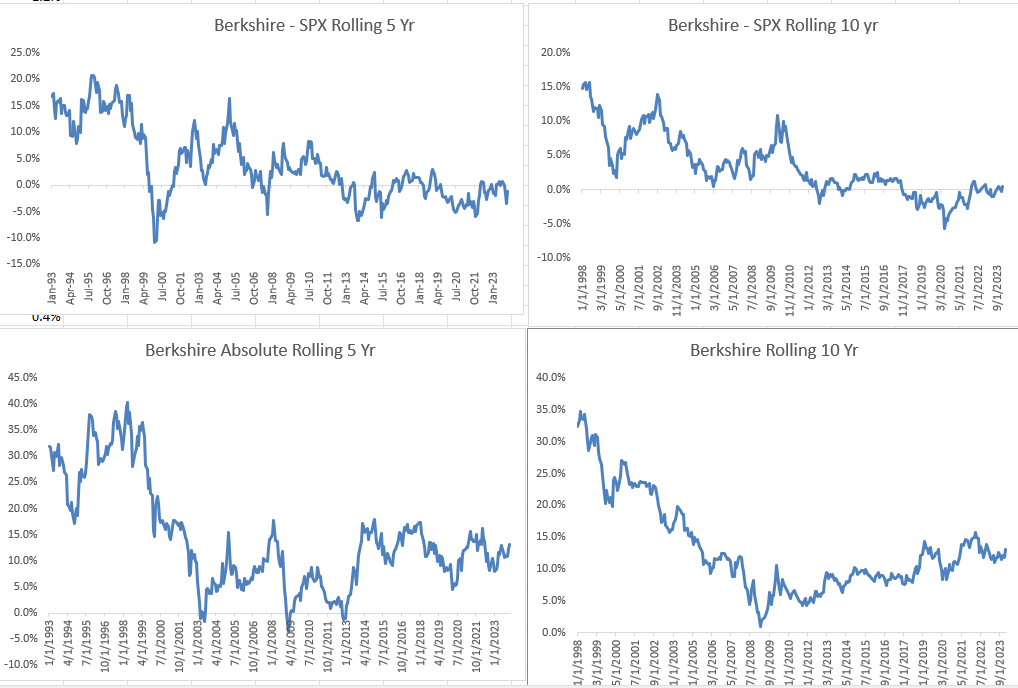
- it's been a great time to own Berkshire - it's been an almost just as great time to own US stocks (and at various points in the last decade, even better than berkshire) - Berkshire's outperformance has been positive but very small in the post GFC era - if one has a 5-10+ year time horizon it's hard to lose money owning Berkshire, I think moreso than it is w/ US stocks, but that's subjective. - I'd note the "barely OP'd for 20 years" commentary is a bit unfair to Berkshire considering its HUGE outperformance in the years leading up to that time frame, in early 2004, Berkshire had just done 17-19%/yr for decade and 5-8%/yr better than market. - below is rolling performance vs S&P, to avoid focusing on any single data point.
-
Why did so many smart investors miss making a killing on BRK stock?
thepupil replied to Viking's topic in Berkshire Hathaway
I've owned some berkshire for the entirety of my investing life. I'm not THAT much wealthier for it relative to S&P, and I'm definitely poorer for it relative to QQQ or FAANG/MAG7or friends who just bought apple / MSFT / google and held (who knew nothing about stocks, but said "google/apple go up"). more generally, if my dad/grandparent are representative of mass affluent, people who have been investing since 1950's in case of my late grandpa and 1980's in case of my dad. most normal investor people wither just buy hold household name divvy stocks (at least that's what my grandpa did) or just invest in what their broker put them in (american funds which earned marked +-1% - 1% ish fee) Buffett was pretty niche stuff for a long time. I think investment in berkshire is a very reasonable way to preserve and grow purchasing power. I'm at my lowest Berkshire weighting of the last 13 or so years save a brief moment where I owned none. My IRR on berkshire (while I've not explicitly calculated) likely exceeds 15% and I've generally been able to buy / sell at good times having come to know it decently well. With that said, the rewards for picking the absolute best companies of the last decade or two have far exceeded investment in Berkshire. I don't really consider myself capable of doing that, so I'll likely continue to hold, at least some Berkshire for a while. -
@Salukii will agree with you on those @Gmthebeau I'm not saying he's a saint, just that your characterization (which fits the popular narrative of that interview) does not, in my opinion, have any consistency with the facts. He's done like 20% gross/year for 20 years. It may not be luck. Guess that's what makes a market.
-
curious way to drive the stocks down...by saying he's buying in that very same interview. I don't know man...Isn't the alternative explanation (that he actually believed what he was saying) the simplest and most consistent. - he thought lots of people would die (lots of people died) - he thought we should shut down for 30 days (we ended up shutting down for longer, probably a big mistake, but idk if 30 day shutdown was a mistake for society, was reasonable view to take at time w/ facts known). - he thought the turmoil he foresaw in february 2020 was not priced into credit markets, put on a huge position in them, and made money when it got priced into credit markets. - he thought his highs quality restaurant and hotel stocks would see it through and recover. they recovered. - within reason, all of this was communicated in commercially reasonable real time to his limited partners for whom he tonned it. I have zero ethical concerns with this fact pattern; everything seems quite rational and in the interest of both society and his LP's. Is he a drama queen? sure. but I still don't understand why people give him shit for this call. he was pretty much right on everything. I'm not saying he's infallible, but just don't see anything wrong with this episode. I mean we've all got better things to do than debate what Bill ackman said 4 years ago, but for whatver reason, this is a "perception becomes a reality" thing that just seems completely inconsistent with he facts and where people extrapolate one one sound byte to draw sweeping conclusions. March 18th 2020 https://www.cnbc.com/2020/03/18/bill-ackman-pleads-to-trump-to-increase-closures-to-save-the-economy-shut-it-down-now.html
-
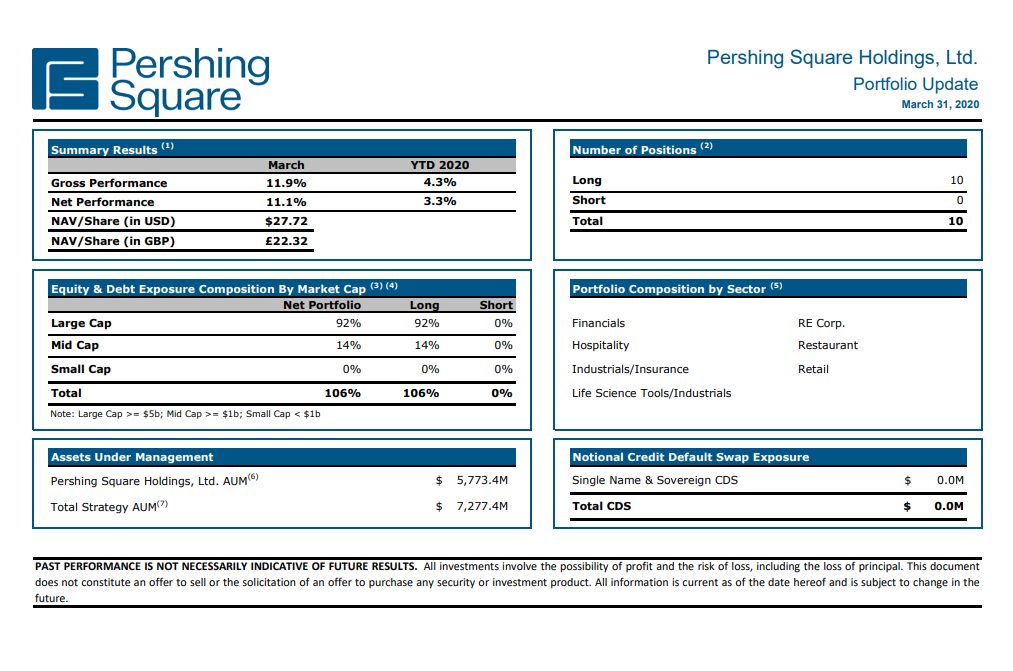
the timeline of this incident is inaccurate. the narrative around the "hell is coming" interview is false. Ackman was aggressively getting longer of stocks in March and monetizing his hedge (half of which already had been sold by the time of the CNBC interview). as someone who was buying his fund monitoring the net exposure, I was a little taken aback at how quickly and aggressively long of restaurants and hotels he had gotten in March and April. The 28 minute interview , where he talks about buying stocks can be found here https://www.cnbc.com/2020/03/18/watch-the-full-interview-with-bill-ackman-on-the-coranvirus-threat-to-economy-shut-it-down-now.html?__source=twitter|main The details regarding the hedge monetization here. At March 31st 2020, PSH was long and strong Bill's story that he didn't make much more money after his interview. This is corroborated in the data by the spread on CDX IG which widened from 40-60 bps in February to 140 on the 18th. It peaked at 152. on 3/20/2020 and ended the month at 113. He made the bulk of his money on the move from 40 to 140 (and had already taken off over half of it) before the interview, not from 140 to 155, even if you think he widened out CDX with that interview. .
-
lol, BND is at $71.80. It peaked recently at $73.5, after which it paid $0.2. so it's down about 2% in terms of total return from recent peak. $TLT is 7% off peak, less a little coupon. For something with a little more duration I have some Caltech 2119 bonds that I bought at $58 in October, think they got to $72, and are now at $68. In what world is that blowing up? a bit dramatic
-
Sold 1/2 for $90.1, some lots purchased in May 2023 @ $75, others in August 2023 closer to $80, all in cost of $78. decent returnfor risk taken (think like 20% ish total return since August, 30% ish from may, higher IRR's, beat SPY, JNK, BND, etc). Think the bonds are perfectly fine at today's price, but looking to add to other stuff/maybe some new ideas/longer term stuff. the callability means it's very easy to calculate your max upside. EDIT: I ended up selling the rest a few days later. just think I'll have better opps.
-
as an interesting data point, my parents church had an annual budget shortfall of $100K as donations did not come in as expected. they dropped their windstorm coverage ($100K of $120K / yr total insurance premium) in order to meet the budget and plan to forego coverage indefinitely. I'm sure there's a relevant bible verse to share here, but I guess I didn't pay enough attention growing up...
-
I mean marginal tax rates on short term gains are like 50% with NII and state and federal
-
I didn't see any new info in this article regarding my understanding of how the industry works / what the incentives are. I believe we simply disagree on interpretation of the same facts.
-
how so? who's getting paid by whom? from my understanding activist short sellers have several models. they either take LP's in an SPV or fund structure and use that capital to put on positions. they can do the research themselves, or can collaborate with other hedge funds/freelancers who wish to stay off the radar from a regulatory/LP/company/general reputation standpoint. so from my understanding activist short sellers are paid fees by other HF (either success or cash based) and get paid on their performance from trading their ideas. the prime brokers get paid through trading flow, through the arranging of securities lending which results from demand from HF's and from fully paid stock from retail / LO's. longs get paid by being right, have heard several longs with very successful stock purcahses whcih resulted from dislocations from an ultimately inaccurate activist short report the twisted incentives to do work, share information and make money in the markets thereon for the benefit of LP's or personal capital. what would you correct / add?
-
there are already regulations against using false or misleading information to manipulate the price of a stock. activist do the same thing on long side w/ calls in monetizing bumps. risk of selling / buying something because of what someone else said is borne by those acting on that information. there is nothing wrong with short (or long) reports if they use true information. if people want to sell or buy the stock as a result of their assessment of the information, that is the market functioning. everyone's accountable under the current system. if you bring to light interesting enough info that causes longs to sell, you get rewarded if you lie, you (should) get prosecuted/punished. if your schtick has no impact or even further heartens bulls / the company is well capitalized, you get run over. seems pretty fair / well functioning to me.
-
well I'm just glad the board's (at time irrational) hatred of short sellers will be reinforced for decades to come. Guarantees my role as resident short seller apologist for a long time. this one seems pretty myeh...
-
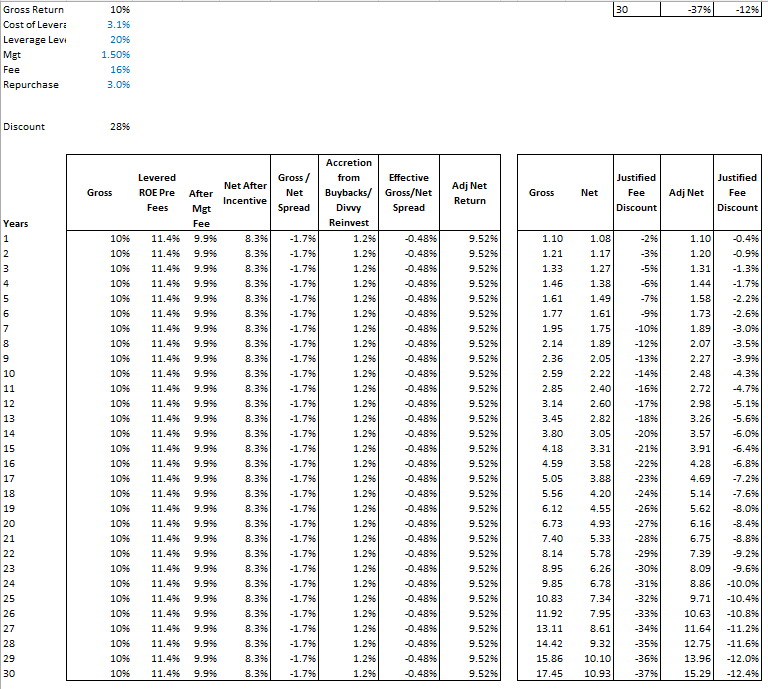
this is similar to how I view things, with a little help from low cost leverage and discount, a buyback/divvy reinvestment of 3% of NAV more or less cancels out the fees such that gross return should be quite close to the net return. this is why a consistent divvy/buyback is so important with discounted NAV vehicles. it acts as a self-correcting mechanism by which the discount allows for accretion to offset other factors which weigh on NAV growth. It does not guarantee a closing of the discount but does help with per share value growth.
-
can you point to any data that backs this impression? it goes against my anecdata (which is that immigrants are, for the most part, working their asses off to make the next generation better)
-
From henceforth, 80-90% of you all won’t pay income taxes…lol
-
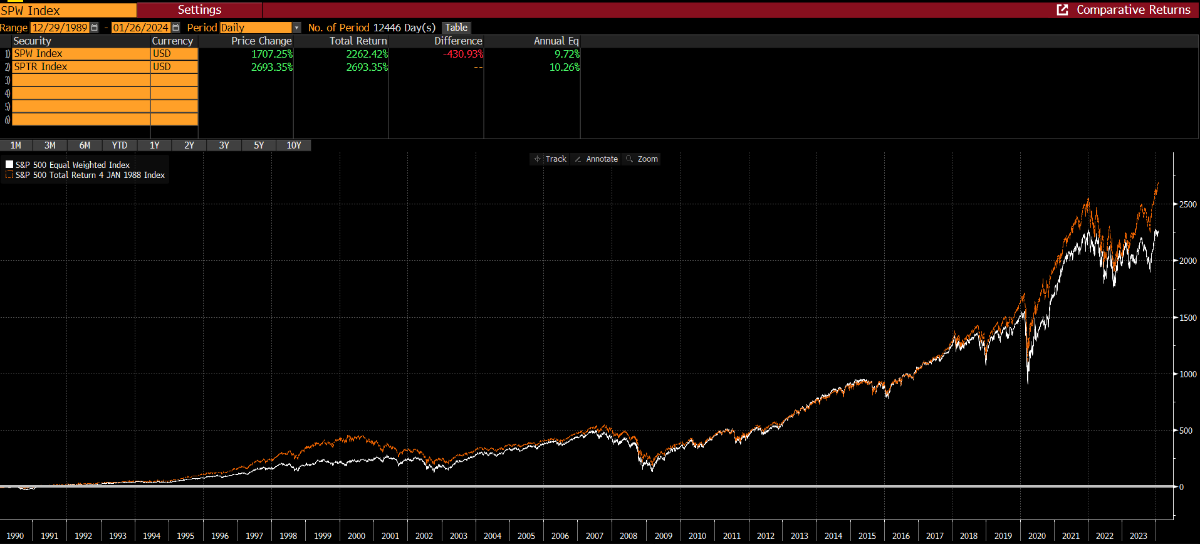
It's interesting in that I remember distinctly in the early 2010's working at a place that was benchmarking managers against equal weighted indices because equal weighted had done so much better than cap weighted (particularly abroad where indices concentrated, often in banks) over the past decade. I'd also note that the longest term data I have does indeed show that cap weighted beats equal weighted, but it's not by as much as you'd think, and the two approaches were tied at 9.4%/yr for the entire period 1990-2016. I think it's impressive that the equal weighted basket of 500 US stocks (rebalanced quarterly i believe) has done as well as it has. Makes a good case for RSP. SPY has about 29% in Mag7. RSP has about 1.75%. 1990-1999 Cap weighted: +18.2%/yr , Equal Weighted: +12.5%/yr 2000-2009: -1%/yr vs +3.4%/yr (equal weighted wins) 2010-2019- +13.5% vs +13.55% (cap weighted edges by .05%/yr) 2020-Present: +12.5% vs +9.9% (equal weighted wins) Whole Period Cap Weighted: +10.26% , 2693% Equal Weighted: +9.72%, 2262%