thepupil
-
Posts
5,003 -
Joined
-
Days Won
6
Content Type
Profiles
Forums
Events
Everything posted by thepupil
-
one reason to cover as an activist short is that you can find yourself overly successful in attracting other people shorting and risk borrow drying up, so if you got a portion of your profit in exchange for sharing your thesis, better to take the bird in hand.
-
yes, we agree here, he should not have lied about "staying long until X" and sold it that day. he should not have said he didn't take compensation from any HF's when in fact he did. he should not have said he managed external capital when he didn't (or implied it, unclear to me he actually said it). he definitely lied a few times, but much of the complaint seem very weak and has pretty big implications for anyone who speaks publicly about stocks with any kind of specificity.
-
it's not a question of ethics though is it? the law does not mandate ethics. it mandates following the law. what you or I consider distasteful doesn't matter, right? no one faces 20 years of jail time for cheating on one's spouse, even if it is unethical. I doubt that I'd like to spend any time with Left or have him marry my sister. lots of people do unethical things (some of what Left did I take issue with, some i do not), but not all of them are publicly charged by our government and facing up to 20 years in jail. e can't arbitrarily redefine what market manipulation is just because we don't like someone or don't like their investment strategy. that's what it feels like to me is happening here and that's why I hope he successfully defends himself. also I do agree with the critics that this will certainly silence potential short activists who are already the subject of enough persecution by companies and regulators. It feels the SEC is hollowing out a community that in aggregate likely does more to bring down bad companies than the SEC itself does.
-
yes. 2/26 = 7.6%. Making 7.6% in a day is a better IRR than making 3.5x in say 3-5 years...IF you have enough ideas to reinvest at similarly insane IRR's, perfectly reasonable to close out that day. Let's say Andrew's skill/podium were good for 7% every 2 months. in two years that's 125% return while only being exposed to one company on a fraction of trading days. he made a fair bit of money using only is own capital so it was effective, potentially even rational to monetize the short term moves in the stock. Saying something is worth $100 to the public does not carry any obligation to hold it to $100. one could certainly argue that it's 100% rational to do what he did and take the better risk adjusted returns particularly given the path dependency of shorting and degree tow which most ideas were shorts. that's what concerns me about this. the SEC seems to have made portfolio management a crime. if 5-10% in a day is too small a move, then what's the line? what about 20% in a week? a month? 3 months? to my knowledge the SEC has not mandated a holding period for a position on which you state an opinion of intrinsic value. nor should they. should one be penalized for effectively moving the market? no. if you say something false or just make shit up to try to then yes (which is my understanding of the law in place). the SEC seems to be shifting that with this case. I think SEC just doesn't like activist shortselling and needs something to show for their investigations these last three years. And there are clear instances where Left did lie...but not really about stocks, about stuff like not being compensated by HFs or implying that he managed external capital when he didn't. there I think it's more clear cut, but those don't strike me as serious as the other allegations. about the companies themselves, the SEC offers very little in their complaint regarding him saying untruthful things. as some bloggers and matt levinge have pointed out, he was often right (and sometimes wrong) in his analysis of companies, like any of us.
-
okay. just wanted to make sure we're looking at same thing. don't expect us to agree on this.
-
can you point me to what you are reading? all i can find is the below. I have the opposite impression from this. defense is basically "he was right on the companies in most cases" and "no need to disclose trades", with which i agree. https://www.cnbc.com/2024/07/29/andrew-left-citron-capital-securities-fraud-los-angeles.html
-
I think this is a good thread on the matter. https://x.com/compound248/status/1816878276662497773
-
so I guess my idea of manipulation is making false statements about the company. I don't consider a price target in itself (which is subjective) to be a false statement or misleading. the complaint details Left coming up with a sensational price target (without basis) to move the stock. that's the crux here. But can an opinion on where a stock should trade be false and misleading? If you say you're still "extremely short" something when you've covered 75% of your position, is that illegal? what if beforehand you were simply even more extremely short? I would assume that a complaint of this nature would include people pumping up a stock (or trying to get it down) by making false/misleading statements about the company the complaint alleges that Citron's intent to buy/sell the securities at the time of release of information was not disclosed to investors. the "stupid disclaimer" does just that. just seems like tons of leaps/grey areas/points of concern that when brought to logical conclusion would apply to almost anyone, but in the end, he's going down. no one wins against SEC once they come after you. he's done.
-
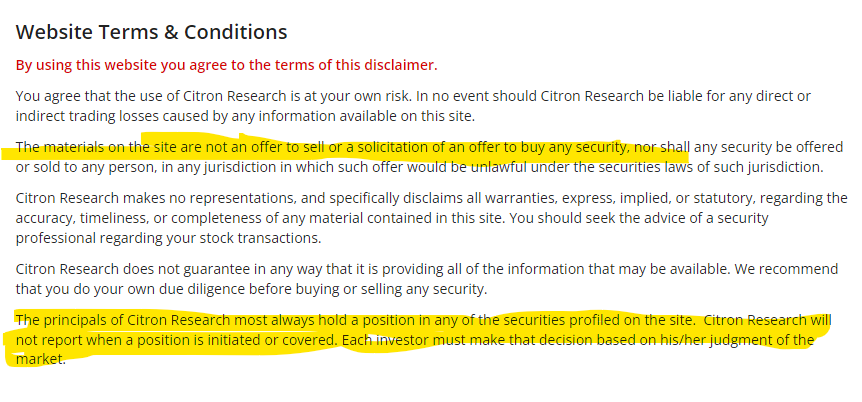
also, isn't this the whole reason every activist short or long has something like this in their materials/website?

-
Left seems to be the most egregious in monetization of short term moves, but I did not, until today, know that is was illegal to publish a price target and then take an action inconsistent therewith. I think there's enough false statements made for SEC to have a case, but I find some of the implications of what is legal / not legal to be both disturbing and far reaching. Here's the full complaint. https://www.sec.gov/files/litigation/complaints/2024/comp-pr2024-89.pdf What I find most interesting about this is the idea that having a price target and then selling / covering at some price different from that price target is "false and misleading" (see the appendix) By this definition, if I on twitter said that I think AIV is worth $16 and then sold half my position at $9, having bought at $6.50, I've made a false and misleading statement, when in fact, I'm merely taking profits. Now if i did that 25 times and used sensational language and did it on small moves on a number of stocks over very short time frames and told my colleagues i was taking retail investors money like candy from a baby, and i had 100K twitter followers instead of 7K, then maybe the SEC would come after me. But a lot of the individual acts by left here don't seem "false and misleading" to me.
-
I agree w/ this, but I'll always be at least like 80% equities because can't time the re-entry. curious if you think we're still in a time of "volatile and/or rising inflation?"
-
haha, those were some good bonds...FWIW I'd probably leave the last two points to someone else.
-
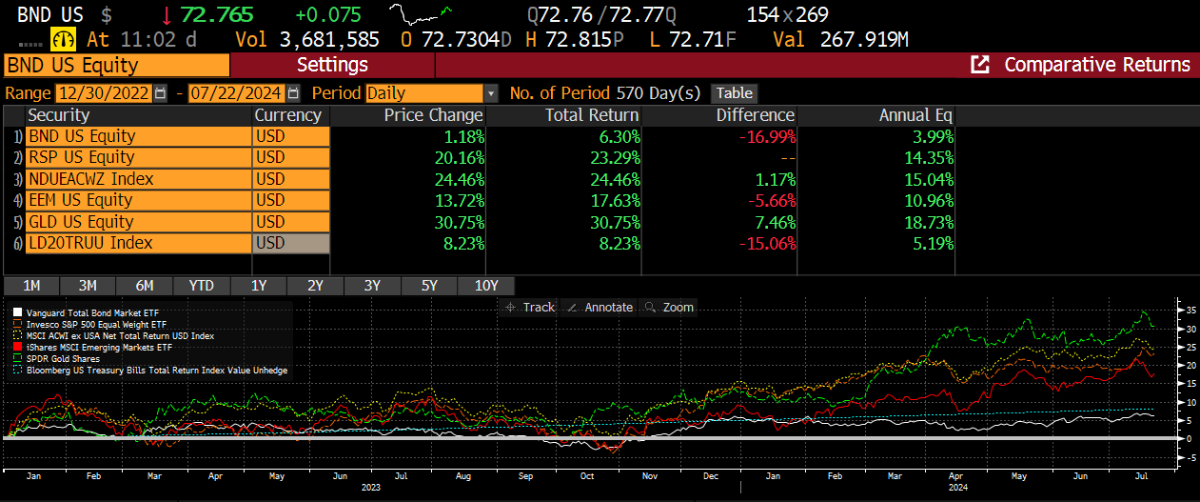
if we include 2022, indeed S&P 500 equal weight is < t-bills at 3% ish, SPY at almost 8%/yr, 3% ish for stocks outside US. EM and bonds are negative. Gold a nice 11%/yr. so yea, I agree with you over that time frame that non mag7 stocks not really worth owning vs t-bills (with the benefit of hindsight).
-
not sure I agree. since the beginning of 2023, bonds have been worse than t-bills, Equal Wgt S&P500, ACWI ex United States, EM stocks, Gold. it's not just a Mag7 thing. I've been building bonds all the way over that time period. The bond index is now my single biggest line item (but still only like 9% of my nut), but let's not pretend that bonds have done well or added any benefit to relative to other asset classes thus far. so far it's been wrong to have any. may be different going forward. only been a couple of years with +real rates.
-
yep, was aware of the 1256 (hence no wash sales). I definitely can do it more optimally and need to sit down build an excel sheet/plan. @aws objective is to have no economic gains/losses, not use "substantially identical" securities and have an array of unrealized gains/losses to choose from.
-
another factor is XLF flows. When Berkshire has a short term run-up (or down) it's often in tandem w/ XLF (driven by big banks, asset managers, payments, etc)
-
example: I went long about $xxxK notional of $VT via (synthetic long, short put long call) and short the same of SPX via futures options expiring in december. so long world / short US, not the exact same security, but about 65% or so pretty similar since world is 65% US. I'm invested mostly in US in all accounts including tax advantaged so being short US for this trade wasn't a concern. I lost $xxK on the short SPX leg and was up $xxK on the $VT leg at time I closed out the SPX short and realized $xxK of losses. I then re-established a similar short position in a slightly different US based index (even though 1256 contracts don't have wash sales so this was not necessary). Assuming the $VT leg is still profitable at expiry, I can choose to exercise in December (which will require borrowing a bit of money) which will build the gain into the VT shares but allow me to control timing of realization. there's a number of iterations. I think the "right" way to do this would be to diversify across tons of highly correlated pairs including individual stocks, but I'm optimizing for pre-clearing as few things as possible at my employer.
-
are we "fixating" on bonds or just moving from #neverbonds to #maybesomebonds? of course, since I wrote that, SPY is +30.1% and bonds are +6.8%, but it's also been 9 months and not 7-10 years.
-
I manage my money as well as that of my retired parents. Their taxable portfolio is ~50% basis / ~50% unrealized appreciation but the positions at the top (Berkshire / Google / Apple / Black Stone Minerals / Microsoft etc) are 5% - 30% basis with rest in unrealized appreciation creating significant tax friction for selling. Nevertheless as florida retirees, paying 15-23% on trims isn't so terrible and is portfolio is relatively tax efficient. My own portfolio is traded much more aggressively and is much more concentrated and far less tax efficient; on top of that I'm in a high tax state. My own taxable's portfolios CAGR is much higher than theirs (last 5 years = 25%/yr for taxable, last 5 years = 13% / yr for theirs). TO be clear, this is my main taxable account's CAGR and not my whole portfolio and reflects a very favorable time frame and is obviously not a sustainable return. Way too high. Will be much lower. On a longer time frame, I'm more like SPY +3% (of which I'm proud because as a value luddite, I do the whole "OP'd without tech" nonsense) but much of that +3% has likely gone to taxes. I think given the tax inefficiency of my approach, their portfolio's risk adjusted after tax return is better than mine and their approach is probably where I'll shake out eventually. the result of my greater aggression has been compounding at a higher rate, but I've also been paying taxes as a I go whereas they build a favorable form of leverage with a DTL. It takes a pretty big delta in returns to overcome taxes. Nevertheless, I do not prioritize tax efficiency because a) so far more or less have paid for the increased taxes w/ better returns b) have built a (top 1% for age I suspect) amount of tax advantaged accounts from $0 over last 13 years so a portion of my investing will always be tax agnostic. Lately, I've introduced a tax overlay on my own portfolio where I'm long and short various indices, trying to generate $0 of net PnL but lots of gross positive and negative pnl. thus far this has been moderately successful and allowed me to sell all my highly appreciated berkshire with minimal tax friction, but it's also because I just haven't made that much money this year and paid lots of taxes in the past. long way of saying, I kind of get both sides of this debate. regarding berkshire, my view of the core businesses competitive position (Burlington vs UNP, GEICO vs Progressive, BHE/utes on an absolute basis) etc has dimmed relative to 3,5,7 years ago. My view of apple's valuation has as well, and the P/B multiple is quite healthy particularly considering just how much is in liquid stuff available at market outside of berkshire. the DTL is more likely to be realized / real as Buff dog trims Aapl, so you're paying quite a premium to an already rich valuation for a pretty big portion of the book. I've been at $0 of berkshire 2x in 13 years. I may regret it. it remains my parents largest position. I expect it to do okay from here over the long term.
-
i sold all my remaining Berkshire yesterday.
-
I disagree. 100's of managers shut down a year without committing fraud. Him losing AUM and shutting down and the management company being worthless is completely normal. Even highly successful fund managers shut down. I can think of a few who voluntarily returned billions and just quit as well as many more who lost their AUM because they failed from an investment standpoint or failed from a sales standpoint. the vast majority of fund managers have no terminal value beyond the founder's career. having your management company become worthless is not equivalent to fraud and not equivalent to your investment funds going to zero. the disagreement re the loan payments is sketchy and deserves scrutiny. my gut is chanos would not commit such blatant fraud, but we'll see. courts will figure out.
-
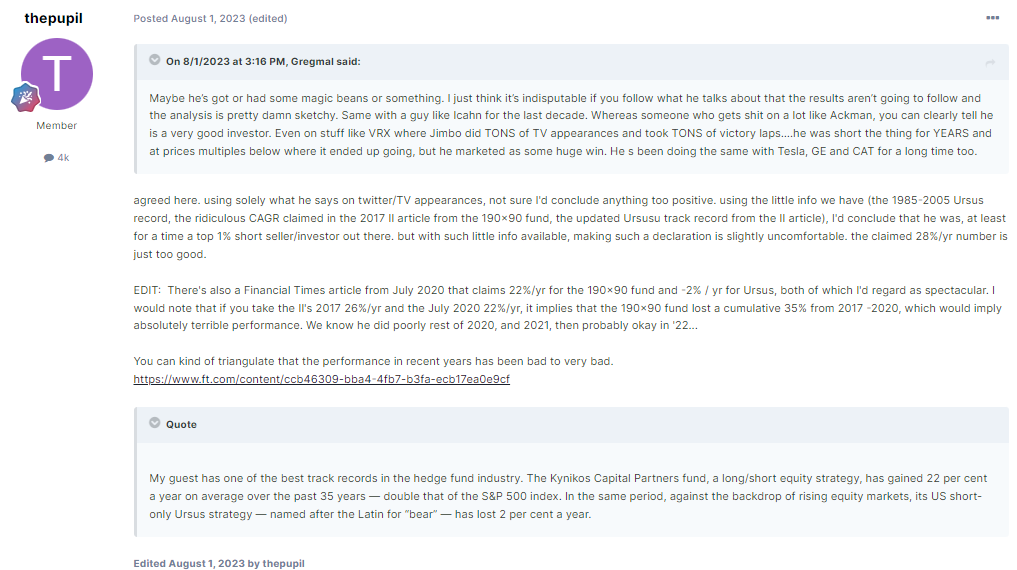
i don't really get that, I think the goal of his long/short fund was absolutely to make money (it allegedly made quite a lot for a very long time). the goal of his short only vehicles was to make money (when combined with the long investments of his underlying investors). goal of any GP is to make money off fees in addition to the investment returns. all sources indicate he's sucked for a while. He ran a long/short fund. - there's a 2017 and 2020 article in media (II and FT) claiming spectacular long term moneymaking performance by said fund. its so good, that as I've noted in the past, I'm skeptical and think it's probably VERY front loaded or erroneously quoted or even somehow mistated. either he WAS an amazing investor or something amiss. - and in fact using the 2017 /2020 claimed record you can deduce he hasn't done well for a long time he ran a short only fund - there's a track record 1985-2005 floating around on here that you/parsad/et all think is very bad and I'd regard as phenomenal if short only and if true. the type of short return that when combined with long book would compound at high rate (as claimed by the long/short fund) there's some public info on the performance of a European UCITS fund he launched in 2022 and shut down in November 2023. it did poorly. https://greenash-partners.com/documents/Chanos/Monthly-Factsheets/Chanos Feb 2023.pdf https://www.hedgeweek.com/swiss-boutique-green-ash-to-close-chanos-long-short-equity-fund/ So putting it all together - II / FT have reported returns of the l/s fund. they report very very very good moneymaking performance from inception to 2017 and 2020. from the short only fund track record and the description of the l/s strategy (which says they index on long side) this was driven by short alpha / effective short selling. - all publicly available info, including the words of chanos himself, indicate he's had a rough go of it for a long time, since the mid 2010's and not made money, AUM collapsed (from $7B to "family office" alpha generative short selling helps a fund compound capital. negative alpha generative short selling destroys capital. some third parties corroborate very very good early returns for chanos. ALL sources of information are consistent on him sucking of late, including him.
-
Chanos haters will take joy in this amusing e-mail thread regarding the state of the firm's investment strategy as of late 22 From a Mike Salem at Kynikos From a guy invested in Chanos & Co and angry about it in response.
-
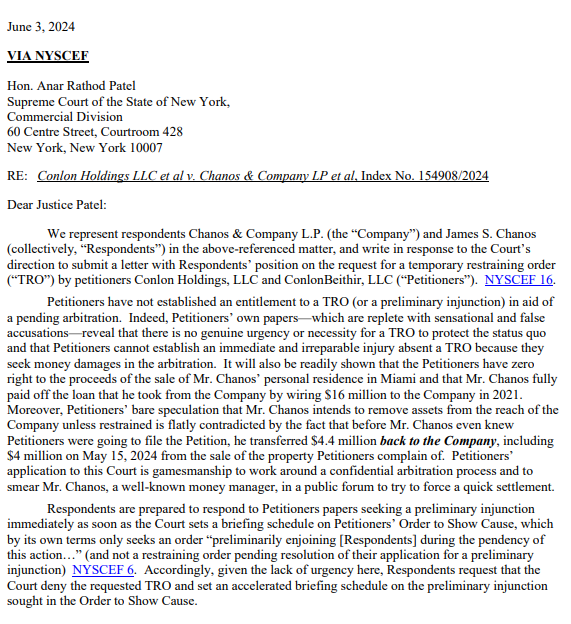
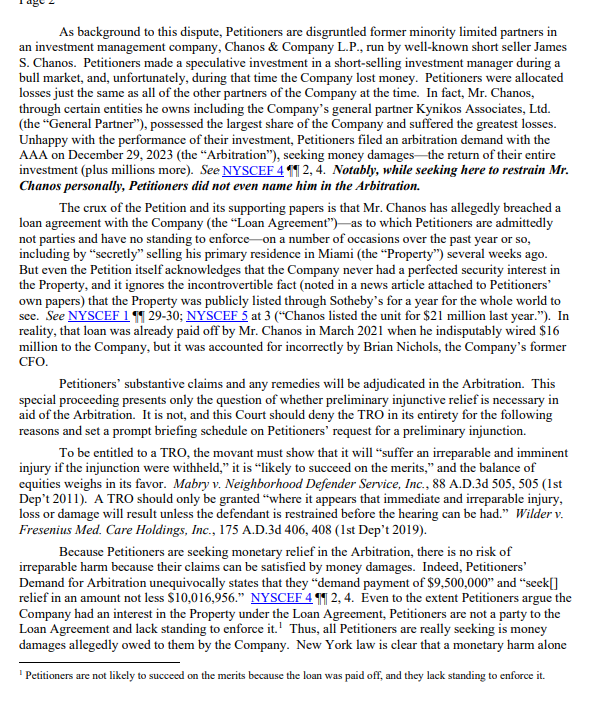
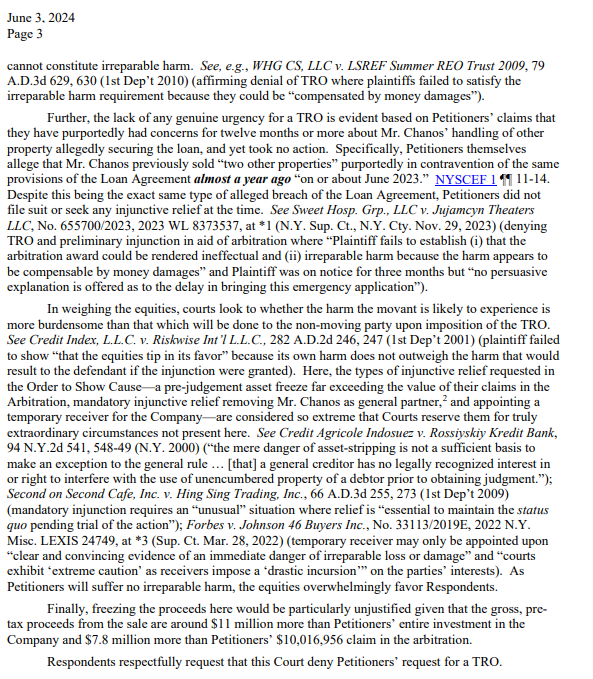
I read the minority investor's complaint (a bit cumbersome to screenshot, but the juiciest parts are in public domain. it sounds pretty bad. below is Chanos defense. the biggest point of disagreement seems to be whether the money that Chanos put into the mgt co (Chanos & Co) was a repayment of the loan to him or merely a capital contribution to the mgt company that did not in fact repay the loan. here's Chanos defense. they allege Chanos & Co's CFO mischaracterized these as capital contributions. CFO says Chanos still had loan on 2022 tax returns and they were not repayments. a bit of a he said / she said. As an aside, it's a nice window into tax efficiency. Chanos runs an investment firm. he owns several trophy properties. the investment firm makes a loan to him secured by the properties, nice tax efficient monetization of the company (i assume that's why structured this way).
-
that’s not my interpretation. from what I read - Colson bought a minority stake in the HF manager (Chanos & Co) in 2020. At the time, AUM was $1.5B, down from a peak of $7B+ - Chanos & Co’s AUM has collapsed since; they shut down funds in late ‘23 All else equal, I’d expect a minority stake in GP/mgt company to be worthless when AUM collapses. An important nuance is that from what I read, Chanos was removed as GP from the LP that held the minority stake in Chanos and Co, and not the GP of the institutional funds he managed. I have been unable to find the full suit though, so happy to be proven wrong. As Cohodes points out the bar for LP’s removing GP is incredibly high. If I’m fact that LP was not constituted by a diverse group of institutional investors, but instead by 1-2 people who bought a GP/mgt company stake that’s now worthless, it makes more sense that he’d be removed as GP. regarding the loan to Chanos, the repayment or lack thereof, the story is conflicting so not sure what do do with that without more information sale of condo seems kosher if realtor paid market rate and condo got fair value. Bad optics of course, but not clearly wrong to me as with all things Chanos, we’re feeling one part of the elephant and have imperfect information.