Thrifty3000
-
Posts
683 -
Joined
-
Last visited
-
Days Won
6
Content Type
Profiles
Forums
Events
Everything posted by Thrifty3000
-
I’m in my early 40s and my family of 5 lives off our investment portfolio. FFH now makes up roughly a third of the portfolio at an average cost of ~$400 per share. I think about my portfolio differently than most. I buy solid and growing look through earnings. Full stop. I want my portfolio’s look through earnings to exceed my family’s annual expenditures by a WIDE margin (several times over). I try to buy look through earnings for the lowest cost possible. Even at the current stock price Fairfax produces the highest look through earnings for the price of any investment in my portfolio or watchlist. So it would make me sad to sell those earnings - equivalent to a pay cut. Focusing on look through earnings helps me not obsess over the share price short term. It does make me obsess over the quality and sustainability of those earnings in relationship to my family’s expenditures. In short, FFH is still my favorite.
-
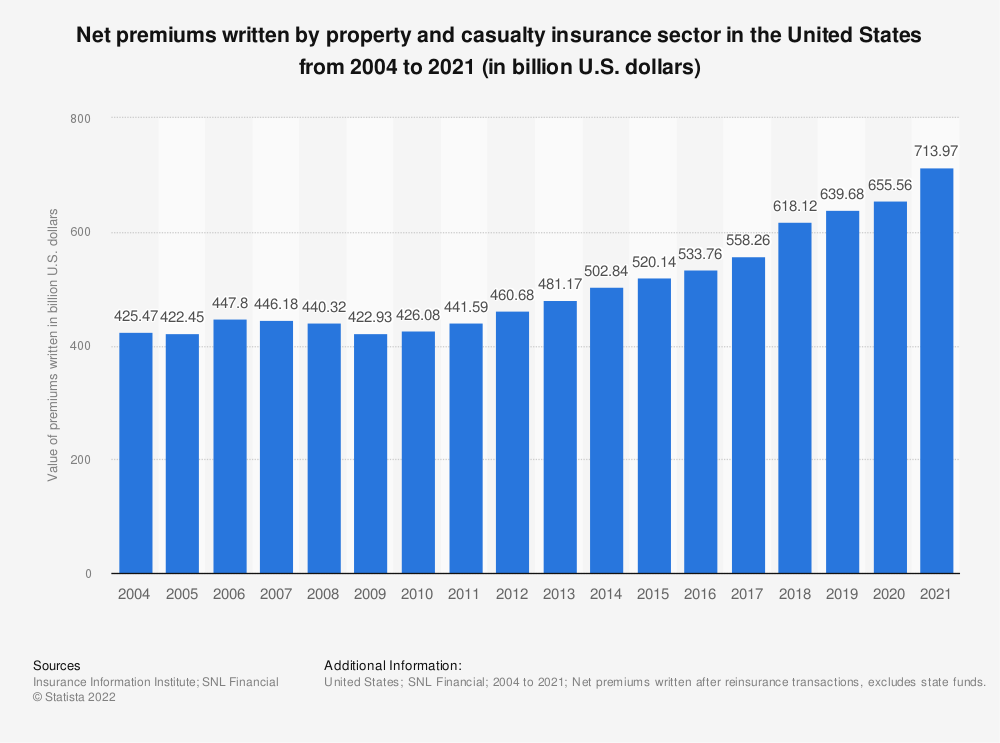
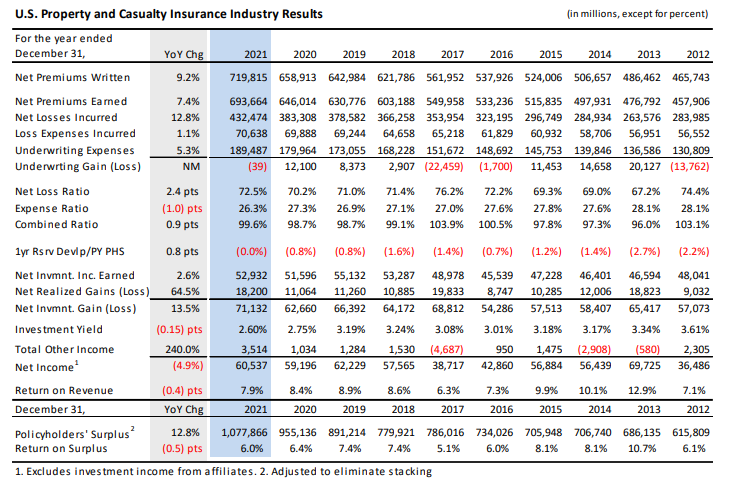
Total P&C sector annual premiums written continue marching higher. Combined ratio fluctuates cyclically (largely due to cycles of capital availability and risk appetite).

-
Or that they keep buying back bigly. As long as the business keeps improving I'll be sitting on my hands.
-
Hold the phone a second. We're talking about an amount that's over 50% of tangible book value. (And, that's assuming stock markets don't tank after said 1 in 250 year event, which would further tank book value.) I understand claims would be paid out over time, but the loss would be booked immediately. Wouldn't that trip debt covenants and force an equity raise - at a huge discount to the pre-event stock price? If the $8 bil estimate is legit, it's sounds like FFH is accepting a very low-probability existential risk to me. That's a different game from Berkshire's bulletproof balance sheet stance. (I'm not sure it makes sense to accept a 1 in 250 year existential risk if Fairfax is supposed to be the Watsa family's investment vehicle for the next 250 years. Sounds like some future set of Watsa heirs would pretty much be guaranteed to suffer a wealth reset.)
-
@Parsad what’s the rough dollar amount of the largest exposure FFH might have? Like, if California fell into the ocean or NYC got leveled by a sharknado? Are we talking $2 billion? I think Buffett has said BRK could presumably see a $5 bil loss event. Curious what FFH’s extreme mega cat exposure is.
-
Don’t forget FFH is the Watsa Family Office disguised as a public company. FFH is the Watsas’ investment vehicle. Excess cash will stockpile and be deployed in the investment vehicle in the most tax efficient way. If what’s best for the Watsas is good for you then all is well.
-
I did some rough math on whether buybacks are better than increasing premiums. Looks to me like buybacks are the winner while share prices and interest rates are around the current levels. My rough logic: If FFH has a spare $1 billion should it write premiums or buy back shares? Premiums: With $1 bil in a hard market it can write $1.5 bil in premiums and invest the float. Let’s assume 95 CR and around 4% interest on invested float. Let’s call it around $120 million of pre-tax earnings potential. Divide that by 23 million shares and the pre-tax earnings per share is roughly $5. Buybacks: With $1 bil FFH could buy back about 1.66 million shares at $600 USD per share. If we assume $2 billion of earnings potential then the buyback would increase earnings potential per share from roughly $85 per share pre buy back to around $92 per share post buy back. A $7 per share increase. $7 per share from buybacks > $5 per share from insurance so by my math buybacks wins.
-
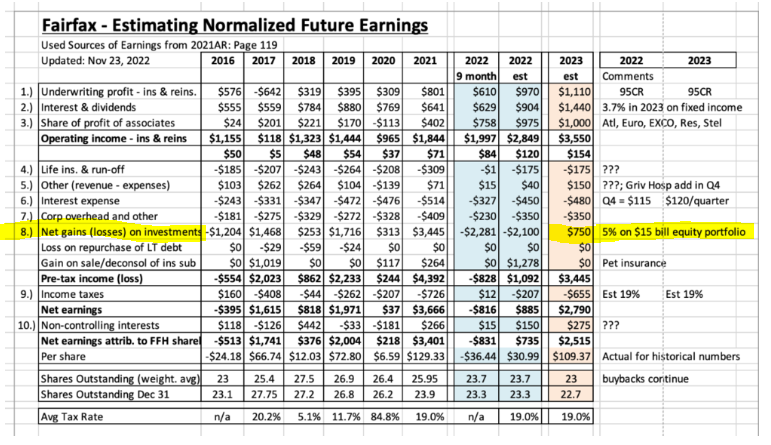
@Viking I'm not an accountant by any stretch. One thing jumped out at me. In section 8. there's an assumption of a 5% gain on the entire equity portfolio. Are you assuming the value of the non-mark to market equities will be revised upward or profitably divested over time? Otherwise, I'm curious if expecting $750 from the equities is a bit aggressive if the $6,851 mtm portfolio will have to produce the lion's share of that growth.
-
I’ve been curious about this too. I’ve heard Prem talk about a relationship between hard/soft markets and book value. How they’ll ramp premiums to around 1.5x book value during hard markets. Seems they’ve gone higher than that in this one. My assumption is during soft markets premiums will drop back down to somewhere around book value depending on how soft. So, conservatively modeling a full cycle run rate in the neighborhood of maybe 1 or 1.2 times book might be appropriate. After that it’s a matter of growth rate over time.
-
Buffett/Berkshire - general news
Thrifty3000 replied to fareastwarriors's topic in Berkshire Hathaway
+1 love the “behind the scenes” insights into convos with WEB and Chuck -
Buffett/Berkshire - general news
Thrifty3000 replied to fareastwarriors's topic in Berkshire Hathaway
Last time the shares were in this price range he was scooping up $5 to $6 billion per quarter. I assume he's buying back that amount again now. -
Trading Fairfax Financial (FRFHF) on Vanguard
Thrifty3000 replied to JGBRK's topic in Fairfax Financial
Ah, got it. Im slow. Haha -
Trading Fairfax Financial (FRFHF) on Vanguard
Thrifty3000 replied to JGBRK's topic in Fairfax Financial
@gregmal I don’t have an interactive account. What is the 50% look through earnings yield you mentioned? Does interactive provide their own analysis? -
Trading Fairfax Financial (FRFHF) on Vanguard
Thrifty3000 replied to JGBRK's topic in Fairfax Financial
Well, good luck with that. Vanguard treated me like garbage when I asked to speak to a manager about FFH. And, I wasn’t rude or anything. I was just shocked when I said I would likely transfer my existing FFH shares (not a small number) to another brokerage that trades FFH, and the kid basically just says, “so, is there anything else I can do for you?” (I’m sure Bogle flipped in his grave.) In contrast, Ameritrade treats me like royalty and I have less than 15% of my portfolio with them. (Though that’s changing every time I pick up more FFH.) I say hold your Vanguard ETFs and Mutual funds in a Vanguard account, so you don’t get charged extortionist transaction fees. But, move everything else to a brokerage that actually cares about keeping your business. #cancelVanguard haha -
Trading Fairfax Financial (FRFHF) on Vanguard
Thrifty3000 replied to JGBRK's topic in Fairfax Financial
Hear, hear! -
@Viking all this interest rate and inflation talk begs the question, have you factored in higher interest expense for FFH into your model going forward? Curious what interest expense per share is today and what it could look like when FFH's debt rolls over. (Actually, I think you've mentioned you assume combined ratio and interest rates will correlate in a way that allows overall earnings to remain reasonably protected.)
-
I’m with you there. I read Hoisington religiously (after popping a few Prozacs haha). For years Hoisington has laid out the case for the forces and trends that will continue pushing long term interest rates lower. Too much debt, too much debt, too much debt. And, they have not faltered on that thesis. They have, however, called out the one scenario they watch for that would have them unload all their long term treasuries in a heartbeat. That is, in short, if congress passes a law legalizing banana republic style money printing. Recently, however, their letters have discussed the near-term implications of the extraordinary fiscal/monetary response to the pandemic. Their position is if the government doesn’t intervene further then we’re looking at a painful recession that has already started. But, if we have a painful recession and the government follows the same playbook used during the GFC and the pandemic, then we’re looking at more near-term inflation and volatility. Hoisington doesn’t have any reason to believe the government will exercise restraint. So, Hoisington is calling for ever more extreme cycles of volatility until the government and the Fed get back on the rails of the original Fed mandate. And, they’re calling for increased risk of banana republic style inflation. Hoisington has the luxury of not having to do anything about near term volatility, as long as their investors trust them. They can hold long term treasuries through the short term cycles, and benefit from the long term deflationary trends. Prem doesn’t have the luxury of ignoring short term volatility, because it can disrupt insurance underwriting capabilities - as is being seen throughout the insurance industry this year. In short, I think Prem and Hoisington can maintain the same long term outlook, but have to position their portfolios differently to navigate near-term volatility and risk. Here is Hoisington’s conclusion from their most recent letter… “Monetary considerations coupled with these real side indicators point to recession and a reduction in inflation and long-term Treasury bond yields. If the Fed stays within the scope of the Federal Reserve Acts, they will have difficulty in containing the recession and fostering a recovery. But that situation puts us on alert to the possibility that the Fed returns to a Pandemic type of response that generated an inflation rate far above their target, as the experience of the past two years has so painfully taught. The economy might recover temporarily, but the expansion would be interrupted by another cost-of-living crisis and the Fed would not achieve either of its mandates for employment or inflation.”
-
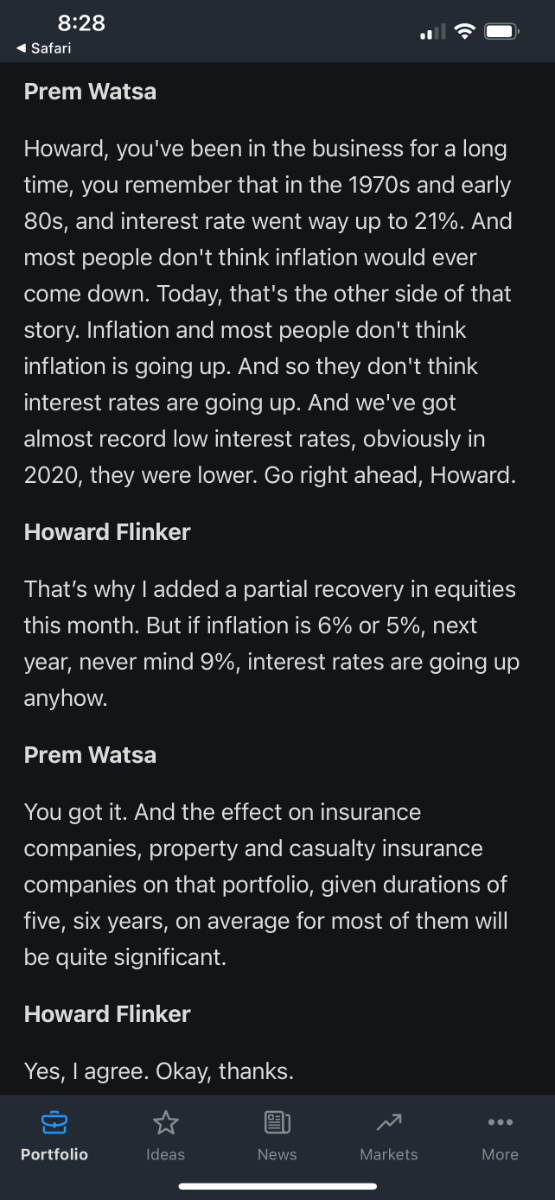
This is from the earnings call in July. Prem may expect long term deflation, but it sounds to me like near term inflation risk is top of mind these days…
-
Yeah, I think we have to rule out seeing FFH reach for yield on the bond front. Prem believes strongly in regression to the historical mean when it comes to interest rates. So, I expect we won’t see them make any aggressive moves unless they find some yields that are at least a standard deviation above historical norms. Prem has mentioned a number of times how scary it was in the 80’s to invest in bonds thinking you were getting a great rate (at 7%, 8%, 10%, etc) only to watch yields continue climbing above 15% with seemingly no end in sight. He doesn’t want to be in that situation.
-
Yes, FRFHF. I don't appear to have the ability to trade FFH.TO in my account.
-
Vanguard allows US clients with personal accounts to continue owning it, they just won't allow you to buy more going forward. It's a recent policy that wasn't in place when I bought the bulk of my shares in 2020. I'm sure Vanguard still holds FFH in its international ETFs. And, it may still execute over the counter trades for professional clients. I assume they stopped allowing OTC trades after they went to a zero commission model. I noticed my other brokerage, which has a mostly zero commission model, does actually charge several dollars per OTC trade.
-
@Viking I agree with your reasons for it being undervalued. A couple other factors... 1) I've also always assumed there would be a permanent, deserved, discount because of the dual share class structure giving control to the Watsa gene pool. I'm not sure how to quantify it, and I'm sure there will be times when Mr. Market overlooks the risk, but it's a relevant factor nonetheless. Probably not a bad idea to knock 10% to 20% off of a DCF or sum of the parts valuation to factor it in. (Some children of billionaires do a perfectly fine job selecting good operators to run the family business. Other children of billionaires go bat$hit crazy.) 2) This is actually more of a question. Will there be a liquidity/visibility discount for not being listed on the NYSE anymore? I'm curious if that takes it off the radar of a lot of algorithmic traders and ETFs. Furthermore, I know firsthand Vanguard won't even let US clients purchase Fairfax. That has to sting a bit. It seems we're left with the handful of value investors that do their own independent research and thinking to support the value of Fairfax; many of whom were burned holding Fairfax over the last decade. ^ that's why I think we may need a couple years of solid book value growth before Fairfax starts showing up on stock screens and garnering attention from more big money managers. In the meantime I hope the price stays crazy discounted while FFH buys back hand over fist.
-
When it was $265 I was forecasting Fairfax earning $28 per share annually with earnings growth modestly outpacing inflation. That was based largely on their earnings of the prior 5 years and their share dilution trends. I invested a lot around $250 per share because I thought there was a decent chance Prem wouldn't repeat past sins, earnings would outpace expectations, and the share price could double within 5 years. Boy, were my earnings and share dilution projections off. I'm now more in the same camp as Viking as far as future expectations. So, I think FFH has hit its stride, and it will be a lot of fun to hold for the next few years. I also think $500 per share today represents about the same discount to my future expectations as $250 did when I first backed up the truck.
-
To further expound, BRK will probably be a ready buyer of ATCO for $10+ billion in a few years.
-
It just hit me what the next few chess plays might look like once Sokol is drawn even deeper into the FFH sphere after the Atco deal. First, Sokol gets a board seat at Fairfax, and it comes with some kind of rich, share-based, incentive to be more involved with operations and deal-making than just being a board member (but, it won't come with a formal operational title). Second, within 5 years we'll start seeing some sweetheart deals involving both BRK and FFH, because at that point Greg Abel will be rewarding his old buddy D. Sokol for sourcing the much-needed ideas.