Viking
-
Posts
6,052 -
Joined
-
Last visited
-
Days Won
78
Content Type
Profiles
Forums
Events
Everything posted by Viking
-
We all want to see the war end. An end to the stalemate would be good news (I think). As a reminder, below is a list of what Iran wants. At some point, Iran will want the US/Israeli's to sign on the dotted one. Lot's of work yet to be done. ----------- Iran’s Core Demands (as of late March 2026) Iran has put forward a multi-point ceasefire framework. The key elements are: 1) Immediate end to military attacks A full halt to U.S./Israeli strikes, including airstrikes and targeted assassinations Iran frames this as ending “aggression” 2) Binding guarantees the war will not resume Iran wants credible, enforceable assurances (not just a ceasefire) This is critical because Iran does not trust temporary agreements based on past experience 3) Financial compensation (reparations) Payment for: Infrastructure damage Civilian losses This is a non-trivial sticking point—rare in modern ceasefire deals 4) No further regime-change efforts or interference Implicit but central: End assassination campaigns End attempts to destabilize the Iranian government This directly counters stated U.S./Israeli objectives of regime change 5) Maintain strategic control (especially Strait of Hormuz) Iran has refused to concede control or access terms over the Strait of Hormuz This is a major leverage point given its importance to global oil flows 6) Broader regional inclusion (in some proposals) Iran has pushed for: Inclusion of Lebanon / regional theaters in any ceasefire Reflects that the war is not confined to Iran alone The Core Conflict: Why a Deal Is Difficult The gap between Iran and the U.S./Israel is structural, not tactical: U.S./Israel demands (simplified) End uranium enrichment Dismantle nuclear program Restrict missile capabilities Cut support to regional allies Iran’s position Willing to stop fighting, but: Not willing to capitulate strategically Not willing to give up deterrence (nuclear/missiles/influence) Bottom Line Iran’s demands can be reduced to three strategic objectives: Stop the war without surrendering power Lock in long-term security guarantees Preserve geopolitical leverage (especially energy chokepoints) That is why negotiations are stalled: The U.S. is pushing for structural concessions Iran is pushing for security and sovereignty preservation
-
I think we have incomplete information. One additional piece of information we do have: Gates marriage blew up. Why? Speculation: Bill's association with Epstein, leading to trust issues for Melinda. Doesn't appear to be a loyalty thing to me. I'm with Buffett on this one.
-
Well looking at financial markets it appears the war in the Persian Gulf will be ending soon. What a relief! I can step back from the ledge. What changed? President Trump posted a 'truth'. Really? Yup. ----------- "Fool me once, shame on you; fool me twice, shame on me" is a proverb meaning that while it is understandable to be tricked once (the deceiver's fault), allowing the same person to trick you again makes it your own fault for not learning from the experience. It emphasizes personal responsibility, caution, and learning from mistakes. ------------ Here is an alternative perspective: the US will leave the Gulf when Iran lets them. I know that sounds ludicrous. But what has been happening the past 4.5 weeks is even more ludicrous. People need to read Joseph Heller's book Catch 22 to more fully appreciate just how messed up the world is becoming (with Trump being just one of the central characters). The problem the world has is the Straight of Hormuz is closed. It has been closed for 4.5 weeks. We are just getting to the fun part (physical shortages). Let that sink in... Iran will open the straight when they get agreement on their war demands. I don't think that is a crazy thing to say. What else would you expect them to do (if you were in their shoes)? It shouldn't be a complicated thing for people to understand. Obviously, the US has figured out they can't open the straight. That's why they are desperate to pull out before it really gets bad (the physical shortages). If the US can't open the straight - and they have the greatest military in the world - why do we think the rest of the world can? What needs to happen? Let me say it again: Iran has already told you what needs to happen. Listen, I am not a fan of the regime in Iran. Writing this doesn't make me happy. But being open minded/inquisitive/rational is important for investors. Yes, we will get through this. ----------- Joseph Heller’s Catch-22 (1961) is a satirical novel set during World War II, centered on Captain Yossarian, a U.S. Army Air Forces bombardier stationed on a Mediterranean island. Core premise: Yossarian is desperate to avoid flying more combat missions because each mission brings a high probability of death. However, he is trapped in a bureaucratic system that continually raises the required number of missions and prevents him from being grounded. Tone and structure: Nonlinear, fragmented narrative Dark humor mixed with existential anxiety Characters often represent exaggerated institutional archetypes Core themes: Absurdity of war Dehumanizing bureaucracy Self-preservation vs duty The illusion of rational systems Why Heller Wrote the Book Heller drew heavily from his own experience as a WWII bombardier. But the novel is not simply autobiographical—it is a critique of modern institutions: Postwar disillusionment: After WWII, many writers questioned whether large organizations (military, corporate, government) were rational or fundamentally absurd. Cold War context: The rise of nuclear risk and massive bureaucracies heightened fears of systems beyond individual control. Satirical intent: Heller wanted to expose how rules designed to appear logical can produce irrational and harmful outcomes. In essence, Catch-22 is less about WWII specifically and more about how systems trap individuals through internally consistent—but insane—logic. Circular Logic (“Catch-22”) — The Central Device The term “Catch-22” itself refers to a self-reinforcing, no-win rule. The most famous example: Structure of the logic: Rule A: Insane people don’t have to fly missions. Rule B: You must request evaluation to be declared insane. Rule Wanting to avoid danger is rational → proves sanity. Conclusion: No one qualifies as insane → everyone must fly. This is circular and self-sealing: The rule uses its own outcome as proof of its validity. There is no external criterion to break the loop. Broader Use of Circular Logic in the Novel Heller generalizes this pattern across the system: Mission quotas: The number of required missions keeps increasing, making completion impossible in practice. Authority justification: Officers make arbitrary decisions but justify them using the same rules they control. Moral inversion: Actions that are clearly irrational (risking lives unnecessarily) are framed as duty or patriotism. Bottom Line Catch-22 is a system-level critique: Heller shows that institutions can become logically consistent yet functionally insane, trapping individuals in loops where: Compliance is mandatory Escape is impossible Logic itself becomes the mechanism of control The phrase “Catch-22” has since entered common language to describe exactly this kind of closed-loop, self-validating constraint.
-
Fairfax has a lot going on right now (all expected to close in Q2): Sale of Eurolife's life insurance business Sale of half of Poseidon Take private of Kennedy Wilson My guess is they may surprise us with how aggressive they have been with share buybacks in Q1. If the stock stays low, 2026 could end up being a big year for share buybacks (more than the 1 million they bought back and retired last year).
-
I think we have one potential solution of how the current impasse might be resolved: perhaps the US/Israeli's simply exit the conflict. As per Rubio's list... clearly the US has achieved all their objectives. Job well done. Why would they stay if they have checked all of their boxes? It takes two to tango - and if one party leaves...? That would leave it to Gulf countries, Iran and the rest of the world (primarily Asian countries) to come to some sort of compromise. Difficult. But probably more likely than the current set up. This also would allow the US/Israel to come back any time they wanted and continue to bomb the shit out of Iran (you make up the reason why). Strategically, is it in the best interests of the US to have a fractured middle east? Trump might think it is. Diabolical. Who gives a shit if a match has just been dropped on a gasoline region like the middle east. After all, the US doesn't need the oil anymore...
-
Rory is a great follow to get real-time information/perspective on what is going on in the Persian Gulf and energy markets.

-
Part of the problem is it happens in small increments (it’s usually not binary… one bad decision). An older family friend recently shared that they had lost a bundle ‘investing’ in silver - they bought near the highs. Back luck… And then last week I got another piece of information that explained where the logic for the silver investment had come from. It appears a couple of years ago this same person ‘invested’ in a pre-build condo in Vancouver. Possession was last year, was forced to buy it, and he is likely down well over $100,000. The investment in silver this year was an attempt to re-coup his loss on the condo. Bad decisions compounding over time. The result is a financial disaster. i don’t think this guy is unique.
-
How will the war in the Persian Gulf end? Below are some possibilities... (does Trump have any unmarried kids????) ----------- Blood feuds tend to end through one of a few mechanisms: Exhaustion or attrition – one side is eliminated, weakened, or loses the will/capacity to continue. Negotiated settlement – mediated peace, often involving compensation (money, land, marriage alliances, or restitution). External authority intervention – a state, court system, or dominant power imposes order and punishes further retaliation. Social or cultural shift – norms change (e.g., rule of law replaces honor-based retaliation). Common external threat – both sides unify against a larger danger. In practice, durable endings usually require credible enforcement (rule of law) plus a face-saving settlement that allows both sides to stop without appearing to lose.
-
I have no idea. 4 weeks ago, I would have told you it wouldn't ever be shut down. So that tells you how smart I am. I am not assuming the straight will open because it 'has to'. That is what I would have said 4 weeks ago - and it has proven to be completely wrong. I underestimated the regime in Iran. What is the pain to Iran to string this along for another month or more? Modest. They are able to sell their oil, and now that sanctions have come off, they are able to capture top $. The regime in Iran fears peace, not war. What is the pain to the US if the straight remains closed? Modest in the near term. It is the rest of the world that is bearing the majority of the cost. It really is an interesting set up. It is like a blood feud. With the cost of the feud largely being borne by external parties. And outsiders watching keep expecting the participants to all of sudden behave rationally. Because they 'have to'. Really? That's not how blood feuds work...
-
Fairfax India (back under $16.00 ) and CSU ($2,355).
-
@Gregmal, when do you think the Straight of Hormuz will open again? (By open, I mean back to 'normal'.) I don't think it takes a rocket scientist to understand that the answer to the question above is important when trying to forecast prices for oil/LNG, refined products, fertilizer, helium etc. If the straight stays closed for another month we will see much higher prices. This will ripple through the economy - slower growth and higher inflation. If the straight opens in the next week prices will start to come down. The global economy will start to healing process. Of course, the answer (when) is unknowable (just like it was 4 weeks ago). The fact it is unknowable doesn't mean it is not important.
-
Compared to the market averages, Fairfax has been holding up surprisingly well since the war in the Persian Gulf started (over the past month). Yes, the stock underperformed the market averages in Jan/Feb. In Q1, operating earnings should be solid for Fairfax: underwriting income, interest and dividend income, share of profit of associates and non-insurance consolidated companies. Investment gains will be very noisy. This bucket will get hit hard with the aggressive sell-off in both stocks and bonds (spiking yields). I'll do an update tomorrow (quarter end) for the stock portfolio. Of note, compared to P/C insurance peers, Fairfax is very well positioned with their fixed income portfolio (very short duration and very high quality) - the hit to book value from much higher interest rates (and widening credit spreads) will be much less for Fairfax. They will also have a chance to lock in higher yields and add duration.
-
Great point. There will also be some positive externalities. This war may give politicians the cover the need to get rational/pragmatic on the policy front: NATO countries need to start taking defence seriously. This might break the fossil fuel hysteria fever in countries like Canada. Maybe we get another pipeline approved.
-
The closure of the straight is impacting many foundational products: oil, LNG, refined products (propane, jet fuel etc), helium, fertilizers... etc. These a re commodities. Much higher prices in one region of the world - given enough time - will (generally) eventually be felt in other regions - traders will arbitrage the growing price differences. And yes, this is a big science experiment - we have never experienced a disruption like this in the past. So anyone who tells you anything with certainty is full of shit (on both sides... the doomers... and also the 'nothing to see here' types).
-
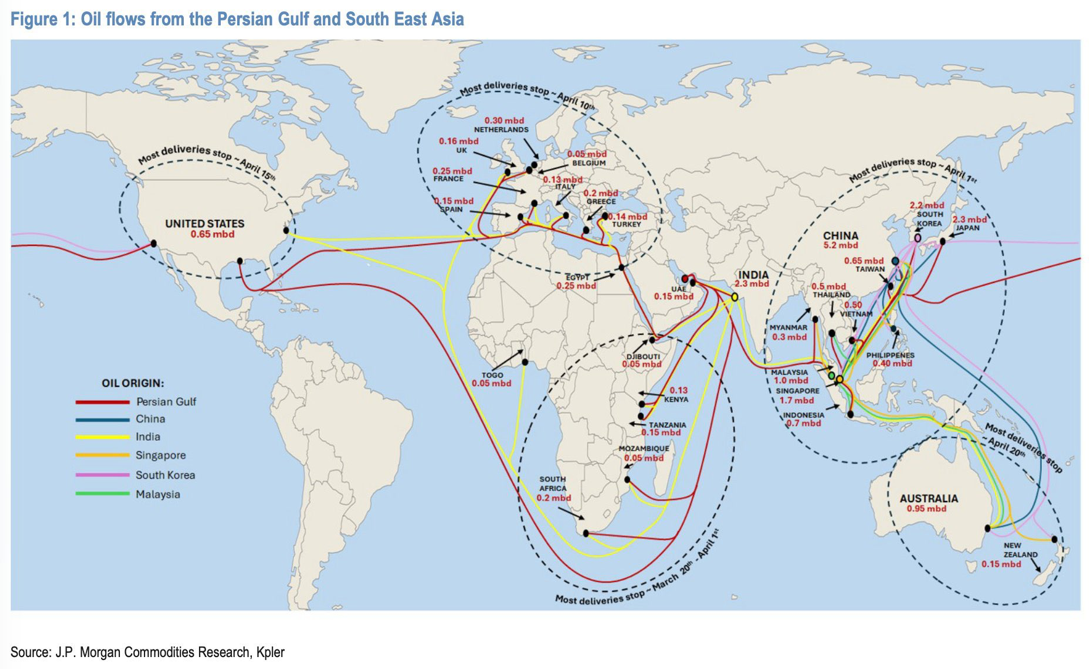
From JP Morgan (via @Rory_Johnston on Twitter) There is a lag from the time oil production stops to when it impacts the global economy. The map below provides some great insight - the rough timing of when oil deliveries will drop off for each region. Africa: March 20 - April 1 Asia: April 1 Europe: April 10 US: April 15 Australia: April 20
-
@ourkid8, if you are asking if I would prefer to get arrested (Israel) or shot (Iran) for protesting… I would choose the Israeli option.
-
@Spekulatius, it will all make sense in a few more years. I remember when I thought someone who was 20 was old...
-
+1. In late 2021, Fairfax sold their corporate bonds at a 1% yield (locking in close to a $300M investment gain). They moved the average duration of their fixed income portfolio to 1.2 years. People consider it a macro bet. It wasn’t. They correctly assessed that fixed income investors were not getting paid for duration risk. It was about risk mitigation. Fairfax’s positioning made the company billions when interest rates spiked. (By made I mean opportunity cost). It also allowed them to grow more aggressively in the hard market. The key point is investors need to be as rational as possible. Simple to understand. But very hard to do.
-
The Art of the Deal?
-
I look at Fairfax's insurance operations using two different buckets: Insurance and Re-insurance (ongoing) Runoff Insurance and re-insurance - great business. Runoff - shitty business (especially since they sold much of the 'good stuff' a couple of years ago). Each year we get adverse development from runoff. I treat that in my earnings estimate as an annual expense - just like interest expense. It runs about $250 million per year (on average). A little higher in some years. A little lower in others. This is not new news. A question I have is if they have been more aggressively trying to settle/wind this exposure down in recent years. Just a feeling I have reading between the lines of how they talk about it. When they report results, Fairfax lumps runoff together with Eurolife's life insurance business (kind like an 'other' bucket). I like this separation from going insurance/reinsurance. But it does muddy the water when looking at the total insurance business. With the sale of the Eurolife's life insurance business it will be interesting to see how they continue to report runoff. Importantly, the ongoing insurance/reinsurance business has exploded in size over the past 8 years. At the same time, with the sale of Riverstone Europe, the size of the runoff business is much smaller. Put these two developments together: runoff is nothing I worry about. For me it is an annual expense that is shrinking in importance over time (in terms of Fairfax's overall business). Now when I followed Fairfax 25 years ago, runoff was a big deal. And $200 million in adverse development meant something. Not so much today. Fairfax has done an amazing job of pivoting their insurance business (growing the good stuff). Yes, more work needs to be done. They are all over it.
-
Was the IRGC a grave danger to the world 4 weeks ago? My read was their influence (economic and military) was at a historic 39-year low. Internally within Iran, they were hated. I watched a podcast the other day and the Iran expert said the IRGC fears peace, not war. In important respects this war is the shot in the arm the IRGC needed - and that is a hard thing for Western commentators to comprehend. It looks to me like the US/Israel badly miscalculated with their attack 4 weeks ago. The IRGC has changed tactics - and this appears to have caught everyone by surprise. Of course, it is much too early to say anything definitively. Let's hope there is more to this than we see/know today - that makes sense of it all.
-
To get the Straight of Hormuz working again, one of the two main participants in this war needs to capitulate. As the US administration keeps reminding everyone, the straight of Hormuz being closed is not (really) a US problem. It is looking to me like the solution will need to come from the rest of the world. The US wants (and needs) to exit. The rest of the world needs to pony up/appeal to Iran (it is not the ROW that is Iran's enemy. So why should Iran want to punish it?). But that brings us back to Iran - will they be reasonable with what they ask? ---------- Of course, there is another parallel universe where there is the opportunity to get regime change with Iran. Again, in the fog of war it is impossible to know anything with certainty.
-
I think the Ukraine war is having a profound impact on the global economy under the hood. Europe used to get most of their energy needs from Russia. Now they get it from the US. (Do we see export controls in LNG in the US in the coming weeks?) This move just started - the war in Ukraine exposed Europe's disastrous energy policies of the past 20 years. Russia's invasion of Ukraine exposed all sorts of problems with NATO. NATO countries have been living in a fiction for the past 20 years (not taking security seriously). NATO countries (already with way too much debt) are dramatically increasing the amount they are spending on the military - this is blowing out debt levels even more (Canada is a great example). With the Ukraine war, the US weaponized the US$ (confiscated Russian $) - this has had profound impact on the US$ as a safe haven asset - and gold. The Ukraine war kicked geopolitical changes into high gear. Iran has been supplying drones to Russia. The Ukraine war gave Iran capabilities (not just the technology and mass production of the drone but the tactics in how to use them). This informed their most recent response to the US/Israeli attacks of 4 weeks ago. The Ukraine war has been changing the world in fundamental ways under the hood (economic growth, inflation etc). I could go on. But all of these things take years to manifest (matter/become clear). And of course, lots of other important things are happening at the same time. When combined with other events what has been happening becomes even more impactful.
-
@Castanza, well said. I know I am a different duck. My long term average return (over almost 30 years) has been about 20%. One of the (many) reasons I have been able to do this is because I pay attention to macro at times. It works for me. Of course, this doesn't mean it will work for others (trying to blindly copy other investors rarely ends well). Over the years, I have been much better at the defence part. And less successful at the offence part. It remains a work in process. Bottom line, my returns have been very good - so I am not beating myself up too much. People on the board need to find an investment framework that fits how they are wired. This board provides a wonderful canvas to help us all figure things out (the more people post the better).
-
To be clear, I have no idea how things are going to play out. You could be right. And that is what I like about investing - we all place our bets and live with the results. I hope everyone on this board does well (for us on this board it is not a zero sum game). I really appreciate the opportunity to debate. There are lots of wicked smart people with lots of valuable things to say. I learn something new every day. Board members would be smart to listen to a wide range of posters (and I say this out of respect).