All Activity
- Past hour
-

Fairfax - A Deep Dive on Management and Culture
Viking replied to Viking's topic in Fairfax Financial
On share buybacks, Buffett definitely talked out of both sides of his mouth. He had one line of reasoning for buying back BRK stock... and a completely different line of reasoning when businesses he owned did it. That is not a criticism... it is complicated. -
You might want to keep in mind that we're almost at the end of Q2, a quarter where the average crude price has been very elevated. For most, Q2 earnings will be released around mid August. Today, most companies are priced at what the average crude price was, when the war started. An opportunity SD
-
GOOG
-
Yeah, at the time, I think it was a no-brainer. Why wouldn't you use a massive bomb you recently developed in a war that already lasted four years? It also was pretty tiny relative to nukes today. My impression is that the controversy only arose decades later, when the moment was long past and people had the prosperity necessary to develop luxury beliefs.
-
I’m Canadian. No clue on Mr. Lulani!
- Today
-
And who has the lowest price of compute or will have it?
-
Back in my trading days I looked at these positioning tools of day traders. In almost every case whatever the position was of retail it was inversely correlated with how prices was moving. I checked it back for years. So yes, most retail traders suck, but also, many of them are just fading price rather than going with the trend.
-

Fairfax - A Deep Dive on Management and Culture
dartmonkey replied to Viking's topic in Fairfax Financial
I agree with your Fairfax India example. But I think it's a bit different from Atlas or Resolute. Fairfax set up Fairfax India so that shareholders could invest in Indian companies alongside Fairfax. I have no issue with Fairfax purchasing more shares of Fairfax India from shareholders who wish to sell, but I would have an issue with Fairfax taking out the company to the detriment of shareholders who would have wished to keep the holding. It would not be consistent with the initial promise, so in that way it would not be fair, and it would also make it difficult to trust management if they ever came up with another scheme (like Fairfax Africa, or Fairfax IDBI for instance...) Whereas if someone bought Resolute shares to coat-tail Fairfax's idea, and ended up being bought out at a low takeover price, that's just a risk everyone has to take with any investment and there would be no contradiction with any implicit or explicit prior engagement made by Fairfax, so I don't see anything unfair about it. -
-

Fairfax - A Deep Dive on Management and Culture
Hoodlum replied to Viking's topic in Fairfax Financial
I could be wrong but when Fairfax was formed and the "fair and friendly" motto was introduced, Fairfax was not acquiring non-insurance companies and taking them private. I don't believe that started to occur until many years later. The "Fair and Friendly" motto was more in reference to the insurance companies they were acquiring, which was very frequent early on. -
what are you f'ing Hawaiian?!
-

I Need a Laugh. Tell me a Joke. Keep em PC.
Xerxes replied to doughishere's topic in General Discussion

-

Fairfax - A Deep Dive on Management and Culture
RichardGibbons replied to Viking's topic in Fairfax Financial
Yeah, I totally agree with your straw man, that Fair and Friendly shouldn't mean that no shareholder in the acquired company is disappointed with the price. The issue is integrity. Buying businesses below fair value (e.g. Atlas) is totally reasonable. For me, it lacks integrity to support a clearly inferior bid, even if it is legal (though there was also a minority shareholder lawsuit against Resolute that won, where the shareholders received $1.59 (boosted to $2.50 by interest and legal fees) rather than $1.) That said, integrity is fairly personal and often more flexible than one would think--people justify all sorts of things if it makes money--so your beliefs maybe be different than mine. Like, if Fairfax India were conservative in valuing its assets, and then Fairfax bought it all at roughly market price, I'd consider that to lack integrity, even though it would be quite good for Fairfax's shareholders and Fairfax would be paying what the market said was a fair price. But I don't think it's unreasonable if someone else considers that sort of transaction to be kosher. (Heck, Buffett used to argue that share buybacks could be considered questionable, while I have no problem with that outside of major undisclosed insider information.) -
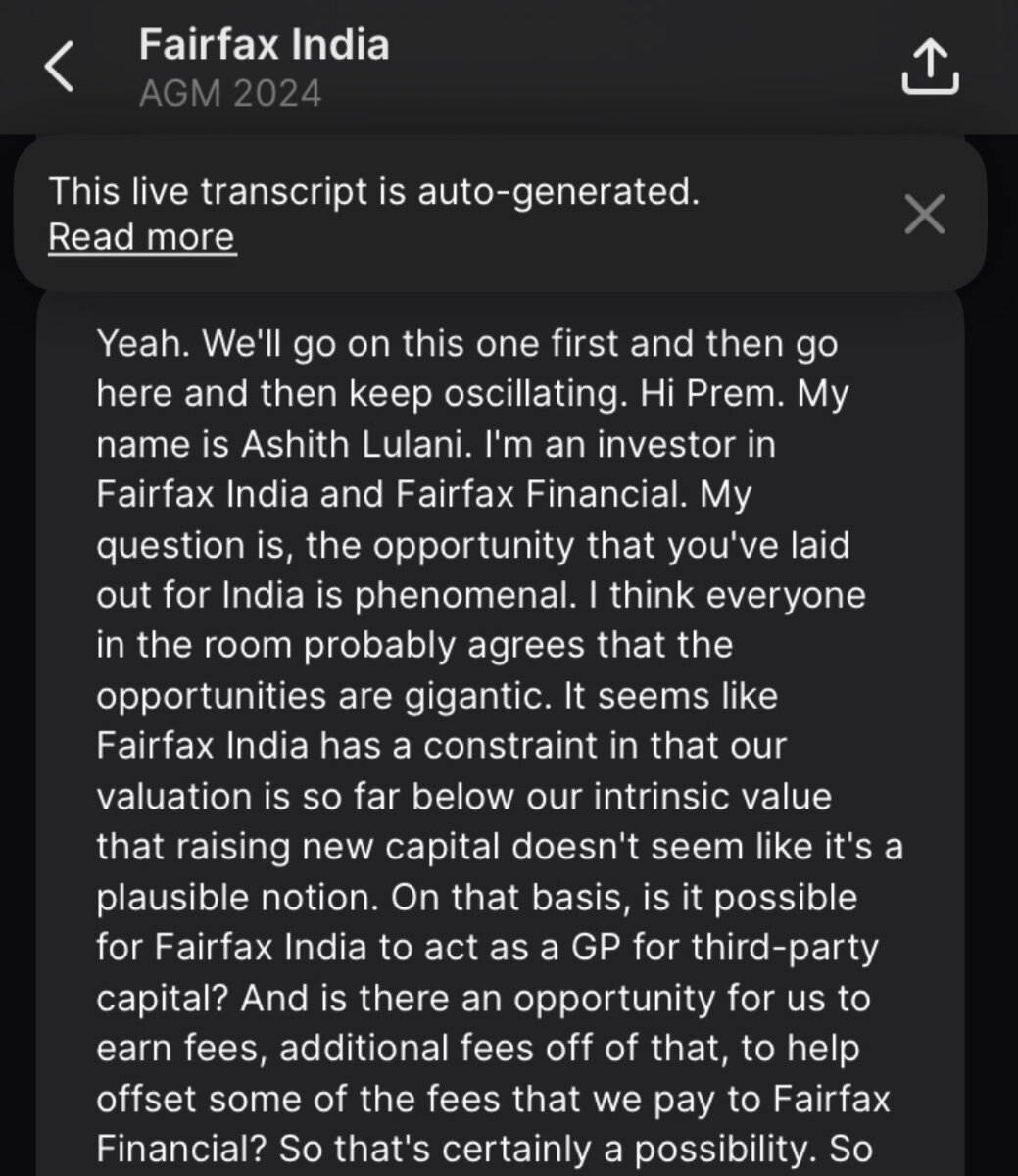
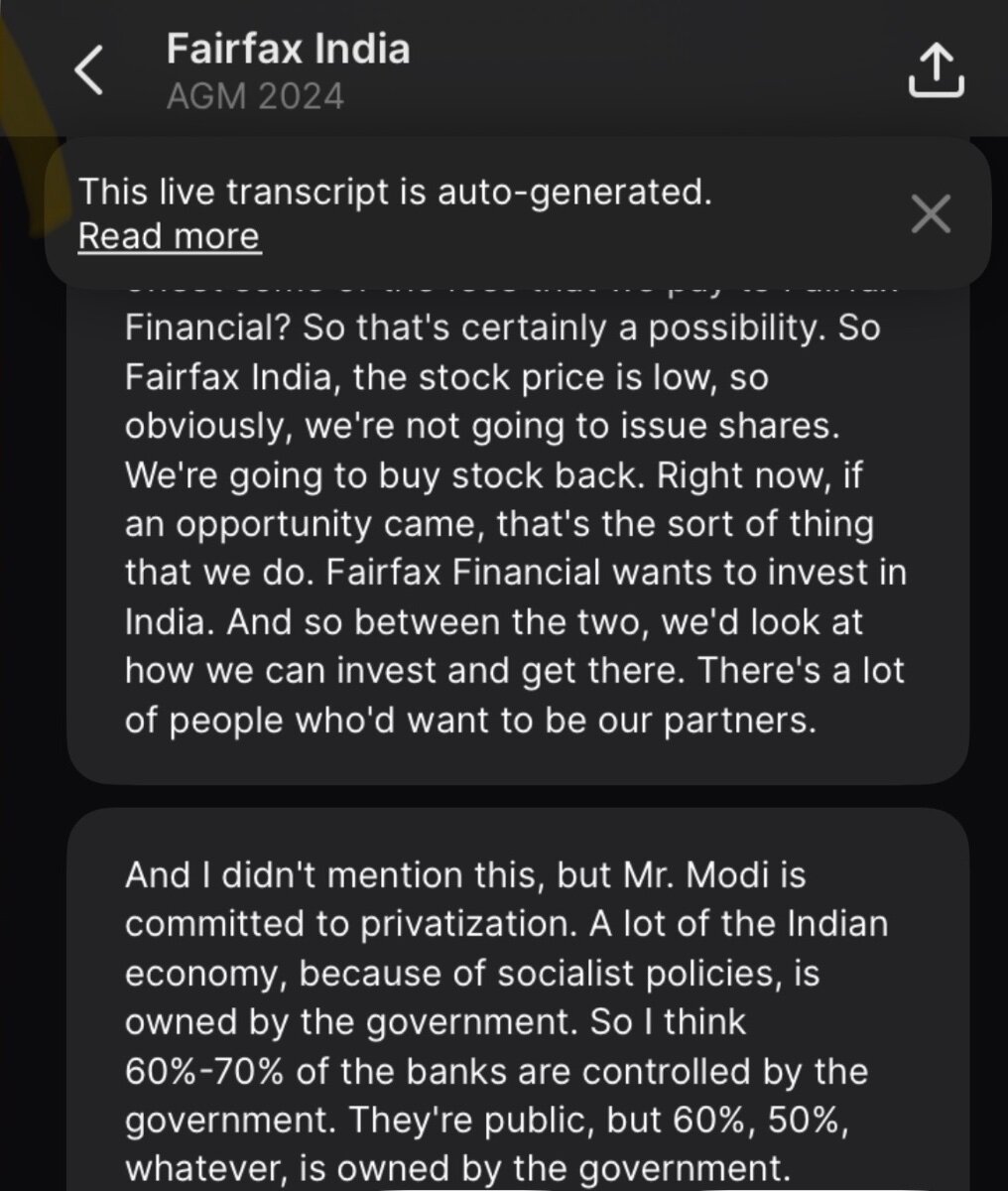
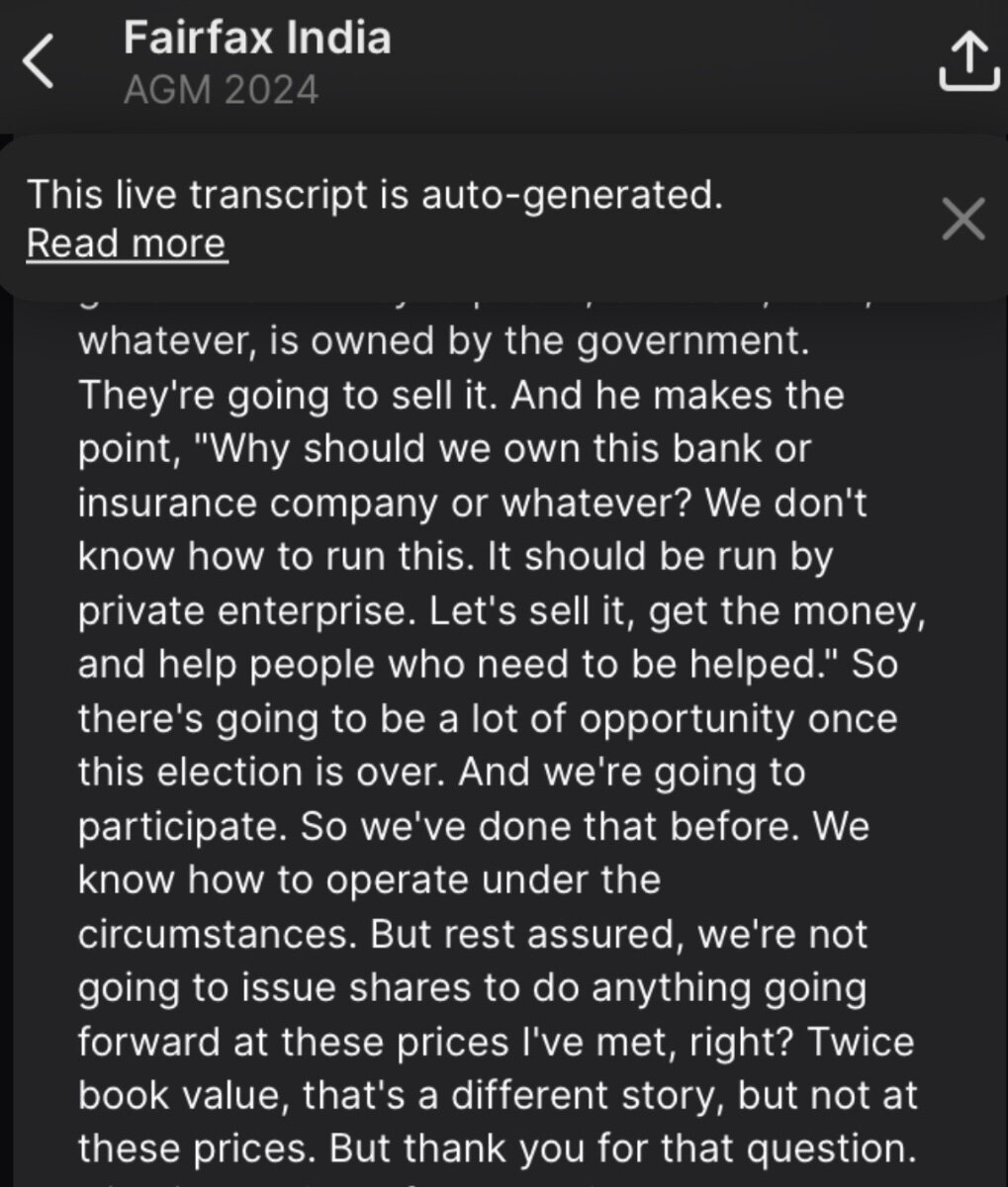
Zero chance new FIH shares are issued. I assume it will be a GP/LP structure with an FIH subsidiary as the GP and FFH along with other global investors as LPs. Ashith Lulani asked the question in the 2024 AGM and I think the answer is probably the same today.
-
Fairfax - A Deep Dive on Management and Culture
dartmonkey replied to Viking's topic in Fairfax Financial
Whether the motto is marketing or not, I don't believe that it was intended to mean that they will pay more than they have to for acquisitions so that no outgoing shareholders in the acquired company are disappointed with the price. They wouldn't last long as a public company if that were what it meant. -
It will most certainly be interesting to see how this was structured. Possible it was a simple loan from Parent Co to FIH? If it was share issuance, one would think that would be a disclosable event under securities regulations.
-
Fairfax - A Deep Dive on Management and Culture
Viking replied to Viking's topic in Fairfax Financial
Article 3 in the series Decentralization at Fairfax – A Growing Competitive Advantage Most investors focus on financial statements, valuation metrics, and earnings forecasts. Few spend much time thinking about organizational structure. That is unfortunate because structure influences how decisions are made, how capital is allocated, how employees behave, and ultimately how businesses perform. Over long periods of time, organizational structure can have a meaningful impact on shareholder returns. One of Fairfax's defining characteristics since its founding in 1985 has been its commitment to decentralization. Rather than directing operations from head office, Fairfax pushes decision-making closer to customers and markets. Operating managers are given significant autonomy to run their businesses, while head office focuses on capital allocation, culture, and oversight. The benefits are substantial. Decentralization promotes accountability because authority and responsibility reside with the same people. It improves speed and flexibility because decisions are made by managers closest to the business. It also helps attract entrepreneurial leaders who value autonomy over bureaucracy and centralized control. The model can also be an advantage when making acquisitions. Many successful management teams are reluctant to sell to buyers who intend to integrate operations and impose centralized control. Fairfax offers a different proposition. Acquired businesses are generally allowed to continue operating independently, preserving both culture and leadership. Over time, decentralization can become a powerful competitive advantage. Entrepreneurial managers tend to produce better operating results. Better results generate more cash flow. Head office can then redeploy that capital to the most attractive opportunities across the organization. As Fairfax acquires and partners with additional high-quality operators, its competitive advantage deepens. This article examines Fairfax's decentralized structure from four perspectives. First, Prem Watsa explains the philosophy behind the model. Second, Silvy Wright illustrates how empowerment can drive organic growth throughout an organization. Third, Lou Iglesias explains how decentralization can become a competitive advantage in acquisitions. Finally, we examine how Fairfax continues to deepen the model through the expansion of profit centres and independent operating companies. Part 1: Prem Watsa — The Big Picture In his 2024 shareholder letter, Prem Watsa devoted unusual attention to Fairfax's decentralized operating structure. The reason was straightforward: succession. As Fairfax prepares for future generations of leadership, Prem wanted to clearly document why decentralization has been central to the company's success and why it must be preserved. His message was simple: Fairfax's long-term results are not the product of centralized decision-making. They are the product of empowering talented people, holding them accountable, and creating an environment where entrepreneurs can thrive. Since we began in 1985, 39 years ago, our book value per share has compounded at 18.7% per year (including dividends) while our common stock price has compounded at 19.2% (including dividends) annually. As I have mentioned previously, our success throughout our history and again in 2024, has come under a decentralized structure with outstanding management executing a disciplined approach to underwriting. Over the years, those who have followed Fairfax, read our letters and attended our annual meeting, are well aware that we are passionately devoted to the decentralized operating philosophy. This year, I want to spend more time on this subject. Aside from helping inform our shareholders about our thinking in the past and present, I have an ulterior motive that comes from an eye on the future. As Fairfax rolls into the future, your Chairman (gradually) passes leadership to the next generation, and they, in turn, to later generations; it is very important that we memorialize why decentralization is such a critical feature of Fairfax. I want and expect Fairfax to thrive over the next 100 years, and well beyond. To do so, I believe it is of paramount importance that we never abandon our decentralized approach! So, why are we so fervently attached to this model? At its foundation, decentralization places its faith in the many rather than the few. Embedded in the Guiding Principles, which we have published every year in this report, is our deep and abiding respect for the fact that we are all created equal before God. All of our offices display prominently The Golden Rule; treat others as you want to be treated yourself as depicted in all the religions of the world. All of our CEO’s have a plaque with the following quote Ronald Reagan loved so much and kept on his desk: “There is no limit to what a man can do or where he can go if he doesn’t care who gets the credit.” Decentralization is the best system for unleashing the power of the many, rather than being limited to the talents of the few. And it aligns so perfectly with the foundational values of Fairfax since its inception. Our optimism in what empowered people can accomplish is unbounded! What are the advantages of an empowering, decentralized operating system? Let me count the ways: 1.) Ownership and Accountability Each of our CEO’s is given full autonomy over all underwriting and operational functions within their company, other than investments. They set strategy and tactics. They are responsible for managing risk within the limits of their allocated capital. Accordingly, they are fully accountable for underwriting performance and its results. The decisions implemented in their companies are their own, not those passed down from above. 2.) Management Retention A direct benefit of this Ownership Culture is the exceptional continuity of management we enjoy at Fairfax. As I write this, our Presidents and Senior Executives at Fairfax average close to 20 years of service. We are big believers in the benefits that come from this continuity. Rather than shuttling in new leaders every four or five years, our companies are able to continually build on success, without undergoing the strategic U-turns that management turnover often brings. 3.) Flexibility and Nimbleness The autonomy our companies enjoy allows a degree of operating agility absent from large, centralized organizations. Our performance during the recent hard market years of 2020 to 2023 bear this out, as we advantageously expanded at an industry leading pace! We rely on the expertise and judgment at each of our companies, and we do not prescribe from the top. For example, when the cyber insurance market underwent radical change at the end of 2020, we had four of our major companies dramatically expand their activity, each pursuing a different strategy. Had we imposed a one-size-fits-all approach to this challenging class, the growth would have been a fraction of what it was. 4.) Reduced Leakage from Acquisitions We do not, as a general rule, look to integrate acquisitions into existing operations, which means we keep much more of the business and people we acquire. Our industry is replete with examples of acquisitions that have little to show after three or four years because people have left and portfolios have melted away! 5.) Financial Flexibility Maintaining independent, separately capitalized companies gives us a source of financial flexibility. While it will always be the case that none of our companies is for sale, there may be times it makes sense for us to sell a minority stake. Witness the sale of 10% of Odyssey a few years ago, enabling us to make a large share re-purchase at an opportune time. At Fairfax, for today and the future, we believe the best conditions for operating success depend on the Three Ts: 1.) Trust must be reciprocal between the holding and operating companies. Trust has to be earned and its strength increases over time. Decentralization cannot work without it. 2.) Transparency with clear and open communication is required at all times. 3.) Talent is necessary to operate successfully at a high level in a challenging industry. There are those who might look at Fairfax from the outside and lay out a plan that would, on paper, describe myriad benefits to be obtained by abandoning our approach. They would do so without being able to quantify the intangible benefits we enjoy. It is vitally important to me that the Fairfax approach does not change because I believe our long-term success depends on it!! Prem Watsa – Fairfax 2024 Annual Report Prem identifies five advantages of decentralization: ownership and accountability, management retention, flexibility, acquisition integration, and financial flexibility. The underlying principle is straightforward: Fairfax succeeds when talented people are trusted to run their businesses. Building an organization around trust, transparency, and talent has taken decades, but it has become one of Fairfax's defining characteristics. Part 2: Silvy Wright — Driving Organic Growth Northbridge provides a useful example of how decentralization works in practice. At Fairfax's 2025 AGM, Silvy Wright explained how the Canadian operations were transformed after four separate insurance companies were brought together operationally in 2011. Importantly, the objective was not centralization or cost-cutting. The objective was to create a stronger organization while preserving the entrepreneurial culture that had made the individual companies successful. (A)s you can appreciate, we've all had different journeys, and mine started in 1994. So I just want to take just a few moments to share an employee experience. And that's me. In 1994, I joined Markel. And Markel, as you all know, was the first company Prem bought. And in 1994, Markel was about $60 million in revenue (and) 60 people… I was not a president 30 years ago. Well, my parents would have been pretty proud if that happened. But I wasn't the president back then. (When) I joined, I was an accountant, but with a strong entrepreneurial drive. And it was very clear to me, when I joined Markel, that Prem's philosophy on decentralization really inspired that entrepreneurial spirit in Markel. There were 60 of us. And when I refer to entrepreneurial spirit, I'm thinking you feel like an owner of the company, so you work like an owner of the company. You've got the freedom to take risks or you have the freedom to challenge the status quo. And then you have a great sense of pride of what you do. And that spirit lived in all 60 people, from the collections manager who collected every dollar like her own, to the underwriting head who developed strong relationships with the customers. And within that environment, all the employees built the leading transportation insurer of Canada. Now of course, it didn't happen overnight, but over the years, that's what all the employees did. So flash forward, so I'm still here, 16 years later, I learned a lot at Markel, a lot of freedom, a lot of mistakes, learning along the way, and I was appointed the CEO of Northbridge Financial (in 2011). Northbridge Financial represented the Canadian insurance operations of four separate companies. And at that time -- I know you're not going to like this Prem. But at that time, we asked for the unthinkable. And that is to bring the 4 companies together from an operational perspective. And we asked for that because we really wanted to compete more effectively in the changing landscape in Canada. Not for layoffs -- we didn't have layoffs. But we knew that we could leverage the combined talents of the group. We can leverage the diverse portfolios that we had in the various companies so that we could be a stronger force with the broker distribution and then obviously to leverage scale to invest in that company. So that's what we did. But the top goal of that beginning was not that obvious. The obvious was, okay, you're going to make changes, you better make a profit. The top goal was not that. The top goal, having been with Fairfax already 16 years at that time, was to build the culture and the entrepreneurial spirit that I knew creates success in the long term. And so that's what we did. We empower -- we continuously fostered an employee empowerment. And empowerment does not work if it just sits at the top, right? Yes, presidents have freedom. But the success is when you cascade that empowerment throughout the organization. When people feel that they have the freedom to challenge the status quo, to come up to the president and share an idea, and that's what we've done. And we're not perfect, but we've unleashed a lot of talent, and it's all in the talent of those employees that we have established a very good record. And now we have a nice shiny silver cup. So, with that, thank you… Prem… the trust… we both took a risk, and it paid off. Silvy Wright – Fairfax AGM – April 2025 Silvy's comments highlight an important point: decentralization only works when empowerment extends throughout the organization. It cannot be limited to senior management. Employees must also be encouraged to think independently, challenge assumptions, and act on opportunities. Northbridge's long-term performance suggests that when this culture is successfully embedded, it can become a meaningful competitive advantage. Part 3: Lou Iglesias — Driving Growth Through Acquisitions Allied World demonstrates another benefit of decentralization: acquisitions. Many successful management teams are reluctant to sell their businesses to buyers that intend to integrate operations, replace leadership, or impose centralized control. Fairfax offers a different model. Operating companies retain substantial autonomy and continue executing their own strategies. At Fairfax's 2025 AGM, Lou Iglesias explained why this mattered when Allied World evaluated strategic alternatives in 2016 and 2017. It's good to see everybody. Obviously, one of the themes at the AGM this year is decentralization. So, I thought I would… talk about Allied World and decentralization and how it affects an operating company. And I'd like to start with a little story. I know some of my new friends that I met last night would like to hear a story about that. So going back to 2016, 2017 time-frame. At Allied, we were looking for a transaction, right? We were a midsized public company. We thought getting a bigger, better platform would help us continue our journey, build our company out. We felt that we still had the ability to create a lot of value. So we were talking to several suitors. And one, we got pretty far along with. We were working with them for over a year, and we're getting close to the finish line. And so now we're getting into the details. And we started to realize that this would be a merger and that it would be likely that Allied World would be broken up. And that didn't sit very well with us. It wasn't what we wanted as a company. So that transaction never happened. Shortly after that, we get a call from Fairfax. And at the time, we didn't know a lot about Fairfax. We were a little bit tired of working for over a year on a transaction that didn't work, and we were a little reluctant. But Prem said, wait a minute, Fairfax does things differently. You should hear us out. And we all know Prem could be very convincing. So we took the meeting, and we heard a lot about the Fairfax culture, which sounded very good to us. And we heard a lot about decentralization in the independent operating model, which sounded great to us because, again, we felt that we still had a great runway to build our company out. So, we finished a meeting. I went across the street to the restaurant with John Bender and Wes DuPont, who are sitting up there and a couple of others. And being the good underwriters that we are, we were kind of skeptical, a little bit. Prem loves to tell that story. We're a little skeptical, but we did our diligence, and we found out, yes, that is how they do it at Fairfax. And we did the transaction. And very quickly, since Fairfax exceeded most of our expectations, the skepticism went away, right? So very quickly, we got past that. But the point of this story is, number one, decentralization was so important to Allied World that it's likely that we may never have been part of Fairfax if it wasn't for it. And I think the second thing to take away is that I think Fairfax is going to have the #1 slot to talk to companies and acquire companies that still feel that they could do great things, right? Because that's the platform that you want to be able to move your company forward. So we had our own same management team, staff, strategies, no layoffs, right, and we move forward. So where does that bring us today? So, if you look at the full 6 years that we've been part of the Fairfax family we've posted over $1.6 billion of underwriting profit, over $3.6 billion of net income. Our combined ratio has improved for 6 years in a row every year. In 2024, just last year, we had $540 million of underwriting income, which is a record for Allied World and our third record year in a row. And we've more than doubled the size of the company at over $7.2 billion since we were acquired. So, a lot of things go into that. I credit our people, who I think are fantastic, and Andy talked about people. The ability to keep the best people certainly is a huge part of the results that I just talked about. That's one thing. We have great professionals at our company. But I'd also say, I could say with great confidence that in a centralized company or in a merged company, that level of performance I don't think would have been possible. And prior to Allied World, I was with a large centralized company for many years so I could see the differences pretty clearly. And they're stark, right? The ability to run your business, the ability to carry out your strategy seamlessly, to keep the best people, the lack of bureaucracy which is a really, really big benefit for all the Fairfax companies, is tremendous. And last thing I really want to touch on is trust because I don't believe that you could have a successful decentralized operation without trust, right? And we trust Fairfax explicitly. We believe they trust us as well. But trust equals transparency, right? So you could have decentralization. We have a tremendous amount of transparency without having to write thousands of reports, right? Andy and I, in a 1-hour call, will cover what would take me 7 hours of reports that I would have had to write, okay? Transparency is key. And I also think that Fairfax deserves a tremendous amount of credit. It's not easy to run a large decentralized company as successfully as they do, a large global company. It takes dedication, takes discipline, professionalism, and it takes a very unique skill set to be able to do it effectively. So great credit to Fairfax. And I think all the operating companies benefit tremendously. Lou Iglesias – Fairfax AGM – April 2025 Lou's comments highlight a competitive advantage that is difficult to quantify. Fairfax is often an attractive buyer for companies that believe their best years still lie ahead. For management teams seeking permanence, capital, and autonomy, Fairfax offers something few acquirers can match. This advantage may become increasingly important over time. The best businesses are often built by talented entrepreneurs who want to continue running their companies after a transaction closes. Fairfax's decentralized model makes it a natural home for these businesses and may improve both the quantity and quality of acquisition opportunities available to the company. Part 4: Walking the Talk — Expanding the Decentralized Model Decentralization has been a core part of Fairfax's culture for decades. What is interesting for investors today is not the philosophy itself, but the evidence that Fairfax continues to deepen and expand the model across the organization. One of the clearest indicators is the steady growth in the number of profit centres within Fairfax's insurance operations: 2022: approximately 200 profit centres 2023: more than 225 profit centres 2024: more than 250 profit centres 2025: more than 275 profit centres Much of this expansion can be traced to Andy Barnard and his team, who spent more than a decade systematically increasing the number of profit centres across Fairfax's insurance operations. The result has been greater accountability, transparency, and entrepreneurial decision-making throughout the organization. Each profit centre focuses on a specific geography, customer segment, or product line and is responsible for its own results. As the number of profit centres increases, decision-making moves closer to customers while accountability becomes more transparent. The trend extends beyond insurance. Fairfax increasingly appears to be applying the same philosophy across its non-insurance holdings. In 2025, Quess was separated into three independent public companies: Quess, Digitide, and Bluspring. The Keg was also spun out of Recipe Unlimited as a standalone private business. In both cases, Fairfax moved toward greater autonomy, accountability, and managerial ownership rather than increased centralization. As Prem Watsa noted in Fairfax's 2025 annual report: "We have over 275 profit centres across our group. Each profit centre is focused on a unique set of customers, geographies or products that benefit from market leadership, product knowledge and the ability to provide excellent customer service. These profit centres facilitate transparency, enabling Andy Barnard, Brian Young and Peter Clarke to effectively monitor the insurance operations. Empowerment thrives at Fairfax." For investors, the significance is straightforward. Fairfax is not merely talking about decentralization—it is actively building a more decentralized organization. Conclusion Decentralization is easy to describe but difficult to implement. It requires trust from head office, talented managers throughout the organization, and a culture that rewards accountability rather than bureaucracy. Building such a system takes years, often decades. The evidence suggests Fairfax has spent forty years building exactly that kind of organization. The result is an organization that appears unusually well positioned to attract entrepreneurial leaders, retain talented managers, integrate acquisitions, and adapt to changing markets. These advantages do not appear on a balance sheet and cannot be measured using a financial ratio. Nevertheless, they may prove to be one of Fairfax's most important long-term competitive advantages. -
Would be interested to know how it was structured - We're shares issued to create the $1B? If so - at what price? And if shares weren't created, who lent it them or what did they sell for the liquidity?
-
Mostly in office every day. This and next week are different. National holiday tomorrow in QC and then again next Wednesday which is Canada Day. Quiet week in office. Might as well stay home.
-
Perhaps part of the GP/LP structure. I can see the regulator allowing them to defer announcement until it’s made public in India. Apparently there is a process to have funds onshore ahead of a tender announcement.
-
There shouldn’t be a link between the two but maybe it pushes the regulators along.
-
Yup, good to hear from you CW. The Japanese have no sympathy from me. Hell, it took them 50 years before they ever apologized for the millions of Chinese they murdered, let alone Allied POW's.
-
Good thing that you worked from home that day, may be work from home 5 days a week? By the way, still no Jardine transcript.
-
Cubs we don't often agree but I am with you 100% on this. Those in charge of Japan at the time were completely ruthless and life was relatively worthless. Death and torture by the Japanese was commonplace and quite acceptable. To end the war with an invasion would have taken as many as 1,000,000 lives. On the other hand the two A bombs killed approximately 200,000 people and ended the war. Further, and what many tend to forget, the nightly B-29 raids in 1945 were fire bombing Japanese cities and were burning to death as many as 100,000 Japanese people per NIGHT. Personally, I would much rather be vaporized than burned to death. But those critical of dropping the bombs seem to overlook the hard truths of the situation. I knew a guy who was in the Canadian army and posted in Singapore when the Japanese took the city in early 1942. He was captured and spent the balance of the war in prison camps. People today have no concept of the situation in 1940's Japan. And those who who like to apply present day morals to decisions made 80 years ago do a great disservice to those who fought and died for our present day lives and society. Here is a small example for those who don't know. The Sandakan Death Marches (1945) The Sandakan Death Marches directly involved Allied prisoners of war (POWs) who were captured during the fall of Singapore in 1942. The Background: Thousands of Australian and British POWs captured at Singapore were shipped to labor camps in Sandakan, North Borneo (now Malaysia). The Marches: As the war neared its end in 1945, Japanese forces, fearing an Allied rescue, forced emaciated and sick POWs to march hundreds of kilometers through the dense Bornean jungle into the interior. The Outcome: Of the roughly 2,500 Allied prisoners (1,787 Australians and 641 British) forced to march, only six Australians survived by escaping into the jungle. The rest died from starvation, disease, exhaustion, or execution The number of prisoners who died in Japanese POW camps was 7-8 times higher than those who failed to survive German POW camps in WWII.
-
Small % of my portfolio making sure there is ample excess liquidity. I tend to buy calls on stocks I already like and own that have multiple down days in a row for no good reason (recently CPNG and BRK). The idea being that the stock is already undervalued but also it may be due for a short term bounce regardless. The key is to also be aggressive in selling when it pops but also if it doesn't jump am willing to take a 50-90% loss and roll forward. Definitely don't want to play the buy and hold game. I've had multiple situations where I lose like 50%+ on multiple rolls, but then eventually one hits and am up 100's% and it makes up for all the losses and then some. United health this year and last was a good one. Loss, loss, loss, and then huge gain and overall positive return. You have to be willing to take big realized losses and have the guts to keep reinvesting. Sprinkle in some put selling when the IV is high which it usually is if the stock drops a bunch. Put selling I keep at like 6 months expiry max. Berkshire is a special case because the IV is super low as it generally doesn't move much, but then you have days with big jumps where you can sell. Also, it's the one exception where I don't mind selling LEAP puts. I've shorted a bunch of Dec 2028 puts (the furthest out at this point). It's a big hit to my excess liquidity, but am willing to take that chance because it's Berkshire and there is a countercyclical component to the stock, and it hasn't done anything in 2 years, big cash position, buybacks, etc.