All Activity
- Past hour
-
1/3 of HST and ABNB
-
@Hoodlum, it is difficult to "value" Fairfax's equity portfolio. What do you include? Market value/price? Or carrying value/prices? How should FFH-total return swaps be captured in the analysis? Bottom line, it is complicated. I normally use my Excel spreadsheet because it is easy and consistent - but this overstates the $ value of individual holdings and the total (it captures all market traded holdings at market value, including FFH-TRS). Bottom line, my numbers materially understate Fairfax's actual performance (which should be measured using carry value for associate and non-insurance holdings). In terms of where equities go (% of total investments), the key will be what Fairfax does with capital allocation. In recent years, Fairfax's primary use of capital has been share buybacks (shrinking their capital base). They have also spend a significant amount in recent years taking out their insurance partners - and they still have two large stakes to go: Allied World and Odyssey (growing insurance earnings). I don't think Fairfax has any desire to become a big conglomerate like Berkshire Hathaway. Bottom line, it will be interesting to see where the fixed income/equities split goes in the coming years.
- Today
-
That's the beauty of IPCO. Anything over $60 oil and we'll do well here.
-
March 2027 NFLX LEAP calls. Nibbled on some LQDA common stock.
-
NBF is at $60 for the quarter and $185 for the year.
-
I agree (and my portfolio benefits immensely on days like today where oil is down (with semis...), but it's about probabilities and price/value, and what I find interesting is that you can buy some cheap portfolio protection currently, as some of these E&P companies hardly price in anything more than $70 USD oil (and shale needs something like ~63-65$ to be economic, which seems like a reasonable assumptions for a long term floor, and one which has been moving higher). So you make a lot of money every day oil is at $80 USD, a ton of money if we get a period >$100 USD (while others parts of the portfolio might get smacked) and do okay even if oil goes down to $65. Is IPCO my best idea currently? I'm not really sure, but it gives my portfolio something beneficial. (and despite oil being ~flat since I first bought in '22, it's a 3x)
-
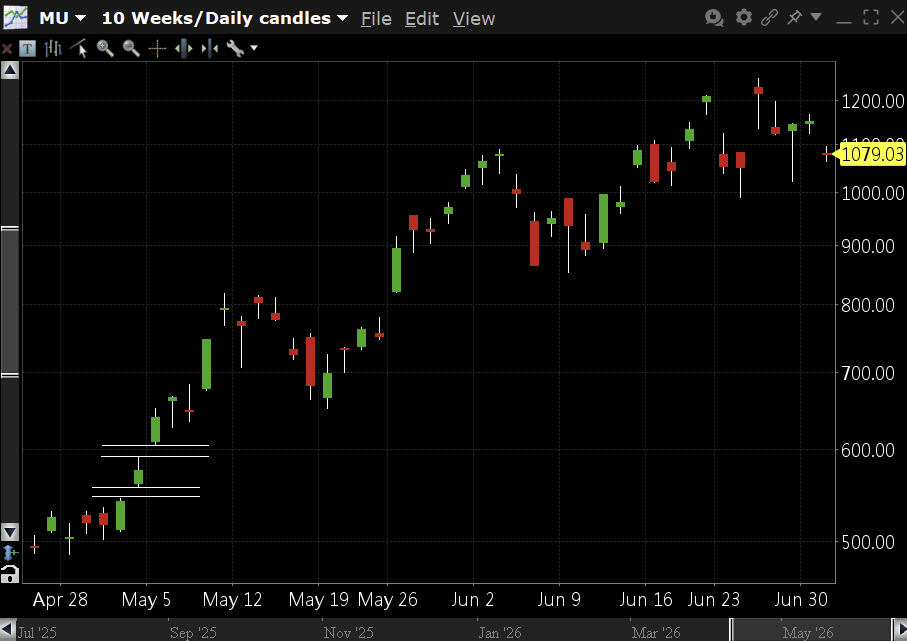
Given that the US shares of SK Hynix still trade at a large premium to the KRX-traded primary listing (and an even bigger discount to that holdco that owns 20% of SKHY) - it is probably a better short than Micron. Micron is a good long here, believe it or not. Head & Shoulders top about to blow up in a bunch of traders faces. don't be one of them!
-
I just got lucky and I didn't close my short position yet so who knows how this will play out I do think SKHY is a better short than Micron
-
 Great timing. Thanks for this idea.
 -
What makes you think 80% of MAGA can even read? Ask their leader what was the last book he read or look how MAGA followers tend to believe the outragous lies he spouts on a daily basis.
-
This takes me way back to HS. My first experience with beer (a terrible one). Me and a buddy went on a backpacking trip over fall break in the New River Gorge WV and nabbed some Guinness Extra Stout from his Dads cellar thinking it would be awesome. Did some 30 mile trail and stopped about half way to camp. "Nothing like a beer after a long hike!" Yuck! Can still remember the awful taste of warm Extra Stout to someone without a taste for beer. Ended up using it to cook instead lol
-
Do perpetuals for Doge and Shiba Inu count? Because those exist.
-
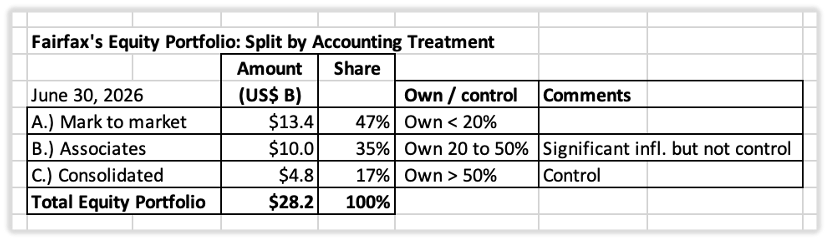
Thanks @Viking for this detailed writeup. When we look at the Associate and Consolidated $ amounts, are we seeing the value on the book for these? If so, I wonder how FV would impact the percentage breakdown of these when compared with the Marked to Market bucket. The FV amount would also increase the total equities amount in comparison to Fixed Income. I wonder if the insurance regulators look at FV of equities when determining the percentage of high quality fixed incomed that is needed when investing. I could see FV of equities growing to over 50% of the Investment portfolio with Fairfax over time.
-
Yup

-
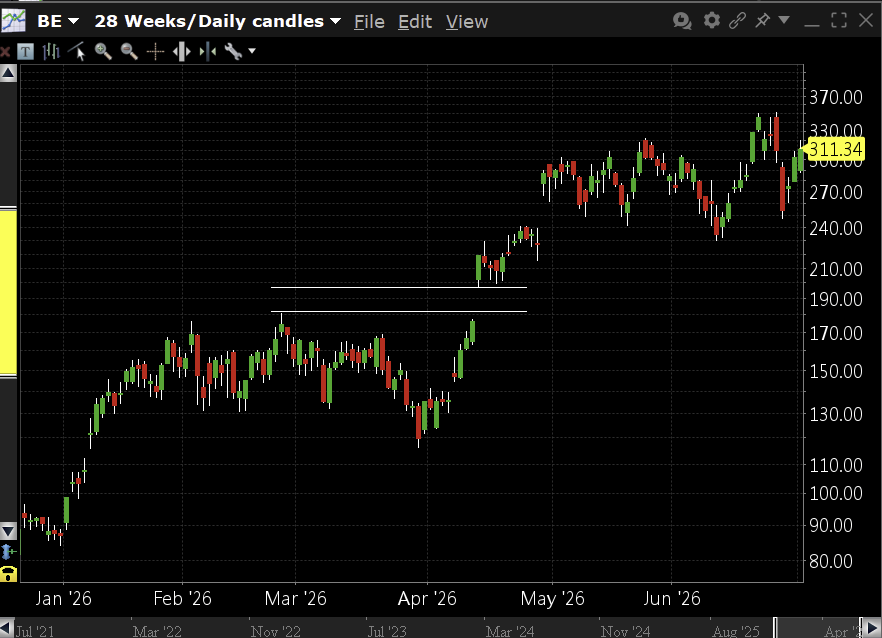
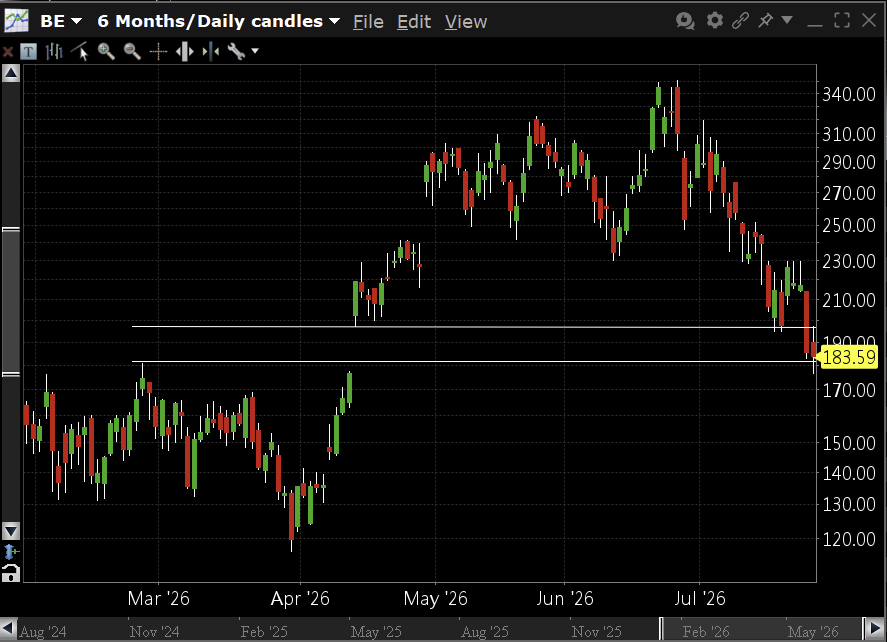
BE gap now closed...:
-
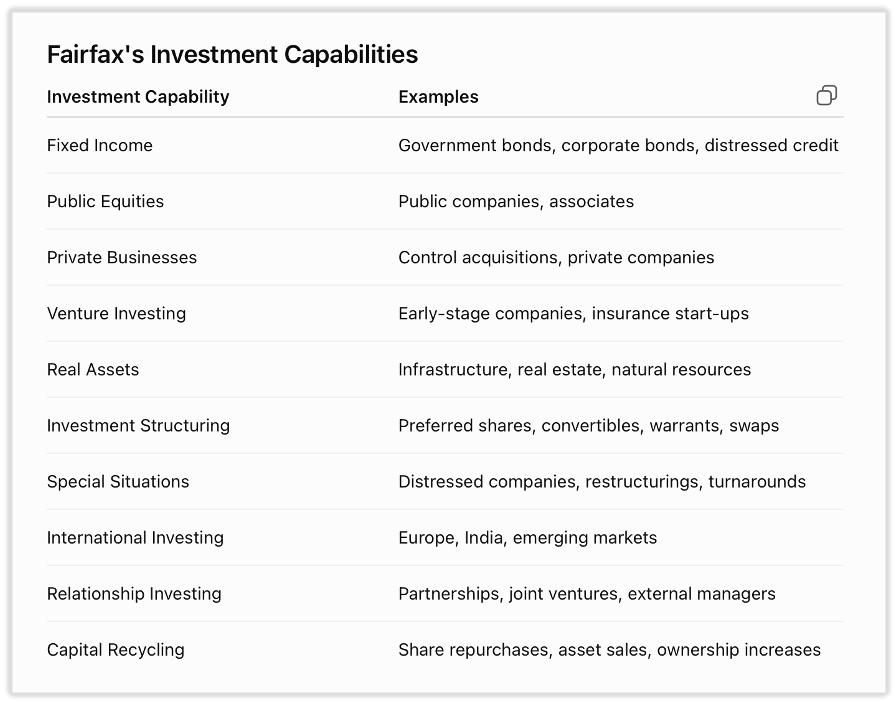
Article 3 in the 6 part series. Articles 4 to 6 will be posted tomorrow. How Fairfax Invests Most investors think of Fairfax's investment portfolio as a collection of stocks and bonds. That view is incomplete. Over the past four decades, Fairfax has built a broad investment platform capable of investing across public and private markets, debt and equity, developed and emerging economies, and through a wide variety of investment structures. These capabilities significantly expand Fairfax's investment opportunity set. They allow management to allocate capital wherever it believes the best long-term risk-adjusted returns can be earned. Each capability expands the range of opportunities available to Fairfax. Together, they create an investment platform that is significantly broader than that of a typical property and casualty insurer. Fixed Income Most insurers invest conservatively in government and investment-grade corporate bonds. Fairfax has developed expertise across a much broader fixed income universe, including distressed debt and special situations when market conditions warrant. Management also actively adjusts portfolio duration, credit exposure and liquidity as market conditions change. The company demonstrated this capability in 2021 by positioning the portfolio for rising interest rates. When rates increased sharply over the following two years, Fairfax largely avoided the significant bond losses experienced by many financial institutions while preserving the flexibility to reinvest at much higher yields. The investment strategy demonstrates Fairfax's ability to actively manage risk while positioning the portfolio to capitalize on changing market conditions. Public Equities Fairfax invests in publicly traded companies around the world, seeking businesses with capable management, strong competitive positions and attractive long-term economics. Public markets provide liquidity and a broad opportunity set, allowing Fairfax to capitalize on periods when market prices diverge significantly from intrinsic value. Eurobank illustrates this capability. Fairfax invested after the Greek banking crisis, when investor sentiment remained deeply negative. As Greece's economy recovered, interest rates normalized and management executed exceptionally well, Eurobank became one of the most successful public equity investments in Fairfax's history. The investment demonstrates Fairfax's value investing discipline: investing in quality businesses when they are out of favour and allowing time for business performance to drive investment returns. Private Businesses Fairfax has demonstrated the ability to acquire, build and own private businesses across multiple industries. Private ownership allows Fairfax to partner directly with management teams, influence capital allocation and support long-term value creation without the pressures of public markets. Peak Achievement (Bauer) illustrates this capability. Fairfax partnered with Sagard to acquire the business out of bankruptcy in 2017, backing an experienced management team with patient, long-term capital. As the business recovered and performed well, Fairfax acquired Sagard's ownership interest in 2024. The investment demonstrates Fairfax's ability to identify strong management teams, support operational improvement and increase ownership in successful businesses over time. Venture Investing Fairfax also invests selectively in early-stage businesses. By partnering with exceptional entrepreneurs early, Fairfax can participate in the creation of valuable businesses long before they become attractive public or private acquisition opportunities. Digit Insurance illustrates this capability. Fairfax made a modest investment when the company was still a start-up, backing an experienced management team led by Kamesh Goyal. As the business grew into one of India's leading digital insurers, it completed a successful initial public offering and became one of Fairfax's most successful investments of the past decade. The investment demonstrates Fairfax's ability to identify exceptional entrepreneurs early and generate outsized returns from relatively modest initial investments. Real Assets Fairfax invests selectively in infrastructure, real estate and natural resource businesses that own durable assets capable of generating long-term cash flow. These investments provide recurring income while offering protection against inflation and diversification across economic cycles. Bangalore International Airport illustrates this capability. Fairfax recognized the opportunity early, acquired a controlling interest and installed an experienced management team led by Hari Marar. As the airport expanded and passenger traffic grew, Fairfax increased its ownership to approximately 74%. The investment demonstrates Fairfax's ability to identify attractive real assets, actively improve their performance and increase ownership as long-term value is created. Investment Structuring Fairfax has developed expertise in structuring investments using preferred shares, convertible securities, warrants, swaps and other customized financing arrangements. Rather than simply buying stocks or bonds, management creatively structures investments to tailor risk and return, solve financing problems and capitalize on short-term opportunities when financial markets become dislocated. Fairfax's use of total return swaps illustrates this capability. In 2020, management believed Fairfax's shares were trading at a substantial discount to intrinsic value but wanted to preserve cash during a period of significant uncertainty. Rather than repurchasing shares outright, Fairfax used total return swaps to gain significant economic exposure while committing relatively little capital. As Fairfax's share price recovered, the position became one of the company's most successful investments of the past five years. The investment demonstrates management's creativity in structuring investments to capitalize on attractive opportunities. Special Situations Fairfax has repeatedly invested where other investors were unwilling or unable to provide capital. Periods of financial distress and market dislocation often create attractive opportunities for patient, long-term investors. Dexterra illustrates this capability well. Fairfax invested after the collapse of Carillion plc, recognizing that the problems lay with the UK parent, not the Canadian operations. It later supported the combination with Horizon North, creating a stronger, better-positioned business. Dexterra has since expanded into the United States, and its share price has performed exceptionally well. The investment demonstrates Fairfax's ability to create long-term value through patient capital and disciplined execution. International Investing Fairfax has invested internationally for decades. Management has consistently demonstrated a willingness to invest wherever it finds the best long-term opportunities, regardless of geography. Fairbridge illustrates this capability. Fairfax built its investment platform in India through Fairbridge, led by Sumit Maheshwari. Its on-the-ground presence provides deep local knowledge, trusted relationships and investment expertise that strengthen Fairfax's ability to source, evaluate and manage investments in one of the world's fastest-growing economies. Relationship Investing Many of Fairfax's best investment opportunities originate through long-standing relationships rather than competitive auctions. By partnering with experienced entrepreneurs, investment managers and business families, Fairfax gains access to proprietary opportunities that may not be available to other investors. The acquisition of portions of PacWest's loan portfolio alongside Kennedy Wilson illustrates this capability. During the 2023 regional banking turmoil, Fairfax partnered with an experienced real estate investor to acquire assets under attractive terms. The investment demonstrates how trusted relationships can expand Fairfax's opportunity set during periods of market dislocation. Capital Recycling Fairfax does not simply make investments. It actively recycles capital by continually reallocating it to the opportunities offering the highest expected long-term returns. As investments mature and new opportunities emerge, management has demonstrated a willingness to sell businesses, increase ownership in successful investments, repurchase Fairfax shares and redeploy capital wherever it believes it can create the most value. Fairfax's share repurchases since 2018 illustrate this capability. Management has repurchased a meaningful percentage of the company's outstanding shares when it believed they were trading below intrinsic value, while also increasing ownership in successful businesses and redeploying capital from mature investments into new opportunities. The repurchases demonstrate Fairfax's willingness to treat its own shares like any other investment opportunity, allocating capital where it believes it will earn the highest long-term return. Summary Over the past four decades, Fairfax has built an unusually broad set of investment capabilities. This breadth gives management a significant competitive advantage. Rather than being confined to a particular asset class, geography or investment structure, Fairfax can allocate capital wherever it believes long-term risk-adjusted returns are most attractive. A larger opportunity set increases the probability of finding exceptional investment opportunities. Capabilities alone, however, are not enough. Management must also execute well. Fairfax's record provides a compelling answer. Over the past 40 years, the company has compounded its share price at approximately 19% annually. That performance is not the result of a single successful investment or favourable market cycle. It is the cumulative result of disciplined capital allocation over four decades. Recent execution has been equally impressive. Management has successfully navigated changing fixed income markets, generated outstanding returns from public and private investments, structured investments creatively, recycled capital with discipline and acted decisively during periods of market dislocation. The result has been exceptional growth in book value per share, intrinsic value and Fairfax's share price. Today, Fairfax is generating record amounts of capital from both its insurance and investment businesses. Its insurance operations are stronger than ever, and its investment platform has never been broader or more capable. Together, these businesses position Fairfax well to continue creating long-term shareholder value. The company appears well positioned to continue delivering above-average growth in intrinsic value per share over the long term. A Final Observation Fairfax's investment platform also helps explain why the company differs from most property and casualty insurers. Many of Fairfax's investment capabilities are difficult to recognize, difficult to value and often do not show up in reported financial results until years later. As a result, investors tend to underappreciate them. This helps explain why Fairfax can be a difficult company to understand, analyze and value.
-
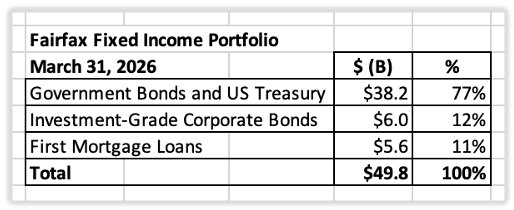
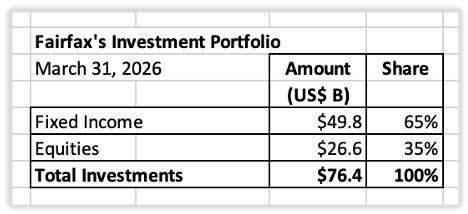
Article 2 in the 6 part series. Inside Fairfax’s Investment Portfolio Fairfax's Q1 2026 conference call provided investors with an updated look at the company's investment portfolio. Hamblin Watsa President and Chief Investment Officer Wade Burton discussed how the portfolio is currently positioned and the thinking behind it. Three themes stand out: a conservative fixed income portfolio, significant investment flexibility, and a portfolio of high-quality equity investments. A $76 Billion Investment Portfolio At March 31, 2026, Fairfax managed an investment portfolio totaling approximately $76 billion, consisting of: $49.8 billion of fixed income investments (65%) $26.6 billion of equity and equity-exposed investments (35%) Each component serves a different purpose. The fixed income portfolio provides safety, liquidity and recurring interest income. The equity portfolio provides exposure to businesses that management believes can compound capital over many years. Fixed Income: Safety, Liquidity and Optionality Fairfax's fixed income portfolio consists of: $38.2 billion of government bonds and U.S. Treasuries (77%) $6.0 billion of investment-grade corporate bonds (12%) $5.6 billion of mortgages (11%) Recent performance has been strong: 0.3% during the first quarter of 2026 5.6% over the past twelve months 4.9% annualized over the past three years The portfolio has: average duration of 2.2 years average maturity of 3 years currently yields approximately 5%. Burton also emphasized that Fairfax has no traditional private credit exposure. The portfolio's structure reflects management's priorities. Approximately 77% is invested in government bonds and U.S. Treasuries, emphasizing safety. An average duration of 2.2 years provides significant financial flexibility, while a yield of approximately 5% generates attractive recurring interest income. Why This Matters Most investors think of a bond portfolio primarily as a source of income. Fairfax views it in a broader context. The fixed income portfolio generates attractive recurring interest income, but it also serves as strategic capital. By emphasizing safety and liquidity, Fairfax is positioned to deploy capital quickly when market dislocations create exceptional investment opportunities. Rather than reaching for yield, management has preserved the flexibility to act when others cannot. Burton's comment that Fairfax has zero traditional private credit exposure is especially revealing. In recent years, many insurers increased their exposure to private credit in search of higher yields. Fairfax chose a different path. This is value investing applied to fixed income. Management was unwilling to assume additional credit and liquidity risk unless it was adequately compensated. Rather than stretching for incremental yield, Fairfax maintained a conservative, highly liquid portfolio while still earning approximately 5%. Recent developments suggest that decision was well founded. More importantly, it illustrates how Fairfax approaches capital allocation. Management is willing to be different when it believes the risk-reward trade-off is unattractive. It also challenges a common perception. Many investors think of Fairfax as an aggressive investor. Its fixed income portfolio tells a very different story. It is positioned much more conservatively than many property and casualty insurance peers while still generating an attractive yield. Equities: The Long-Term Compounding Engine Fairfax's $26.6 billion equity portfolio includes public equities, associates, consolidated non-insurance businesses and preferred shares. Burton noted that all parts of the portfolio were performing well, particularly Fairfax's larger investments. Recent performance has been strong: 2.9% during the first quarter of 2026 28.9% over the past twelve months 20.5% annualized over the past three years The equity portfolio looks very different today than it did a decade ago. Since 2018, Fairfax has upgraded the quality of its holdings, emphasizing stronger businesses, better management teams and greater long-term compounding potential. The strong performance in recent years suggests that repositioning has been successful. Key Takeaway Fairfax's investment portfolio is deliberately structured to achieve two complementary objectives. The fixed income portfolio protects the balance sheet, generates recurring interest income and preserves financial flexibility. The equity portfolio is designed to compound capital at attractive rates over long periods through ownership of high-quality businesses. Together, they reflect a disciplined investment philosophy. Fairfax seeks attractive long-term returns, but only when the prospective rewards justify the risks being assumed. That philosophy is evident in both the conservatism of the fixed income portfolio and the quality of the equity portfolio. The strategy is working. Fairfax is currently earning approximately 5% on its fixed income portfolio while generating substantially higher returns from its equity investments. The combination has produced one of the strongest long-term investment records in the property and casualty insurance industry. Q1 2026 Conference Call Excerpt Wade Burton, President and Chief Investment Officer of Hamblin Watsa: “Good morning. March 31st, 2026, ends another good quarter on the investment side. Performance continues to be excellent. Equities are up 2.9% on the quarter, 28.9% for the last 12 months, and 20.5% through 3 years. Similarly, our bonds have outperformed, up 0.3% on the quarter, 5.6% for the last 12 months, and 4.9% through 3 years. Our fixed income portfolio is safe and earning strong interest income, our public equities, associates, and consolidated non-insurance investments continue to perform well. We ended the quarter with $49.8 billion in fixed income investments and $26.6 billion in equity and equity exposed investments. The fixed income portfolio includes $5.6 billion in mortgages, $6 billion in corporates, all very short-term, mainly investment-grade and–I will repeat–zero traditional private credit exposure, and $38.2 billion in government bonds and treasuries. Duration is 2.2 years, average maturity is 3 years and our yield is approximately 5%. A lot of safety and flexibility is built into the fixed income portfolio, which is our response to the playing field as it sits. The economic and interest environment has many conflicting factors, so we’re playing it safe, keeping lots of flexibility, and making a good return as we wait. As I said, we have $26.6 billion invested in common shares, equity associates, consolidated non-insurance equity investments, and preferred shares. All doing well, especially the bigger investments.”
-
I have not seen the detailed report.
-
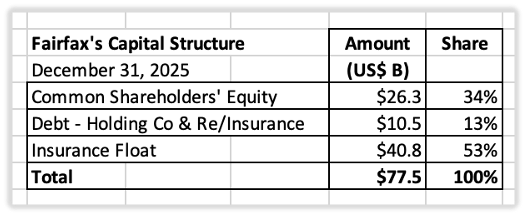
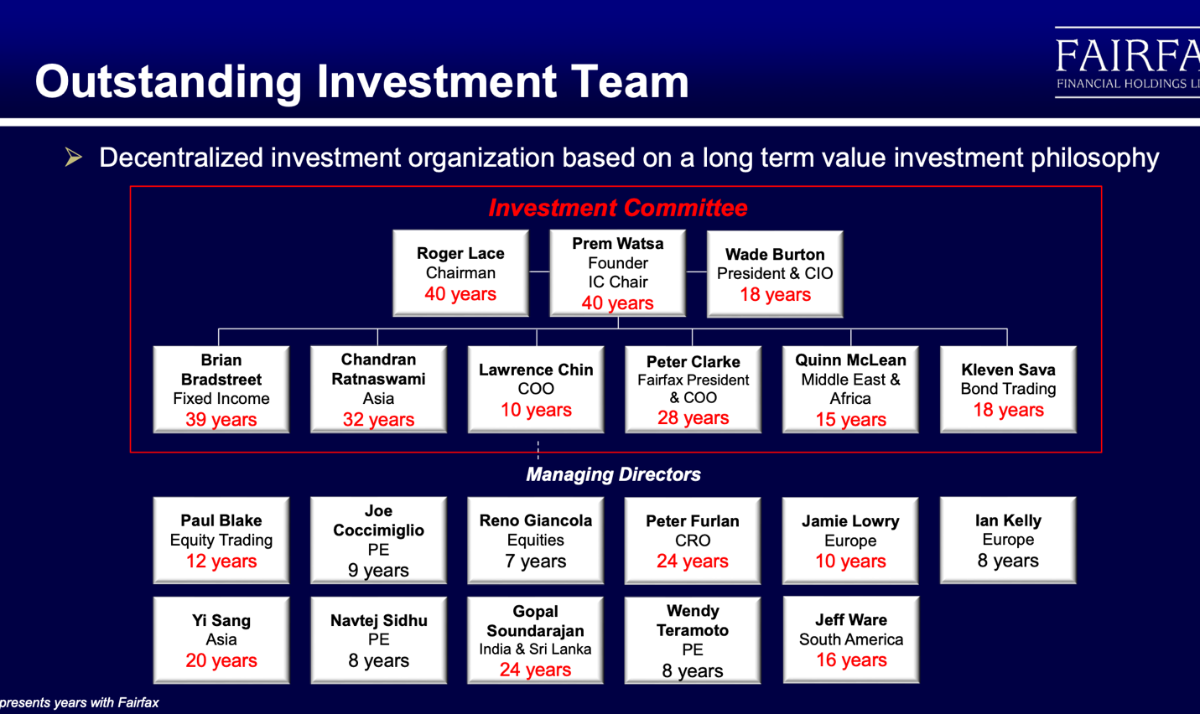
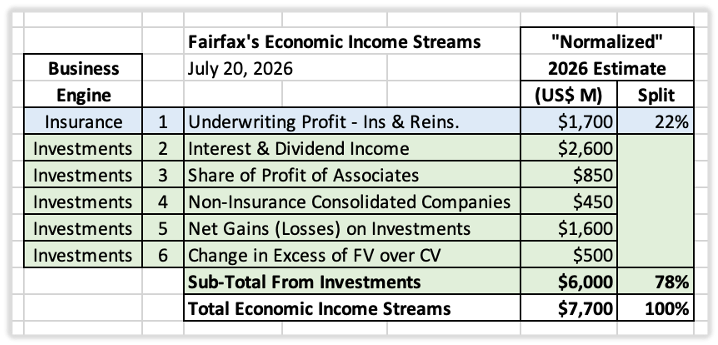
Article 1 in the 6 part series. The Investment Platform Fairfax Has Two Businesses Most investors think of Fairfax as a property and casualty insurer. That description is accurate, but incomplete. Today, Fairfax operates two complementary business engines. The insurance engine generates underwriting profits and provides access to insurance float. The investment engine allocates capital across a diversified portfolio and compounds it over time. The insurance business provides the foundation. The investment business converts that capital into long-term shareholder value. Together, they form the core of Fairfax's business model. Understanding Fairfax therefore requires understanding both engines. This chapter examines the second: Fairfax's investment platform. The Investment Business Is Large At March 31, 2026, Fairfax managed an investment portfolio of approximately $76 billion. Unlike a traditional investment manager, this capital does not come from outside clients. Fairfax finances its investment portfolio primarily with common shareholders' equity, insurance float and debt, with insurance float providing more than half of the capital. Chart 1: Fairfax's Capital Structure This capital structure is one of the defining characteristics of Fairfax's business model. It allows the company to control an investment portfolio that is almost three times larger than common shareholders' equity, giving investment results an outsized influence on earnings, intrinsic value and long-term shareholder returns. The People Behind the Investment Platform Fairfax has also assembled one of the deepest investment organizations in the insurance industry. The team combines decades of experience across fixed income, public equities, private equity, infrastructure, emerging markets and insurance operations. Just as important, many senior investment professionals have spent decades working together, creating continuity in both philosophy and decision making. Chart 2: Fairfax's Investment Organization Source: Fairfax management presentation, 2026 Annual General Meeting. The investment platform is far larger than any one individual. It is a decentralized organization built around a shared long-term value investing philosophy. How Fairfax Invests At a high level, Fairfax allocates its investment portfolio across two broad asset classes: fixed income securities and equities. The fixed income portfolio provides liquidity, protects the balance sheet and generates recurring interest income. The equity portfolio is designed to compound capital over long periods through public investments, associates and controlled businesses. Chart 3: Fairfax's Investment Portfolio This fixed income/equity framework provides a useful starting point. The articles that follow look beneath the surface to explain how Fairfax structures its investments and why that matters for both reported earnings and long-term shareholder returns. Looking Inside the Equity Portfolio Not all equity investments are accounted for in the same way. For analytical purposes, Fairfax's equity portfolio can be grouped into three categories based on IFRS accounting treatment: Mark-to-market investments — generally ownership interests of less than 20%. Associates — companies in which Fairfax has significant influence, but not control. Consolidated subsidiaries — businesses that Fairfax controls. Chart 4: Fairfax's Equity Portfolio by Accounting Treatment These classifications determine how investment results flow through Fairfax's financial statements and explain why investment earnings appear in multiple places within the income statement. The Investment Business Drives Earnings Understanding the investment platform becomes even more important when viewed through earnings. In a normalized year, Fairfax generates economic earnings from six primary income streams. Only one—underwriting profit—is generated directly by the insurance business. The remaining five are produced by the investment portfolio. Chart 5: Fairfax's Economic Income Streams Based on our normalized estimates, approximately 78% of Fairfax's economic earnings are generated by the investment business, compared with 22% from underwriting. Insurance remains essential because it produces underwriting profits and, more importantly, provides access to insurance float. The investment business is what converts that capital into long-term shareholder value. Why This Matters Fairfax's investment portfolio is almost three times larger than common shareholders' equity. This investment leverage amplifies the impact of investment performance. Combined with Fairfax's strong long-term investment record, it gives the investment business an outsized influence on earnings, intrinsic value and long-term shareholder returns. Understanding how Fairfax invests is therefore essential to understanding the company—and valuing its shares.
-
Fairfax's is a devilishly difficult company to understand. Why? How it invests. But there is an even more important take-away. Fairfax is very good at how it invests - much better than investors generally recognize. As a result, I am adding a new Chapter to my book - Chapter 5 Fairfax's Investment Platform The goal is to pull back the curtain and shed some light on this critically important topic. Today I will post the Chapter Summary and the first three articles. Tomorrow I will post the second three articles (there are a total of 6 in the Chapter). This is my initial draft. I look forward to getting the feedback from board members - that is how we all learn. ------------- Chapter Summary This chapter examines Fairfax's investment business—the second engine that powers the company's long-term growth. It explains how Fairfax invests, why its approach differs from most property and casualty insurers, and why its investment platform has become one of the company's greatest competitive advantages. The chapter is organized into six articles: The Investment Platform introduces Fairfax's investment business, explaining where the capital comes from, how it is financed and why it has become the primary driver of the company's long-term earnings power. Inside Fairfax's Investment Portfolio examines the composition of the approximately US$76 billion investment portfolio, including fixed income, public equities, associates and consolidated holdings, and explains the role each plays in the overall portfolio. Fairfax's Investment Capabilities explores the broad range of ways Fairfax allocates capital—from bonds and public equities to private businesses, distressed investments, infrastructure and venture investing—and explains why this flexibility provides a competitive advantage. Fairfax’s Investment Platform Comes of Age uses Wade Burton's Q1 2026 conference call comments to explain how Fairfax's investment platform has evolved and why it is better positioned than at any point in the company's history. The DNA of Fairfax's Investment Philosophy traces the ideas that shaped Fairfax's investment approach, from Benjamin Graham and Warren Buffett to John Templeton, Henry Singleton and others, showing how these influences continue to guide investment decisions today. Estimating Fairfax's Investment Earnings analyzes Fairfax's long-term investment performance and develops a reasonable estimate of the economic earnings the investment business can generate over a normal investment cycle.
-
,Canceled $600k Salesforce contract "to replace" it with multi-million dollar spend on Anthropic (51-minute mark). Sure, you can say they used Anthropic for other things too but this is the type of story that I keep hearing about and seeing. Lots of other things here that are inconsistencies that point that AI isn't killing software.
-

High Quality Multi-family REITs - EQR, CPT, ESS, AVB
thepupil replied to thepupil's topic in General Discussion
under contract for $30mm less ($250mm vs $280mm) wasn't able to preclear w/ employer on time to buy day after so the big profits for me are merely hypothetical/theoretical...but I know some other folks made some $$$. Elme Communities – Provides Update on Liquidation (BankruptcyData) Publish Date: 2026-07-26 15:27:52 UTC Elme Communities updated shareholders on its ongoing liquidation under the Plan of Sale and Liquidation approved in October 2025, according to a statement. In 2026, the Company completed the sale of six remaining properties, five multifamily communities and the Watergate 600 office property, for approximately $294 million in gross proceeds. After the original buyer withdrew, Elme signed a new agreement to sell Riverside Apartments for $250 million, with closing expected by September 14, 2026, subject to inspection and customary closing conditions. Purchase agreements for Elme Bethesda, The Kenmore, and 3801 Connecticut Avenue, totaling about $168 million in gross proceeds, remain on track. Elme Bethesda is expected to close by August 11, 2026, while the two Washington, D.C., properties are expected to close after completing the required Tenant Opportunity to Purchase Act (TOPA) process by year-end. Following the initial $14.67 per-share liquidating distribution paid in January 2026, the Company now expects additional liquidating distributions of $1.74 to $1.94 per share, bringing total estimated distributions to $16.41 to $16.61 per share. To contact B -
Nice call. Your timing is spot on.
-
-
Do you know what his earnings estimates are for this quarter and year?