nwoodman
-
Posts
1,892 -
Joined
-
Last visited
-
Days Won
15
Content Type
Profiles
Forums
Events
Everything posted by nwoodman
-
Thanks Viking
-
TLDR : A recent interview with IRDAI Chairman Debasish Panda. 20 applications under way by prospective insurance companies. 2022-2023 2 life insurers one general insurer granted registration. Composite registration - ability to offer a one stop shop under consideration. Insurers, especially Life, seem as sources of patient capital for infrastructure. Marine and aviation opportunities. By way of background, HDFC and Axis Bank have made investments in GoDigit Life but GoDigit is yet to receive a final nod from the insurance regulator for its life insurance license. On March 31, the Insurance Regulatory and Development Authority of India (IRDAI) granted new-age insurer Acko a licence to operate a life insurance business, along with a nod to microfinance company Credit Access to commence a life insurance business. IRDAI closely monitors insurers’ investments, intervenes if necessary: Chairman Debasish Panda "The IRDAI has an extensive framework for regulating and monitoring investments made by insurance companies, which is applicable on both the pattern of investment as well as exposure norms. The exposure norms have been defined for entity level, group level and also the industry level." Dheeraj Tiwari The Insurance Regulatory and Development Authority of India (IRDAI) closely monitors the investments made by insurance companies and intervenes whenever it is deemed necessary, says its chairman, Debasish Panda. There are 20 firms whose applications are being considered for setting up insurance ventures in the country, he tells Dheeraj Tiwari in an interview. Edited excerpts: Questions have been raised about the investment policies of insurers, especially investment made in corporate firms… The IRDAI has an extensive framework for regulating and monitoring investments made by insurance companies, which is applicable on both the pattern of investment as well as exposure norms. The exposure norms have been defined for entity level, group level and also the industry level. Insurance companies are mandated to invest their funds in accordance with the board-approved investment policy. A prudent risk-management framework has also been laid out for insurance companies. The investment wing of the IRDAI closely monitors the investments made by insurance companies and intervenes whenever it is deemed necessary. In addition, the IRDAI has mandated that insurers need to maintain a certain level of solvency margin, which is a measure of their ability to absorb losses. This ensures that insurers have adequate capital to meet their obligations even in the event of a crisis. While the existing regulations are designed to ensure prudence and safety of investments made by insurers, the regulator continuously reviews and updates the same to keep pace with changing market dynamics and to address any emerging risks. Do you think more robust regulations have to be put in place before allowing large companies like LIC to enter all segments of the insurance sector? Allowing composite registration is one of the proposed amendments to Insurance Acts. The intent is to enable a one-stop solution for all insurance needs for the general public. Once the statute is amended, a necessary regulatory framework will be put in place duly addressing all the possible risks and vulnerabilities. However, it must be reiterated that composite registration will still be an option. If a big insurance company with a strong distribution network is able to offer all types of insurance products, it will lead to economies of scale, leading to greater affordability and improved accessibility of insurance coverage. This will also result in better and efficient capital management. Going forward, a risk-based capital regime will ensure sufficient capital is available at all times for the level of business activities and risks being undertaken by the insurance entities. Implementation of IFRS/Ind AS standards will improve transparency and investor confidence. A necessary framework, in terms of a risk-based supervision framework, is also being laid out to keep a check on the risk profile of the insurance companies. What is the key rationale behind the recent regulatory changes and facilitation? The key rationale behind all the facilitations is to make insurance available, accessible and affordable to each citizen and every business of this country. These amendments aim to make the sector business as well as investor friendly. In the financial year 2022-23 alone, three new insurance companies have been registered, two in the life insurance segment and one in the general insurance segment. This comes after a 12-year hiatus in life insurance and a 5-year gap in general insurance. Another 20-plus applications are under consideration with the IRDAI. This indicates that the business environment is favourable and conducive, and investors are getting attracted to the insurance sector. The reforms have created a favourable investment climate for both domestic and foreign investors. There is a demand to push more insurance funds towards infrastructure investment... Insurance companies, especially life insurers, are the providers of long-term patient capital. Recently, investments in debt securities of InvITs and REITs have been allowed in addition to the investment in their units. Further, insurers’ exposure to long-term bonds by banks for financing of infrastructure and affordable housing is treated as exposure to infrastructure or housing. A new credit-rating system has also been recognised for infrastructure. With the objective of de-concentration and diversification and also participation in environmental, social and governance initiatives, insurance companies are encouraged to consider investing in sovereign green bonds. A detailed framework on the pattern of investment along with exposure norms has been provided to ensure safety of the funds while also allowing avenues for diversification. The risk management framework enables the regulator to monitor, review and intervene as and when deemed necessary. We still lack strength in sectors such as marine and aviation insurance… Covering risks pertaining to marine hull and aviation is some of the specialised areas of insurance. These have unique character with a huge concentration risk, require advanced technical capacities to underwrite along with huge capital deployment. The said risks invariably require reinsurance support in order to ensure better diversification and optimum capital deployment. A lot of measures pertaining to ease in doing business have been taken or are under consideration to encourage foreign reinsurers to set up branches in India, like reduction in assigned capital requirements, repatriation of surplus, reduced compliance burden and equitable opportunities. The cross-border reinsurer area is also encouraged to open branches in the domestic tariff area or set up offices in IFSC - Gift City, Gujarat. Efforts are also being directed towards building IFSC – Gift City as a global reinsurance hub, which will lead to improved technical and financial capacities to undertake specialised lines of business. Can you elaborate on some of the innovations which you feel may further drive insurance penetration? With digital technologies such as big data analytics, artificial intelligence, machine learning and mobile distribution models, block-chain, etc., tech-enabled companies including insurtechs are trying to address current challenges and provide innovative solutions. There have been various concepts that have been successfully implemented like pay as you go, pay as you drive, floater policies in motor and wellness & preventive features in health. Further, the IRDAI had announced a hackathon and invited innovative solutions in the areas of automated death claim settlement, curtailing miss-selling, identifying uninsured motor vehicles, fraud mitigation/ prevention, etc. A dedicated. insurtech mission mode team at IRDAI with young and energetic officers are working towards making the sector tech-equipped and facilitating the creation of e-marketplace protocol for insurance.
-
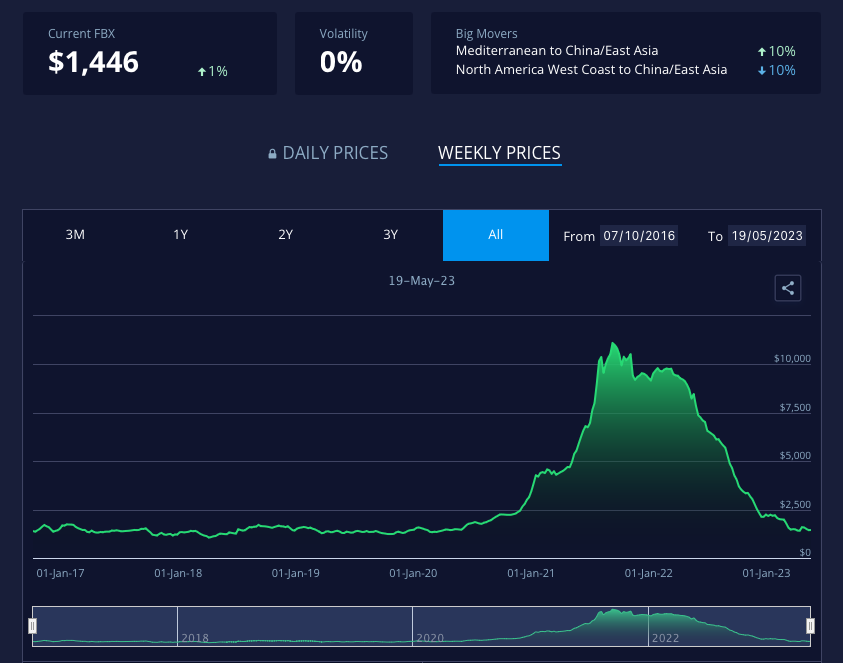
This is still ringing in my ears: You have two types of rates. One is spot, the other is contract,” said Hapag-Lloyd CEO Rolf Habben Jansen on a call last August. “A contract means you commit yourself to a certain rate. There’s always a risk that during some periods, the spot rate is lower. “That’s no reason to say, ‘OK, we will lower the contract rate. That would mean the contract rate is a combination of a [fixed] rate and a downward adjustment if the spot rate is lower. If you do that, there’s no reason to have contracts anymore. It wouldn’t make any sense. That’s why we have two types of rates.” Zim clearly has a different view. The company’s CFO, Xavier Destriau, confirmed on a call in November that the company’s May 2022-April 2023 trans-Pacific contracts were reset lower in an effort to maintain long-term customer relationships. Good chance this gets ugly. We said a while back that Seaspan needs to have some water-tight contracts in place when things turn. Hopefully, as you are implying, they are the strong hands here with loyal and sticky customers. Time will tell The FBX (global continer freight index) is a a beauty https://fbx.freightos.com

-
Faarck, Mr Market is loving those election results
-
Interesting question I was thinking about this over the last couple of days too. It does appear that we are moving into an El Niño cycle https://www.jpl.nasa.gov/news/international-sea-level-satellite-spots-early-signs-of-el-nino An El Niño cycle typically reduces Hurricane formation due to an increase in wind shear. https://www.weather.gov/jan/el_nino_and_la_nina#:~:text=El Niño events generally suppress,high in the atmosphere weaken. So my humble take is that it improves the probability that it could work out well. Edit: Some impressive graphics in this article https://www.usatoday.com/in-depth/graphics/2023/05/20/graphics-el-nino-is-building-what-this-means-for-the-worlds-weather/70211954007/ Transcript https://www.artemis.bm/news/berkshire-hathaway-property-cat-book-unbalanced-towards-florida-ajit-jain/
-
Batteries are flat on my crystal ball but I envisage in around 7 years time that Berkshire will have doubled in size and will be paying a dividend of 2-3%.
-
IIRC don’t they have to sell down CSB over time as a condition of the IPO. Gets awfully complicated if they were to merge entities. Thinking about it further this is probably why Prem wants another toehold, with control, in the Indian banking sector.
-
No good reason, other than time of holdings. The retirement fund initially had three holdings BRK FRFHF L. Two out of the three went to zero, in terms of holdings. Fairfax made it back in the last couple of years. Added a number of times in the personal portfolio to BRK but it was setup later than the retirement fund due to running money for others and private business interests etc.
-
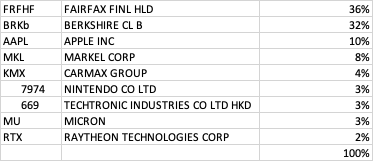
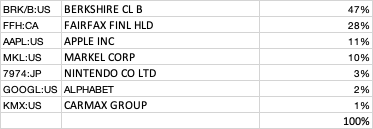
A really interesting thread. My positions are pre-tax so concentration looks a little more balanced after-tax. Genuinely envious of those of you who get to reallocate without any tax penalties. My expectation is for inflation plus 4-5%, so utilising some mixed currency margin (AUD, USD, JPY) for the personal account. Personal Account Retirement
-
I for one won’t mind in the least . Thanks for providing a little more colour.
-
Yes, but honest question this surely dwarfs anything FIH could do by themselves, so where would the funding come from? Then importantly for FIH shareholders on what terms? All a bit previous at this stage I know.
-
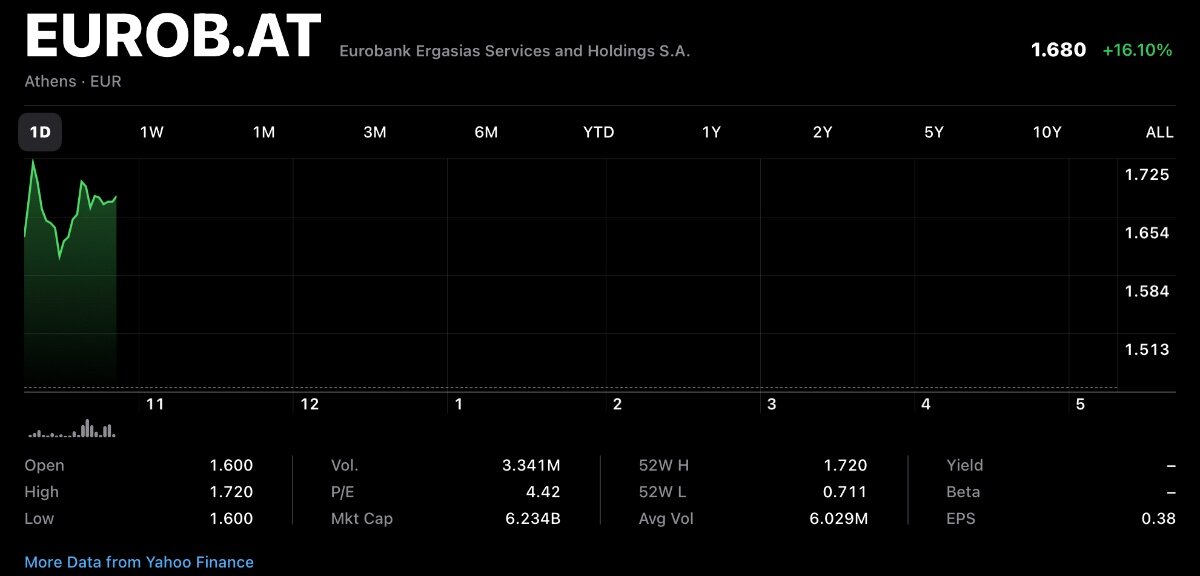
Recent interview with Prem. Connection was a little sketchy, so it is somewhat fragmented. Greece is going gangbusters, economy grew by 5+%. Elections next month. Eurobank divs likely to start next year. Touches on some minor acquisitions they have made. Also calls out the investments made by the major tech companies who have set up regional cloud infrastructure in Greece.
-
Thanks for posting, and also those that DM'ed me. Hard to get the tone, but I thought this CC was a standout. A couple of quotes that struck me. On earnings outlook V.Watsa "For the first time at our 37-year history, I can say to you, we expect, of course, no guarantees, our operating income to be more than $3 billion annually for the next 3 years. Operating income consists of $1.5 billion from interest and dividend income, $1 billion plus from underwriting profit and $0.5 billion from noninsurance companies. This works out to about $100 per share after interest expenses, overhead and taxes. Our first quarter is running at these levels." On the mechanics of IFRS 17 Tom MacKinnon Great. Yes, Jen, I was just wondering, the things that really impact IFRS 17, the change in the risk adjustment, the unwind of the discount, the build of the discount and the change in the discount rate. So, if we kind of had a flat interest rate environment and pretty well steady state with respect to your growth. Would all of this noise be pretty minimal, like what kind of conditions would make this noise show up more to the positive or actually show up more to the negative? Jennifer Allen Yes. Sure. It's a good question, Tom. So, the way I think if you're in a steady state, if your underlying net reserves from a risk profile duration does not change, then as you unwind your discounting that you don't have a change in your discount rate, it should really be offset and really don't see a huge impact. The other side of it is, your risk adjustment would be steady state, you would be releasing your risk adjustment on your old book, but you would also be setting up the same risk adjustment on your new book. So it's only when your book grows, so if your net reserve starts to grow, you'll start to get that net benefit through again, if it shrinks, it would be a negative impact to your total portfolio. Tom MacKinnon And then on the change in the discount rate, is that just generally, if we have a flat interest rate environment, then we wouldn't get that noise as well, I assume. Jennifer Allen Correct. On passing their biggest test IMHO and how and importantly why they are positioned now Peter Clarke Tom, 1 point that you should know is that we're generally saying we benefited to the tune of $2.4 billion net for the year 2022. We had a bond loss in '22 of about $1 billion. If we were matched (fixed typo), we'd have a $2.4 billion loss, and you'd have had a discounting of $2.4 billion, and we wouldn't have had any benefit. The fact that we weren't matched, the fact that we had -- we didn't reach for yield and it was the reason why we benefited to the tune of $2.4 billion. That's a significant benefit. And I just wanted to put that in perspective for you. Tom MacKinnon Are you more matched now, Prem, with 80% in government treasuries because... V. Watsa Yes, still not, Tom, because we are 2.5 years as, I think, Peter, our liabilities at least 4 years, right? 4 plus. And what we're thinking, Tom, is that we've got government securities, [indiscernible] have locked in close to 4% plus/minus for our bond portfolio in treasuries, like I said, 80% of the short-term corporates will mature. But when you have a recession, we don't know that there'll be a recession. But in the next 3 years, if you have a recession, if the spreads, which happened widened and I experience over a long period of time as when you have a recession, the spreads widen. And when the spreads widen, we think we'll go into very high-quality corporates, as I've said at the AGM, 3, 4, 5 years in a term as opposed to duration, and then lock in those rates, very high quality rates. And hopefully, we'll make some money perhaps on treasuries, but in respective, we locked those rates. And that could be pretty significant when the spread widens, but that's just speculating in terms of what's potentially possible. On leverage Peter Clarke Yes. No, I think the way we look at our debt to total cap has been dropping nicely in the last number of years, and we're in the low-20s now. And as our equity base expands, that ratio will come down even further, that would give us excess capacity in an environment where we were looking to raise that. But we're comfortable where we are, and I think you'll see that ratio decrease as the equity base gets bigger. Our equity base, we are focused on our equity base going bigger. And I mentioned this operating income is $100 a share. That's like, you add 3 years to that. That's pretty significant, right? And they're focused on that becoming bigger. Another really helpful conference call. Talk about firiing on all cylinders
-
Seeking Alpha seems to have dropped the ball on providing a transcript for the Q1 CC. If anyone has a copy of the transcript could you repost here or DM me a copy? Thanks in advance
-
Further speculation on the state of play for the approximate 60% stake in IDBI Bank that is up for grabs. The current market cap is 572.35B INR =>US$7bn, so in round terms, Fairfax would need to trump up around $US4.5bn, a decent chunk of change. https://www.thehindubusinessline.com/money-and-banking/kotak-vs-watsa-the-battle-for-acquiring-idbi-bank-intensifies/article66850311.ece Based on the timeline in the article financial bids are scheduled for September
-
It’s also worthwhile looking at how minority shareholders of Fairfax subs have have faired historically. Often the rug gets pulled just before the real value accretes. Of course this time might be different.
-
Management fees that accrue to the parent company. I am excited by the prospects but why not just own Fairfax, they have full control anyway.
-
Beautiful photos @Vish_ram. Weather is one of those “not negotiables” at the best of times but goes to next level in the Himalayas. We count ourselves incredibly lucky to have fluked near perfect conditions. However, as we were leaving our minor summit the wind picked up considerably and I don’t envy the climbers on the their way up that we passed on out way down. You made a wise decision to scrap it . Plenty of digits and more importantly lives lost due to summit fever. Margin of safety resonates across so many disciplines Edit: Damn straight Ama Dablam is without a doubt one of the most beautiful mountains in the region even though it is “only” 6812m.
-
7974.T Nintendo
-
DIS, will roll proceeds into Nintendo
-
Agree 100%, The results are staggeringly good, I think I might get this quarterly framed . $US1000/share here we come.
-
Unfortunately not much of note, hard to find elevation in Australia. As I implied earlier my background is more hiking/trekking. This trip was an eye-opener, though and I have a growing list of some of the less technical peaks around the world to add to a rather long list of hikes. The key insight for me was if I take it slow, and I mean really slow, I seem to acclimatise OK. Also, this trip was a stark reminder to try and stay fit and healthy so you can keep chipping away at that bucket list. Thanks for the link to the Eiger video, Ueli Steck was an absolute beast, such a great loss. However, the video also brings back some fond memories of doing a section of the Alpine Pass Route many years ago, we camped overlooking the Jungfrau and the Eiger, one of the most beautiful camp spots of my life
-
Awesome, that is the stuff of bucket lists. Doing these types of adventures with your kids is ultimately what it is all about, but I suspect I would be preaching to the converted
-
Hey Luca, toughest hit out of my 52 years . I trained pretty hard and got to a level of fitness that was the best since pre-COVID. I acclimatised well, thanks to our guides but I was only two out of 17 who didn’t end taking Diamox for Acute Mountain Sickness (AMS). However, what I underestimated was the various bugs percolating in the tea houses.We had three out of our 17 person group helicoptered out because of AMS/bugs. The group I went with were mostly younger and fitter than me but we only had 7 out of 14 reach the summit of Island Peak which I was one The coldest temperatures I had experienced before this was around -5C skiing so this was something new. I got into difficulties on one of the acclimatisation climbs due to the cold (-10C). So for Island Peak I took no chances and rugged up for the -15C so no issues. We started the climb at 1am and summited around 8:30am just before the wind picked up, so windchill wasn’t an issue. I am taking my boys back in April next year to do another of the trekking peaks (Mera) which is around 6400m but much easier than Island Peak. I am no mountaineer, more hiker than climber. However, like yourself love watching mountaineering docos. My desire to do this trip was purely to give me some empathy for what the big boys are doing. I got that in spades and it only makes me marvel at their fitness and mental strength even more. It also reinforced the fact that on the big climbs very few would be there if it weren’t for the Nepalese People who support annd facilitate our Western aspirations.
-
Picked up a few more FRFHF