Article 3 in the 6 part series. Articles 4 to 6 will be posted tomorrow.
How Fairfax Invests
Most investors think of Fairfax's investment portfolio as a collection of stocks and bonds.
That view is incomplete.
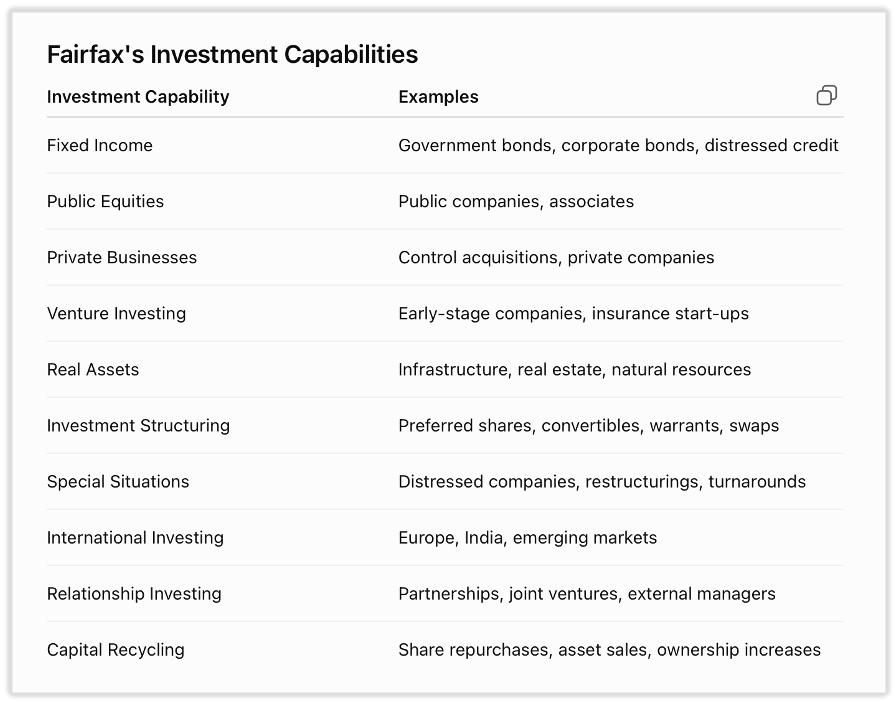
Over the past four decades, Fairfax has built a broad investment platform capable of investing across public and private markets, debt and equity, developed and emerging economies, and through a wide variety of investment structures.
These capabilities significantly expand Fairfax's investment opportunity set. They allow management to allocate capital wherever it believes the best long-term risk-adjusted returns can be earned.
Each capability expands the range of opportunities available to Fairfax. Together, they create an investment platform that is significantly broader than that of a typical property and casualty insurer.
Fixed Income
Most insurers invest conservatively in government and investment-grade corporate bonds.
Fairfax has developed expertise across a much broader fixed income universe, including distressed debt and special situations when market conditions warrant. Management also actively adjusts portfolio duration, credit exposure and liquidity as market conditions change.
The company demonstrated this capability in 2021 by positioning the portfolio for rising interest rates. When rates increased sharply over the following two years, Fairfax largely avoided the significant bond losses experienced by many financial institutions while preserving the flexibility to reinvest at much higher yields. The investment strategy demonstrates Fairfax's ability to actively manage risk while positioning the portfolio to capitalize on changing market conditions.
Public Equities
Fairfax invests in publicly traded companies around the world, seeking businesses with capable management, strong competitive positions and attractive long-term economics. Public markets provide liquidity and a broad opportunity set, allowing Fairfax to capitalize on periods when market prices diverge significantly from intrinsic value.
Eurobank illustrates this capability. Fairfax invested after the Greek banking crisis, when investor sentiment remained deeply negative. As Greece's economy recovered, interest rates normalized and management executed exceptionally well, Eurobank became one of the most successful public equity investments in Fairfax's history. The investment demonstrates Fairfax's value investing discipline: investing in quality businesses when they are out of favour and allowing time for business performance to drive investment returns.
Private Businesses
Fairfax has demonstrated the ability to acquire, build and own private businesses across multiple industries. Private ownership allows Fairfax to partner directly with management teams, influence capital allocation and support long-term value creation without the pressures of public markets.
Peak Achievement (Bauer) illustrates this capability. Fairfax partnered with Sagard to acquire the business out of bankruptcy in 2017, backing an experienced management team with patient, long-term capital. As the business recovered and performed well, Fairfax acquired Sagard's ownership interest in 2024. The investment demonstrates Fairfax's ability to identify strong management teams, support operational improvement and increase ownership in successful businesses over time.
Venture Investing
Fairfax also invests selectively in early-stage businesses. By partnering with exceptional entrepreneurs early, Fairfax can participate in the creation of valuable businesses long before they become attractive public or private acquisition opportunities.
Digit Insurance illustrates this capability. Fairfax made a modest investment when the company was still a start-up, backing an experienced management team led by Kamesh Goyal. As the business grew into one of India's leading digital insurers, it completed a successful initial public offering and became one of Fairfax's most successful investments of the past decade. The investment demonstrates Fairfax's ability to identify exceptional entrepreneurs early and generate outsized returns from relatively modest initial investments.
Real Assets
Fairfax invests selectively in infrastructure, real estate and natural resource businesses that own durable assets capable of generating long-term cash flow. These investments provide recurring income while offering protection against inflation and diversification across economic cycles.
Bangalore International Airport illustrates this capability. Fairfax recognized the opportunity early, acquired a controlling interest and installed an experienced management team led by Hari Marar. As the airport expanded and passenger traffic grew, Fairfax increased its ownership to approximately 74%. The investment demonstrates Fairfax's ability to identify attractive real assets, actively improve their performance and increase ownership as long-term value is created.
Investment Structuring
Fairfax has developed expertise in structuring investments using preferred shares, convertible securities, warrants, swaps and other customized financing arrangements. Rather than simply buying stocks or bonds, management creatively structures investments to tailor risk and return, solve financing problems and capitalize on short-term opportunities when financial markets become dislocated.
Fairfax's use of total return swaps illustrates this capability. In 2020, management believed Fairfax's shares were trading at a substantial discount to intrinsic value but wanted to preserve cash during a period of significant uncertainty. Rather than repurchasing shares outright, Fairfax used total return swaps to gain significant economic exposure while committing relatively little capital. As Fairfax's share price recovered, the position became one of the company's most successful investments of the past five years. The investment demonstrates management's creativity in structuring investments to capitalize on attractive opportunities.
Special Situations
Fairfax has repeatedly invested where other investors were unwilling or unable to provide capital. Periods of financial distress and market dislocation often create attractive opportunities for patient, long-term investors.
Dexterra illustrates this capability well. Fairfax invested after the collapse of Carillion plc, recognizing that the problems lay with the UK parent, not the Canadian operations. It later supported the combination with Horizon North, creating a stronger, better-positioned business. Dexterra has since expanded into the United States, and its share price has performed exceptionally well. The investment demonstrates Fairfax's ability to create long-term value through patient capital and disciplined execution.
International Investing
Fairfax has invested internationally for decades. Management has consistently demonstrated a willingness to invest wherever it finds the best long-term opportunities, regardless of geography.
Fairbridge illustrates this capability. Fairfax built its investment platform in India through Fairbridge, led by Sumit Maheshwari. Its on-the-ground presence provides deep local knowledge, trusted relationships and investment expertise that strengthen Fairfax's ability to source, evaluate and manage investments in one of the world's fastest-growing economies.
Relationship Investing
Many of Fairfax's best investment opportunities originate through long-standing relationships rather than competitive auctions. By partnering with experienced entrepreneurs, investment managers and business families, Fairfax gains access to proprietary opportunities that may not be available to other investors.
The acquisition of portions of PacWest's loan portfolio alongside Kennedy Wilson illustrates this capability. During the 2023 regional banking turmoil, Fairfax partnered with an experienced real estate investor to acquire assets under attractive terms. The investment demonstrates how trusted relationships can expand Fairfax's opportunity set during periods of market dislocation.
Capital Recycling
Fairfax does not simply make investments. It actively recycles capital by continually reallocating it to the opportunities offering the highest expected long-term returns. As investments mature and new opportunities emerge, management has demonstrated a willingness to sell businesses, increase ownership in successful investments, repurchase Fairfax shares and redeploy capital wherever it believes it can create the most value.
Fairfax's share repurchases since 2018 illustrate this capability. Management has repurchased a meaningful percentage of the company's outstanding shares when it believed they were trading below intrinsic value, while also increasing ownership in successful businesses and redeploying capital from mature investments into new opportunities. The repurchases demonstrate Fairfax's willingness to treat its own shares like any other investment opportunity, allocating capital where it believes it will earn the highest long-term return.
Summary
Over the past four decades, Fairfax has built an unusually broad set of investment capabilities.
This breadth gives management a significant competitive advantage. Rather than being confined to a particular asset class, geography or investment structure, Fairfax can allocate capital wherever it believes long-term risk-adjusted returns are most attractive. A larger opportunity set increases the probability of finding exceptional investment opportunities.
Capabilities alone, however, are not enough. Management must also execute well.
Fairfax's record provides a compelling answer. Over the past 40 years, the company has compounded its share price at approximately 19% annually. That performance is not the result of a single successful investment or favourable market cycle. It is the cumulative result of disciplined capital allocation over four decades.
Recent execution has been equally impressive. Management has successfully navigated changing fixed income markets, generated outstanding returns from public and private investments, structured investments creatively, recycled capital with discipline and acted decisively during periods of market dislocation. The result has been exceptional growth in book value per share, intrinsic value and Fairfax's share price.
Today, Fairfax is generating record amounts of capital from both its insurance and investment businesses. Its insurance operations are stronger than ever, and its investment platform has never been broader or more capable.
Together, these businesses position Fairfax well to continue creating long-term shareholder value. The company appears well positioned to continue delivering above-average growth in intrinsic value per share over the long term.
A Final Observation
Fairfax's investment platform also helps explain why the company differs from most property and casualty insurers.
Many of Fairfax's investment capabilities are difficult to recognize, difficult to value and often do not show up in reported financial results until years later. As a result, investors tend to underappreciate them.
This helps explain why Fairfax can be a difficult company to understand, analyze and value.

 Is there some way to frame an IPO of Fannie/Freddie as victory in Iran/SoH? Perhaps then they'll finally get done I know according to Trump we've already won, and according to DJT an IPO is imminent ....for awhile....but two wrongs make a right so maybe we can tie a bow on both of these at the same time
 Great timing. Thanks for this idea.