mcliu
-
Posts
1,313 -
Joined
-
Last visited
-
Days Won
2
Content Type
Profiles
Forums
Events
Everything posted by mcliu
-
Interesting thanks. Any thoughts on the excess capital and ILS that's contributed to soft pricing in the past? Has this dissipated? Is the capital still flowing but investors are just getting more cautious?
-
Isn’t Cramer usually a contrarian indicator?
-
Better infrastructure would be nice too. But apparently more expensive houses and stocks win elections.
-
If what you said is true, that makes this virus far less deadly than we think today? On the investment side, these type of event usually marks the end of a long bear market. Just think about how the end of SARS marked the end of a long bear market in Asia. Is it possible they're hiding deaths as well as infections?
-
Same here. The prices on Walmart also don't change as dramatically like on Amazon. If you use CamelCamelCamel, you can track prices on Amazon and see how much it fluctuates. Also, Walmart seem to have a more comprehensive selection of branded products and less 3rd party garbage. Amazon still has faster shipping, but even there, recent shipments of household goods have been sub-par (damaged/defective).
-
Weren't there plenty of cheap stocks during the dot-com bubble? I think stocks with real earnings and value started doing well after people tried to turn their "Pets.com" shares into real money and realized there's nothing there once the greater fool is exhausted. At some point the cycle will turn unless maybe central banks step in big time and start buying stocks.
-
Koyfin.com has consensus estimate graphs for sales, ebitda, eps.
-
It's pretty insane how big the regulatory differences are between managing an investment pool and managing a real estate corporation/private-mortgage lender. One issue with a corporation may be the higher taxation of passive income, especially from the foreign interest/dividends.
-
Thanks for starting this thread. This is a really important documentary that all investors should watch. More than just investment lessons, it also helps to paint the big picture. It's a reflection of the systematic failures in regulation and the ability of Chinese fraudsters to exploit the system. While the documentary is a few years old, the content is even more relevant today with larger Chinese listings ($2 trillion market cap?). Meanwhile, investor protection still remains weak as ever. And it's not just frauds, but also legitimate companies but "owned" through offshore VIE structures. Minority investors really need to think whether these structures will protect or exploit their interests.
-
Clearly companies like FB, Google are making tons of $ off of their user's data. In exchange, users get to use their search/map/social-media tools for free. But is that enough compensation? Should they be paying users to use/sell their data? Thoughts?
-
I beg to differ somewhat. I don’t condone restricting investing in China, but I can understand to forbid the nefarious VIE structures via letterbox holding companies in tax havens for listed companies. The fact is that as an investor in BABA and all these listed companies, you do not own these companies directly, own a contractural right (anyone ever seen these contracts, because I haven’t ) via a multilayered hold8ng structure while in realty a Chinese person or entity really owns this. This was done to get around the problem that the Chinese government does not allow direct ownership of Chinese companies in many sectors to foreigner. It is also a structure that is ideally set up to scam foreign investor out their money without any recourse. so, I think a case can be made that the US should not allow this structure for US listed stocks and the Chinese have a choice either to change their ownership rules ( just like most other countries) and allow foreign ownership and essentially open their capital markets, or those companies delist and trade in the OTC markets. Agreed. There's zero recourse for these structures. It's a trade based on hope. It's unfortunate so many shareholders are seduced by the fast-growth of these big Chinese listings. I wonder if there's a study that summarizes how much capital Chinese firms have been able to raise in the US vs how much capital actually returned through dividend/buybacks to investors. The China Hustle is a good documentary to watch. Most of the firms were smaller and were outright accounting scams, but it highlights the lack of recourse to investors and repercussion to "management". https://en.wikipedia.org/wiki/The_China_Hustle
-
Cigarbutt's post makes sense. The conventional wisdom is that when you buy a negative-yielding bond (pay a big premium to par), your return will be negative. That's only true if you hold to maturity. In the meantime, with the ECB/BOJ buying ever more and more bonds, there's opportunity to flip bonds to them for a positive return. (Which is probably the intended effect.) In essence, the central banks are bailing out bank shareholders by inflating asset values instead of doing a restructuring/capital-injection like in the US/UK.
-
Negative interest rates take investors into surreal territory
mcliu replied to Viking's topic in General Discussion
Maybe they are too deep in? If rates increase, the value of those low/no/ negative interest rates bonds would drop and the bagholders owning them wouldn’t broke. Maybe all that can be done at this point is dig deeper. It might reveal the extent of insolvency in European banks. -
Random thought: Maybe, you can still achieve positive returns when you buy bonds at 180% of par. Just sell it to the ECB for 190%. The ECB can be the "greater fool" of last resort. ::)
-
He will eventually be right and the market plunges. ;D

-
I don't really understand this. There shouldn't be a lower limit for yields if ECB will buy at any price. Yields don't matter anymore if ECB can buy at ever higher prices. Even when yields are negative, expected (nominal) return can be positive because you can sell to ECB at higher prices.
-
I guess this is an example of what Buffett meant by: temperament is more important than IQ in investing.
-
Negative interest rates take investors into surreal territory
mcliu replied to Viking's topic in General Discussion
Yes but if a borrower needs cash to pay for their principal amortization, can't they can just borrow more? And if they need more cash to repay those debts (interest/principal), they can borrow even more.. so on and so forth.. Doesn't that make default impossible. Hence, the term zombie firms? So in order to default, you would need a liquidity crunch.. However, central banks are suggesting that if you want to borrow, they will lend. So they are effectively guaranteeing liquidity. -
Negative interest rates take investors into surreal territory
mcliu replied to Viking's topic in General Discussion
I am waiting for the day when a couple of negative interest rate loans default. If indeed momentum and hope for capital gains (betting on negative interest rates becoming more negative) is the driving force, then everyone knows it’s a fools game and jut hopes they can sell before the rest does and once momentum turns, things could get rather strange when everyone runs for the exit. Can negative-rate loans default? Wouldn't the company just refinance at even lower rates? Maybe even negative-coupons? It's clear that monetary policy is reaching is limits in effectiveness. Rates are below zero without significant effect on economic growth and inflation. SD makes a good point, it is interesting that there's been such a lack of fiscal response.. -
Here's the full video. Imo, one of the more interesting panels from these type of conferences. Singer and Rubenstein got into a bit of a debate. Singer's seems concerned about the money printing and potential of currency debasement.
-
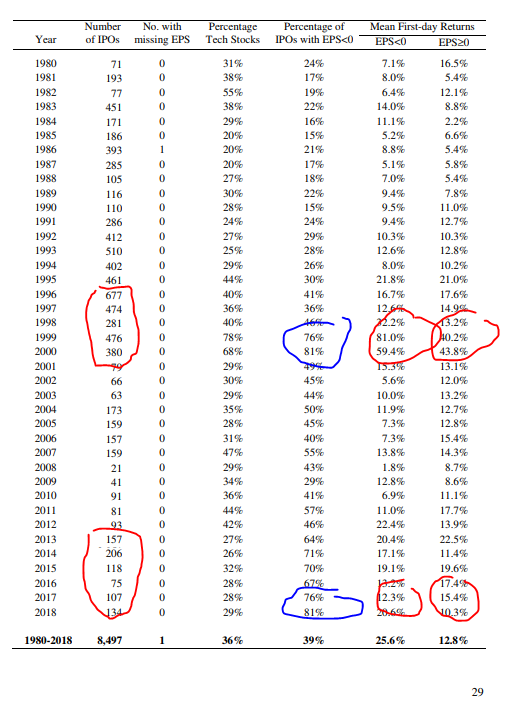
This paper on IPO stats is kind of interesting, I've attached an excerpt (page 29): https://site.warrington.ufl.edu/ritter/files/2019/01/IPOs2018Statistics_Dec.pdf The % of companies IPOing with negative earnings in 2018 is definitely at a high of 81%. However, the euphoria is nowhere near 1999 in terms of the number of IPOs and the first day stock price increase.
-
Negative interest rates take investors into surreal territory
mcliu replied to Viking's topic in General Discussion
Yes, it seems kind of crazy in Germany to not do some infrastructure investments (housing, rail etc), because in a lot of cities, the supply hasn’t kept up with demand. Fast rising housing is not popular in Germany because the percentage of homeowners is much lower than in US. Germany had a budget surplus, record low interest rates and demand that can’t be met. I instead of bitching over the negative effect of the immigration , there should be much more focus on making use of it and do what needs to be done. Seem like a no brained to build housing for a million people in cities with job growth, rail infrastructure to meet increased demand and get some of new inhabitants to work at He same time, instead of playing financial stimulus that doesn’t seem to do much. But then again, I am not an economist. Yes exactly! It just seems so obvious.. All this money printing hasn't driven real productivity or real economic activity. It's just sloshing around the financial system looking for returns and driving up prices. (Not sure why though.. Maybe extreme risk-aversion, uncertainty..?) It seems like an opportune time for governments to borrow big-time at negative rates and invest in long-term productivity projects.. -
Negative interest rates take investors into surreal territory
mcliu replied to Viking's topic in General Discussion
Don't necessarily disagree that some infrastructure spending would be beneficial, but i don't think we should hold out hope that fiscal policy will stoke growth. There's something called the monetary offset in economics, which basically states that any increased spending on the fiscal side will be cancelled out if the monetary policy target is credible. I like to think in extremes for though experiments: If we started running a 10% fiscal deficit, but had a 2% inflation target many would worry about upcoming inflation because of large deficits. But the monetary authorities (in theory) could refuse to finance that deficit and stick with the 2% inflation target. Default, etc may happen but if a central banks wants to, it can always overwhelm fiscal policy. This is obviously a bit theoretical and in reality, politics comes into play. But imo, the more likely real world example is that we don't default but go more the japan route where, despite a huge amount of debt, their low inflation target overwhelms any fiscal deficit/debt they've had. Would also note that if we want to stoke growth, imo monetary policy is less wasteful that fiscal policy (fiscal policy risks spending money on things that aren't needed) whereas monetary policy is more evenly distributed and less wasteful The growth isn't necessarily from the spending itself but from the productivity gains that better infrastructure will provide over the long-term. It's clear that the private sector is more efficient than the government, but there are certain spending and projects that necessarily need government intervention/support. In addition, markets don't always allocate resources that efficiently either.. The massive housing bubble and excessive investments in real estate is a recent example.. On monetary policy, wouldn't the implementation and transmission may also impact inflation and expectations? Is quantitative easing (buying bonds) the most effective way of printing money vs writing a cheque to everyone vs adding a 0 to everyone's bank accounts? -
Negative interest rates take investors into surreal territory
mcliu replied to Viking's topic in General Discussion
This feels like a missed opportunity for massive infrastructure investment like what China did since 2008 by building a national high speed railway system. Isn't it interesting that governments aren't using fiscal policy but instead focused on monetary stimulus? Clearly, at this point, monetary policy has had limited effect on driving inflation and wages higher, but may be creating risks in asset price inflation. It just seems like a big investment in infrastructure (high speed rail, internet/fibre/5g, airports) is quite obvious ad it will tighten labour markets, drive wages, increase inflation and interest rates and drive long-term productivity. And the market is basically saying, it'll finance it for next to nothing.. 0 high speed rail in the US vs 428km of high-speed rail in China in 2007 to 29,000km in 2017 5 of the 6 top airports in the world are in Asia.. Fastest internet: Taiwan, Singapore, Denmark, Sweden, Japan.. -
Negative interest rates take investors into surreal territory
mcliu replied to Viking's topic in General Discussion
What a crazy situation.. Doesn't the entire financial system just feel like a ponzi scheme? Central banks seem to be trapped into a position where they need to consistently lower interest rates (in-order to stimulate asset prices) so people feel wealthier (and will keep spending). At this point, is fundamental analysis even relevant? It almost makes sense to keep buying homes/stocks/bonds/assets at ever higher prices because the system cannot tolerate a drop in prices (which will inevitably lead to a "politically unacceptable" recession/depression..) Also, another perspective: Are the elevated home prices a reflection of growing value for homes (as derived from higher incomes, population, etc.)? or are they a reflection of the declining value (debasement) of the currency? Maybe in this modern financial system (and an age of abundance), rapid/hyper inflation is reflected not in the prices of consumer products, but in the prices of financial assets? No idea. Just thinking out loud.