mcliu
-
Posts
1,313 -
Joined
-
Last visited
-
Days Won
2
Content Type
Profiles
Forums
Events
Everything posted by mcliu
-
The one thing I've been struggling with is which factors will drive mortgage rates higher? Rates have kept going lower for the past 30 years. http://www.tradingeconomics.com/canada/interest-rate If housing and the economy slows down, rates will likely be even lower than today.. With negative rates a possibility, BoC can always pay lenders to lend.. Most government would rather see much higher asset prices, lower interest rates (lower C$), and lower unemployment than lower asset prices, higher interest rates (higher C$) and higher unemployment. So given the bias of BoC toward lowering rates, will rates ever "normalize"? Is there even a normal?
-
I've been collecting some data on Toronto and Vancouver housing. May be interesting: http://www.liucapital.com/p/canadian-housing.html It's surprisingly hard to get historical real estate data. Do you guys have any good sources?
-
Cash flows don't matter when you're getting double-digit tax-free capital gains each year.. I can just imagine the realtor pitch: "Why settle for 1% taxed income in your savings account, when you can get 10% annual unlevered gains in Vancouver real estate tax-free? Sure win! Prices have only gone up for the past 3 decades!"
-
I had to comment on this - in every bubble because the timing is unknown those who warn of the bust look stupid because the timing is unknowable. Speculators get more and more confident as the price signal confirms their hypothesis. In reality the price has absolutely nothing to do with value. Many thought Buffett was on old fool in the 1999/2000 internet bubble because he avoided tech. If you are going nuts because it has been 15 yrs - hang in there. Ireland was the same until it blew to smitherines. And the crash will likely be much more rapid and harsh. I am still doing research but Canada seems like a classic real estate bubble with low cap rates in many places. Key question- what are the rough owner cap rates of your city? I define owner cap rate as rent minus all expenses a tenant would not pay (real estate tax, insurance, etc excluding broker commission to rent the place out) in the numerator and in the denominator the unlevered home price. I am trying to get a sense of the unlevered return an owner is making by buying a home excluding appreciation depreciation. San Diego was ~2% at the peak in 2006 for an average apartment. Totally insane. Now we have centuries low interest rates and people think that is normal. I asked the same thing a few pages back. wisdom said it's 2% to 3% in Vancouver. http://www.cornerofberkshireandfairfax.ca/forum/general-discussion/garth-turner-greaterfool/msg258551/#msg258551 http://www.cornerofberkshireandfairfax.ca/forum/general-discussion/garth-turner-greaterfool/msg258558/#msg258558
-
Do you have the population figures for the same periods? I'd be interested to compare. For Toronto, it would also be interesting to look at the larger GTA's area, since at some point toronto proper just runs into the suburbs and these are the ones that grow. Interesting question. I went ahead and ran the numbers. Pop growth 1991 to 2001: Vancouver: 24% (+384,375ppl) ~2,400/sq.km. GTA: 19% (+884,673ppl) ~2,400/sq.km. Pop growth 2001 to 2011: Vancouver: 16.4% (+323,363ppl) ~9,200/sq.km. Toronto: 18% (+1,002,046ppl) ~9,800/sq.km. https://www1.toronto.ca/city_of_toronto/social_development_finance__administration/files/pdf/2011-census-backgrounder.pdf https://en.wikipedia.org/wiki/Demographics_of_Vancouver Maybe another interesting study would be to do this exercise for all the cities, and then also compare the housing prices vs. density across these periods.
-
It's not. It's a very small sample of the high end market. "Routledge compiled the data by extrapolating from a Financial Times survey of 77 high-end buyers and data from the U.S. National Association of Realtors."
-
The Mistakes Made in Value Investing By The BigWigs and Ourselves
mcliu replied to AzCactus's topic in General Discussion
I invested in Valeant after the Philidor scandal and my big take away is to do your own research and not blindly copy other investors, no matter how good of a track record they have. -
I struggled with that, unfortunately, there's no good instrument to short housing. It's hard to figure out the magnitude/timing and carrying costs for the trade is high. Nothing with attractive risk/reward trades like CDS. Some possibilities but nothing really worthwhile: 1) Short mortgage insurance (Genworth MI), but carrying cost is high. 2) Short mortgage investment company. Only good candidate is ERM (Eclipse MIC, second tranche of first mortgage + uninsured mortgages), but liquidity is low, sub $30 million market cap, and also high carrying cost. 3) Short banks, but banks carry low LTV or insured mortgages. Maybe the only option is to long government bonds, since a housing crisis will likely lead to big rate cuts. However, the bubble is centered around 2 cities, and US rates are rising. If you live in these cities, maybe you can sell your house, or rent. Become a builder, but there's liquidity risks there if you don't complete in time. Would love to hear if you guys have any ideas. Do you know what kind of financing they're getting and from where? Also, there's the fact that the amount of mortgage/consumer debt that's been added in the past 7 years in Canada/Australia is much larger than the possible capital outflow that China can inject into the foreign real estate..
-
Is it that benign though? The same metric for the US was around 17% in 2006/2007. The ratio subsequently spiked in 2008 and 2009 as asset prices came tumbling down.. http://3.bp.blogspot.com/-geOLT7b-_7w/VQiPDlkVIAI/AAAAAAAAS78/Wii0qaRArl0/s1600/Household%2Bleverage.jpg Look at the charts and reports that I've attached in this post: http://www.cornerofberkshireandfairfax.ca/forum/general-discussion/garth-turner-greaterfool/msg258546/#msg258546 1) Over 20% of BC households had a household debt to income ratio of over 500% in 2012. Imagine what it is today given that the Household Debt to Income metric has climbed ~20% since 2012 for the country overall. 2) RBC's affordability report shows that ownership costs for a SFD home in Vancouver is over 100% of median household income. How is that not worrying? :o
-
Except, it's not just Chinese people buying up the million-plus dollar SFD homes/condos in Vancouver/Toronto/Adelaide/Melbourne. The global housing market is too big. Ex. The Chinese buying those homes are probably worth at least 100 million RMB or C$20 million. There's less 100,000 people in that bracket in China. There are only around 1 million US$ millionaires in China. That's only 3% of Canada's population. You can't just make up these numbers.. http://www.hurun.net/EN/ArticleShow.aspx?nid=4558 Hurun 2014: "The country has 1,090,000 millionaires and 67,000 super-rich, an increase of 3.8% and 3.7% respectively from last year." "millionaires (defined as individuals with personal wealth of CNY 10 million, equivalent to US$1.6 million and GBP 1 million)" "super-rich (defined as individuals with personal wealth of CNY 100 million, equivalent to US$16 million and GBP 10 million)" The US by far has the most millionaires. Canada has around the same number of dollar millionaires as China. The myth that there are millions of extremely wealthy Chinese investors looking to buy global real estate is just not accurate.. http://www.cnbc.com/2015/10/13/countries-with-the-most-millionaires.html
-
That's fair and indeed in general it has been true but what about the times when it hasn't been true? I mean, at what point does a good investment turn bad? For an extreme example, if prices hit $100 million for a house in Vancouver while population and incomes grow at 2%, does that signal a bubble or should we continue to justify prices? $100 million is extreme but going down from there, there is still a point where you can safely declare that prices have far surpassed fundamentals. Maybe it's there already, maybe it'll take another 2x, 3x, 10x gain to convince people. (Although I guess, counterintuively, the higher prices go, the less people will be convinced that there is a bubble.) Based on the data that I've seen, the situation is pretty clear... “You don’t have to know a man’s exact weight to know that he’s fat.” – Ben Graham
-
Population growth alone can't explain the increase in prices because the number of houses is also increasing. Housing stock actually increased by 9.8% over the same period. Note that housing prices increased 39% from 2006 to 2011. (It could be the case that there's a severe shortage of homes in 2006. Inventory was indeed at an all time low in 2006. However, inventory increased from 650 units in 2006 to 3,500 units in 2011. So in that period they've added more housing stock than the market absorbed. CMHC Data Portal) "The 2011 Census shows the number of occupied dwellings to be 891,340. The 2011 Census figure of 891,340 occupied private dwellings is an increase of 74,300 dwellings units over the 2006 Census. The region’s private housing stock grew by 9.8% since the 2006 Census, higher than the 8.4% (58,320 units) during the preceding five years (2001‐2006)." http://www.metrovancouver.org/services/regional-planning/PlanningPublications/MV_Housing_Data_Book.pdf#search="housing%20book" So didn't HK have a real estate crash before? Didn't Londo , Paris , New York , etc do too? But why do they continue to be the most expensive places on the planet? +1 Speculation is real, but fundamentals are also real. We'll all learn more and analyze better if we are open-minded about all the possibilities. Which fundamentals metrics do you think are relevant? Usually people look at Price-to-Income and Rental Yields.. I don't think I've see any P/CF based valuation metrics which shows Vancouver undervalued. The only metrics that show Vancouver being under valued would be something like a comparable on a $/sq.ft. basis against New York/London/Shanghai/Hong Kong, etc..
-
Interesting. The fact that anecdotes like that exist seems to points to a frothy market. I mean in how many other cities can you flip a house in a day for a 10% gain?
-
Thanks wisdom. Would the yield be before or after CAM/opex, taxes, maintenance capex?
-
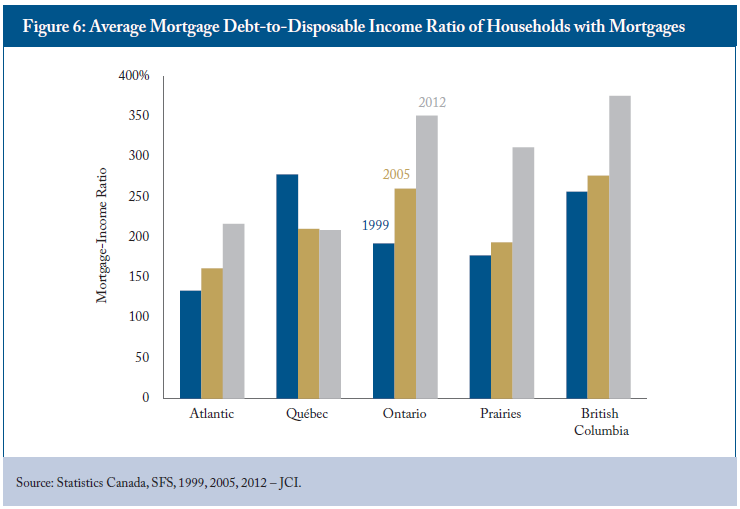
I attached the "Mortgaged to the Hilt" report that was mentioned in the Fairfax annual letter. Some of the findings are downright scary. ex. Household Debt to Disposable Income has risen from 200% in 1999 to over 350% in 2012 for Ontario. The percentage of households with Debt-to-Income >500% has risen from ~2.5% to ~12.5% in Ontario and ~7.5% to >20% in BC over the same period. Interestingly, while total debt has gone up significantly, RBC's affordability report suggests that ownership costs have not risen as a result of lower interest payments. I wonder how much further this can continue, I mean at some point, you have to wonder whether households can afford to repay the principal amounts. On the bright side, if housing does ever wobble and consumers face a balance sheet recession, BoC can always keep cutting rates now that there's no zero bound. ;D 0% mortgages anyone? Also, does anyone here actually invest in Vancouver/Toronto residential real estate and have some data on unlevered/levered rental yields? february_2015_rbc_housing_affordability_report.pdf Mortgaged_to_the_Hilt.pdf

-
I wonder about that too. It just seems like the housing market is too big for foreign capital to have such a big impact. Too bad there's no data on this. I was looking at this BBC article on Australian housing: "Last year Chinese buyers spent a record A$12bn on Australian property, boosting house prices at a time when locals were already feeling anxious about the rocketing cost of property." http://www.bbc.com/news/world-australia-35601102 Not sure if that's accurate, but if it is, then it's tiny compared to Australia's outstanding housing-related debt of $1.5 trillion. The growth in housing credit (7.6%) last year or $108 billion is significantly higher than the $12 billion of Chinese buyers. http://www.rba.gov.au/statistics/tables/xls/d02hist.xls?v=2016-03-09-11-13-12
-
I guess another question is: at what prices would make you believe that a bubble has formed? Would it considered a bubble if median prices were $3 million, $5 million, $10 million or is there no limit? Are there some similarities between what's happening in Toronto/Vancouver and Sydney/Auckland/Melbourne. (Would they be considered global cities too?) It seems like Australian prices were fuelled by a combination of foreign demand and lax lending. Thoughts? http://www.bloomberg.com/news/articles/2016-02-22/one-sign-australia-s-housing-market-is-due-for-a-2008-moment What about major cities like Chicago, Houston, why aren't they experiencing such elevated home prices. Apparently, prices in Milton, Ontario(?) Increased by 42% yoy.. Is that even part of the GTA? http://www.theglobeandmail.com/report-on-business/economy/housing/the-real-estate-beat/torontos-hot-housing-market-drives-big-bidding-wars-in-suburbs/article29053048/&ved=0ahUKEwihx4K8s7HLAhWHhywKHTKZA-oQqQIIGigAMAA&usg=AFQjCNHWv6ncMw0Mqn5oVkISEeBae2NXuQ&sig2=ajPFoh6gjTEmrtEBapiJpQ
-
At least one of your assumptions is incorrect. http://www.thestar.com/business/real_estate/2015/10/24/the-rise-of-willowdale-torontos-hottest-new-neighbourhood.html "Land values alone have escalated so dramatically the last couple of years in this area just east of the North York Civic Centre that Jalali says banks are appraising most original homes at 97 per cent land value." Is there some sort of land constraint or zoning regulation in the GTA area? When I look at Google Maps, there's so much land.. :o The article you pointed out seems to be land that's pre-built. What about values for land for new construction? It just seems like, out of all the countries in the world, Canada should be the last one having a shortage of land problem. Also, is there a big pricing discrepancy between residential land and farmland? Is it hard to get farmland re-zoned to residential? Just trying to understand the market here. At these million+ prices, it still seems very profitable to buy a couple of acres of land, convert it to residential, built a stack of homes.. Are there any publicly-traded Canadian home builders? Would be nice to look at the financials..
-
With homes trading so far above replacement value, why aren't there people building homes like crazy in Toronto and Vancouver? The margins must be huge. And it's not like there's a shortage of land..
-
Do you have to be a permanent residence to buy a house?
-
What was his performance? Was it that dire? Market really isn't off by that much from its highs.. ???
-
What do you think is true, that most everyone believe the opposite?
mcliu replied to LongHaul's topic in General Discussion
Don't forget Vancouver Real Estate. Everyone thinks Vancouver RE is not a bubble since it's land constrained and there will always be demand from Chinese buyers. ::) -
Happy holidays!!
-
You would add the minority interest to your equity to get EV and compare multiples based on that EV.
-
Unicorns everywhere: ::) http://www.ritholtz.com/blog/wp-content/uploads/2015/10/unicorn.png