MMM20
-
Posts
3,353 -
Joined
-
Last visited
-
Days Won
14
Content Type
Profiles
Forums
Events
Everything posted by MMM20
-
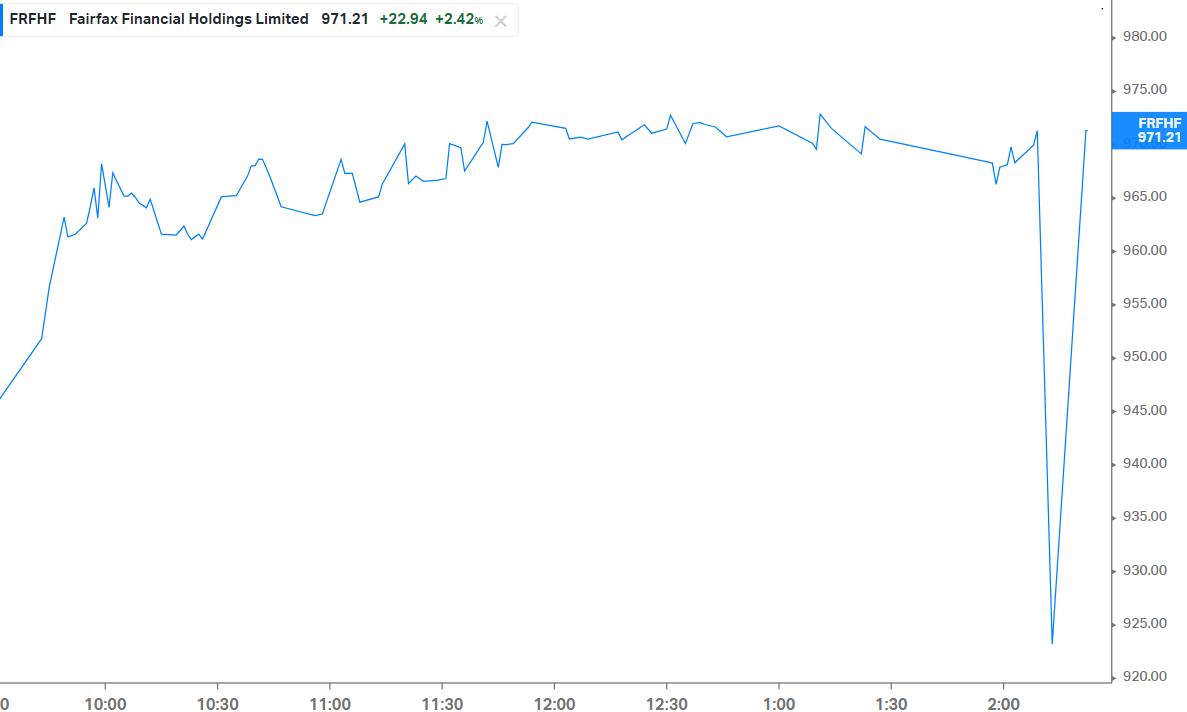
Weird. From Koyfin.
-
So who just got the bargain of the day?

-
many will scoff at 2.5-3x P/B but that roughly equates to intrinsic value IMHO
-
So... is this enough to extend the hard market another couple years? https://www.wsj.com/articles/u-s-saw-record-breaking-thunderstorm-damage-in-2023-e42fa775 Thunderstorms in 2023 caused $76 billion in losses in North America and Europe, a record for such weather events, which have in recent years begun to rival hurricanes in terms of the damage they collectively mete out to businesses and homes. The weather events, formally known as severe convective storms, in North America destroyed assets valued at $66 billion, according to an analysis of the year’s natural catastrophes released Tuesday by reinsurer Munich Re. About $50 billion of that was insured. In the U.S., two thunderstorm series—a Midwest storm in March and a Texas storm in June—together caused $17 billion in losses, contributing to the highest level of total thunderstorm losses the country has seen, Munich Re said. Though insurers classify thunderstorms as “secondary perils,” behind primary perils such as hurricanes and earthquakes, their volume in 2023 led to cumulative losses that outstripped those caused by a season of hurricanes. Beyond rain and thunder, severe convective storms can spawn damaging phenomena such as hail, tornadoes and straight-line winds.
-
Tom Gayner has this figured out. Sounds like you want MKL.
-
I'm reluctant to wade in here b/c it probably won't be productive, but I can't help but point out that accounting book value still has almost nothing to do with intrinsic value (and therefore the wisdom or folly of various capital allocation decisions) for Fairfax and almost every other company nowadays. The fact that even smart investors still think this way is probably part of why Fairfax remains so cheap. Fairfax's recent transformation into a cash machine isn't really reflected in the historical accounts and that's *still* the whole opportunity in a nutshell. "Thank God we don't design bridges and airplanes the way we do accounting." -Munger
-
Would love to debate this point over at the BAT / PM threads
-
Maybe now Mr Market starts paying more attention to the structurally higher earnings power.
-
This is a better question for the MKL board FFH goes for it with some big positions, even if they're not everyone's cup of tea. I believe roughly a half dozen investments (across everything) add up to roughly half the NAV. The same is roughly true for BRK. I don't think it's anywhere close to that for MKL nowadays, but please correct me if I'm wrong. Also, I ask myself a similar question about short selling. Why bother with a few insignificant short positions if they're just another thing to track and never move the needle? I think the answer is it makes you better as a long investor to be able to adopt the mindset and framework of a short seller. The same is probably true of Fairfax with their big positions, even something like the GFC big short, the Digit investment, or maybe even the mid 2010s insurance acquisitions. Would they have pulled these things off if they simply indexed? Maybe not! So you take the good with the bad and focus on where it all nets out. And the result has been pretty damn good over a pretty damn long time period.
-
You can argue that earnings in the out years would be lower (I'm skeptical) but don't forget that the fair multiple of those earnings would be higher - holding ERP constant at least.
-
Just thinking though downside scenarios. Does anyone know if the KW vehicles are set up in such a way that, worst case, Fairfax can hold indefinitely? If I’m an insurance company I might want to just go team #neversell on some quality real estate anyway. Of course there are opportunity costs and let’s hope we don’t end up with real estate broadly cut in half but better not to be forced sellers in such a scenario.
-
In a downside case where cap rates double or whatever, can't KW/Fairfax foreclose and just hold the properties?
-
Does anyone here have a view on whether this should matter much to Fairfax investors? https://lindynewsletter.beehiiv.com/p/borders-lindy The Canada Experiment In a bold and unprecedented move, Canada is embarking on an audacious experiment, opening its doors to millions of high-skilled immigrants in a bid to outpace the economic might of its southern neighbor, America. This strategy is anchored in the belief that an infusion of skilled talent can catalyze innovation, boost productivity, and propel Canada to new economic heights, potentially surpassing the United States in wealth and technological advancement. In 2023, Canada is on track to welcome nearly 500,000 new permanent residents, marking a significant increase from previous years and surpassing its annual target. The plan is to keep this going, adding millions every 2 years and turning Canada into a 20-40 percent high-skilled immigrant country. However, this gamble carries with it the risk of significant societal upheaval. If the policy fails to integrate these new immigrants smoothly, or if it inadvertently exacerbates economic disparities and cultural tensions, Canada could find itself grappling with deep internal divisions. In the worst-case scenario, such tensions could escalate into widespread civil unrest or states seceding from the union like Quebec or Alberta. What if it’s successful? In a successful scenario of Canada's immigration strategy, the country actively transforms into an economic superpower, surpassing even the United States. By welcoming millions of high-skilled immigrants, Canada ignites an innovation and productivity renaissance. Cities like Toronto, Vancouver, and Montreal rapidly develop into global tech hubs, challenging Silicon Valley's dominance. Canadian companies, driven by a diverse and talented workforce, lead groundbreaking advancements in fields like AI, renewable energy, and biotechnology, attracting worldwide investments. This is a high stakes gamble. If Canada’s plan works. If you can just import high-skilled immigrants and create an economic superpower, than America may copy it. A lot of people want to move to America. Billions. We are all waiting and watching the Canadian experiment.
-
Ring true for you too @Viking? “The best ideas are usually the ones most people find unappealing, even if the investment thesis is articulated well. This is why you may have found it frustrating to share your best ideas, even if - or maybe *especially* if - those ideas went on to be big winners.” -John Mihaljevic
-
-
Are global scale economies not a moat in the insurance business? I think we’ve increasingly seen that in Fairfax’s results. And could a deep pocketed investor replicate Fairfax’s footprint and well managed operation today? How much capital and how many years and missteps would that take? I think that’s real now. Also, what are the best private businesses in Canada? Would those owners see Prem as someone who would take good care of their babies and so consider selling to FFH at lower prices than some random private equity firms? If not, well, that seems like a missed opportunity. I think of that as the secret sauce for BRK, a reputation well and hard earned over many decades of doing what they say as permanent owners. So to the degree Fairfax is moving in that direction, they are gradually widening the moat and incremental returns should remain high (if volatile/chunky) for a long time.
-
Has anyone here made a big investment that didn’t work out? And have you still made good returns on your overall portfolio? I’ll be the first to raise my hand. I’ve owned an EM value fund for the last ~15 years and still compounded at mid-high teens. Do I get no credit for the overall result because I got one big decision wrong? For that matter I also missed the easy money in big tech. Should that define me as an investor? This is what I think about whenever anyone writes more than one sentence about BB nowadays. I get the baggage and it’s painful to think about the opportunity cost of owning Brazilian crap for the last ~15 years too. But doesn’t that clearly miss the forest for one single tree? It is almost like writing a 10 page report about how Berkshire is uninvestable because of Precision Castparts or, like, Snowflake, I don’t know. I’m sure there’s a better comparison, but why not focus on Fairfax’s insurance acquisitions that were brilliantly timed in retrospect, or any of the investments that actually move the needle for Fairfax today? I’m not sure I’ve seen a bigger disconnect between spilled ink and what actually matters to a company now and looking forward. It is a bit exasperating.
-
Yeah it doesn't make sense to me either, but I always have these sorts of tensions with these "someone else's fund" sort of investments. I want them doing things that I wouldn't do myself, eg Fairfax with Digit, Berkshire with Apple, Exor with Ferrari/Stellantis, and all technology/biotech venture capital for that matter. I guess the question is just whether there is an ethical issue - if the critics have a valid point that they're taking advantage the public with overhyped expensive IPOs and/or minority shareholders with take privates at obviously depressed pricing. Why not just inject capital and take the public for the ride to redemption and burnish your reputation that way? Maybe because it's just too expensive to be a tiny public company nowadays? There is no way I would even take a look at Farmers Edge personally... but that's part of why I own Fairfax. I just want to know I'm going to be treated fairly as a partner and that they aren't bailing out their friends. So if nothing else, maybe this sort of thing just puts a lid on multiple expansion?
-
I don’t get it either, but we are talking about one day of cash flow for this.
-
~15% ish should be sustainable for a pretty long time if we're in a more normal interest rate environment... really for as long as small and mid cap equities can move the needle. The issue for Buffett now is that a $5B home run investment in the Japanese trading companies adds what, like 100-200 bps to BRK intrinsic value? Things like that are barely worth his time so he goes elephant hunting in mega caps, right? By contrast, Eurobank and Digit could each add 1000-2000+ bps to FFH IVPS over a few years if things cut a certain way.
-
The bad news... https://inc42.com/buzz/ipo-bound-go-digit-gets-show-cause-notice-multiple-advisories-from-insurance-regulator/ IPO Bound Go Digit Gets Show Cause Notice, Multiple Advisories From Insurance Regulator 14 Nov'23 Insurtech major Go Digit General Insurance, which is gearing up for its initial public offering (IPO), has received a show cause notice and multiple advisories from the Insurance Regulatory and Development Authority of India (IRDAI) last month, the company said in a new addendum to its draft prospectus filed with the Securities And Exchange Board of India (SEBI). The development comes at a time when the company’s IPO is yet to receive final approval from the SEBI even after Go Digit refiled its draft red herring prospectus (DRHP) addressing certain concerns that the market regulator had raised earlier. Go Digit revealed that the show cause notice from IRDAI has alleged non-disclosure of change in the conversion ratio of the CCPS issued by Go Digit Infoworks Services (GDISPL), the parent of Go Digit General Insurance, to FAL Corporation. FAL Corporation is a part of Canada-based Fairfax Financial Holdings, which is one of the major investors in Go Digit. “In terms of the Notice, the change in the conversion ratio of 6,300,000 CCPS issued by GDISPL to FAL Corporation, from ‘1 CCPS for 2.324 equity shares’ to ‘2.324 CCPS for each equity share’, which was reflected by way of an amendment to the JV Agreement dated August 11, 2022, is a material change to the information furnished at the time of applying for registration to the IRDAI,” the company’s regulatory disclosure to SEBI said. As per the notice, Go Digit was expected to provide the details of such change to the IRDAI but it did not furnish the “full particulars”. Hence, IRDAI has also alleged that the startup is in violation of Section 26 of the Insurance Act. If an adverse order is passed against Go Digit and its officers responsible for the non-compliance, the insurtech unicorn would be slapped with a maximum penalty of INR 1 Lakh for each day during which such failure continues, or INR 1 Cr, whichever is lower, the addendum mentioned. Besides, IRDAI has also issued certain advisories and cautioned Go Digit on a few aspects. The advisory notice has been issued for failing to take the insurance regulator’s approval for the change in remuneration of its Chief Executive Officer (CEO) on the account of the change in ESAR 2018 (employee stock appreciation rights scheme) to ESOP 2018 (employee stock option plans) and for failing to inform IRDAI of the retrospective grant of ESARs prior to the date of grant of the company’s certificate of registration. “In the event the IRDAI is not satisfied with our responses or we fail to adhere to the advisories and cautions issued by the IRDAI, we may be subject to warnings, show-cause notices and/ or penalties in the future, which would, amongst other things, adversely impact our brand and reputation,” Go Digit said in its regulatory disclosure to SEBI. Meanwhile, the IRDAI has also cautioned the startup to ensure due care and correct disclosures in the offer documents, of the position in relation to the commission on long-term policies and that acquisition costs incurred in the year, among several other advisories issued. It is pertinent to note that Go Digit filed its DRHP with the SEBI in August last year. Within months, it also received the IRDAI’s approval to launch the IPO in November last year though SEBI had kept the IPO in ‘abeyance’. In March this year, the startup refiled the DRHP with the market regulator for its $440 Mn, addressing the latter’s concerns about its ESOPs. In the latest filing, Go Digit said its erstwhile Go Digit – Employee Stock Appreciation Rights Plan, 2018 has been amended and changed to ESOP 2018, pursuant to the resolutions passed by the board and shareholders on March 21, 2023 and March 27, 2023, respectively. Founded in 2017 by Kamesh Goyal, Go Digit offers insurance policies across verticals including motor vehicle, health, travel, and property. Besides Prem Watsa’s Fairfax, the startup is also backed by prominent names such as Sequoia, cricketer Virat Kohli, and actor Anushka Sharma. Go Digit’s IPO comprises a fresh issue of shares worth INR 1,250 Cr and an offer for sale (OFS) of 109.45 Mn shares.
-
The good news... https://www.apnnews.com/digit-insurance-wins-digital-insurer-of-the-year-award-at-asia-insurance-industry-awards-2023/ Digit Insurance wins Digital Insurer of the Year Award at Asia Insurance Industry Awards 2023 Published on November 14, 2023 Bengaluru: Go Digit General Insurance Limited, one of India’s leading digital full stack insurance companies, announced it has won the “Digital Insurer of the Year” Award at the prestigious 27th Asia Insurance Industry Awards 2023 held in Singapore. This is Digit’s fourth AIIA award in the last five years. The Asia Insurance Industry Awards, 2023 stated that “Digit’s technological innovations have enabled it to achieve efficient underwriting, which is its differentiator from other insurer.” Digit’s hybrid model of AI-enabled analytics and human assessment along with its partnership-based model has helped the company mitigate India’s geographic limitations. Hong Kong-based AIA Group and FWD Group were the other two finalists for the Digital Insurer of the Year category. Only two Indian companies won an award at this year’s edition. Digit Insurance is also the only Indian insurance company to have bagged the Digital Insurer of the Year award twice in the last five years. The company had bagged the General Insurance Company of the Year Award back-to-back in 2019 and 2020. Digit is also the only Indian company to be nominated this year for two organizational categories, the other being “Technology Initiative of the Year” award. Commenting on the win, Jasleen Kohli, MD & CEO, Digit Insurance, said, “We are extremely honoured and delighted to win the prestigious Asia Insurance Industry Award. Winning the ‘Digital Insurer of the Year’ is truly special as it is a testimony of our in-house tech capabilities that form the backbone of our company. Our advanced tech platform is surely one of our competitive strengths that has aided in our growth and helped us in delivering high quality customer experience.” The entries were judged by a panel of 26 expert judges from across the insurance industry and the winners were chosen from nearly 200 entries in 17 categories received from insurance companies all over Asia. The awards are well known for their stringent criteria and transparent selection process and is overseen by a panel of expert judges from across the insurance industry.
-
Maybe the goldilocks scenario is that but still with some big drawdowns so Prem can do a few more big auction buybacks. Buckle up?
-
Play around with the numbers yourself and decide what you think is fair, but this is one way to get to ~15%. Someone please tell me if I'm missing something stupid. Didn't sleep much last night. Investments ~$40B cash+fixed income @ ~5-6% yield ~$20B equities @ ~8-10% total return = ~$4-4.5B return on assets Financed in part by ~$30B float @ ~2-3% net margin (~97-98% combined) = negative $600-900mm ~$10B in debt+prefs @ 7-8% = ~$700-800mm = ~zero net financing cost minus opex and taxes ~$3-3.5B net income vs ~$20B equity = ~15%+ ROE Let's see if Prem follows through on his Teledyne inclinations and takes out enough stock over time to shrink book value to 0. If he does, I think some of our board members' heads might explode BTW even if we're looking at more like a ~10-12% ROE, that's enough for a ~15%+ per share return if they're using cash flow to buy back big chunks of stock at big discounts to IV (eg Dec '21).
-
Maybe the catalyst for FFH to rerate to ~1.4x book (low teens normalized earnings) is the marginal MKL shareholder (re)discovering FFH. As a noted MKL hater, nothing would please me more.