jfan
-
Posts
860 -
Joined
-
Last visited
-
Days Won
5
Content Type
Profiles
Forums
Events
Everything posted by jfan
-
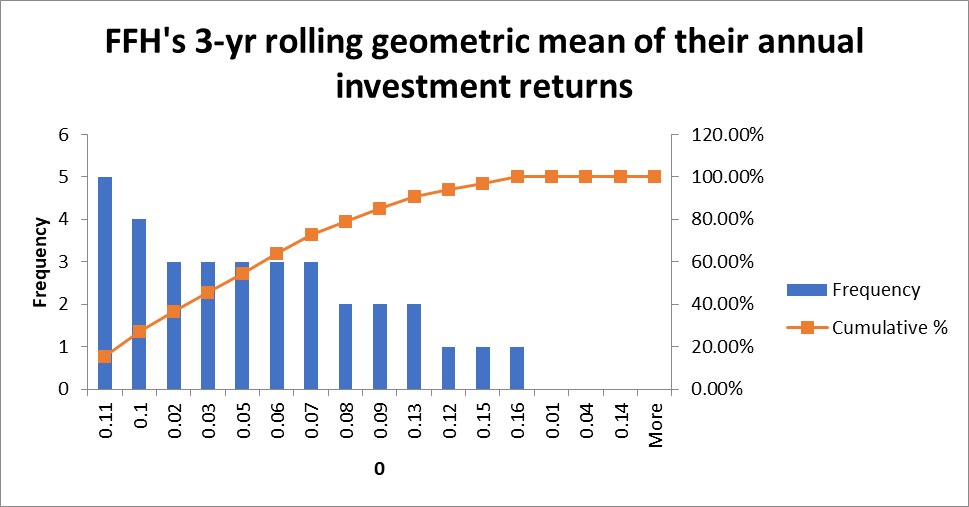
Thanks @Viking for sharing all your hard work. I take a slightly different approach to valuing FFH as long as the management team and their goals remain stable. Given that their investment returns are their primary driver to earnings power, I use an expected value framework by focusing on the following variables: 1) Investment $ available 2) median combined ratio of 97.3% (data from 2007 - present) 3) median corporate expense 4) current interest expense 5) % of earnings attributable to minority interest 6) current outstanding shares I build out a theoretical EPS for the range of all their geometric mean % investment returns and use their historical probabilities of occurrence to come to an expected EPS. Below is a graph of their return frequencies. From this I get a point estimate of their EPS of $95 USD/share. Just another approach which seems to triangulate with @Viking's more detailed breakdown. Thought this would be interesting to share.

-
Agreed. Electrical costs are likely higher. Which means the floor price is higher as well. At $0.12/kwh, you are looking at $18-19k. https://advisor.visualcapitalist.com/global-energy-prices-by-country/ The link above has a good list of electrical costs per kWh across the globe. Fooling around with numbers, 3x 100 th/s rigs that cost about $1500 each, will get a positive return at $0.12/kWh with a floor price of $12-13k. This of course assuming no friction wrt to obtaining rigs, access to hosting space, getting them up and running, no maintenance costs, etc. Obviously, the Ponzi scheme/manipulated BTC price could push below this floor. But unlike proof of stake or altcoins, proof of work and mining economics suggest there is some fundamentals at work.
-
With the least efficient miner establishing the floor price...using the following assumptions 140 th/s rig costing $5750 usd new, lasting 4 years $0.079/kwh 1.2x yoy difficulty increase 10% discount rate Purchasing the miners with BTC, will yield 1.14 mined BTC for every 1 BTC spent. Or the discounted cost of mining 1 BTC is ~ $14.5k usd.
-
Thanks for this...very interesting. Apparently Saskatchewan also has non recourse mortgages as well. A friend chatted with a CFO at one of the Canadian banks and was told that pre pandemic, 5% of mortgages had 30 year amortization whereas now, this has reached 30%. With such banking concentration, and forced renewals every 5 years, the key economic indicator may actually be unemployment rates. The Canadian housing system/politics/banking has every incentive to keep people in their homes. Keeps everything and everybody solvent. The velocity of housing transactions may slow but as long as people can keep paying something, the price correction hopefully won't be precipitous. That said, the banks will have some degree of pain, and I'm not sure all of them have this scenario priced in yet.
-
The problem I see that prevents having a rational discussion on this topic are the following: 1) Entrenched worldviews that are biased towards one's own context and experience 2) The intense emotions this debate engenders and the unwillingness to try to steel man your own arguments 3) The lack of data presentation from good information sources (ie not headline media) 4) The challenge of agreeing on what we are debating (philosophy vs technology vs macroeconomics). The resolution of these matters will eventually occur but everyone has to wait. There are a few general themes that I see might be relevant: 1) This is an early? late start venture capital/technology bet that may have various possible use cases (store of value, medium of exchange, fixed issuance, decentralized currency, etc) (at least as it pertains to BTC). This is not something that traditional value investing along the lines of Graham, Buffett, Munger, and Watsa would do well in (if there is any value in the end). 2) What is value? (traditional DCF vs shared socio-cultural understanding [eg parent's love of their children, historical works of art and music]) 3) What is useful in one society is not useful in another (eg WeChat in China vs WeChat in North America, Farmland ownership in a country with a rule of law vs a country with a dictator) 4) Cryptocurrency does not need to replace all other traditional assets. Securitization of companies was an invention of man https://en.wikipedia.org/wiki/Joint-stock_company#Early_joint-stock_companies (Here is a wiki page on early securities of companies). One has to wonder what people said of this invention when it started up. ("This is crazy. Why do you want to own a piece of paper when you can use your money to buy a piece of farmland?") I built a little excel calculator after reading https://lemoncakesinvesting.substack.com/p/lessons-from-murray-stahl#footnote-12-45570065 I quite liked inverting Kelly's Criterion to look at the implied probabilities of Bitcoin's commonly touted use cases...1) Gold substitute 2) M2 money supply substitute vs A ZERO. Anyways, no one has to plant absolute flagpoles on one side or the other. It's probably more important to just remain curious and open to ideas. No one has to lay down any money here. There are opportunities everywhere and elsewhere for everyone. Just have to pick stuff you are interested in. ** I do own a little bit of US and Canadian Farmland too Kelly Criterion for BTC .xlsx
-
Ntdoy
-
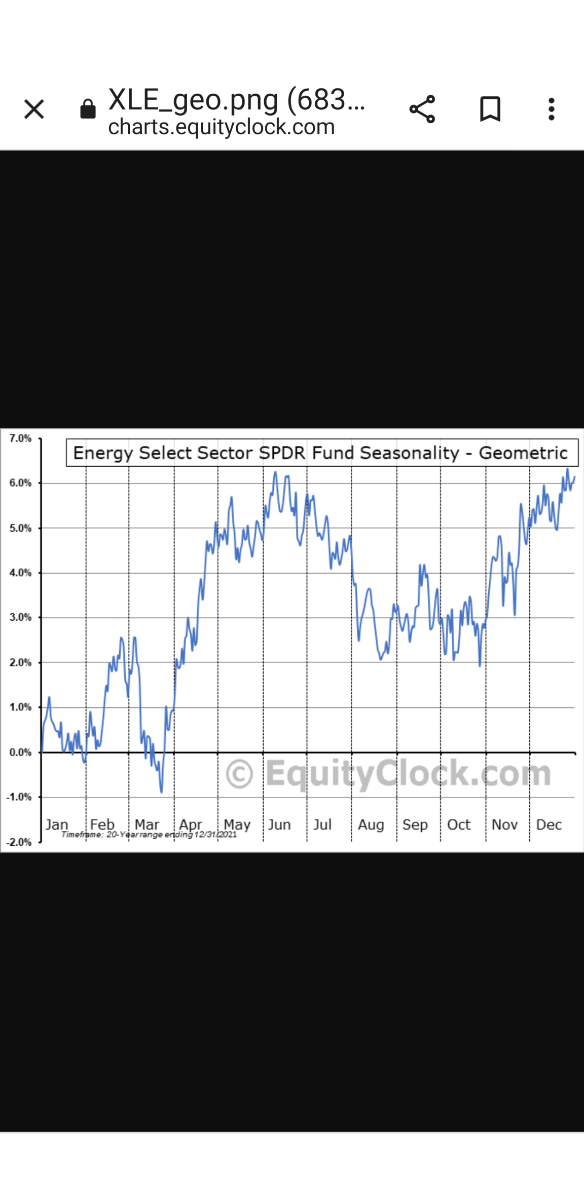
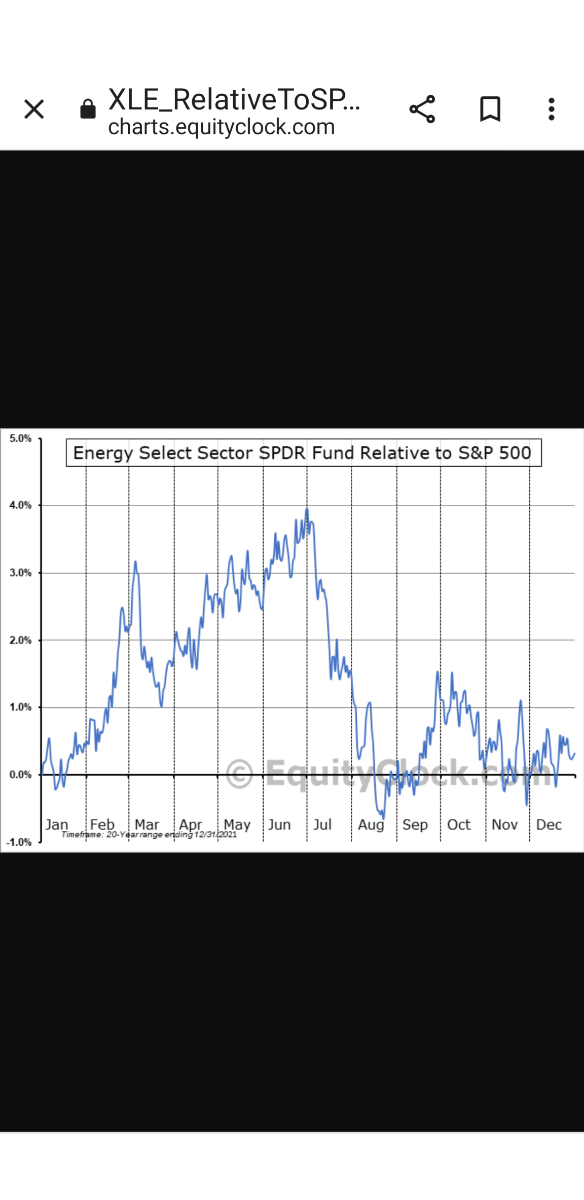
Perhaps there is also a bit of a seasonal effect in play as well.
-
Thank you @SharperDingaan. I respect your opinion greatly. In fact, your posts have been particularly insightful for me. Your ideas and @Gregmal have both shaped a fair amount of my understanding on this framework. You make an excellent point that forecasting is a dynamic process and requires updating , continuous learning, and reflection of past conclusions. Matching your time frame with the 1/2 life of the relevant inputs is key. I guess a reasonable analog is we know that keeping an ideal body mass is important to good health and longevity but knowing the day to day fluctuations in weight is less impactful unless you are planning to get into your wedding suit/dress. You also make a great point on advice and advisors. The key is to have your own independent thought. I am finally grasping the fact that to function adeptly in this world requires simultaneous skepticism and keeping an open mind to people and ideas, although can be sometimes in opposition, is an absolute necessity. Again, appreciate the feedback.
-
https://thequestionableinvestor.substack.com/p/thoughts-on-decision-making-position?sd=pf Wasn't sure where to put this post...its a little bit about my thoughts on position sizing, decision making, Meta, BTC, and Francis Chou. Welcome people's feedback. Thanks in advance.
-
For those interested in btc mining economics courtesy of horizon kinetics Mining-Economics-What-Drives-the-Bitcoin-Price_Sep-2022_Final.pdf
-
META, ICE and FNV The banking industry looks quite cheap with all this chatter about recession risk even if earnings decline. Am I missing something here?
-
thanks for this paper. I read this a while ago but got more out of it second, third time around
-
The one yellow flag for me with them is the discordance between they willingness to pay down their debt after an acquisition despite speaking about it publicly. The second yellow flag is it seems that there is a transition process occurring with Jeff out of the CEO role over the past year with him bring his top managers into the spotlight.
-
Daniel Kahneman, who many are familiar with. Pioneered the concept of System 1 and System 2, along with risk aversion bias, base rates, etc. Gerd Gigerenzer, is quoted less in general media, but a really big academic in the world of heuristics and decision-making in wicked environments. Gary Klein has done alot of qualitative research on naturalistic decision making by experts and intuition. He has also done work on guided learning via case scenarios. He also has a structured way of conducting pre-mortems in groups. Phil Tetlock and his superforecasting book. (Fermi method, starting with base rates, adjusting priors, successful group forecasting) Garrett Hardin's Filters against Folly is classic. Shane Parrish has a whole collection of writing on decision making, utility of journaling, and has a course on decision making. Alot of focus by the above is on the cognitive aspects of decision-making. Less is focused on the affective side. I haven't found alot of good sources but Scarcity by Sendhil Mullainathan and Eldar Shafir is really good on understanding how environmental and social stresses can affect cognitive bandwidth. Robert Cialdini's Pre-suasion book is also great as well. Hope this helps.
-
Sorry could be a bit clearer. Just trying to draw historical lessons from the demise of MySpace and to see if there are parallels with the Meta story.
-
I joined you in this toilet flushing moment. Not that I'm fantastic at pinpointing intrinsic value. But it seems to me the market has already priced in a digital ad market share decline from mid 20% to mid teens, and a terminal value PE multiple compression to 16 over the next decade. I just see WhatsApp monetization and Reality Labs as a free option at these market values. I guess the biggest risk is an exponential deterioration of social networks when people churn off to competitors. What were the reasons for MySpace's demise?
-
Has anyone used openbb.co?
-
@wonderingThanks for posting this video. I quite enjoyed it. Tope is very articulate and seems like an intelligent and shrewd operator. Africa does seem to have many opportunities and the paucity of institutional funds is definitely advantageous for Helios, being a first mover with permanent capital. It was insightful to learn that the opportunities like cellular towers are similar but different in an African context. Similarly, how bank profitability is very different due to the large mobile penetration but high # of unbanked individuals. I think it is very hard to say when Africa will attract institutional interest again. I think this microcap special situation/start-up will require a 10+ year investing time frame with very uncertain IRRs but the probability of a zero with Tope in charge is much reduced. PS - I am down a lot too
-
A couple quick primer resource on the history of the Vancouver Stock Exchange scam https://scamcouver.files.wordpress.com/2012/04/scam-capital.pdf https://www.vancouverpolicemuseum.ca/post/the-vancouver-stock-exchange-a-legacy-of-fraud-and-money-laundering-part-i https://www.vancouverpolicemuseum.ca/post/the-vancouver-stock-exchange-a-legacy-of-fraud-and-money-laundering-part-ii Reading this reminds me of the current crypto ICO headlines.
-
Thanks @Spekulatius. Will check out his resources. Wrt Blockchain, if you eliminate the central exchange, the regular trader would still need a communication interface with the ledger. I assume this would be the function of wallets in this case. My question is then, how do we trust the wallet provider to provide us the info that we needed and guarantee it's authenticity ( given that most of us have no coding skill). And how will these wallet providers have a profitable business model and goes will regulations affect them? I assume these wallets will not need some minimum amount of liquidity given that the Blockchain ledger is publicly transparent? And this statement is true, disrupts the centralized stock exchanges?
-
I'm looking to learn more about stock exchanges and their evolution. Does anybody have some recommendation, resources, blog links to build a foundation? Thanks
-
No, I didn't get that sense. He didn't come across judgmental. He tried to explain each country's rationale for making the moves they did. Reasons spanned from geopolitical ambitions, unresolved social conflicts, economic wealth creation, and energy security.
-
Highly recommend Daniel Yergin's recent book "The New Map". Too much material to summarize here but very comprehensive work on the nexus of geopolitics/security/economics with current and future forms of energy. He discusses the interplay between the 2 and how they shape each other. He gives me an impression of a balanced view of all sides. The big take home message is that oil is not going away yet (and unlikely to do so) and the transition will take many decades with lots of challenges. Interestingly, Canada only gets a passing mention about how the oil sands are competitive wrt to GHG emissions in North America and globally. Doesn't appear that Canada has much volatile geopolitics that shape the world or the oil/gas industry to write about. ** listened to the audiobook. Tried reading his book, The Prize, years ago, just too dense for my simpleton brain.
-
No
-
I understand that the methodology to calculate LCOE is highly tweekable and the outputs from various agencies can also vary. I came across EROI or EROEI as a concept as well for energy sources. It seems that depending on the organization publishing this data, the "value" of various energy sources can vary dramatically. Just wondering if anyone can give a primer on the difference between the two and what in your opinion is closer to the "truth"?