SafetyinNumbers
-
Posts
2,816 -
Joined
-
Last visited
-
Days Won
37
Content Type
Profiles
Forums
Events
Everything posted by SafetyinNumbers
-
its hard to say. Ultimately, share prices are just supply and demand so anything that might keep someone from selling or helping someone decide to buy is a good thing. I know after visiting with Hari and his team with a group of other investors at the airport almost a year ago I decided to buy more stock. I own 60% more FIH shares now than I did a year ago. The discount to intrinsic value has probably grown substantially even if book value hasn’t changed much.
-
Yeah, it was shared here on Dec 19. I guess you don’t think it’s a good idea?
-
Thanks for sharing. Is this an AI podcast?
-
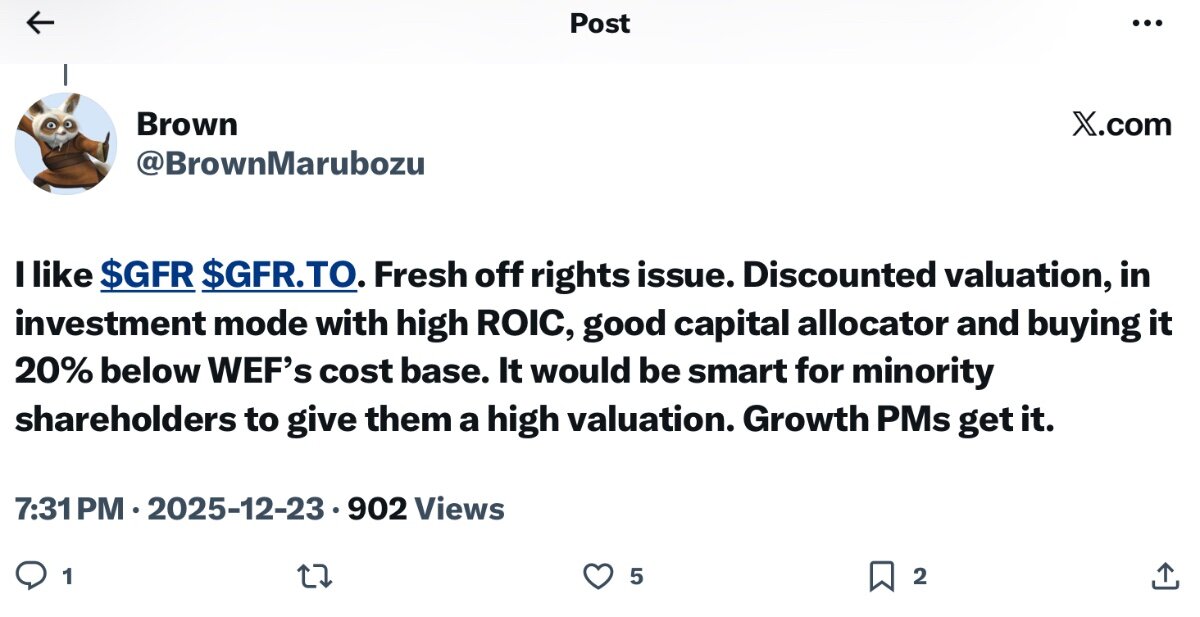
My pick is oils sands producer GFR.TO GFR.N. WEF III controls 71%, FFH owns 77.5% of WEF III. Their cost base is just over C$8. Buying the public shares allows minority investors to sidecar for free and at a ~20% discount. Fairfax India shareholders might appreciate riding on FFH’s dime for a change. The company completed a rights issue last week which has the effect of clearing out the weakest hands. The oil price is low and GFR trades at a big discount to peers including sister company SCR so any strength in oil prices is likely to lead to inflows. SCR also completed its C$2.1b dividend/distribution which is likely to hit accounts of shareholders next week (mine hit Christmas Eve after the close) who may also decide to pick up GFR shares. GFR’s entire float cap is C$350m. The company used the rights issue to pay off expensive debt with restrictive covenants. It’s going to outspend cash flow next year to grow production as 95% of its cost base is fixed. A production increase of 25%+ will have a dramatic increase in cash flow given the operating leverage. To me the best case scenario is that the shares quickly rerate and they use the paper to consolidate the region where a few private oil sands companies may be open to all stock deals. These deals will probably be accretive and increase the float enough to get into a few benchmarks which should further help with multiple expansion. Fairfax India could also have a great year if they are able to buy IDBI in a creative way and/or if they are able to IPO Anchorage, a holding company which owns part of BIAL.

-
I know a few investors that own FIH and no FFH and more vice versa. The reason why my FFH positions is 11x FIH is because I understand the mechanism by which it rerates which is in part due to being in benchmarks. It also has excess capital for buybacks if it’s not rerating and because the floor ROE is high. Marginal FIH holders treat it much more as a trading stock because there are no buyers if the discount shrinks whereas the FFH multiple is open ended. Maybe I’m too influenced by ELF. An important distinction between the ones you listed and FIH is that ELF is also listed on the TSX. I’m much more familiar with Canadian market structure than foreign markets given my professional experience investing and trading Canada. If an investor had high confidence in the Anchorage IPO timing, high confidence that the discount wouldn’t grow significantly and a small enough position to trade out on a big move, it probably makes sense to be long more FIH vs FFH for the catalyst.
-
Could just be my confirmation bias. I usually tend to think people that I share similar views to me are smart.
-
Alternatives to VOO to reduce Mag 7 exposure
SafetyinNumbers replied to DooDiligence's topic in General Discussion
The 100-1 stock split probably confuses the sites. The regular dividend is only $0.16 per year so less than a 1% dividend. -
Alternatives to VOO to reduce Mag 7 exposure
SafetyinNumbers replied to DooDiligence's topic in General Discussion
Have you considered ELF.TO? They own a bunch of VOO but also a bunch of other global and US quality stocks via closed end funds EVT.TO and UNC.TO. Trades at a ~30% discount to book and probably a ~40% discount to liquidation which offers some margin of safety. -
Agree. I think it’s an example of how easy it is to pass over FIH for bad reasons.
-
It’s a shorthand way to calculate the relationship between ROE and P/B taught to me by another investor. I think it builds in some margin of safety when the ROE is high and probably means paying fair value when the ROE is low. The actual relationship should be exponential especially with a low payout ratio as the retained capital is compounded at a higher rate.
-
Whatever floats your boat! Some investors use P/B to determine intrinsic value. I use P/B based on forward ROE / 7, 15x PE (above market ROE, fair market multiple) and book value + float (Buffett method) to triangulate mine. The recent article below has its own methodology. All end up in the same ballpark which is encouraging. https://seekingalpha.com/article/4855494-fairfax-financial-valueadded-acquisitions-and-disciplined-investments-are-yielding-rewards
-
An example from Twitter. Ian is a smart guy and owns LATAM airports but they all screen well. FIH doesn’t.
-
Great analysis as always Viking. It will be interesting to compare these returns to the accounting return. It’s part of what gives me high confidence in forward ROE over the next 5 years. These deferred gains may take years to realize in names like Eurobank meanwhile the accounting return on carrying value remains high enough that ROE gets a big boost at 3:1 leverage.
-
Most active managers also use quant screens.
-
Fixed income makes sense because presumably they are passing through the income. My point was that anything that looks like FIH trades at a discount like FIH. The discount to IV is even bigger because of how conservative they are with marks. Even the public positions trade at a discount in part because of how much FIH owns.
-
I think we just disagree about what market structure entails. These companies screen well and that’s what quants like.
-
Can you list them? I’m surprised that there are so many closed end funds that trade at premiums to listed NAV.
-
Hi Ashton, There is a thread set up to discuss the week by @NormR and a link to his website that lists all of the events. Thanks for coming to Toronto and hope I get the chance to meet you.
-
Go talk to OMERS. They have 20m shares.
-
I think the take under talk is nonsense because of the much worse capital treatment for the insurance companies. Also just because a take under is proposed doesn’t mean shareholders have to accept it. They usually do because they want to avoid a drawdown after experiencing a takeover premium.
-
If FIH consolidated all of its holdings it would likely trade at a different multiple. The holdcos with premium valuations are rollups and consolidate their holdings. They are eligible for ETFs and adored by quant funds. Again it comes back to market structure.
-
They did a reorganization and merged the operating company and holding company together which may have caused an issue. On a separate note, as soon as the reorganization was done, the buyback turned back on again.
-
I think the conclusion is incorrect. The market likes stocks that screen well and holdcos don’t. It’s a market structure issue.
-
I want the discount to close but I don’t want it to happen at the expense of making long term investments. I think they could have marked the portfolio up like Brookfield would and while that would mean a higher share price it would also have meant more fees. I have also seen with ELF.TO that, despite buying back half of the float, paying special dividends, increasing the regular dividend 30x and splitting the stock 100-1, it still trades at a 30%+ discount when they own the most liquid stocks in the world. Ultimately, I’m taking a longer term view and don’t subscribe to your view that they are nefarious actors.
-
So ultimately buying shares at higher prices. It’s a tough problem.