SafetyinNumbers
-
Posts
2,810 -
Joined
-
Last visited
-
Days Won
37
Content Type
Profiles
Forums
Events
Everything posted by SafetyinNumbers
-
I think they tend to stack reserves as much as possible period but especially after they do an acquisition. It’s interesting how the response from market participants is that they made another bad acquisition because the combined ratios jump after buying something as opposed to them choosing to increase reserves to defer income (and taxes).
-
I don’t think there is much benefit to get very granular on the subject. Float provides leverage that grows and provides a return if the combined ratio is below 100. I think if one can buy Fairfax at a big discount to book value + float that provides margin of safety. I’m not looking to sell if the discount closes unless my forecast for forward ROE goes below 10%.
-
Is this how you think about FIH? The intrinsic value isn’t there because it’s not reflected in book value? I’m trying to understand the empty shell reference. If they were creating less value than the fee, then I get it. I have been in some net nets like that.
-
Probably in a similar way. They via one of their subsidiaries are the GP of the funds that have LPs which would make the investment in the fund paying fees but I’m not a Brookfield expert. Onex does it similarly. They co-invest with their funds that have LPs.
-
A lot of investors avoid Fairfax India because of the management and performance fees paid to FFH. If you’re in that camp but also own FFH, do you think that it paying fees to WEF to own GFR and SCR or to KW, BDT etc… is a bad capital allocation decision?
-
If they were the GP?
-
Have they ever said that was a goal?
-
Why the confidence in another increase in the dividend? They were at $10 for over a decade. I would prefer no increase as it means faster growth in BVPS.
-
I think this is more likely to be a GP/LP structure with FIH as the GP and FFH w/ other PE type players (pensions etc…) as LPs. FIH could contribute its stake in CSB and some cash. I don’t think Anchorage IPO proceeds will go to FIH but stay inside Anchorage for other investments (more airports?). It would be pretty interesting if the fees from IDBI offset most of the FIH fees to FFH as that’s a big part of the bear case.
-
This implies it’s worth more than its dollar value as an asset because float with a quality insurance business attached is always growing. A growing revolving liability that in theory (and practice) may never have to be paid back is better than the asset itself. The risk is mitigated by the culture. Framed another way given the history of reserve redundancy, arguably over the fullness of time float will eventually become equity albeit after taxes.
-
Framing the float as an asset for a well run insurance business like Fairfax has was discussed by Buffett in the 1996 AGM. BV + float is a good way to measure intrinsic value.
-
My guess is Q1 when they get the Eurolife proceeds.
-
Thanks! That’s very helpful.
-
This is such an important point. This position was marked at US$2.26 at the end of Q3 and Eurobank could earn US$0.47 on a FTM basis. That’s a 20% ROCV (return on carrying value). The CV goes up every quarter by our share of earnings but gets reduced by dividends paid and our cost basis from selling into the buyback. At the current rate FFH is selling over a 100k shares of Eurobank a day but the claim on earnings remains the same. Recall given the ~3:1 investments to equity leverage, the largest position with a 20% return takes the pressure off the rest to meet the expectations of 6-7% for the equity portfolio as a whole.
-
Here it is:
-
I think it was an intentional bet. Issuing equity well above book value to buy float at a discount to book knowing that there going to be plenty of losses in the portfolio. I haven’t worked out what the actual economic returns were but my guess is they were pretty good.
-
The workbook is AI. Not affiliated with the author.
-
I appreciate debate and believe I am respectful in my comments but I do bristle when posters choose a framing that questions the integrity of Fairfax management and claims that they are acting in a malicious manner towards minority shareholders. I think the group that has let down minority holders are the institutional investors that originally agreed to the fee structure. They and quite frankly everyone who purchased FIH has done so with their eyes open. If they understood FFH’s culture, they would know that positions would be marked conservatively so BV growth would probably understate intrinsic value growth. They likely appreciated the cheap leverage offset a portion of the management fee. They knew the potential for FFH to elect for performance fees in shares incentivized them to close the discount every three years. They believed that FIH could trade at a big premium to book (closer to intrinsic value) and it did for the first few years but then the market structure changed and most of the PMs that negotiated on behalf of the minority probably lost their jobs or sold their positions. I think FFH has done everything we would expect them to do. They had FIH buyback stock to more than offset the performance fees that they were forced contractually to take in stock. They bought more shares themselves. It’s not surprising they would prefer to use FIH’s capital to make investments vs buying back stock. While we can lament about the stock price return for the last 10 years, it’s more interesting to think what it might be over the next 10. Much like the mothership, returns can be deferred for only so long before it starts coming through in the reported numbers.
-
Has anyone compiled the returns from these ideas?
-
its hard to say. Ultimately, share prices are just supply and demand so anything that might keep someone from selling or helping someone decide to buy is a good thing. I know after visiting with Hari and his team with a group of other investors at the airport almost a year ago I decided to buy more stock. I own 60% more FIH shares now than I did a year ago. The discount to intrinsic value has probably grown substantially even if book value hasn’t changed much.
-
Yeah, it was shared here on Dec 19. I guess you don’t think it’s a good idea?
-
Thanks for sharing. Is this an AI podcast?
-
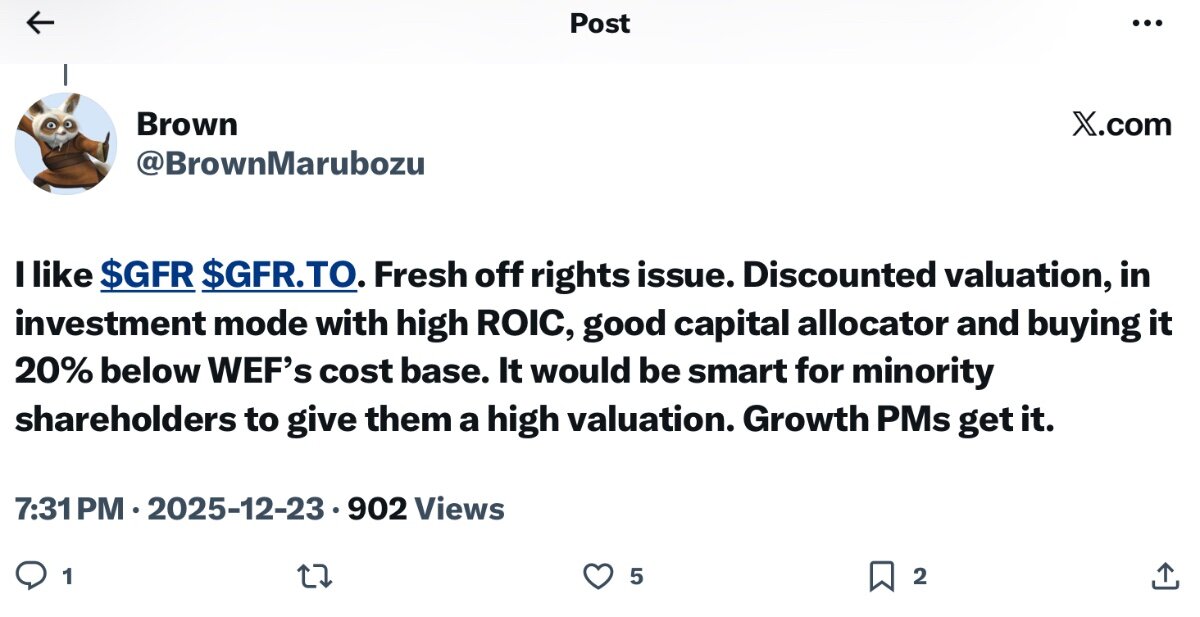
My pick is oils sands producer GFR.TO GFR.N. WEF III controls 71%, FFH owns 77.5% of WEF III. Their cost base is just over C$8. Buying the public shares allows minority investors to sidecar for free and at a ~20% discount. Fairfax India shareholders might appreciate riding on FFH’s dime for a change. The company completed a rights issue last week which has the effect of clearing out the weakest hands. The oil price is low and GFR trades at a big discount to peers including sister company SCR so any strength in oil prices is likely to lead to inflows. SCR also completed its C$2.1b dividend/distribution which is likely to hit accounts of shareholders next week (mine hit Christmas Eve after the close) who may also decide to pick up GFR shares. GFR’s entire float cap is C$350m. The company used the rights issue to pay off expensive debt with restrictive covenants. It’s going to outspend cash flow next year to grow production as 95% of its cost base is fixed. A production increase of 25%+ will have a dramatic increase in cash flow given the operating leverage. To me the best case scenario is that the shares quickly rerate and they use the paper to consolidate the region where a few private oil sands companies may be open to all stock deals. These deals will probably be accretive and increase the float enough to get into a few benchmarks which should further help with multiple expansion. Fairfax India could also have a great year if they are able to buy IDBI in a creative way and/or if they are able to IPO Anchorage, a holding company which owns part of BIAL.

-
I know a few investors that own FIH and no FFH and more vice versa. The reason why my FFH positions is 11x FIH is because I understand the mechanism by which it rerates which is in part due to being in benchmarks. It also has excess capital for buybacks if it’s not rerating and because the floor ROE is high. Marginal FIH holders treat it much more as a trading stock because there are no buyers if the discount shrinks whereas the FFH multiple is open ended. Maybe I’m too influenced by ELF. An important distinction between the ones you listed and FIH is that ELF is also listed on the TSX. I’m much more familiar with Canadian market structure than foreign markets given my professional experience investing and trading Canada. If an investor had high confidence in the Anchorage IPO timing, high confidence that the discount wouldn’t grow significantly and a small enough position to trade out on a big move, it probably makes sense to be long more FIH vs FFH for the catalyst.
-
Could just be my confirmation bias. I usually tend to think people that I share similar views to me are smart.