All Activity
- Past hour
-
And now Israel will hit Beirut until Hezbollah stops, just like they did with Gaza. At least Hamas is mostly killing their own Palestinians now.
-
Don't worry change - I would never mess with you!
-
Yesterday STX today MU
-
Remind me never to get into a bust up with you in real life @cubsfan
-
He is becoming Chairman. Probably all set in motion by current chairman David Brandon retiring. I bought some too.
-
In my experience, when a CEO or CFO leaves voluntarily, it is rarely a good sign, unless the executive leaves due to really bad health issues. Also, have you taken a look at Yum Brands?
-
Sorry, meant disproportional loss of innocent human life. And of course no one can explain or justify Hezbollah presence in Southern Lebanon as just one example. Lebanon doesn't want them there and neither does Israel yet when Israel responds to their terrorist attacks, it gets blamed and used as a pawn and/or excuse for jeopardizing a peace deal with Iran. Informed people know better.
- Today
-
The whole notion of "proportionality" in war is total bullshit. You end wars with disproportional responses - not 1 for 1, but 10 for 1. Why do you think the USA has not invaded Iran? We could never end it with "proportional" responses. Therefore, we obliterate what we can without any losses to the US. Israel would be stupid to play this game with Hamas or Hezbollah. Both terrorist organizations are getting exactly what they deserve - where Gaza is a pile of ruble and Southern Lebanon may end up. For every Israeli death - Israelis are responding "disproportionately" Proportionality is nonsense when you are in war.
-
Cubs, the issue is always proportionality and whether it was necessary. Again, hindsight is much more clear than present day. We didn't start or provoke WWII but we ended it. The issue is how we ended it and whether we would do the same thing again. We did learn how destructive a nuclear bomb can be, which hopefully is the reason it will remain a useful deterrent for those who have it and who value human life.
-
+1. This is a capex bubble first and foremost.
-
Of course it was the right thing to do. The Japanese Military killed 8 civilians for every 1 soldier they lost. Japan killed 16 million civilians.. They earned the bomb. Why would the US risk 1 million casualties to invade Japan when we could end the war is 3 days with 2 bombs?
-
Agreed. I think the important issue is that smart people learn from their mistakes. I would hope that we have. I'd also like to think that the Japanese have forgiven us and remain ashamed of being on the wrong side of morality during WWII even though there remain apologists in this Country who are unable to learn from history.
-
That is the conventional wisdom - that the Japanese saw the destructive force of the bombs in Hiroshima and Nagasaki and threw up their hands.....what people forget is the Japanese leadership was already thoroughly desensitized to the annihilation of their cities by then. By August 1945, the US Army Air Forces had firebombed over 60 Japanese cities to ash. While the atomic bomb was a terrifying technological leap, it was fundamentally just a bigger bomb.....historians argue that to the Japanese high command, Hiroshima merely represented city number 6x being destroyed and it did not fundamentally change their military arithmetic. The military arithmetic that most likely DID turn their head was the entry of the Soviet Union into the war two days after Hiroshima but hours before Nagasaki. Before then the feeling was that the US (acting alone) could be repelled from the Japanese homeland - the entry of the USSR into the war changed the math utterly. The answer of course is likely cumulative....the nukes plus the USSR did it but having looked at the evidence my guess is it was more like 80% the USSR and 20% Nukes that pushed the Japanese to throw up their hands. The story (we) tell ourselves as liberal idealists is that the use of nukes ended the war....their use, by us the 'good guys' was an act of cruel kindness to save aggregate lives on both sides...as in most things the stories we tell ourselves and reality diverge meaningfully. Read more here if interested - https://apjjf.org/tsuyoshi-hasegawa/2501/article Timeline below from Gemini - "The August 1945 Timeline March 9-10, 1945: The US firebombs Tokyo (Operation Meetinghouse), killing an estimated 100,000 people and destroying 16 square miles of the city. August 6, 1945: The US drops an atomic bomb on Hiroshima. August 8, 1945 (Midnight): The Soviet Union officially declares war on Japan, violating the Soviet-Japanese Neutrality Pact. August 9, 1945 (Early Morning): A massive Soviet force of over 1.5 million men invades Japanese-occupied Manchuria. August 9, 1945 (11:02 AM): The US drops a second atomic bomb on Nagasaki. August 15, 1945: Emperor Hirohito broadcasts the surrender of Japan. The Timing of the Supreme Council Meeting Perhaps the most compelling piece of evidence is the behavior of the Japanese leadership. After the bombing of Hiroshima on August 6, the Supreme War Council did not convene an emergency meeting. However, when news of the Soviet declaration of war and invasion reached Tokyo early on August 9, the council rapidly convened to discuss surrender. They were already in this meeting discussing the Soviet crisis when the news of the Nagasaki bombing was delivered to them later that morning."
-
On your last question, agree 100%
-
If token prices plummet, lowest cost of compute will win out. Cheap tokens make so many more use cases possible.
-
More DPZ
-
I highly suggest trying GLM 5.2 - pretty much on par with Opus, some argue it's better even. Atlas Knowledge's stock has 15x'd YTD. The question is how far that rubber band can stretch... If frontier intelligence can increasingly be developed in the East at a fraction of the cost incurred in the West ( GLM-5.2, was trained entirely on 100,000 Ascend 910B processors with zero Nvidia silicon), then the largest capital allocators are also the ones most exposed to over-investment risk. The breaking point was always likely to be when one of the major spenders concludes that shareholder returns are better served by spending slightly less. The problem is that “slightly less” is not embedded in anyone’s assumptions. The entire AI complex is priced for ever rising capex as inference demand grows. This set up is becoming increasingly precarious. The louder this message gets the more momo bottleneck bros inch toward the exit which creates neg momentum in its own right. Now we might be inclined to say who cares about GLM because it's distilled from Claude & GPT, but distillation is/was/ and always will be only one part of the equation. It's at best a bootstrapping method, the training, harness and weights over that existing distillation is still differentiated and great. If distillation is all that is required to make a model on par with the frontier labs, I don't think GLM would be the only option. But thus far, it's the only one that has come close. Then there's the seemingly endless debate on open-source being good for hyperscalers. First, the premise is inconvertible: Jevons on volume, i.e. free ish weights collapse the price of intelligence + current elasticity = massively expanded token consumption. And in parallel, margins migrate somewhat away from frontier labs as "good-enough" OS eats the middle of the task distribution (albeit pricing will be pareto distributed anyway so wouldn't overstate this margin point). The labs currently act like demand aggregators, and this proliferates outward, ok, no debate thus far. Second, OS weights can be served by anyone: neoclouds, sovereigns, on-prem, and maybe (probably not) the edge. So not just Hyperscalers. OS explodes TAM for everyone not just the Hyperscalers. So, for me, the shape of compute demand changes from prepaid capex commitments (from two behemoths primarily) to fragmented opex amidst a price war. So, from the Hyperscalers perspective what's changed assuming OS demand make wholes (and then some) frontier lab demand? Well, the demand risk now moves onto their balance sheet. Earlier it was the VCs carrying (via financing the frontier labs) that demand risk. Now, that demand risk shifts onto hyperscaler b/sheet. Third, a question that's less clear to me: in an OS/OW inference dominated world, doesn't the cheapest integrated stack (Google) win? Doesn't the margin migrate from frontier labs to the Hyperscalers with lowest servicing cost to compete? So the OS = Hyperscaler bull case is really a cost leadership bet again. Thoughts?
-
It also ended WWII. Not to suggest it was the right thing to do in hindsight but hindsight is often much clearer than silly comments.
-
There's one country in history that has used nukes on people. And it ain't Iran or Israel. Mirror mirror on the wall, who is the most barbaric country of them all?
-
I am not sure of the accuracy of this as FIH doesn't have the cash to acquire these bonds. https://www.reuters.com/world/india/canadas-fairfax-buys-nearly-1-billion-indian-bonds-rare-move-sources-say-2026-06-23/ MUMBAI, June 23 (Reuters) - Fairfax (FFH.TO), bought Indian government debt worth nearly $1 billion last Friday, according to five sources, in a rare purchase through the local unit of the Canadian investment holding company. The purchases by Fairfax India Holding Corp (FIHu.TO), were made to bring capital into the country ahead of a potential deal to buy stake in government-owned IDBI Bank (IDBI.NS), one of the sources, who is close to Fairfax, said. India's recent decision to exempt foreign investors in government bonds from capital gains tax made the transaction viable, according to this source. Fairfax bought around 60 billion rupees ($633.7 million) of the 6.03% 2029 bond, which was sold at an auction last Friday, at a yield that was 5 basis points lower than market levels, four of the sources, all treasury officials, said. The company also likely bought around 6 billion rupees of the 6.79% 2027 bond and 26 billion rupees of treasury bills maturing in May and June 2027, the treasury officials added.
-
See, this is where our thinking diverges just a bit. The difference between those who value human life and those who don't is the same difference between those who would use a nuclear weapon and those who wouldn't. How many countries or civilizations use human shields, stockpile military weapons in schools and hospitals and build tunnels through homes in residential neighborhoods to smuggle weapons and plot terrorist acts? How many suppress the lives of their population in the name of an ideology calling for death and destruction? The distinction reflects barbarianism and is the reason why anyone who morally equates the actions of Israel and Iran is either supremely ignorant or ideologically bankrupt. I don't think humanity is going away anytime soon and my hope is that it can overcome barbarianism for as long as possible, though it will require educating a lot of so-called educated folks about the true meaning of prejudice.
-
International is growing faster and parts of casualty are still strong. They also plan to use less reinsurance so they might grow net premiums by 5% not 3%. That needs a billion plus in capital. They do need capital to buy Allied World but, Eurolife is supposed to close next quarter and they raised the $750m in 30 year debt so have plenty of liquidity to scoop those up. Again, I don’t think the decision is acquisitions vs dividends at the subsidiary level. The constraints at the holdco seem to be maintaining the investment:equity leverage and debt:equity leverage.
-
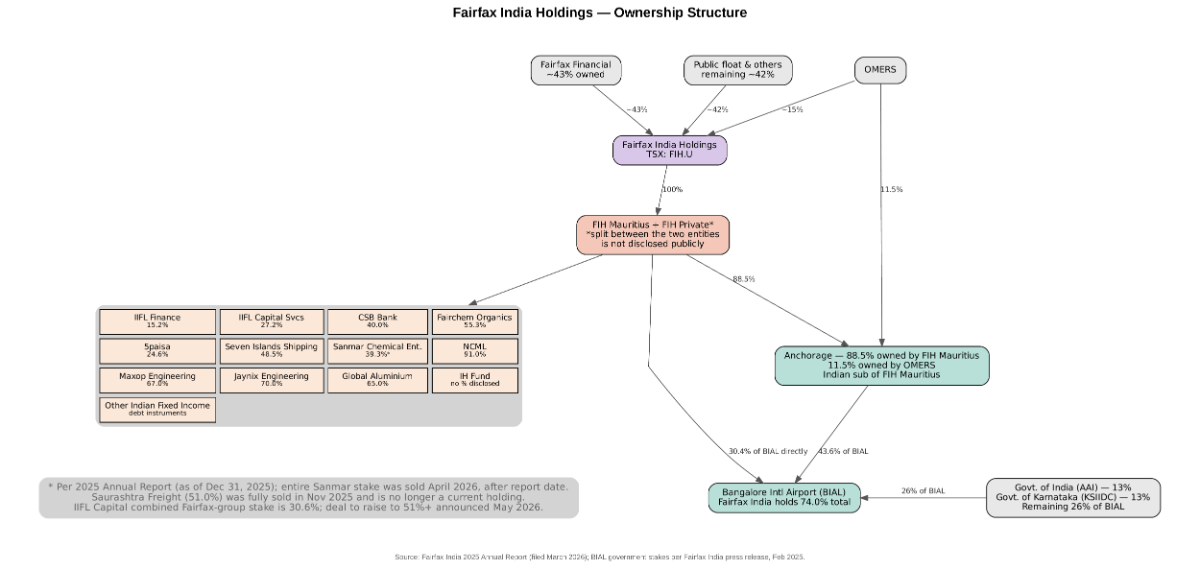
In an attempt to better understand the ownership structure of FIH.U, I used Claud to try and build a visual. I welcome feedback on what I don't have correct, or what is missing. Overall it was a somewhat frustrating experience, Claud kept putting boxes in bizarre places and had lines crossing each other all over the place and was writing text on top of each other. Makes me wonder if ADBE really is going to die quickly due to AI. Perhaps I am bad at prompting, or perhaps Claud isn't the best AI for this task.

-
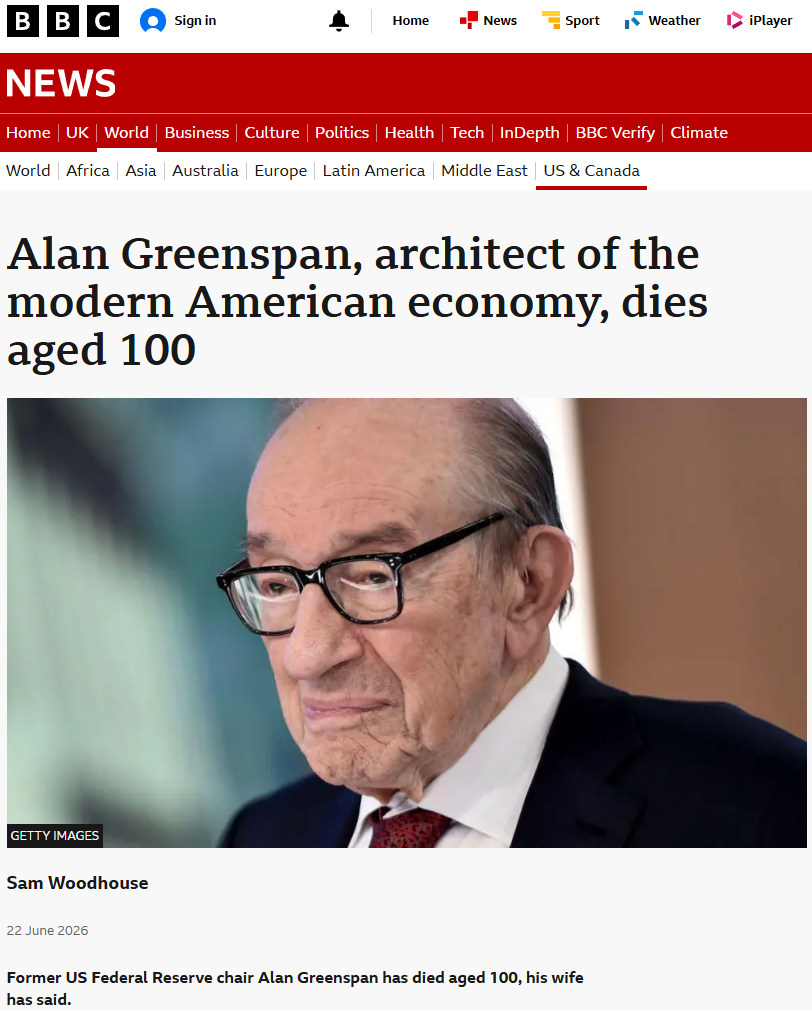
The BBC today. Yes Sam Woodhouse, the American economy is the way it is because of Alan Greenspan.
-
And there we go again with the green Lincoln Memorial reflecting pool! - It's killing me! - It's only about USD 16 million, none of them mine!