TwoCitiesCapital
-
Posts
6,303 -
Joined
-
Last visited
-
Days Won
10
Content Type
Profiles
Forums
Events
Everything posted by TwoCitiesCapital
-
I think it will be widely acknowledged and accepted by Gen Z - I think everyone else will struggle with it. That being said, we don't need understanding to get wide adoption. A minority of 1% of people can explain the interconnection of our banking system and how things like wires and ACH work, why there are multiple days worth of delays, and etc. And yet nearly everyone has a bank account, swipes debit/credit cards, and uses apps like Venmo to pay friends. Bitcoin simply needs adoption on the backend of these institutional transfers and will magically take the market share of payment processors and all of the red tape in between. While we debate on and on about micro payments - Bitcoin's competitive advantage in large payments is basically insurmountable. I don't see why it can't be used for purchases of cars, houses, cross-border remittances, settlements between corporate accounts, central bank transactions, and a global reserve currency to get rid of exchange rates and all of the unproductive jobs/energy/cost/waste that goes into simply exchanging monies to the right monies.
-
I'd be more interested if there were impactful share repurchases occurring. Even if it was only for 3-5% of the shares. At such a large discount to their supposed NAV, share repurchases is almost a guaranteed 100% return which has got to be an easier lay-up than some of the businesses they're deploying capital into. And yet...they aren't.
-
I know I saw India's GDP growth is expected to slow some in 2025 - perhaps thats weighing on the market as a whole? The NIFTY index is down 10-12% since September? Also, while dangerous to apply generalizations to individual circumstances, my understanding is that MOST IPOs return to their IPO price, if not lower, within 3-years of the IPO once the hype and limited volume/access has faded. This is precisely why I have a rule to not buy IPOs in the first 2-years in place for my portfolios.
-
I've basically been concerned my entire adult life Not necessarily because of valuations - that didn't start until 2015/2016 when the US started to really get elevated to the rest of the world (and then later on an absolute basis). But more from a policy stand point. It's clear to me that too much debt IS the primary issue and we keep 'solving' it with more debt which is problematic. And I have been concerned about those policy responses since starting investing in 2007 by buying Ford stock. I think what I had failed to appreciate is that 1) debt crisis can take decades to work through and don't have to correct overnight and 2) it's different when you're the reserve currency. My caution probably would have been justified if I were European. Double dip recession in 2011. Brexit/Grexit fears thereafter. Started to recover and catch up to the US and then COVID reset the game. Then Russia's invasion of Ukraine blowing a hole in your energy security. But none of that matters to the US when you have the fortune of printing as much money as you like and there always being a bid for it as the rest of the globe is net short USD. Plus smaller impacts like one of tax changes, the explosion of fracking, etc also probably helped. Ultimately I don't think it's sustainable. I'm still concerned. But also recognize I have no ability to know where it ends. I've largely given up buying puts on the market, but still watch the market for the direction of the tide.
-
https://fortune.com/crypto/2025/01/09/federal-government-allowed-sell-bitcoin-silk-road-courts/ So the question is - do they sell as they always have? Or is this the start of the "Bitcoin reserve" we keep hearing people clamoring about. I think it gets sold. I have zero faith the US government, and especially DJT, care about balanced budgets and hard currencies. And even if they did, there is no feasible path for the US government to acquire anywhere near enough BTC to matter for trillion dollar deficits and tens of trillions of debt (and more unfunded liabilities).
-
I tend to agree that climate change is something that needs to be addressed - but I think it needs to be addressed by governments and industry by putting forth solutions and alternatives - not by starving existing industries of insurance coverage when no reasonable replacement exists
-
If you had said because of auto-401k contributions, I probably would have bought this. But you didn't so I remain skeptical. We don't have to go back more than 15 years to the largest recession/stock drawdown/economic chaos from the Great Depression. That was still THIS generation - in the age of internet and 401ks and IRAs and pensions and etc. It happened then - it can happen again. Especially once the view of society tips to inflation being a bigger threat than equity drawdowns and deficit spending is hamstrung...even in a pullback. Perhaps we're already there? The local top in bonds this year was right before the Fed started cutting rates and they've been bleeding ever since. Perhaps lower rates is no LONGER a good thing and perhaps neither are multitrilion deficits required to bail us out of whatever the next crisis is.
-
Lol - yes and know. I learned about Peter Lynch after Buffett - for sure. But I also remember learning that the average Magellan fund investor during his tenure compounded at less than 1/2 his rate because they were entering and exiting at exactly the wrong times which made me appreciate that human behavior and psychology are the beast to be conquered and NOT security analysis. I think the best book I've read on the subject - and that has formed much of my opinions on the market - has been the book Unexpected Returns by Ed Easterling of Crestmont Research which does a great job of overlaying historical market returns, multiples, to inflation and what forward returns have been from that matrix. Basically the items I took from it were : 1) Inflation matters a hell of a lot more to forward nominal returns than I ever appreciated (and not in a good way) and 2) There are times to be passive (when stocks on the whole are cheap) and times to be active (when stocks on the whole are expensive) I read it back in the ~2015 era and have been of the view that risk/stocks need to be actively managed since given that the U.S. was expensive on a relative basis to the rest of the world then and even more so (and on an absolute basis) today. As a result, I regularly trade around a core position selling rips and buying dips, sell covered calls to generate extra return while maintaining sell discipline, manage position limits and reduce positions from their maximums, committing to buys/sells at prices long before they're hit using GTC limit orders, etc. If the market was at significantly cheaper levels, I would probably just index and deleverage myself from the effort. Like many of my foreign holdings that I don't actively trade, don't sell options on, don't hedge, etc. But they're cheap. The U.S. market is mostly not. Even as I a devout believer in deep value strategies and use assets/NAV and low P/Es as my primary guides own Bitcoin. Its a different animal than any stock - and probably a more important development than any company has made in our lifetimes. Just as the cost of energy touches just about every industry and facet of life, the price of money touches everything and impacts everything. And when your money is based on unsound principles, it creates perverse incentives and results in a ton of wasted/unproductive work implemented for its production/distribution/maintenance of which sound money would only require a fraction of.
-
It will still be going. With people counting down the days until Trump's 3rd term where he'll finally release the companies!
-
The problem is when interest rates were zero, everyone used 0% rates as an argument for why multiples should be elevated (double counting IMO). Now that rates aren't 0%, they've forgotten all of that and multiples are elevated because the US is exceptional and the only country with high quality companies (or Daddy Trump is going to do 1000% better than he did his first 4-year term). In neither environment was I comfortable with the multiples nor satisfied with the explanations provided - but Shiller P/E HAS been elevated basically my entire adult life so who is to say it won't stay that way for a few more years? People will always find an excuse to justify elevated prices because their portfolio values, net worth, and/or happiness is dependent on 'number go up'. And to some extent - they're not wrong. Optimists get rewarded in the market far more regularly than pessimists. For me? I'm very heavily interested intermediate fixed income for someone my age. I own a few conviction names, a small % that I trade around, a hefty slug of Bitcoin, and ~50% intermediate agency mortgages and treasuries. Some people are happy to pay 35-40x for stagnant earnings at Apple. I am much happier getting 4-6% YTMs that are basics guaranteed and can use the income/gains from that position to pick off names that become attractive when they're attractive.
-
The miners are the ones who contribute blocks to the network. The nodes are what communicate and all agree that the blocks are legit via consensus. Having distributed nodes makes it easy for anyone to verify transactions that have occurred, communicate their own to the blockchain. So even if a govt bans Bitcoin, you can still communicate your own transactions via node without having to rely on an intermediary protecting the chain from adversarial govt action. Additionally, my basic understanding is that nodes can reject transactions and not communicate/come-to-a-consensus which is why it node operators that shut down the attempt to make BTC blocks larger in size resulting in the hard fork of Bitcoin cash that is largely worthless in comparison
-
That and they would all occur the same day at the same price. Different prices and Bradstreet's occurring on a different day make you wonder. This is beer money for all of those guys. What gives?
-
The nodes are an oft overlooked form of security for the network and its users. +1
-
Is Europe becoming uninvestable?
TwoCitiesCapital replied to lnofeisone's topic in General Discussion
ah - ok. Didn't realize it was forward earnings that were being used. -
At this point - are largely in insignificant position - especially with the reduced/eliminated convertible exposure... Would love to see them exit and redeploy, but its not likely to move the needle.
-
Is Europe becoming uninvestable?
TwoCitiesCapital replied to lnofeisone's topic in General Discussion
Are you annualizing the 6-month earnings? Just a quick look at the financials from free sights seems to suggest significant cyclicality to the earnings with the June half being 2x the amount of the other half? So closer to 20-21x earnings? -
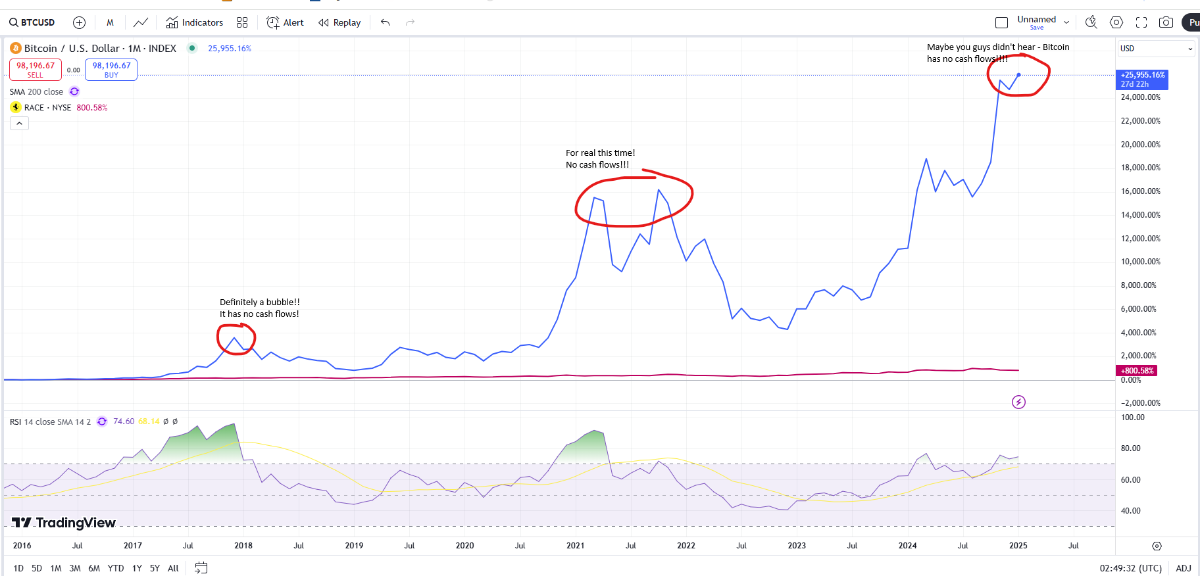
At one point - there were no known valuation metrics for EVERY investment and they were literally "just made up". Some made sense and persisted through time. The methods I mentioned aren't even really new - they extend back to the advent of the telephone but don't often get applied to investments because until recent history nobody could buy a protocol at the network level. Go try to buy HTTP or TCP/IP or FTP or SMTP or etc. etc. etc. You can't. But you can buy the protocol for sending money over the internet. But since you don't like, we'll ignore all of that history and just call it "made up" as if that makes it different from every other valuation method in some way. Ironically - people can't agree on the value of stocks and how best to do it. 1 BTC = 1 BTC is a fairly absolute way to value it. But you demand a price to wrap your head around that so yes - the value of ANY currency quoted in something else is always relative. Not sure why that would be a big revelation. And Bitcoin keeps buying relatively more things even while 1 BTC = 1 BTC is the absolute value. Gold didn't just become valuable. It was valuable that whole time and GREW in value as more and more adoption occurred. Thousands of years solidified its case as a store of value - but isn't what made it one and the people who recognized it early did better than those who recognized later. Gold's returns would look a hell of a lot better had you compressed that monetary adoption to a generation, or two, instead of thousands of years. This is what I expect of Bitcoin given that information now travels near the speed of light and not by boat. It is NOT gold's industrial use cases that support the $18 trillion market cap. That is mostly monetary premium. Bitcoin will be the same. Bitcoin has unique characteristics that make it superior to gold IMO. And because of that, will absorb that monetary premium IMO. I don't need to necessarily argue with you here. I've argued gold is a terrible inflation hedge in the past suggested it is actually a hedge against negative real rates - often accompanying inflation but not always - which is why gold's history is spotted when it comes to inflation hedging success. But gold still did a hell of lot better than equities/TIPS/other commodities in the inflation shock of 2022 so I think the real question is actually why does everything still think THOSE things are inflation hedges when the "not-hedge" of gold still crushed them. At this point - the posts are more for the others reading. 73 Reds has basically all but admitted that there is no price or scenario in which he would be interested and seemingly can't get behind that even things without cash flows have value as demonstrated by all of the companies generating cash flows selling those things...
-
Current price is determined by network value. There are ways to estimate this as well as expected growth of that network/value. Not so different from telephones/Internet/social media. Networks contain immense value - just in the past that was captured by private enterprise at the application level and not democratized and at the protocol level that Bitcoin allows for. Alternatively, you can ask yourself what the market capitalization of a global monetary asset should reasonably be, or what other stores of value are and what they're valued at, and then discount BTC back pending your estimate of how long it takes to get there. IMO, it remains cheap by both methods This says more about you than Bitcoin.
-
This is precisely where you're wrong. Never before has there been a monetary asset with a perfectly inelastic supply that can't be manipulated by politicians Never before has is been so easy to send that wealth anywhere in the world with settlement times of ~10 minutes for less than the cost of a bank wire Never before has there been such an easy/cheap way to secure such a large portion of wealth Bitcoin has plenty of unique qualities that no other "money" currently has. Lol
-
So you were buying it at $20k in 2022? Or at $5k in 2020? Because I'm going to guess the sentiment was similar then even at those local lows and I'm going to guess the sentiment will be the same when it's at $250k. But I'd be happy for you to prove me wrong. We aren't talking about transportation? Your comment was that you didn't understand how limiting to 21 million coins has anything to do with value. It seems you understand the concept of scarcity as it relates to Ferrari and their relative values, but won't apply the same concept to monies and their relative values?
-
The real comparison - nearly a decade of absolutely trouncing the performance of one the best performing stocks...

-
If Ferrari produced 14 million vehicles a year instead of 14 thousand - how much do you think they'd be able to charge for each vehicle?
-
Same. With Bitcoin's performance this year, I've actually been able to modestly add to my position where I had been forced to trim in prior years to keep at ~10%. That was definitely an issue after Fairfax's blockbuster 2022 when everything else I owned was dropping as it rose.
-
+1 the rule is "substantially similar securities" In in the money calls and in the money puts are substantially similar to the underlying stock and would be a wash sale. The actual gray area is OTM options. If the stock is trading at 90 - is a $95 strike call substantially similar? Is an $85 put? Both have dramatically different economics, different betas, and different risks (like expiring worthless if the stock doesn't move, or moves the opposite direction). But it's probably best to not get cute with it and just roll to competitor if you're that concerned about 1-month of beta exposure.
-
The Techno-Optimist Manifesto
TwoCitiesCapital replied to formthirteen's topic in General Discussion
So 10+ years if we scale these estimates estimates to his estimates of FSD @ Tesla. Still sooner than I'd have hoped.