All Activity
- Past hour
-
Why Soccer Is Boring The Better Team Loses Almost Half the Time One of the best ways to determine how much luck is involved in a sport is to measure how often the worse team beats the better one. If the favourite wins 80 per cent of the time, that’s a high-skill sport: the better side reliably prevails, and the remaining 20 per cent is luck. If the favourite wins 55 per cent of the time, you’re watching something closer to a coin flip. https://archive.ph/vSNN3#selection-1033.9-1033.29
-
I really hope, bullet point 3 and 4 will last. If they don't do any major blunders, the compounding goal of 15% on the average looks more than achievable. The outcome could be much higher. But then again, it's insurance and there are unknown unknows in the risks they cover.
- Today
-
It is certainly ironic. Given that Spain is the biggest leech in NATO - it's really Europe that should be pissed and not the USA!
-
@djokovic1, I think what makes today unique is a number of things have converged: Higher interest rates, which you mention. Higher quality insurance business Higher quality equity holdings Better capital allocation (matured?) The 4 have come together at the same time. Bodes well for future returns. The good news is that it appears little of that is priced into the stock today.
- Yesterday
-
Yes you are right. But I still think the leverage increases, not for the reason I said but just because an equal decrease in investments and equity will make the ratio higher. For instance, with $74.9b invested and $26.3b in equity at the end of 2025, for a 2.85 ratio, buying a million shares this year might cost about $1.6b, bringing the ratio to 73.3/24.7=2.97. Pretty big improvement.
-

Understanding Fairfax's Business Model
SafetyinNumbers replied to Viking's topic in Fairfax Financial
Doesn’t it reduce book value by the same as a $ of repurchasing? That’s the accounting entry. BVPS doesn’t go down as much because the denominator goes down too. -
Sleep Country has bought Sleep Number assets from bankruptcy after increasing their offer to $700M during the auction. https://www.reuters.com/legal/litigation/mattress-company-sleep-number-sells-assets-700-million-bankruptcy-2026-07-20/
-
@Viking I love the flywheel especially because it's true! A lot of other insurance companies operate at a similar leverage, I would argue thats not what makes Fairfax special. What makes them special is they operate at that leverage with 30% in equities whereas most other insurers only have 5% in equities. So the other insurers have much lower ROE. Markel and Berkshire used to operate at much higher leverage when they had a lower amount of equity investment % in the book, not dissimilar to Fairfax today. So I don't think the leverage is an outlier / risky. What makes today unique is a healthy return on the FI book which allows Fairfax to have an exceptional ROE in most circumstances.
-
Repurchases are good for increasing value per share, but they are even better for maintaining the leverage. It would be interesting to see how the last few years of repurchases have changed the leverage, but without access to the numbers (long drive home) I suspect it will have increased. $1 of repurchasing obviously decreases cash by $1 but at a P/B of 1.4, it decreases book value by only 70c. So the ratio of investments to equity should increase.
-
@73 Reds, I think Buffett's view was (is?) that high quality float is better than equity - the key is the quality of the insurance operations. This is one of the reasons I am so happy with what Andy Barnard has done with Fairfax's insurance operations over the past 15 years (they are much higher quality today). This means Fairfax is a much more valuable company today - one of a couple of reasons why it should trade at a higher multiple today than it did 15 years ago. Fairfax's leverage is similar to what is was 15 years ago (if memory serves me correct). It's not like Fairfax has been aggressively levering up the business. Instead, spiking earnings (and shareholders' equity) is not driving leverage lower. At least not right now. (Having a low share price is a big deal - for management teams focussed on per share value creation over the long term). ---------- Another angle to the leverage discussion is size, sources and diversity of earnings. Fairfax is in a very strong position today - much stronger than at any time in its history. It really is remarkable what Fairfax has accomplished over the past 10 years. And how the stars have aligned - insurance, investments, capital allocation etc.
-
Understanding Fairfax's Business Model
SafetyinNumbers replied to Viking's topic in Fairfax Financial
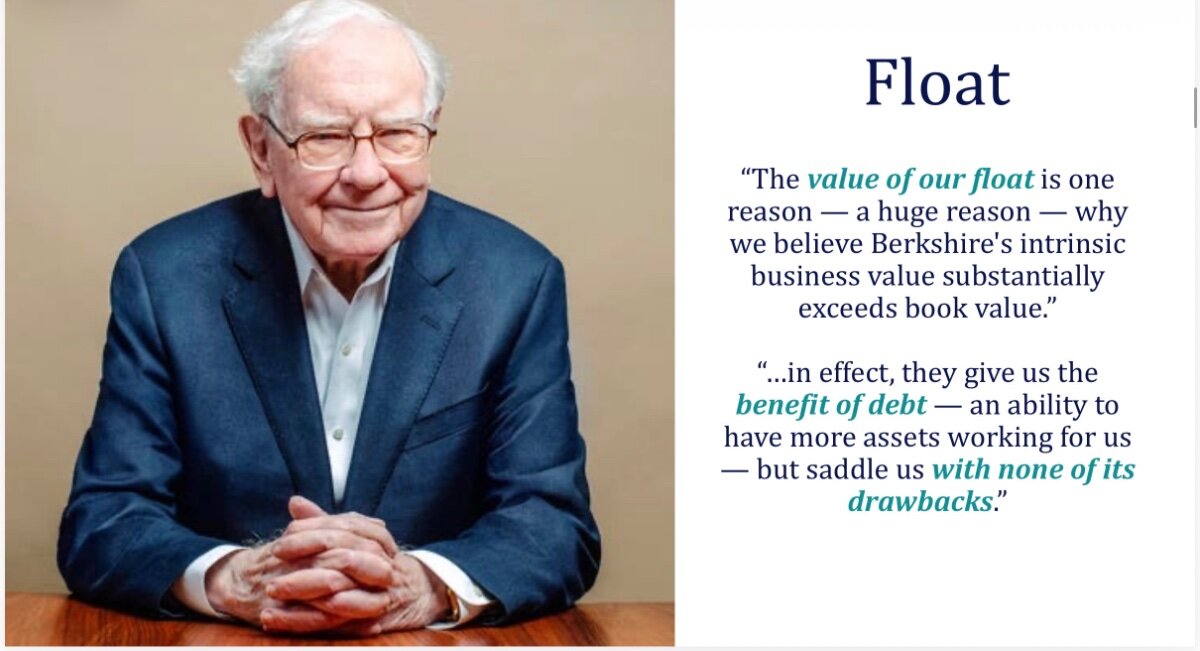
It’s a bit of a philosophical question. For the benefit of others, the base assumptions are that over the long term for a high quality insurance business, the combined ratio will average below 100 and that premiums will grow. If accepted that means float is always growing albeit on a revolving basis. Under these conditions, the float is the equivalent of owning a growing income stream that never has to be paid back. Those are the characteristics of an asset not a liability. The insurance subsidiaries themselves are not that levered and in fact carry extra capital. The additional leverage at the holdco and it’s structured very intelligently with no near term maturities and long duration issues. The leverage at the non-insurance subsidiaries is not relevant as they are non-recourse to the insurance subsidiaries that are mainly the shareholders. Slide from @djokovic1
-
starter in HUBB
-
C'mon...Shakira's hips definitely did not lie! It was the only part of the half-time show I thoroughly enjoyed! Cheers!
-
The best chocolates and 7,000 types of beer powered Belgium! I didn't even recognize Ronaldo! Cheers!
-
I just asked ChatGPT what percentage of Americans work full time, and the answer was 48.6% with another 10% working part time. It doesn't seem like any huge surprise that the bottom 50% generally possess less purchasing power since they're not working... If 50% of a society doesn't work, then they will have the most purchasing power when there's a stronger safety net. Meanwhile, it seems like a lot of the countries with great safety nets don't have as much opportunity for wealth creation from looking at the numbers you're presenting. As far as the median net worth, I feel like the health insurance setup in the USA probably plays the biggest role in this. The biggest obstacle (in the USA) to starting a business, is being able to maintain/afford health insurance. Same problem for anyone who doesn't have a corporate/government job. But you can get free or nearly free insurance by keeping a low income (with ACA) and almost zero assets (with Medicaid). There are plenty of Medicaid recipients that could save some money, but it would be foolish to do so since it would mean getting kicked off of medical insurance. If you're in the bottom 50%, you probably need to bridge the gap to the top 20-30% just to make up for the differential in health insurance costs. When you factor in SNAP, discounted utility rates, section 8 type housing, and EITC, these all act as a huge disincentive for the poor/lower middle class to make otherwise good financial decisions. This framework keeps lots of people poor, costs the taxpayers (almost exclusively the rich by the way) more in the long run, and steers more of our economic activity under the table.
-
Well, Buffett has said that Berkshire's float is better than equity. As a shareholder, I've never bought into that (it is a liability) yet it has some of the same characteristics as equity but solely because of Berkshire's underwriting discipline. In that vein, and with more leverage than Berkshire, do you view Fairfax's float the same or any differently? When does leverage get excessive?
-
This data is from the UBS Global Wealth Report 2026. Yet the same report in 2025 had median US Wealth Per Adult = $124,041. Was there a Great Depression II that hit the US in the last year? $124k in 2025 to $69k in 2026? lolz. I think this study and its results should be taken with a big grain of NaCl. The Federal Reserve does a triannual Survey of Consumer Finances and the latest study in 2025 pegged median US family net worth at $192,900. FWIW. Bill
-
@73 Reds, I am not sure I understand your question. To me float is important. What is perhaps more important is the amount of leverage. @SafetyinNumbers has been talking about this for years... it is slowly sinking in for me. Fairfax is about 2.85x leverage (investments to shareholders' equity. What happens to the amount of leverage over time is important to longevity of the business model. Berkshire Hathaway lost the amount of leverage over time for a bunch of reasons. The end result is BRK's business model has completely changed. Earnings are much lower (still solid). Fairfax appears laser focussed on keeping the amount of leverage high. Which suggests to me it will continue to be a wonderful business for at least the next decade (likely longer). But that is as far as my crystal ball attempts to look.
-
Ok so top 50% is unparalleled in the world basically. And if you tweak a lot of things, the Bottom 50% is maybe top 10 or 15 when compared to small, mostly homogeneous, semi-socialist European countries with no social dynamism. How do you get “poor” from that? You are starting to remind me of the German propagandist on the speaker in Saving Private Ryan “the Statue of Liberty is Kaput”
-
Thanks, Viking. Do you look at Fairfax's float the same as Berkshire's float? If not, how do you view them differently?
-
The best game of the tourney by a mile was England France. The Final was a lopsided beatdown of MS13 lookalikes. What were the shots again? 20-2? Felt bad for the Argentina goalie, though...played a hell of a game, despite his teammates acting like thugs.
-
Thanks a lot @LC! It turns out the process is a bit more nuanced than I had assumed. Just an anecdote: Earlier this year, I experimented with Gemini Pro via Perplexity creating a few PowerShell scripts doing administrative stuff, and I ended up wasting almost more time trying to bypass the overzealous anti-hacking restrictions than on the actual programming. That eventually made me lose interest.
-
That show was terrible. I turned down the sound when Justin f’n Bieber showed up with a Guitar. Might as well let Trump dance a tango with Gianni. I would rather watch some Bud commercials if they are decent.
-
The Unsettling Of America is his Magnum Opus and Nick Offerman narrated the audio book. Very much in line with Thoreau although slightly different focuses. Goes great with a glass of Kentucky Bourbon.
-
Since we are talking about software companies (and IP infringement on code?) in this thread, who even reads code at all outside of some poor senior developers who have to? Soon no one will read the code anymore.