All Activity
- Past hour
-
Has the real estate angle been discussed any where, that would interest me more. Although I don't think it worked out very well when they took that angle with ToysRus
-
Do you think they did the deal to help a Canadian Company? ex like how Blackberry investment likely was about saving a Canadian company (my guess)? or do you think they understand Canada better? I think there is a lot of hidden value in Andrew Peller real estate portfolio that could be unearthed with Capital that Andrew Peller could not.
-
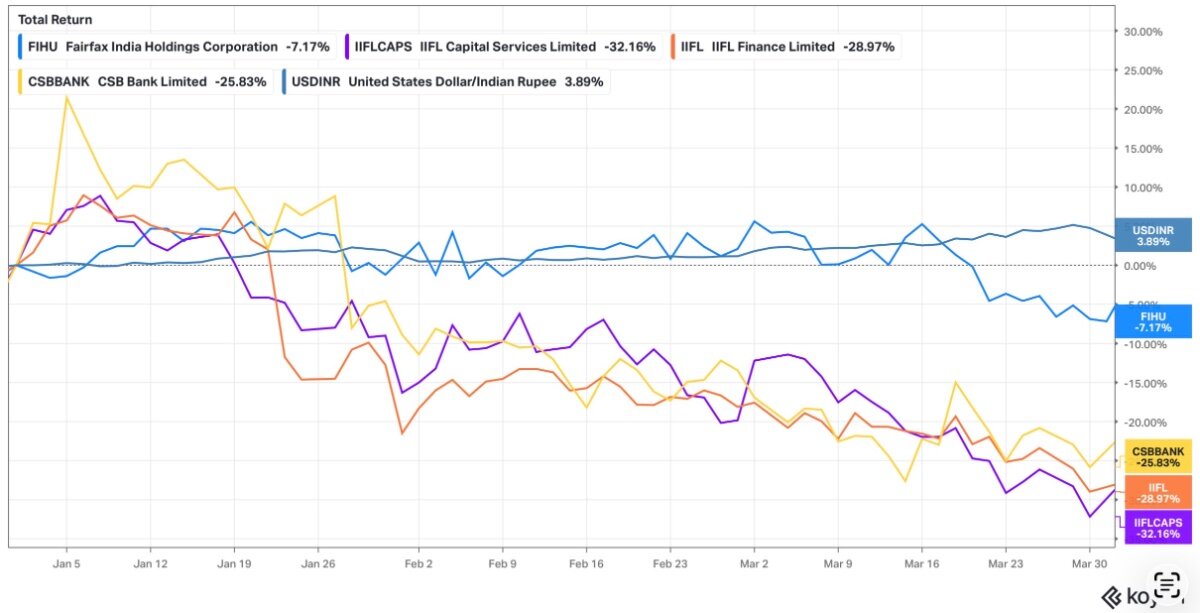
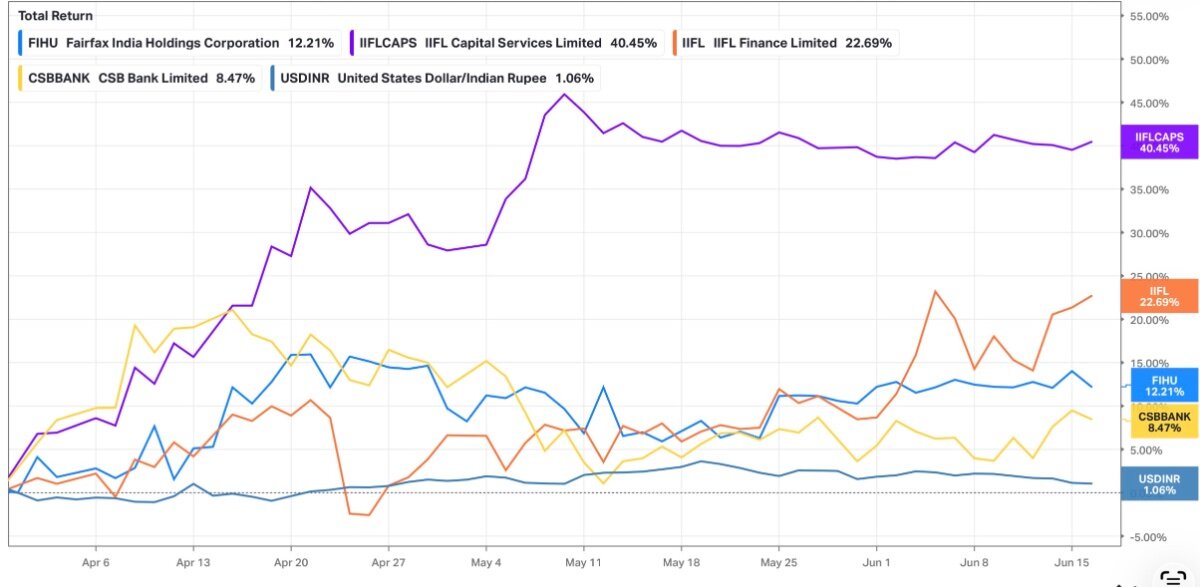
One would think oil plunging would be bullish for Indian stocks. FWIW, the rupee is less of a headwind this quarter vs last and the public market portfolio has bounced a decent amount. I assume BIAL valuation will continue to accrete. I added some today too.

-
All I will say Fairfax often has many headscratching investments! If this wasn't in Canada, would they have bought it?
-
Trying to argue with Trump supporters is like deciding to slam your head repeatedly into a brick wall. The wall of course never budges, and all you get at the end is a horrible headache.
-
It's too bad they decided to attack us earlier this year. It's also been hard working with them considering they withdrew from the JCPOA.
-
Added to my position yesterday. Don't be too hard on me. Remember I'm...
-
I felt some real sexual tension between Donald and Dana. I'm surprised they weren't holding hands as they walked out. I even thought they might kiss there at the end.
-
Finally got a bunch of order fills today after trying every day for weeks. Looks like $17.72 was the lowest I got executed on so far
-
Good thoughts, thanks.
-

Managing a Concentrated Portfolio - How do you do it?
Red Lion replied to Cor's topic in General Discussion
That's my point, there's a huge difference in tax implications. You can sell losers/duds/underperformers to raise cash while allowing winners to compound tax deferred. If you've got $10 million in a taxable investment account and want to take out $400k a year, you could be paying 37% in a high tax state just on long term capital gains, so tax loss harvesting does have value. You'd probably need a lot more than $10 million to really make this worth your time, and there are direct indexing services available, haven't really looked into them. -

Managing a Concentrated Portfolio - How do you do it?
SharperDingaan replied to Cor's topic in General Discussion
+ 1 But that big position had better be a life changer for the amount of risk you are taking .... and you need to be willing to add to it at a 50% decline. Gain in the multiple six digits or higher, and a 'win' that pays off the mortgage ... and then some. Make volatily your friend, and you will also make money your servant .... reducing the anxiety. The squeeze balls, not get squeezed SD - Today
-
The real estate looks to be very high end. Looks like a bunch on multi-million dollar houses for sale in Niagara on the Lake. Any Canadians have an opinion?
-
You do realize, that probably the majority of Americans and even the world, would be happy to shower Iran with economic growth and welcome to the 21st century incentives if they’d just stop the state sponsored terrorism stuff, right?
-
In response: The real estate portfolio and inventory are largely required to run the business - anything that can't be sold can't be valued separately. There are zero meaningful synergies with Recipe/Keg. Peller already has significant distribution as described in the deck. Long term business - yes - but not a very good one. I used to know Concha y Toro in Chile quite well. I came to the conclusion that it is all but impossible to build real brand equity in mass consumption wine. Producers are much better at making taste consistent across vintages than they used to be, but there is immense competition. The best producers can do is earn a commoditised spread between input costs and sales price. That fluctuates from year to year but is fairly stable over time. Concha earned 5-12% ROIC over the 10 years I modelled it, averaging 7-8%. Sector is out of favour - is it? They're paying 11x ebitda* for a glorified farming business in an industry that hasn't grown volumes over the last 25 years. * $579m EV from the release divided by $50m L5Y average ebitda from the deck. I can't see the value here. I hope Fairfax has an angle! If they were buying a decent Burgundy producer at least I might be excited by shareholder discounts at the AGM!
-
Looking through the deal press release, seems like this is much more of a retail, distribution business. 101 store locations plus an importer business in addition to the wine and liqueur brands.
-
Honestly I was only half joking about the KW land redevelopment or Recipe synergies. Is there anything unique about this one? Are Canadians really loyal to it? Scratching my head down here in the US as I’ve read for years about how volumes are struggling and even Napa and Sonoma wineries are closing left and right. And if Prem thinks it’s cyclical, why not buy STZ, TAP, BUD, DEO?
-
Thank you for the Leucadia reference...it's been forever since I even thought about the company, much less saw something in writing about them. -Crip
-
Here is a stab at what Fairfax might be thinking… Management believes the future is likely to feature higher highs and lower lows in inflation and interest rates. Long-term financing becomes more valuable. From that perspective, paying an extra 1% today for a 30-year bond may be a bargain. Imagine two scenarios: Scenario 1: The last 20 years (1982-2020) Inflation trends lower. Interest rates trend lower. Refinancing gets cheaper over time. In this world, issuing 30-year debt often looks expensive in hindsight because you could repeatedly refinance at lower rates. Scenario 2: Th current environment? Inflation is structurally higher. Government debt levels are much higher. Interest rates are more volatile. The risk of a future refinancing at higher rates is meaningful. In this world, a 30-year bond is valuable because it removes uncertainty. The company is effectively saying: "We are willing to pay a little more today so we never have to worry about what the bond market looks like in 2036, 2046, or 2056." This is very consistent with Fairfax's historical approach to risk management. The company often sacrifices a little current profitability to reduce exposure to adverse scenarios.
-

Managing a Concentrated Portfolio - How do you do it?
Intelligent_Investor replied to Cor's topic in General Discussion
If you are just trying to match S&P there is no point in managing 50 2% positions, just buy VOO and call it a day...just sell a small% if you need cash -
Great write up! Wasn't it AIG & other financial companies that also took on the counterparty risk for the CDS. Imagined if the government allowed it to fail like Lehman and what a catastrophe for the whole financial system this would have had. They recognized the exposure but did not imagine their hedge could have been wiped out entirely by the same companies that were taking these extraordinary risks?
-
@MMM20 that's funny. Ian Cumming and Joe Steinberg of Leucadia fame bought four wineries the first in 2000 iirc. They opined in every shareholder letter about how bad they were as businesses but they liked wine and wine lubricated camaraderie. Eventually they spun off the wineries in 2013 as Crimson Wine Group. It's publically traded on the OTC but tiny and still a terrible business. lol
-
>20x FCF for wine? Isn't that a struggling industry with typical multiples in the mid single digits? What's Prem's angle here? Working with KW to redevelop the land? Synergies with Recipe?
-
@Viking sorry I am a little late here but, I've been thinking about this since they raised the debt. Do you have a sense for why they chose such long-term financing with a 2056 maturity? I believe you asked management about this during AGM week, but I can’t remember their response. At a 6.2% coupon, the debt was issued at ~123 bps over the 30-year Treasury, at that time. I understand the logic of locking in long-term capital, but I’m trying to better understand why Fairfax would prefer 30-year debt versus something shorter-dated, especially given the cost.
-
This is exactly why you don’t truly understand Iranian culture, its people, or its religion. “To know your enemy, you must become your enemy.” — Sun Tzu The last two points will start shifting right after Friday’s signing. Iran is about to undergo a major growth acceleration. Simple question: What percentage of Iran’s $300 billion reconstruction fund will American taxpayers end up covering? Just asking that question reveals how much the US has lost in this outcome.