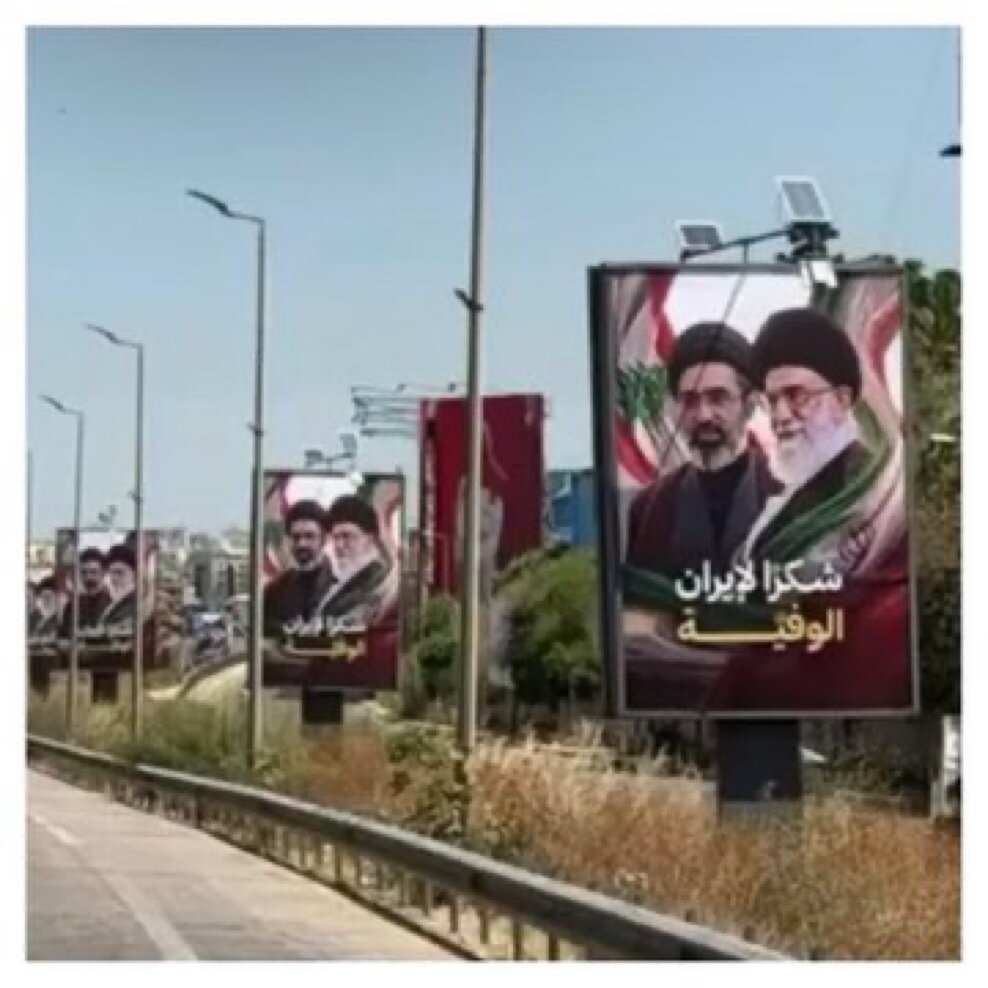
I understand where you guys are coming from and share your disgust of the actions Iran supports indirectly and carries out directly - but your making the standard error in IR, which is your falling to walk a mile in your opponents shoes. The madman fallacy (like with Iran) is the oldest narrative in conflict - first between neighbouring tribes, then between Kingdoms, now between States. The story goes that your enemy is crazy, psychotic & irrational. The the more truer reality is your enemy is paranoid, scared and has no way of knowing what YOUR true intentions are. The cost in international security of attributing benign intent to a rival and getting it wrong - is that you don't get to exist anymore. The problem is compounded by the fact that in war all defensive military spending when viewed through the lens of fear and paranoia looks an awful lot like offensive spending. This leads States to act in ways that you perceive as crazy but is essentially survivalist paranoia driven by incomplete information (i.e. rival intentions)
The reality is if you take a step back and re-frame the Iran & Israel rivalry from a purely classical realist, offensive & defensive perspective - as a regional security competition between two powers vying for regional hegemony it is depressingly similar to so many regional security competitions throughout history. The novelty with Iran/israel (say versus France and Germany's European competitions) is the use of proxies AND the involvment of non-regional global hegemon in the competiton.
When you get down to it - both countries, Iran and Israel'sp, are deeply insecure and hyper-concerned about their survival & security - they should be they live in a bad neighbourhood. They are both adolescent regimes - one created in 1947, the other in 1979 . Both have had existential territorial events in the last 80yrs (i.e. living memory). So they are both paranoid - as they should be. Paranoid geopolitical actors are the ones that survive. When you reframe things with this lens what you find is that Iran since 1979 has been operating a very rational (albeit brutal) relative power/survival playbook. Has it been effective? I mean the proof is in the pudding - the Islamic revolution is still in existence, Iran's territorial map hasn't changed since 1979 despite being the least preferred regime option of the global superpower and its pal in the neighbourhood Israel. Its this still there. Indeed Iran just had the US gunsights on it for a full two months and walked away with an MOU and sanctions relief.
@inofeisone above kind of sums it up well here, my view on Iran.....hate the regime, the behaviour is morally abhorrent.....you can say many things about what they've done, all true.....but irrational isn't one of them....in fact its extreme moral & ethical bankruptcy is a function of its extreme rationality when viewed through the lens of the power asymmetry that exists between them and the US/Israel
I'll tackle your points @Marco Van Basten line by line. Before I do - you need to hold the following realist framework principles constant as they underpin the explanation around Iran's behaviour over time that hopefully helps you see them less as lunatics intent on Israel's destruction and more like the paranoid, weak state that drives much of their decision making. Seen through this lens - Iran's foreign policy is quite rational and dare I say it quite innovative in its construction given the unique security puzzle it has to solve for itself....its not often a regional foe has the complete and almost unfettered support of the Global hegemon as Israel has. Which makes this regional security competition somewhat unique and that uniqueness drives a lot of Iran's novel response to its novel regional security competition.
Anyway here are the principles - it's hard to argue with any of them:
(1) there are no actors in the system above States, the system is anarchic by nature, when you call 911 in the international system nobody answers - its fundamentally a self-help system
(2) States, therefore, are chiefly concerned with their own survival (they have to be, nobody is coming to help)
(3) it's impossible to know the true intent of your international rival, as intent lives in the minds of men
(4) Because the cost of intent miscalculation is "national death,". States must constantly weigh the costs and benefits of their actions based on imperfect information. Paranoia in international relations isn't a psychological defect, it is a structural requirement. You must assume the worst in your rival.
Put all that together you get the output (5)
(5) Because you must assume the worst, and because you can never know how much power is enough to guarantee survival against future threats, the only truly rational choice is to maximize your relative power in whatever way you can. Taken to its extreme the ultimate goal of any highly capable rational state is to become the regional hegemon—to be so overwhelmingly powerful that no other state in the region would even dare to challenge you (similar to the position the US enjoys in the Western Hemisphere). China, as we know, is on this mission in East Asia.
Now let's look at the actions you highlighted as being somehow irrational.
Taking the hostages wasn't an irrational act - it was a deeply insecure, newly formed regime prioritizing its own survival. Because the US had previously orchestrated the 1953 coup to install the Shah, the revolutionaries acted preemptively to eliminate what they rationally assumed was potentially the main staging ground for a second counter-revolution - the US embassy.
Furthermore as you mention the Soviets, Iran shrewdly relied on Cold War calculus here in doing so....they knew their massive border with the Soviet Union served as a geopolitical shield, preventing Washington from risking a full-scale retaliatory war or nuclear strike that could trigger a direct superpower confrontation. It was an ugly violation of international norms, but in the ruthless, zero-sum logic of a self-help system, it was a highly calculated and rational move.
Did it work? Well yeah. By seizing the embassy, the revolutionaries successfully blinded US intelligence to preempt a feared counter-coup, while Ayatollah Khomeini weaponized the external crisis to purge his own domestic rivals and consolidate absolute clerical control. Death to America was a shrewd exercise in consolidating power inside Iran. A fundamental law of statecraft is that a looming external threat is the single most efficient mechanism for internal political cohesion. When the revolutionary regime took power in 1979, it was highly fragile and faced massive domestic fractures from various rival factions. By institutionalizing the specter of an ever-present, monolithic external enemy—the "Great Satan"—the ruling clerics engineered a permanent state of emergency.
Furthermore, using the hostages as an asymmetric deterrent paralyzed the United States for 444 days, shielding the fragile new regime from superpower retaliation and ensuring its immediate short-term survival.
Of course not very nice thing to do, morally abhorrent but brutally effective....a nascent fragile newborn theocratic regime is with us 40yrs+ later via the actions Khamenei decided to take. Death to America - Great Satan...political theatre Disgusting yes, rational if survival of Islamic revolution is the only thing being optimized for. I can argue of course that Khamenei optimized for the short term too much here and created a decades long problem for the regime...."Death to America", the "Great Satan" may have helped him consolidate power inside Iran post-revolution but it became a rallying cry for Israel to recruit the Great Satan himself to help in its relative power games with Iran.
You state that Iran "chose war" against the US by funding Hezbollah to bomb the Marine barracks. A realist would counter that Iran emphatically did not want a conventional war with the United States, because its leaders mathematically understood they would be destroyed.
Instead, Iran was engaging in asymmetric balancing. In 1983, Iran was already fighting a devastating, existential war against Iraq (a war the US was covertly supporting by the way). Simultaneously, the US and Israel had moved massive military forces into Lebanon—right in Iran's geopolitical backyard. From Tehran's perspective, a hostile superpower was projecting overwhelming force into a vulnerable periphery, bolstering a regional rival in Israel while also supporting a neighbouring state (Iraq) to incur into Iran.
Because Iran lacked the conventional capital to challenge the US military directly, it engineered a highly leveraged asymmetric response: Hezbollah. They correctly identified that U.S. survival was not at stake in Beirut and so by consequence Washington’s political tolerance for pain and casualties was naturally low. Iran's leadership mathematically calculated this threshold. The bombing was not a spasm of blind fanaticism; it was a targeted strike on American political will. By inflicting a sudden, unacceptably high cost in blood—241 American servicemembers—Iran fundamentally altered Washington's cost-benefit analysis. The attack forced the Reagan administration to realize that the geopolitical yield of pacifying Lebanon was not worth the asymmetric price being extracted. The true strategic genius of the proxy model, however, lies in risk management. If the Iranian Air Force had bombed the Marine barracks, the U.S. would have been structurally compelled to retaliate directly against Iranian soil, potentially destroying the regime. Proxies keep actions in gray zones and hedge against retaliation.
The strategy succeeded perfectly. A few months later, the United States withdrew its forces from Lebanon. Take a step back - Iran successfully forced a vastly superior global hegemon to retreat from a strategic theater without ever triggering a direct war. This 1983 blueprint established an exercise in pure structural deterrence, proving that a weaker state could successfully balance against a superpower by exporting chaos, managing escalatory risk, and bleeding its adversaries by proxy.
Brutal, morally abhorrent. - but deathly rational and effective.
You correctly point out that pre-1979, Israel and Iran were not at war, and Israeli engineers even built Tehran’s water system. But in international relations, alliances are not built on gratitude or friendship - they are temporary alignments based on mutual interest and threats. Indeed if/when the US goes to war with China people will marvel at how we used to work so closely together on trade. I mean will let them manufacture 100% of our medicine APIs, control all the rare earths we need!
Anyway prior to 1979, both Iran and Israel shared a massive common enemy: the Soviet-backed Arab nationalist bloc (Egypt, Syria, Iraq). Israel and Iran engaged in a highly pragmatic "alliance of the periphery" to pool their power and hedge against that Arab core. The cooperation over water systems and agriculture was simply the byproduct of aligned security interests. However, moving into the late 20th century, the structural landscape of the Middle East underwent a seismic shift. The Arab states were neutralized or hollowed out (Egypt signed a peace treaty, Iraq was severely degraded). The geopolitical board was cleared.
Suddenly, Israel and Iran found themselves as the two most capable, dominant powers in the Middle East. Realist theory dictates that when a regional system consolidates into a duopoly (with two highly capable states and no higher authority to enforce peace) they will inevitably view each other as the primary threat. Iran didn't just wake up and "choose" to hate Israel....the reality is the structural disappearance of their mutual enemies left them alone in the Middle East room together alone, sparking a classic, inescapable security dilemma and an ensuing wholly predictable security competition between them both.
You ask if it is rational to fund groups dedicated to the destruction of Israel. Realist theory teaches us to pay attention to a state's capabilities and structural functions, not its public rhetoric. The rhetoric of "wiping out Israel" is largely an ideological tool used to recruit fighters and legitimize Iran's presence in the Arab world. The actual, on-the-ground function of these groups (for Iran) is fundamentally deterrence and containment.
Consider the severe power imbalance: Israel possesses overwhelming technological superiority, total air dominance, deep structural US backing (from the global superpower no less), and a nuclear arsenal. Iran is under heavy sanctions with an aging conventional military. If Iran were to fight Israel in a direct, state-on-state conventional war, Iran would be decimated. The last thing a rational Iran should ever do is to enter into a conventional war but lets remember Iran is interested in maximzing its relative power in the region despite its inherent weakness relative to Israel/USA.
Therefore, Iran's only rational play is to avoid a direct war while neutralizing or more precisely minimizing Israel's advantages. They do this through a doctrine of "Forward Defense." By heavily arming Hezbollah in Lebanon and Hamas in Gaza, Iran has essentially built a "ring of fire" directly on Israel's borders. It is a containment strategy. It's a deterrent strategy.
A morally bankrupt one - see the horrors of Oct 7th - but ultra rational in its effectiveness given the power, resources asymmetry between Iran on one side and the US/Israel on the other.
The brutal logic of the proxy war is that from a strategic standpoint, a proxy network is the most capital-efficient way for a conventionally weaker state to project power. Using proxies like Hezbollah and Hamas allows Iran to cap its downside exposure (actions of these groups never quite rise to the level of state on state conflict). It keeps things in a gray zone. While also keeping the battle lines thousands of miles away from Iranian borders and forces Israel to expend massive resources fighting multi-front wars of attrition. Resources its unable to project further afield.
Again morally bankrupt - but if the game is relative power, survival etc etc....its highly rational.
I hear you on Iran's "wiping out" aspiration for Israel but you know realist analysis requires us to strictly separate a state's declaratory policy (what it says) from its operational policy (what it actually does with its capital and military).
The public rhetoric about "wiping out Israel" serves a very specific utility: it is a low-cost ideological mechanism used to legitimize Iran's influence on the Arab street, recruit proxy fighters, and justify the regime's heavy security state at home. However, their operational policy is deeply pragmatic and deterrence-based. They are trying to build a security buffer to ensure regime survival against structurally superior adversaries. They know they lack the military capital to actually wipe out a nuclear-armed Israel, so they do not operationally attempt it - instead, they attempt to contain it and establish mutual deterrence.
If Iran were truly an irrational death cult indifferent to its own survival and dedicated to wiping out Israel/US, it would have launched an unprovoked conventional frontal assault against Tel Aviv or a US aircraft carrier decades ago. Instead, Iran operates with extreme discipline to cap its downside exposure. By utilizing a decentralized portfolio of proxies (Hezbollah, Hamas, the Houthis), Iran imposes continuous costs on its rivals while strictly keeping the conflict in a "gray zone" below the threshold of conventional or nuclear retaliation.
You ask - If this is rational, what is not rational? In structural realism, irrationality is defined as a failure to accurately calculate the balance of power, leading a state to take on unhedged, existential risk that guarantees its own destruction.
Examples of true state level irrationality are Imperial Japan attacking Pearl Harbor or Saddam Hussein invading Kuwait - Saddam miscalculated the unipolar dominance of the US, inviting a global coalition to utterly destroy his military infrastructure & regime.
Iran systematically avoids those actions that would bring a true ground invasion (because its highly rational) - it constantly recalibrates its proxy attacks to avoid crossing existential red lines, calibrates its retaliatory responses to US/Israeli attacks and strictly manages its risk to ensure regime survival while keeping its regional rival (Israel) bogged down in its immediate backyard (Gaza, Lebanon)
I find it all disgusting, as I find much of what the US does in the name of its national security at times disgusting - but Iran whatever way you slice operates as a deeply rational, albeit ruthless, geopolitical actor optimizing for its own survival at all costs in an anarchic system where maximizing your relative power best optimizes for the regimes survival over the long haul.