LearningMachine
-
Posts
1,829 -
Joined
-
Last visited
-
Days Won
6
Content Type
Profiles
Forums
Events
Everything posted by LearningMachine
-
Until recently. However, it needed Covid to prove that it would work for highly paid knowledge workers. Still need to wait for supply and inventory to catch up for it to show its real impact. https://fred.stlouisfed.org/series/HOUST https://fred.stlouisfed.org/series/MSACSR
-
I'm curious roughly what LTV they took the mortgage at, and roughly what percentage of their income they were paying? Was it around LTV of 80%, and paying about half their income?
-
How are you getting the 7 million figure? If I add up the annualized housing starts as of January of each year from 2012 to 2021, I get 11.636 million. See https://fred.stlouisfed.org/series/HOUST. In addition, according to Buffett, we already had an extra supply of 3 to 4 million houses as of 2010. See https://buffett.cnbc.com/video/2010/01/20/buffett-a-bad-number-for-housing-starts-is-good.html. This time, the extra supply is going to be less geographically constrained, especially for higher income folks who can work remotely at least some of the time.
-
Whats The Deal With The Jobs Market?
LearningMachine replied to Gregmal's topic in General Discussion
Looks like all the free money directly to people hasn't stopped yet, right? I saw an article about democrats considering extending child tax credit till 2024. There might also be a lag between free money stopping and people looking for a job. Also, all the free money indirectly through bond-buying hasn't stopped yet, resulting in low interest rates and inflated asset prices, including inflated home prices. Buffet explained well about a decade ago how significant percentage of employment is linked to housing industry. When there is euphoria in housing prices like there is now, laborers, plumbers, electricians, architects, roofers, framers, tilers, excavators, lumberjacks, realtors, brokers, truckers, and workers to support them, e.g. day care workers, food workers, etc., etc. are all in high demand. We were able to hit 2 million housing starts last time, which resulted in peak employment. When that resulted in building 0.8 million extra homes per year beyond 1.2 million new households to create an extra-supply of 3-5 million homes, prices and employment all came crashing down. We are currently at 1.6 million construction per year. I think we should hit 2 million soon. See https://fred.stlouisfed.org/series/HOUST. -
How are the the reliability issues with Subarus, e.g. head gasket issues due to the boxer engine, transmission & oil consumption as mileage goes up?
-
Thanks everyone, great points. It is great to see how our collective brain power brings more to the discussion. I think we can use this collective brain power to figure out things that will happen with high certainty. I'm hoping we all agree with Buffett's characterization here of why the housing crash happened last time, i.e. extra supply of 3 to 4 million houses resulting from building 2 million houses per year while household creation was 1.3 million households per year. Last time, I was able to predict the housing crash and the bottom a little differently by plotting Notice of Trustee sales per week, but I still agree with Buffett's explanation as well as that was the root cause and what I was seeing in the data that I was using at the time was an effect. Similarly, I'm hoping we also all agree that if we build 2 million houses per year this time, even though household creation is at 1.2 million households per year, we will end up creating excess supply of 3 to 4 million houses this time also? I understand there will be local nuances, and some people would still want that lakefront property or a certain location even if there are millions of extra brand new houses available farther out or somewhere else, and so my question is at a general level. If you don't agree, it would be good to know how much construction do you think we would need per year to create that extra supply of 3 to 4 million houses when we are forming 1.2 to 1.3 million new households per year? Some data that will help you come up with an answer: https://fred.stlouisfed.org/series/HOUST: We are currently building about 1.6 million houses per year. https://fred.stlouisfed.org/series/TTLHH: We are currently at about 128.5 million total households in the U.S. (those people are presumably living somewhere already), and we have been adding about 1.2 million households per year in the long run.
-
I've been thinking about why I've been wrong so far on my theory that I shared at the beginning of this thread. Here is the part of the prediction that is actually happening: #P1. The search area for dream home has indeed expanded for tech workers by not just a small percentage but by 100s of times. In the past, the most desirable area for a significant percentage of tech workers was within a mile of campus, i.e. a search area of pi * 1^2 square miles = pi square miles. Now, tech workers have no qualms about looking at least 30 miles from campus, i.e. pi * 30^2 square miles = 900 pi square miles. #P2. This has resulted in prices of homes in the much expanded 900 pi square mile area to now approach the prices in the much smaller pi square mile area, but the prices in the smaller pi square mile area have also gone up drastically. In Detroit, 20% effective increase in supply (i.e. 20% vacancy) had resulted in a huge drop in housing prices. So, why did increase in search area of 800+% did not result in any drop in housing prices? Few things were different so far. #R1. Because folks didn't want to list their homes during the pandemic, the inventory of homes listed for sale hit 40 year low. So, there was no effective increase in supply so far. There was only increase in search area for supply. #R2. Remote work resulted in demand for more space and bigger homes. #R3. Pandemic had such a huge emotional impact on people that they went into You-Live-Only-Once-Just-Get-What-You-Want-Now mode. #R4. Interest rates went lower. Regarding #R1, more folks are now starting to come out of the wood-works to list their homes. See https://fred.stlouisfed.org/series/MSACSR. We are now up to 6.2 months of supply from a low of 3.5 months of supply. #R3 is going to just need some time for folks to come out of that mode. #R4 is a wildcard that none of us can predict, but once it reverses, will impact all asset classes, not just real estate. Now regarding #R2, unless something stops it, e.g. interest rate spikes, I think the current 1.6 million annualized rate of new housing starts will get to 2 million annualized rate at some point soon. That was the peak rate we hit before the last crash. See https://fred.stlouisfed.org/series/HOUST. Household creation rate is still around the same: 1.2 to 1.3 million. So, we need that extra construction for a few years to create excess supply of 3-5 million homes like last time. I think I posted earlier what Buffett said in 2010: "We had more supply than demand for many years, three or four years in housing. We produced 2 million housing units a year. We created 1.3 million households [a year]. Result trouble. ... If we would blow 3 to 4 million houses today... If you have inventory overhang, you need demand to be above supply for a significant period of time to work it out. " Source: https://buffett.cnbc.com/video/2010/01/20/buffett-a-bad-number-for-housing-starts-is-good.html So, unless inflation rate goes up longer term, I think those with investments in housing (beyond primary residence) would probably want to sell the latest by the second year builders are producing 2 million housing units a year. That's a very general recommendation for housing nationwide. We can just monitor it at https://fred.stlouisfed.org/series/HOUST. Of course, there will be some local variations in magnitude and timing. Specifically #P1 so far has only impacted increase in search area of supply for knowledge workers. As folks come out of the woodworks to list their homes, #P1 should also increase effective supply for knowledge workers in the now expanded search area much faster than builders can get to creating 3-4 million overall extra supply.
-
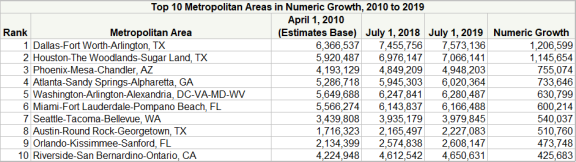
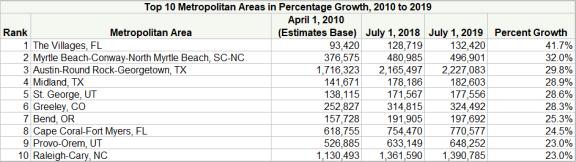
@Gregmal, you're too fast :-). Below is what I had posted. I had removed it as I realized I was getting into multiple topics here. Reposting the topic on geographical growth differences. I'll find another relevant thread to post the other topic. 7.7% population growth in New York from 2010 to 2020 (over 10 years) is actually just close to U.S.-wide population growth of 6.3%. Here is where the real growth happened from 2010 to 2019 (over 9 years) according to https://www.census.gov/newsroom/press-releases/2020/pop-estimates-county-metro.html. 2020 Census results are consistent with this. These numbers are pretty much all pre-covid. Wonder where the growth happened post-Covid, and if Covid just caused acceleration of existing growth rates above. Wonder if you can just follow where builders are piling up orders for new construction to see where growth is. It will take some time for builders to build and folks to move to their new homes.

-
Thanks @Gregmal :-). I totally blew it on the Chevron stake though. The $1.984B reduction in cost basis of "Commercial, industrial and other" was so close to his cost basis on remaining Chevron shares of about $1.964B.
-
Regarding Chevron stake Dec 31, 2020: 48,498,965 shares for a cost basis of $4.024B March 31, 2021: 23,672,271 shares Assuming all Chevron shares were acquired around same cost, remaining Chevron cost basis was then around (23,672,271/48,498,965)*4.024 = $1.964B. Because cost basis of "Commercial, industrial and other" went down by $1.984B, looks like he sold out Chevron completely. In addition, he trimmed something else by $20M in "Commercial, industrial and other," or my math above has an error, or he kept somewhat different cost Chevron shares in Q1 and sold those now, or something else?
-
Cost Basis of "Commercial, industrial and other" went down by $1.984B. Wondering if he sold more of Chevron? Wondering if he added any to VZ? Looks like maybe not? Cost Basis of "Banks, insurance and finance" went up by $654M. Wondering if he bought more of MMC. Looks pricey, but maybe BRK depends a lot on them and thinks they need them to compete with PGR? Doubt he added to any banks? Cost Basis of "Consumer products" went up by $98M. Maybe added to KR?
-
Interesting executive order that moves us only a tiny bit towards the right on the spectrum of Perfect monopolies<-->Perfect competition. https://www.whitehouse.gov/briefing-room/statements-releases/2021/07/09/fact-sheet-executive-order-on-promoting-competition-in-the-american-economy/ As we all know, perfect competition means lower prices, zero profits, and arguably more economic growth, but really hard to achieve. The irony is CCP wants to be right of the spectrum compared to the U.S., and will probably stay so. Anyway, looks like mergers will be harder during this administration. For example, we can forget about Dish being acquired by any tech company, which might actually entrench the restricted spectrum oligopolies further. Any other impacts to any company's shareholders folks see due to the small measures in the executive order?
-
Thanks @nafregnum for sharing. Highlighted is exactly the answer I was looking to confirm.
-
As of 2014, "FXI’s top holdings include[d] Tencent Holdings ( 700.HK ), China Mobile ( 941.HK ), China Construction Bank Corp. ( 939.HK ), Industrial & Commercial Bank of China ( 1398.HK ), Bank of China ( 3988.HK ), China Life Insurance ( 2628.HK ), and Petrochina ( 857.HK )... With FXI around $39" See https://www.barrons.com/articles/the-alibaba-effect-1416274234
-
Thanks @Spekulatius, which specific companies were you thinking here?
-
My apologies if that is how you felt from my posts. I'm actually impressed by what CCP has achieved for China in terms of growth, but as @Spekulatius pointed out, growth may not lead to shareholder returns. I am usually careful with my words in making accurate statements and often provide a source to what I say. If there is something that I said that was really egregious, please let me know, and I'd be happy to clarify. If you're thinking about the BABA thread, I believe, as investors, we should think critically about our investments to figure out entry point and how big of a position to have. I was hoping I could save some time if you or someone else has already figured out the reasons why Chinese indexes didn't perform over the last 10 years. It is an important question for me in considering Chinese indexes as a potential investment. My gut feel is that it is one of the reasons I listed above, but I am open to learning if someone else has already figured out the specific reasons. Next step after that would be figuring out if those specific reasons will continue.
-
Thanks @Spekulatius, I agree a growing economy or a growing sector for that matter may not accrue much to the shareholders if there is perfect competition. I was just curious of the specific reasons for the Chinese indexes over the last 10 years to see how much those specific reasons will continue.
-
Thank you for sharing. Great how it called out interesting parallels to today that led to 1989 Nikkei 225 peak of 40,000 in Japan: "[S]ince interest rates remained low and the rising yen discouraged investors from taking their money abroad, the Japanese people were left with no alternative but to continue investing in the domestic stock market." "Nomura had five million loyal domestic customers, mainly Japanese housewives, who daily put their savings into special Nomura piggy banks, played stock market computer games on Nomura software, faithfully followed Nomura's stock tips…" "Encouraged by low interest rates, people took out fresh loans against the equity of their homes." Nikkei 225 subsequently fell by 80% to 7700 over the next 13-14 years by 2003 even though the "Official Discount Rate was successively cut until, in September 1995, it reached an all-time low of 0.5 percent. The rate remained unchanged until September 1998, when it was cut to 0.25 percent."
-
What do folks think Li Lu means by following? Is he saying Chinese indexes are not good to invest in because China hasn't yet "entered the modern age," or is he saying they are good to invest in? Chinese indexes haven't gone anywhere over the last 10 years. Wonder if it is because companies have been making false accounting statements/projections, companies have been printing shares, CCP hasn't been letting companies exercise pricing power, new companies have been entering at a fast rate & increasing competition, existing companies have been expanding & competing too much, P/E multiples have compressed, or something else? Has anyone looked into it?
-
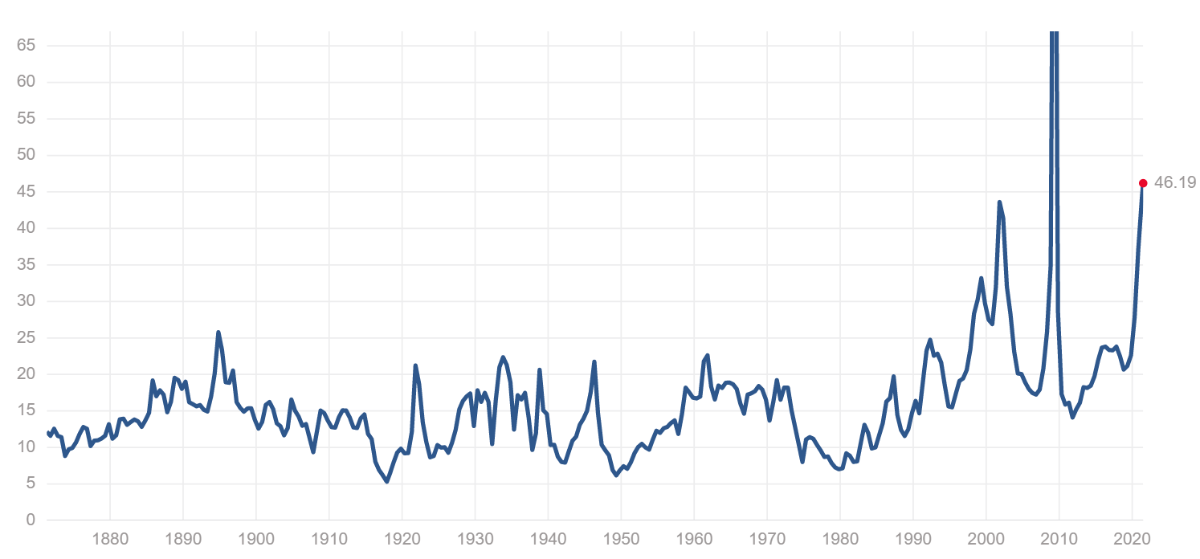
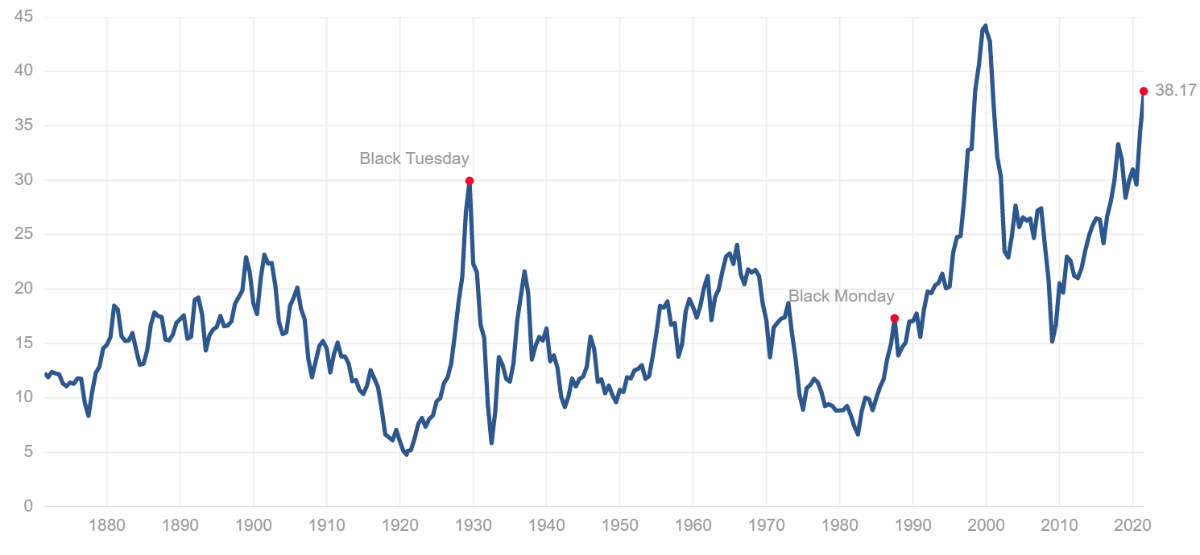
S&P 500 P/E now at 46.19 and Shiller P/E at 38.17. How much more to go till peak? Source: https://www.multpl.com/s-p-500-pe-ratio Source: https://www.multpl.com/shiller-pe
-
Thank you for sharing. Very inspiring:
-
20210629 CNBC interview with Warren & Charlie?
LearningMachine replied to kiwing100's topic in Berkshire Hathaway
His comments about Jack Ma and communists were indeed the most interesting parts :-). I also found the following interesting: -
Different instances of the same reinforcement-learning based AI model also generates a 'range of answers' just like different instances (humans) of same/similar reinforcement-learning based human neural net. Even the same instance of the reinforcement-learning based AI model will also generate a 'range of answers" as it learns or accumulates bias just like the same human neural-net can generate a 'range of answers' as it learns or accumulates bias. I believe if you've enough computation power and signals, you can model human behavior. What some of the tech companies do today in terms of rewarding reinforcement-learning based neural nets for being able to predict and get human neural-nets to do what it wants to do is a start of modeling human behavior. Over time, I think human neural nets will be no match for silicon-based neural nets that have access to way more data and computation power.
-
Thank you @Cigarbutt and @Gregmal for sharing. This is a fascinating multi-disciplinary look at the issue. I haven't read the book yet, but have been thinking about this topic through the lens of multiple disciplines, including the ones you mentioned. I'm still synthesizing, but the discipline that has helped me the most so far in reaching a deeper understanding here was probably AI. When trying to improve accuracy & precision of decisions made by AI neural nets running on silicon-based-computation, sometimes you go back and try to figure out what led to each incorrect decision. Sometimes it might be noise or bias in your raw input, a lot of times it might be missing signals, and other times it might be an issue in one of the intermediate signals in your machine learning ensemble or one of the layers of the neural net. The interesting thing is issues end up being some of the same things @Cigarbutt mentioned above for human neural nets running on hydrocarbon-based-computation. One of the most fascinating moments for me was when the team was analyzing an incorrect decision made by AI to try to figure out why it made the incorrect decision, and then the team realized that the decision made by AI was actually the right one and the human expert in the team had made the wrong decision and labeled it incorrectly. The look on the human neural net's face was priceless :-). He was defending his decision up to some point, but finally went all red and said, "Humans can't get all decisions right, you know." When silicon-based-neural-nets can start outperforming hydrocarbon-based-neural nets for some decisions at such an early stage of AI, it really makes you realize that maybe life is broader than our hydrocarbon-focused view.
-
Buffett/Berkshire - general news
LearningMachine replied to fareastwarriors's topic in Berkshire Hathaway
I'm curious here too. Because he did this in an IRA account, I wonder if he was willing to hold things for much shorter time periods as he didn't have to worry about capital gains? What do folks think? Also, has anyone figured out a way to distinguish between Ted's and Todd's investments on the Berkshire 13F? Do we know any of the investments in Berkshire portfolio that were definitely made by Ted? Also, wonder how was Todd's record before Buffett took him on? I wouldn't be surprised if he looked for a great record there as well.