gfp
-
Posts
8,121 -
Joined
-
Last visited
-
Days Won
20
Content Type
Profiles
Forums
Events
Everything posted by gfp
-
BHE will still have a hugely negative tax rate because they will not lose the production credits on what they already have in service. The bonus depreciation I was referring to started at 100% back in 2017 but was being phased down and was 60% in 2024, would have been 40% this year, etc... Now it is back to 100% and BRK is a large cash tax payer.
-
https://www.cnbc.com/video/2025/08/05/watch-cnbcs-full-interview-with-president-donald-trump.html So CNBC had this interview with the president this morning. Nobody challenges a single mistake in what they are saying. They are complaining about the establishment survey but start by showing a chart of the response rate for the Household survey, a completely different set of data. Then they repeat this line that they revised the jobs numbers down by 818k "right after the election" when it actually happened in August 2024 - the election was in November 2024. The entire narrative and timing is completely wrong but nobody asks a question or corrects it. It's just taken as fact.
-
Thanks - I see now that one date was "started construction" and one date was "placed in service"
-
This is just for solar and wind, not all "energy property construction" Berkshire will be a large beneficiary of accelerated deprecation / 100% bonus depreciation for capital investment. They will finish what they can finish on the green energy side and go with the flow on new investment. BHE is going to do just fine This date should be 2025 not 2027 right? ------ From the recent BHE 10-Q: On July 4, 2025, the One Big Beautiful Bill Act (the "OBBBA") was enacted, introducing substantial revisions to federal energy-related tax policy. Among its provisions, the OBBBA accelerates the phase-out of clean electricity production and investment tax credits and establishes new sourcing requirements applicable to facilities commencing construction after December 31, 2025. The Company is currently evaluating the potential implications of the OBBBA on its future financial results and will assess its impact on the viability and economics of prospective renewable energy, storage and technology neutral projects. On July 7, 2025, a federal executive order (the "Executive Order") was issued directing the Secretary of the Treasury to promulgate new or revised guidance consistent with applicable law to ensure that policies concerning the "beginning of construction" requirements are not circumvented for wind and solar-powered generating facilities. Such guidance may materially affect the applicability of safe harbor provisions and impose more stringent compliance thresholds for eligibility than under existing tax credit frameworks. The Company is actively monitoring developments related to the Executive Order and intends to implement practicable measures to mitigate any adverse effects on its prospective renewable energy projects. The Company's future financial performance and capital expenditures related to renewable energy, storage and technology neutral projects may be affected by the combined effects of the OBBBA, the Executive Order, and broader macroeconomic and geopolitical conditions, including changes in international trade policies and tariff regimes. The pace of change in these areas has accelerated during 2025, and significant uncertainty persists regarding the scope and duration of these external factors. Accordingly, the Company is unable to estimate their impact on its business at this time.
-
I think you guys are wrong about QE and QT. They do almost nothing and often times have at least as much effect in the opposite direction of their intended outcome. One thing QE accomplished was tightening mortgage spreads to their treasury benchmark but I think most of that effect was the effective duration of a 30 year mortgage plummeting during an extended refinancing boom and the appropriate treasury benchmark moving closer to the 2 year bond than the 10 year. QE removes useful treasury securities from the private sector and replaces them with bank reserves, a neutered form of token that only the largest Fed member banks can use. Since lending by the largest banks is not in any way constrained by the level of bank reserves in the system (lending is constrained by demand for loans / balance sheet / regulation / risk adjusted capital requirements), excess bank reserves parked at the fed is not the same as the "cash" most people imagine QE raining down on the economy. A treasury security is the bedrock collateral of the world financial system and can be leveraged, pledged, transformed, swapped, repo'd - it is useful collateral to the private sector. A bank reserve is next to useless unless the level of reserves in the system is too low (it's huge relative to history). At the time they were big on QE, the treasury coupon securities they were removing from the private sector paid interest and the bank reserves paid nothing or next to nothing - removing interest income from the private sector. That is why the Fed's balance sheet was earning a big "profit" during those years - remitting those profits to the treasury. That is the same as a tax - interest income that would have been earned by the private sector is earned by the Fed instead and remitted to the treasury to help reduce the deficit. Tax. (opposite of stimulus) Presently, the excess reserves pay a higher rate than the treasury coupon securities on their books so the Fed's balance sheet is producing losses. This is stimulus. When the Fed pays more net interest into the private sector than it earns it is additive to the fiscal stimulus.
-
https://www.sec.gov/Archives/edgar/data/315090/000095017025102303/xslF345X05/ownership.xml
-
Yes. Last quarter's book value per b-share is $309.64 so we traded below 1.5x today
-
I'm not super bulled up on Berkshire but I had to buy a tiny amount this afternoon on general principle. Hey big spender!

-
Makes me wonder what ever became of our young board member Blake Hampton? Hope he is well and just went on a summer vacation.
-
What on earth is the holiday today Canada? I swear every time I try to place an order y'all are on vacation
-
You guys can call him "not book smart" all you want but I, for one, am excited for the drug prices to go down by 1500% ! https://www.forbes.com/sites/brucelee/2025/08/02/trump-says-he-will-get-drug-prices-down-by-1500/
-
I noticed Pilot was paying down their debt fairly quickly (it is now owed to National Indemnity instead of high priced bank money). Hat tip to kingswell newsletter who pointed out this article mentioning that Pilot may be further pruning non-core businesses (there were quite a few!) by selling their water pipeline / management unit -> https://www.ttnews.com/articles/pilot-sale-explore-water?utm_source=substack&utm_medium=email
-
Yes he did (although he got the math wrong for the first 6 months). My point was that nobody was writing 1000 word twitter threads harping on the over-reporting of Berkshire's earnings last year. They wait until this year when the adjustment helps make a bullish case to make their point. Bloomstran, below: Long story short, properly excluding currency changes on foreign-denominated debt, operating earnings rose 7.9% in the second quarter and 3.1% for the first half, where most are reporting a 3.8% decline in the quarter and 8.9% decline in the first half.
-
It's not so much the asset side that distorts things. Berkshire borrows in Euro and Yen and those changes get put into Berkshire's operating earnings. We over-reported earnings for a while and now there is a tiny pullback in the dollar. Doesn't seem fair to omit it the minute it starts being a headwind instead of a huge operating earnings tailwind.
-
Welcome mengan - I have enjoyed your posts! I wasn't trying to pick on you or anything. Just reading and thinking out loud
-
I don't think Berkshire would be allowed to "write it up again" once an equity method investment is written down because it was deemed to be 'other than temporarily impaired.' The equity method investment (OXY in this example) would be written up by Berkshire's share of undistributed profits or the primary way it would be "written up" in the future would be on a sale or merger that resulted in discontinuing the equity method (all stock deal with Chevron, BRK's position could become mark to market for example - less than 20% of CVX). Sale for cash obviously would become whatever cash showed up. That was one of the reasons short sellers saw red flags at Fairfax - their minority interest deals allowed them to "write up" the value of certain subsidiaries when that is extremely rare in corporate accounting. Especially since they were selling de-facto fixed income preferred stock and not plain vanilla equity at the claimed valuation. It wasn't a scam at Fairfax, and it may have been an IFRS quirk that wouldn't fly in the US - but it raised red flags for a reason. Berkshire can't write up the value of GEICO even though it is held on the books for much less than it is worth today. You have to dig yourself out of the new impaired value with your share of undistributed earnings or a sale if you want to recover the accounting value.
-
The stock is very illiquid so if they were being disciplined and only buying around that price or lower they didn't have much opportunity to buy more. They were competing with me down there LOL
-
At $60 billion market cap it seems like the market is being pretty generous, no? Maybe it was just ahead of itself in 2021
-
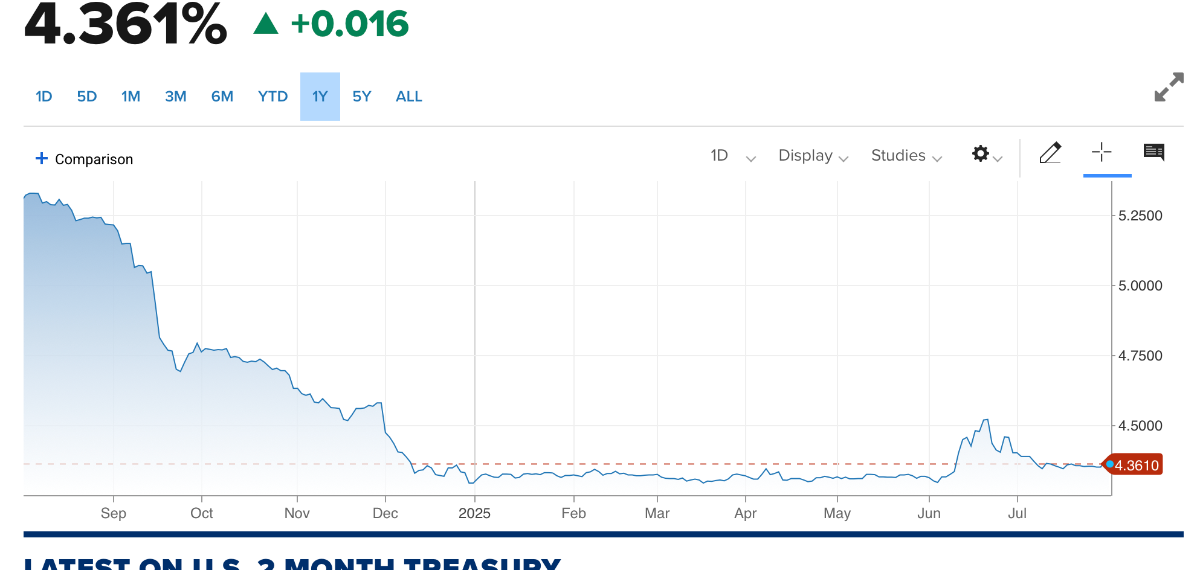
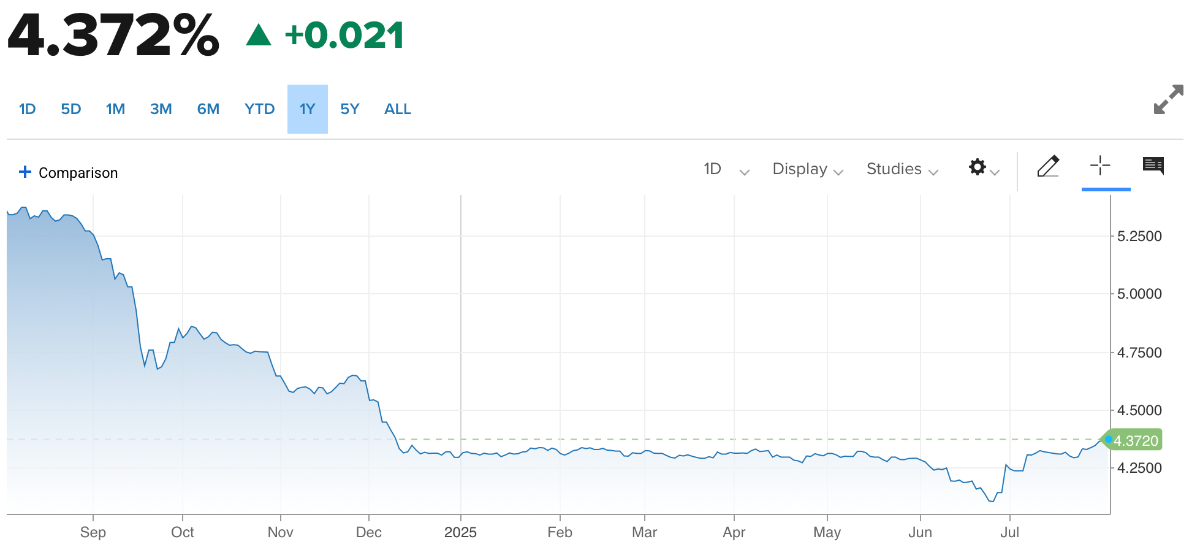
Not really. It's almost entirely t-bills. They call it "cash" when the t-bills are 3 months or less when purchased. They call it "short term investments in t-bils" when it's longer than 3 months. There was a distortion available in the t-bill market during the quarter where t-bills that had a maturity right around the estimated debt ceiling x-date traded with above market yields. Some funds and other market participants avoid maturities that could fall right on a messy date. Berkshire isn't afraid of such things and probably purchased those bills and got a few extra basis points of income. The anomaly subsided as soon as the debt ceiling increase was passed. Here is a graphic representation of what I am talking about from CNBC's crude "2 month t-bill" yield index: You can see how it caused a corresponding distortion (rates unusually low) in the maturities that didn't fall during the estimated x-date range. Here is the same chart as above but for the 30 day t-bill:
-
Thanks for sharing that @nwoodman - how do you calculate $84 Billion in investments? I never had the number that high
-
for a quarter where the share count went up from 21.581m to 21.5918 million shares?
-
IFS_Q2_English.pdf Link is available now - https://www.fairfax.ca/wp-content/uploads/2025/07/FFH-2025-Q2-Interim-Report-Final.pdf
-
https://www.globenewswire.com/news-release/2025/07/31/3125503/0/en/Fairfax-Financial-Holdings-Limited-Financial-Results-for-the-Second-Quarter.html
-
The entire interview with Chris Davis is up on youtube and bloomberg now. The earlier videos were just short clips it turns out. https://www.youtube.com/watch?v=VTrE0PgZyvI
-
Seritage had to send Berkshire another $8 million cash to extend their loan maturity by one year. This was an option they had negotiated earlier in case they couldn't get the BRK loan paid off in time. Ain't running no charity here! https://www.sec.gov/ix?doc=/Archives/edgar/data/1628063/000095017025100344/srg-20250728.htm