nsx5200
-
Posts
625 -
Joined
-
Days Won
4
Content Type
Profiles
Forums
Events
Everything posted by nsx5200
-
There are many contributors leading to the obesity epidemic. The farming policy that favors big farm, big sugar, big beef is just a part of it. On the guideline side, there's also the USDA, which has a hand in updating the guideline, and influenced by https://en.wikipedia.org/wiki/Regulatory_capture from big farm. The conflict of interest is obvious when you look at the history to add sugar to the US nutritional label. From Nutrition Facts Label "Some of these changes sparked a major debate between the food industry and public health agencies. The proposal to indicate sugar added during food production, particular, was brought forward by the FDA as a measure to counter the increase in per capita sugar consumption in the US, which over the last decades exceeded the limits recommended by scientific institutions and governmental agencies." When the body creating the nutritional label fights scientific data, you know they've been bought off. The nutritional guidelines propagate down to the school lunches, official recommendations taught in school, and in medical education. Ultimately, it goes towards increasing the consumption of processed foods just so the food companies can make a buck. The gist of it is that if most people ate lightly processed foods, most of the food companies will go out of business since their 'value-add' is in the processing. So they've been steering the regulatory bodies towards stuff they can process, most of which are carbs (think snacks, ready-to-eat stuff, etc.). Walk into a typical American grocery store, and you'll find that most of the floor space that sells food is processed carb/sugar related. The TLDR version is that there are certainly some events and people that have been outed as major contributors in the epidemic, but even without them, the market forces for trying to 'add value' to food would've lead to similar situation that we're in right now. So IMHO, it's a bit unfair to point our fingers at them, when we should be focused on fixing the problem (especially the conflict of interest parts in the systems). These topics can go really deep, and would like to see if a tighter integrated health system like the NHS in UK can have a better outcome. That's just my humble observations, others may (and most likely will) have a different viewpoint.
-
My experience with a stock that's gone way up beyond expectation is to sell off at least a decent portion of it to lock in at least some(or most) of the profit. If you fear the wife factor, keep the remaining unsold portion so even if it goes to 0, you'll still have something to show for it. If it goes to infinity, what you sold will look insignificant No matter what happens, your brain will mark it as a win, and you'll still look wise to your wife no matter what. Good problem to have. We all wish we were in that situation. Thank you for sharing this fun story.
-
https://www.wsj.com/health/pharma/rivals-emerge-to-ozempic-and-zepboundbut-with-a-lag-60b555bb?mod=WTRN_pos5&cx_testId=3&cx_testVariant=cx_160&cx_artPos=4 "There are dozens of promising biotech companies developing weight-loss drugs. Among the larger drug companies, Amgen AMGN 0.74%increase; green up pointing triangle and Roche stand out at the moment, and Wall Street is giving them some credit for it." That didn't take long...
-
Just curious, how does volatility factor into your investment strategy?
-
If you have to rely on getting the growth rate correct within 5%, you're most likely in trouble. It's more important for you to understand the hidden meaning behind those heuristics. Enduring high ROIC/profit margin can imply wide moat. Enduring growth on top of inflation normally imply the market is not fully tapped yet. A company with both characteristics is generally considered a pretty good company. You're better off learning from Li Liu here (https://roiss.substack.com/p/li-lus-investing-masterclass-at-columbia) than from KCM, IMHO.
-
The type of material that they stuff into the education is absurd as well. When was the last time you needed to know the different mechanism that cell uses to store and use energy, along with all the nomenclature? They force them to memorize these niche information that are useless outside of the intended field, and use the result to rank the kids. Big picture-wise, it's important to know the ideas like scientific method, math up to at least Algebra, etc... At some point, they might as well use something arbitrary like peeing contest to rank the kids (although, the female would be disadvantaged).
-
https://www.wsj.com/world/china/chinas-politburo-pledges-steps-to-boost-consumer-spending-f18e6a5b "As the recovery has shown signs of slowing this year, China’s central bank has already jumped into the fray, delivering a string of surprise rate cuts last week that amount to the most substantial easing of monetary policy so far this year." "The Politburo’s downbeat tone indicates that more policy support and stimulus could be in the offing." As much as I dislike the CCCP, they are working on the issues, which is good for everyone inside and outside of China.
-
Bitcoin mining in the states is exploiting a loophole in the uniform billing of electricity in many parts of the states. In other places, where they have time-of-use (TOU), electricity price changes with the supply-demand, so it's actually worth while to shift energy usage towards the cheaper (less demand) part of the day. Many places in the States have fixed pricing that do not change, and only get adjusted periodically, allowing bitcoin miners to leverage the average of the total demand (including the portion that's outside of bitcoin mining), and essentially spread the actual electricity cost to the whole market. This allows for absurd situations like this one: "Bitcoin mines cash in on electricity — by devouring it, selling it, even turning it off — and they cause immense pollution. In many cases, the public pays a price." https://www.nytimes.com/2023/04/09/business/bitcoin-mining-electricity-pollution.html Your premise that bitcoin mining runs off unwanted electricity is mostly false. If I wanted to transact on the bitcoin network, would I put up waiting for several hours until the electricity demand has died down for the transaction to go through? The answer is obviously no. To provide a near real-time network, bitcoin network must consume electricity, no matter what the aggregate electricity demand is. Even if there are spare electricity, there are better ways of utilizing it. Storing it would be the best, but plenty of stuff can utilize spare electricity like hydrogen production. Yes, there are plenty of waste in the system already, but adding in one more unnecessary waste that has no added benefit to society/human kind really doesn't help advance humanity.
-
Thanks. That's a great long-term view of that particular issue, even though that food safety is a long-standing issue within China. It is nevertheless a good way to view contemporary issues. I read somewhere that Charlie Munger gave a speech on China something along the lines of "China, 2000 years in the past, 2000 years into the future". Did anybody run across any of that material? TIA.
-
https://www.economist.com/china/2024/07/18/fury-erupts-in-china-over-a-food-safety-scandal “A great nation is rising. But it can’t even guarantee the basic safety of cooking oil,” wrote one of many outraged users on Weibo. I think that's a great summary. The race to be the lowest producer of consumer goods, world-swaying military force is not as easy as China make it out to be. The population in China are merely tools for the CCCP to advance their agenda, and if not controlled properly, can turn on the CCCP party. That's the true open-secret: people can easily be enemy for the Chinese government in the long-term. Note that previous whistleblowers to such scandals have not been praised, but have disappeared, or at least been censured, so it's likely these type of issues will continue to pop up. Like previous food scandals, its citizens are forced to devise solutions on their own. Chinese people import milk powder not because they're so prosperous, it's because they're forced to fend for themselves. Journalist have reported increased sale of home oil presses. https://www.nutraingredients-asia.com/Article/2024/04/15/major-infant-nutrition-brands-gaining-market-shares-in-china-despite-shrinking-birth-rates#:~:text=Register here.,Trending ingredients As of last December, the top five English label infant formulas in China in terms of market value share were Aptamil (44.5 per cent), a2 milk (20.6 per cent), Nestle (6.7 per cent), Mead Johnson (4.9 per cent), and Friso (4.2 per cent). In terms of China label products, Feihe took the lead at 21.4 per cent, followed by Yili (9.8 per cent), Aptamil at 7.7 per cent, Friso at 7.2 per cent, and Junlebao at seven per cent, data from Kantar Worldpanel showed.
-
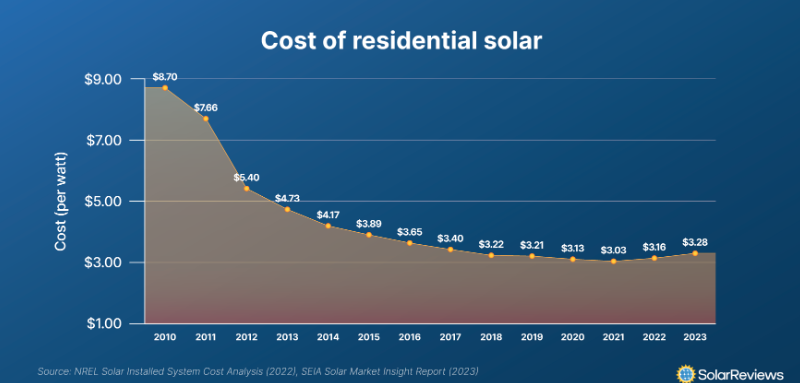
Cost reduction have already tapered off. The big chunk happened when China got into it a couple decades ago, and lowered the panel cost significantly. It's still a slow grind to get cheaper energy, and we've got to keep an eye on this AI+bitcoin energy suckers as well. Like Charlie, I wouldn't mind if the government bans bitcoin mining. At least AI is actually useful. https://www.solarreviews.com/blog/how-has-the-price-and-efficiency-of-solar-panels-changed-over-time

-
In my mind, there are plenty of those type of shady actions happening in traditional retail investment space. One side of the house will promote one investment, while the other side of the house will advise, or even dump the same investment. These conflict of interest have dribble in and out of the news, even from the big 'well regarded' investment houses, and AFAIK, no real significant actions were taken against them. Why go after the big fish when the little fishes are easier to catch? The biggest problem with Left is that he didn't grow big enough not to prosecute. Too big to fail, too big to prosecute. Just like in 2008. If anything, I wouldn't mind something like what they did with the tobacco industry. Force anybody that hawks investment to have a standard disclaimer, and possibly have a softer solution like a TrustPilot/Yelp review of sorts that ranks the trustworthiness of their statements. That's just a off the cuff thinking (and I'm no Charlie), so the correct solution may take a few iterations to get right. Hard regulations like always have strange technical loopholes as well as unintended side effects, like people have mentioned above.
-
That along with Greenblatt's book make me think the SEC is shady and at times ineffective. I'm surprised the courts, with their emphasis on consistency, does not butt head with the SEC more often with such inconsistent enforcement actions. With the overturn of Chevron, I suspect more people will be willing to fight the SEC, and I seriously hope they win, even though it may encourage more fraudsters. Such is the price of liberty.
-
Eh? How's his action different from Roaring Kitty? Or Fahmi Quadir, Greenblatt or even Elon? Doesn't that type of enforcement also run afoul of freedom of speech? I hope some court quickly slap the inconsistent enforcement behavior of SEC and US prosecutors in the face.
-
I'd be a bit wary with SCMP, as any independence Hong Kong had is essentially no longer, and SCMP is more or less a mouth piece for the CCP now. The way to properly evaluate that statement is to ask yourself if you would personally move to China yourself, and see where the the people are generally moving; people do not willingly move towards a worse system. To me, US immigration problem is actually a good problem to have. https://www.wsj.com/world/china/china-economy-debt-borrowing-33f08b5e?mod=hp_lead_pos7 The issue with an opaque system is that you need to double-check the official figures to get a more realistic figure, whereas a more transparent system can be trusted more. The disadvantages of a top-down government are fairly well known, and with Xi in power, I suspect there's not a huge desire to push that power towards the people. Not saying the democratic/capitalistic system is perfect, but looking at the trend, China's moving further towards a top-down system, and we know how that turned out in the case of USSR. I would claim that China's huge growth in the past decades was a result from Deng's effort to push a lot of that power towards the people, which is currently being rolled back. The opaque plenum top-down meeting is where the feedback and course correction happens, so I'm looking forward to see the outcome of that. The good thing about a democratic system is that it's a system created by the people to solve the issues for the people as it's primary mission. Whereas an authoritarian system's primary mission is to keep the authority in power. Solving issues for the people works only to further its primary mission. Maybe I drank the kool-aid and am seeing through tainted lens.
-
I don't know about heading the right or wrong direction, but social discourse, IMHO, is a sign of a healthy democracy. Without social discourse, it's less feedback mechanism for society to improve. All those concerns are very valid points against western society, but I don't think they're solely the product of western society/value. There are stories in China where people are so distrustful of the fallen that they don't even dare try to help them (https://www.bbc.com/news/blogs-china-blog-34612516). Current democratic/capitalistic society is not without issues, and it'll get worse as the trend toward fully mechanization/automation becomes a reality. We'll need discourses to correct them. Exposing the issue is the first step in correcting them and I'm glad somebody took the time to list them so that they can be addressed. I think the proper way to evaluate these contemporary issues is to take a step back, and look at it from a 20+ year span, and the perspective changes significantly.
-
When a government needs to resort to censorship, even for something as innocuous as Youtube, to control the thinking of its people, I'd be very skeptical of what it pushes. Corruption crackdown, viewed in a different light, is a mask for the removal of political adversaries. I'm not saying that's what happened in China, but it's important to keep that in mind, as there's not enough evidence one way or another to say which one is which, from my limited point of view. Not saying that the mass media in the free world doesn't have bias leaning, but given the choice... you know what the 'correct' solution is.
-
That's the propaganda portion. The real power is not with people with capital, but with people with connections to the CCP party(and thus government positions). I don't have articles references on it, but I've been watching Youtube videos where children of government official describe that type of system. Government officials are essentially mini-kings over their 'area of responsibility', and senior official holds similar power over less senior officials. So the meritocracy is actually an autocracy. We've seen the result of that in their seemingly arbitrary decision to completely close and re-open to handle COVID, and not really based on a consistent transparent approach. We're currently seeing their opaque approach to addressing their current real estate issue. Maybe they do have a method to their madness that can eventually solve their issue, but it's really not transparent. Same thing with how they dealt with Qin Gang... well. Actions speaks louder than... dare I say propaganda?
-
At this rate, our best bet is to have our resident real estate expert get together, and we can all pool together some money to buy out a nice building. BLF have their flashlights, COBF will have our buildings.
-
Yet China's rich are leaving the country... https://www.newsweek.com/china-millionaires-leaving-country-1916427 With the kind of propaganda that China can push, and does push, I'm always wary to read articles that pushes only the positive of China. I find that the action of the people speaks much louder than any article/opinion. Just ask any North Korean outside of North Korea.
-
I think a lot of the great investors park their cash at BRK, so I've been doing that. What did you pick up with the sell?
-
My buy limit price got triggered, and caught some baby Berkshire.
-
I wasn't old/wise enough to analyze/understand it back then, but I believe that was how MCI was able to absorb so many companies before it imploded (that and it cooked its own books). Some things never change.
-
https://en.wikipedia.org/wiki/Amur_Annexation They're realists. If Chinese government weren't in such poor relationship with the rest of the world, China would've already recovered if not negotiated the recovery of the huge land mass around Amur by now. Why muck with a few tiny islands in the southeast when they can recover more land mass, as well as 'righting past wrongs' from past unequal treaties. This probably summarize the CCP government's attitude the best https://www.voanews.com/a/ukrainian-youtuber-finds-her-ai-clone-selling-russian-goods-on-chinese-internet-/7509009.html They're like the two prisoners in the prisoner's dilemma currently in an unstable but optimal state. It's probably just a matter of time until it transitions to a more stable state (ironically, the more stable state is actual real instability for either countries).
-
Biggest regrets of the older posters here?
nsx5200 replied to yadayada's topic in General Discussion
Kids are fun. We had twins first (twins are always unexpected), and then we had another unexpected singleton. No regrets. I read some study saying that parents are always less happier with kids, but when you ask them about it, they all say it's worth it. I guess we're all just a little bit of masochist inside. Yeah, the one thing that I regret was not having enough photos of them when they were young (and I took a lot). In the future, all the little one's life will be recorded almost constantly, and the AI will pick out the interesting parts for us to look at. There is a market for that, I guarantee it.