Saluki
-
Posts
2,771 -
Joined
-
Last visited
-
Days Won
5
Content Type
Profiles
Forums
Events
Everything posted by Saluki
-
 I'm halfway through this book and I'm really enjoying it. It was released a few years ago and didn't get much attention. I was going to skip it because I've got investing books to fill a small library, but when I saw that Seth Klarman and Bill Miller gave it a good blurb and that Peter Lynch wrote the forward, I decided to give it a go. There aren't really any specific formulas or criteria in the book that are helpful. It's like when Buffett says that you should buy good companies at reasonable prices and doesn't give much guidance beyond that. But it is very good at pointing out things to look out and things to avoid. It reminds me a lot of the Howard Marks' book, The Most Important Thing, but with some Charlie Munger "invert, always invert" thrown in. The only thing I can't square is the number of positions Tillinghast has. His fund had over 800 positions. It's easy to outperform (or underperform) the SP500 if you have few positions, and as the number of positions goes up it gets almost impossible to beat (or even match after fees) the SP500, so if he was able to beat it, even a small amount (and apparently with less volatility) with so many positions is impressive. But he, like Buffett and many others, says that you make the real money when you get a no-brainer and concentrate in it. He was Lynch's protege so maybe the army of analysts and all the positions is just how he learned to invest at a fund, but the advice for individuals is different? Still a worthwhile read though.
 -
I enjoyed this book also. It isn't your usual finance book but it's got some thought provoking reframing of common attitudes. It's not so much a "how-to" book as a "think about why" book. It reminds me of Your Money or Your Life by Joe Dominguez and Vicki Robin, but with less emphasis on F.I.R.E. stuff.
-
"The key organ in your body in the stock market is your stomach. It’s not the brain. If you can add 8 and 8 and get reasonably close to 16, that’s the only level of math you need to know. " I've always liked this Peter Lynch quote. He's got a lot of pithy quotes.
-
Added some NETI and started a small position in POWW so that I can keep it on my radar.
-
There's a couple of cumulative prefereds that I'm looking at. Here's one: https://finance.yahoo.com/quote/SRG-PA?p=SRG-PA&.tsrc=fin-srch it's at $23.17 with a $25 liquidation preference. currently a 7.58% dividend at this price. Seritage is in a kind of run off mode now and selling off the non-core assets to pay down debt and are open to selling off the entire company. I fell like I'm watching someone defuse a bomb while the timer ticks down. Assuming the common survives and stabilizes long enough for someone to buy what's left and they call the preferreds, you get that dividend plus another 8% ($23.17x 1.08 = $25) when they close you out at par. If it happens soon, it's not a bad place to park your money. There are people who are long the common, so maybe this would appeal to them, because if the common survives, then this is money good, but it's a lot of uncertainty. You will get your $25 before the common equity holders get anything, but if there is something that really goes sidways, the debt holders will get paid out first and that $25 is not guaranteed if there is nothing to pay it with. I'm looking at another cumalative preferred too, much smaller and less debt, and yielding 9% but haven't had time to read the 10-k yet so I don't want to mention it yet.
-
I own some BABA and have been raked over the coals by the Chinese government, so I'm more comfortable now with India (Fairfax India) Korea (Coupang) or Mexico (Televisa) going forward. When Jim Rogers mentioned his bullishness on China, he analogized it to the US in the early 1800s. If you had invested in the US you were buying into the incredible growth. It was lumpy and you had a civil war, the great depression, a genocide of the Indians, several wars with other countries, numerous presidents assassinated, the bankruptcy of the railroads, corrupt politicians and judges, but it was so good that being directionally correct was enough. But I've soured on that outlook because even if he is right, I don't have 200 years to ride out that volatility and if the legal institutions and respect for property rights isn't there, will my ADRs be worth anything to my grandchildren? If you were a British merchant and had invested in NY Gas Light Company in 1824 and left the shares in a safe that was hidden, when your descendants came upon the shares almost 200 years later, they would be entitled to the shares in ConEd and all the uncashed dividends along the way. I don't think anyone believes they wouldn't get every penny of it. As a country with a strong central government that does what it wants, even if it overrides people's rights, it can move quickly and get things done. But what are the odds that Xi's successors will always act in a way that benefits China and not themselves. A powerful central government only needs one autocratic leader who won't step down to turn it into a dictatorship. The Chinese people have never had a democracy, so would they even notice if the power grab was inch by inch instead of all at once? Maybe a war with Taiwan is what they want to rally everyone behind the rulers and jail anyone who opposes them? Who knows? I feel fairly confident that in India you get some of that Asia growth story and some of that Commonwealth legal system respect for property rights that has benefited most of their former colonies (US, Canada, Australia, NZ).
-
There are probably a lot of places, besides the equities markets, where people who are smart and numerate are making a killing because they aren't the type of places that finance guys go to, like horse races. If you are surrounded by people who are innumerate, then "in the land of the blind, the one eyed man is king." As long as you do it quietly so others don't catch on and crowd your trade, you can keep raking money in. Like Ed Thorpe did in the early days of the Black Scholles option model when he had a better version of the model, but used it to get rich instead of publishing papers and winning a Nobel Prize. And, he knew what the model the other guys were using was (because it was published!) so he knew it's weakest spots (convertible bonds). This discussion reminds me of the guy who made a lot of money in the Lottery due to a quirk in the rules. Again, the Lottery is normally a place that people in finance wouldn't go near. https://highline.huffingtonpost.com/articles/en/lotto-winners/ I've remembered this line for years, which reminds me of the equity markets: "The lottery is like a bank vault with walls made of math instead of steel; cracking it is a heist for squares."
-
added a little ATEX.
-
Added a little Eneti and Fairfax India.
-
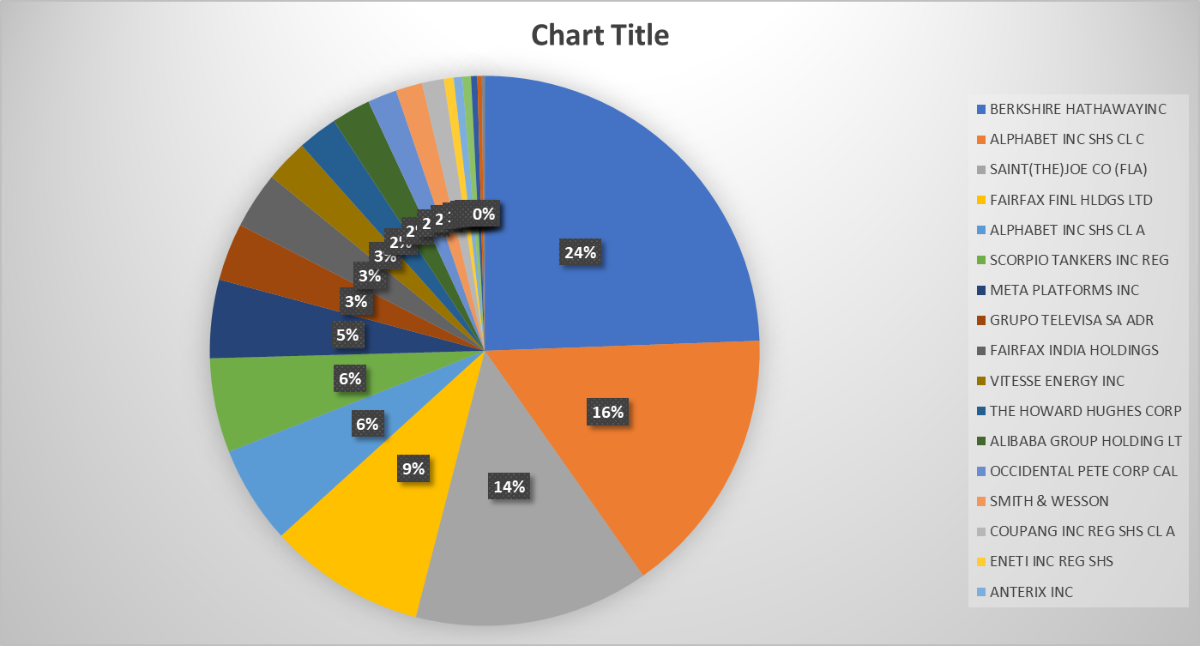
This is combined from my taxable and retirement accounts.

-
Sold a small position that I didn't want to hold anymore and bought some TV, Fairfax India, and Eneti.
-
Some interesting videos from the Capital Link conference (Russian Oil Price Caps, LNG, VLCCs, Product Tankers). Some of these videos have double digit or low triple digit views, which makes me think that the energy sector is still not on most people's minds and has more room to run.
-
Is Concentration a better strategy than Buy and Hold?
Saluki replied to Viking's topic in General Discussion
Wow, that was a painful read. Roku, Trupanion, Carvana, GoodRx. That portfolio looks like it was all offense and no defense. A lot newer managers have never lived through a bear market. -
added a little Coupang. Not any particular news, but I've been thinking about diversifying globally as well as across industries. Ideally with compounders instead of cyclicals. Coupang (CPNG) (probably 1/2 the position size I want, but I'm already fully deployed) Fairfax India (FFXDF): India (could add some more) Televisa (TV): Mexico (full position) Alibaba (BABA): China (full position) I've been thinking about a good one for South America, but although Petrobras looks cheap, It's a cyclical. I really admire what Mercado Libre has done and how it's managed, but it's too rich for my blood. Tigo Millicom I've looked at but can't pull the trigger. Anyone have any suggestions for cheap latin american companies with compounder potential?
-
Is Concentration a better strategy than Buy and Hold?
Saluki replied to Viking's topic in General Discussion
I think Peter Lynch was right when he said the most important organ in investing isn't the head, it's the stomach. If you had held the nifty fifty stocks in the 70s, you would be down 80% at some point, and if you kept holding it for another 30 years, they would've come back, but how realistic is it that someone would have the emotional ability to hold on that long. A lot of legendary investors do things that are mathematically sub optimal but work for them. Peter Cundill would sell half of his position when a stock doubled so that he would feel like the pressure was off because he couldn't lose the original amount he invested. Peter Lynch would call that cutting the flowers and watering the weeds. As your number of positions increases, it becomes increasingly harder to beat the index, but Lynch had hundreds of positions. The recently deceased Rakesh Jhunjhunwala, was worth a few billion when he died. A huge chunk of that was from one stock that he bought and never sold, but he did also buy and sell other positions rapidly and even founded an airline right before he died (which is the worst business in the world, besides the dairy business). Maybe the other active, hectic stuff kept him distracted so that he was able to not sell the golden goose position for decades? I heard of another investor who only puts in buy/sell orders after hours so that he's not looking at blinking red and green numbers and letting his emotions take over. Buffett says that he reads the 10k and then decides to try to figure out what a company is worth without looking at the stock quote. He acknowledges that even he is prone to anchoring bias. In this vein, maybe the best course is figuring out what your personality is and coming up with strategies to compensate for your blindspots or your emotions and then devise a strategy based on that. I started a second trading account at another broker when my main account got too far over the SIPC amount (I know, but I'm a worrier). I do much less trading on that account, because it's only on my phone, not on my desktop computer, so it's not in front of me all day. I have to seek it out to do something. I think when I'm fully deployed, maybe I should find a way to keep myself from looking at my main account. If I have no extra cash and I wasn't planning on selling something, why am I looking at it and thinking about moving things around? Buy and hold works great because (at least among professional managers) the amount of trading activity is inversely corellated with performance. The only exception is quant funds that trade in nano seconds. But to be able to hold for decades, you have to find a way to not be tempted to sell. -
Bought some VTS and OXY with the last of my proceeds from the ATCO squeezeout.
-
My Fairfax India limit order was filled I have almost a full position now but no more cash without selling something else, but if it comes down more or I sell something, I may add more. Air India last month announced that it is buying 470 new aircraft from Airbus and Boeing and wants to be a global aviation leader. One of the airports that they fly out of is Bangalore, which was recently enlarged and may be publicly traded soon. And FF India is still selling below the self-tender price.
-
Added a little TV, OXY and SWBI today. Put in a limit order for FF India, but it didn't get filled
-
Sold some GOOGL. It's still my second biggest position. I tapped into my HELOC and added another 10% when it dipped to the low high 80s/low90s a couple of months ago. No particular reason for the sale other than it was too big a position in my portfolio already and 10% or so in a couple of months in this environment is nice work if you can get it.
-
Some guy who tracks private planes is reporting that 20 private planes have flown to Omaha recently from different regional banking centers and DC. It could be too that uncle Warren is working on some kind of deal with multiple banks to give his imprimatur to boost confidence in them in exchange for some preferred shares as he did with BAC and Goldman.
-
Berkshire 2023 Meeting Side Events, Talks, Meetups, Dinners
Saluki replied to Saluki's topic in Berkshire Hathaway
Sunday Markel Brunch in Omaha: https://ir.markel.com/events-and-presentations/events/event-details/2023/Markel-2023-Omaha-Brunch/default.aspx I'll post other things as I find them to keep track of them all in one place. -
Sold the last of my ATCO shares (got the dividend, and less than 1 percent difference between todays price and the buyout price) and sprinkled it around to some of my favorites: TV, VTS, OXY, BRK, FFH, and FF India. (I also added some BABA, but plan on selling the same amount of much higher cost basis shares in 30 days to try to offset some capital gains).
-
Right before the close I added some OXY (still below the Oracle of Omaha's price), and some FFH. I was on the fence about adding more FFH, but if I was right to be upset about getting squeezed out of ATCO, then when they have 20+ new ships in a couple of years, purchased at 30% cheaper prices than their competitors, it should help Prem and me out
-
It seems that the order book for VLCCs and Product tankers is very low. The shipyards are booked up with orders for containerships (covid reopening and supply chain disruptions?) and LNG ships (ESG fad?). According to this, 2026 is the soonest you could get more. https://www.freightwaves.com/news/crude-shipping-revs-up-supertanker-rates-top-100000-a-day I try to keep on eye on the macro stuff because although replacement orders in tankers and product tankers is low, in the back of my mind I'm always concerned that a recession could hurt demand and bring pain to this industry even if the fleet doesn't grow. But with the wars and sanctions and shutdowns, trade routes are shifting and these assets seem to be a way to go long chaos in the world. And when governments take aim at oil companies with windfall profits taxes, they don't seem to mention ships or refineries, so maybe there is less political risk involved. I have a medium size position in STNG for the past few years, but I haven't really looked at VLCCs. Are there any names you like in that space?
-
Yes, sometimes the bid/ask spread is a couple of cents and balanced b/w buyers and sellers, and on days like yesterday (on no company specific news) it was wide enough to drive a truck through with 5x more asks than bids. Even OXY was trading yesterday for 5% less than the greatest living investor was buying it for last week. Fear is a helluva drug!