Saluki
-
Posts
2,771 -
Joined
-
Last visited
-
Days Won
5
Content Type
Profiles
Forums
Events
Everything posted by Saluki
-
I trade in and out of the SRG cumulative preferreds, currently have a tiny position. They pay 7.5% at par ($25) and periodically dip below $22. It's not a bad place to park your money since the CEO is trying to sell the company and if the common holders get anything at all, the preferreds will be called at $25 and you get the dividend while you wait. It won't make you rich, but it's not scary either. No telling when the company will sell though, since the real estate environment has gotten tougher with the rise in interest rates. I have the SEC filing for another preferred in my reading pile that pays a little more, but it's trading at close to par and the business has been having some problems, so I'll probably won't stick my neck out for a few more basis points.
-
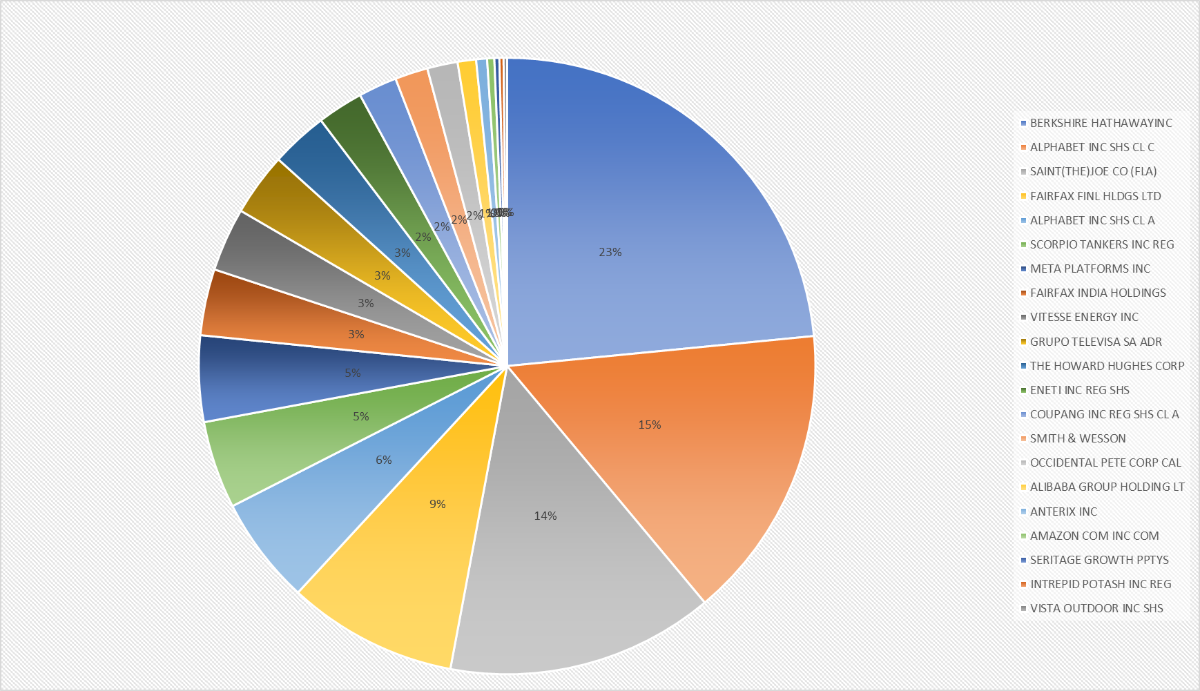
it was a pain, but I did it with excel. I copy/pasted the positions from my brokerage account, which needed reformatting (ugh), then I added a column that figures out percentages. Then click on the "Insert" tab, and on the top of the tool bar there will be a bunch of options for bar or pie charts.
-
I think looking at this in pie format is helpful because it keeps me from stressing about the smaller positions, which won't really hurt me even if they go to zero. The concentration on some of the bigger ones though, is concerning me lately. I'm not Bill Miller who can hold 90% of his personal portfolio in Amazon and just let it ride for 20 years. BRK is a great company that I've owned for more than a decade, and so is Google, but I've been thinking of trimming them if they get past 25% of my portfolio. 30% would definitely be too much for my tastes. Maybe trimming BRK and adding to FFH, or trimming GOOG and adding to something else techy?

-
Sold a bit of junk and bought some Seritage preferred (SRG-PA), STNG, VTS, OXY
-
Added some NETI and CPNG.
-
 I'm almost finished with this book now and I'd highly recommend it for anyone to add to their collection. Just enough anecdotes and charts and post mortems on investments to get the point across, but no fluff whatsoever. No one is as pithy as Peter Lynch, but this guy has a very readable style. Whereas One Up on Wall Street got many people interested in investing that otherwise had no clue, this is a definitely not a beginner's book because it assumes you already know terms like enterprise value and EBITDA, so I think this forum is the target audience. I had several bookshelves full of investment books and have made a deal with my better half that I only buy a new one if I get rid of five old ones. I usually put them in the little free library near my house. There are some that I can't imagine ever getting rid of because I re-read them occasionally (Greenblatt, Peter Lynch, Charlie Munger, Ben Graham's Security Analysis), I think this one will make the permanent collection.
 -
I was an M&A lawyer in the beginning of my career, and the best advice I would give is don't skimp on the due diligence and make sure the lawyers/advisors that you use are experienced in the type of business that you are buying. My firm did a lot a cable transactions and once we had a white shoe manhattan firm on the other side, who did a lot of M&A stuff, but not in our industry, and they probably cost their client 2-3x as much because everything took them longer since they didn't know it and had to "get up to speed" on things while billing for the learning curve. I'm sure it would be prohibitively expensive if someone hired us to do a software or pharmaceutical deal, for the same reasons. It's okay to have different people for different things. Our clients had a boutique tax law firm that represented a lot of cable companies, and they had a different firm for litigation. Just because you use a firm for, say, the real estate portion of the deal, doesn't mean that the tax or IP people in the firm are just as good.
-
I'll echo what others have said that having read both this and 100 baggers, both are worth a read and this is the better of the two books. Along this line of buying compounders and holding for a very long time, a couple of books with similar strategy that are good reads are The Davis Dynasty (the patriarch was a bureaucrat at the state insurance commission and later got rich investing in insurance companies and holding for decades), and the Phil Fisher books (I believe that he held Motorola for decades and it was a huge part of his portfolio).
-
Added a little JOE and CPNG. I think there are cheaper things in my portfolio, but none that I'm willing to increase position size right now.
-
I don't go on Substack, I avoid Twitter like the plague, and I try to avoid articles that give their take on what Buffett said. Like everything in life, it's usually better to go to the primary source. I've got Buffett's chairman's letters in the hardbound book and it's a great learning tool. It seems all media is moving towards shorter, click baity content. Twitter is the worst for the written word, and Tik Tok for video. Maybe you should make a conscious effort to move in the other direction towards long-form content. There are legendary investors who have written books (Peter Lynch, Ben Graham, Phil Fisher, Phil Caret, Joel Greenblatt, Einhorn, Tillinghast, Howard Marks) and I think those are great sources. I read a lot of biographies. Currently I'm reading one on Marvin Bower (responsible for taking McKinsey from two offices to an international powerhouse). In the past I've read books on a particular industry (shipping) and I have one in my queue about graphene now. I don't know if I'll ever use the knowledge, but it's easier to just keep accumulating knowledge and then having it ready if something comes up then to pass up an opportunity because by the time you get up to speed on something the opportunity passed.
-
My better half works at McKinsey, and she is way more tech literate than I am. She mentioned that she just finished a course on ChatGPT on Udemy which was helpful. It helps to learn how to give better prompts and use prior answers to shape future queries apparently. For instance, she had it generate lists of best cities to live with these 5 criteria and rank them in an excel sheet (I didn't know it could do things besides write bad poetry and give passable, generic history essays for high school students).
-
I've been to the AGM 2x before the lockdown (It makes more sense, in some ways than the BRK meeting b/c you can meet Prem and upper management, which isn't really possible in Omaha). I would go again if it wasn't so close in time to the BRK AGM. I hate to fly and don't like to do trips too close together. There's definitely more fun things to do in Toronto, and the side events are much smaller and there is much more signal to noise than in some of the retail oriented side events in Omaha which are like a sales pitch for some firms hawking newsletters (not naming names). I got a picture with Prem and one with Mason Hawkins one year. And I got to meet Arnold Van Dem Berg the first year I went. When people say what a nice guy he is, it's not an exaggeration. I'm not a billionaire so his time would've been better spent talking to the deep pockets, but we had a great conversation and he gave me a copy of a book of quotations that he compiled, and wrote a nice inscription in it, then when I was about to leave he told his son to take a picture of us. Class act! I enjoyed watching it online, but it's not the same. I think I'll be back next year
-
watching it now, thanks for the reminder.
-
This seems like a strange recommendation, by I'm getting a lot of value out of this book. In addition to being a performance psychologist to most of the top PGA golfers, he's also a coach for Point72, and the parallels between top performers in any discipline are really interesting. This book is about Golf, not investing, but you can easily apply the mindset and habit adjustments to investing (or tennis, or bike racing, or surgery, or battle). Really interesting read, and above is a video where he talks about applying the principles to investing, which is NOT discussed in the book.
-
Bought some VTS on the dip yesterday, and I added some NETI, taking it to 2% of my portfolio. I think NETI is a full position now, but I would buy some more VTS on a dip in my retirement account, (I didn't want to sell anything in there, so I bought most of it in my taxable account, and recently realized I should've sold some positions in my retirement account and bought them back in my regular account, and bought VTS in the tax free account since the 10% tax free dividend is like a 15% taxable dividend). [edited to add that I sold some BRK this morning in my retirement account to add to VTS on the dip. I plan on replacing the BRK shares in my taxable account as funds come in so I can maintain my original allocation]
-
VTS, SWBI on the dip. Bought some NETI over the past few days to hold for 30 days and tax loss harvest my older, higher basis, shares and got lucky on the timing.
-
So my back of the envelope math says that even with today's pop in price, FFH is back to .9 price vs book value
-
Yes, some of the pictures you take will look photoshopped. Just beautiful. If you like outdoor adventure stuff, Pucon Chile is like Interlaken Switzerland. We went on a day long hike to the top of an active volcano there. Highly recommend Chiloe Island too. It's the farthest north you can go and still see every type of penguin. There are several companies that take you people out on zodiac boats every 20 minutes or so to the see their nests. Lot's of wooden Unesco churches and houses on stilts too.
-
https://www.cnbc.com/2023/04/12/full-transcript-berkshire-hathaway-chairman-ceo-warren-buffett-speaks-with-cnbcs-becky-quick-on-squawk-box-today-.html Transcript of the interview now online.
-
If you are going to rip on some ridiculous tax breaks, this is a silly one to pick on, it's a university. It's well funded already, but it's going towards education. That writer is an idiot. If this guy really wanted to rail against something he should look at the art "museum" of the Walton heiress or one the Rales' brothers. It's ostensibly a museum, even though it's not really open to the public. So you have taxpayers subisidizing the costs of acquiring and maintaining your art collection on you property. Your grandma doesn't a tax break for her collection of tea spoons from every place she visited, but billionaires get the taxpayers to subsidize their art collecting hobby?
-
managed to add a little more VTS at the open following yesterday's dip. It was negative at the open for a few minutes before going up and I got lucky I sold some appreciated BRK in my retirement account and bought the same amount back in my taxable account so I could buy VTS in the retirement account without having to hold it for a year if it shoots up to unreasonable levels. Someone I met from the board told me he has bought low and sold around $20 twice and bought back again. I tend to hoard stocks like an old lady collecting commemorative plates, but I think if it was in my retirement account where I don't have to pay short term capital gain taxes, I might be open to the idea of trading in and out of something like this.
-
There is also the question of what the mix of immigrants is with regard to skills and education. In the UK, they have historically allowed skilled migrants (Indian doctors) to emigrate easilly, but made it harder for low skilled labor. So if you have a lot of skilled immigrants, it pushes down wages for the upper class, like doctors, and makes professions like plumbers more well off than in the US. In the US we have a lot of unskilled immigrants from Mexico. That makes labor cheap for things like building houses and hurts the wages of construction workers but helps the wages of the constrained supply of highly skilled labor like doctors and lawyers.
-
Just zooming out and thinking about energy from a econ and game theory perspective: SUPPLY SPR is depleted and must be refilled. OPEC announces production cut Russia supply impaired b/c of sanctions. Oil companies don't seem eager to ramp up supply, preferring to pay down debt and increase buybacks and dividends. New production takes years to bring online Windfall taxes discourage reinvestment in new production DEMAND Despite the push for clean energy, every airplane, ship and almost every car on the road use fossil fuel. So most demand is inelastic. Marginal consumer of inelastic demand determines the marginal (market clearing) price. PRICE SIGNALS Oil Prices climbing and the market clearing price will always be where supply and demand intersect. In order for the price to come down, there will have to be more supply, but see above. The other way oil prices come down is if demand comes down. The green alternatives won't impact that in the short term, so the way oil prices come down is by less demand due to some dramatic increase in fuel efficiency or demand destruction due to a recession. the government is unlikely to willingly cause a recession when there is an election next year, so they will likely loosen up monetary policy if high energy prices increase the odds of a recession. money printing causes inflation which causes commodity prices, including oil, to rise. assets purchased by borrowings and investments in yesterday's dollars are being sold in higher (nominal) dollars which gives you a big boost in ROIC until you must replace depleted assets with new reserves. I'm no mathemagician, but if I had to bet on higher oil prices a year from now or lower oil prices a year from now, I would take the former.
-
I went to SF last month and it's amazing how much has changed in 10 years since I was there last. At my downtown CVS, some of the high-theft items are behind plexiglass and you have to ask someone with a key to get it for you. in the downtown CVS, most of the store was behind plexiglass, including the cashiers. Crazy. And even though I grew up in NYC and it was kind of gritty in the 80s, I can't imagine raising kids there now. The fact that the guy who killed someone in cold blood over an argument in a vape store was already on bail for shooting at cops is ridiculous. If you stop arresting people for people for shoplifting, why would anyone pay for stuff? And if everyone is stealing, are you surprised that companies won't put stores there? And don't get me started on releasing people with no cash bail. If you arrest someone for a violent crime and let them go the same day, what makes you think they won't do it again and get released the same day again with no bail and do it again? I'll leave NYC for the tourists. When I quit my job I may get one of those JOE beachfront houses and start a Friday happy hour for COBF refugees.
-
Added some VTS on the dip. (oil is up 2% today, VTS is down 7% on some analyst's downgrade, looks fine to me)