SafetyinNumbers
-
Posts
2,819 -
Joined
-
Last visited
-
Days Won
38
Content Type
Profiles
Forums
Events
Everything posted by SafetyinNumbers
-
Is it fair to assume claims in the quarter has a significant impact on their assessment of reserve adequacy? Based on IFRS17, the reserves seemed to be designated to a time period and then discounted back. Based on the triangles, ~25% of reserves are paid out in the next year so there is a lot of turnover expected (this is probably higher under IFRS17).
-
I accepted what Prem said and it was consistent with the triangles but I'm not an insurance expert. I assume reserves also follow a similar chart pattern as above so would it be reasonable to expect that Fairfax always has a lot of reserves they can and do release in Q3 of every year given the normally high CAT activity? Last year Fairfax had 15% of cat losses in the quarter but the combined ratio was only 100.3%. It's part of why I'm optimistic about the underwriting profit given how well most peers have performed. It's impossible to know what business they actually wrote or what came back to haunt them. Markel reported a 99% combined ratio after the close today and looks like they had both problems.
-
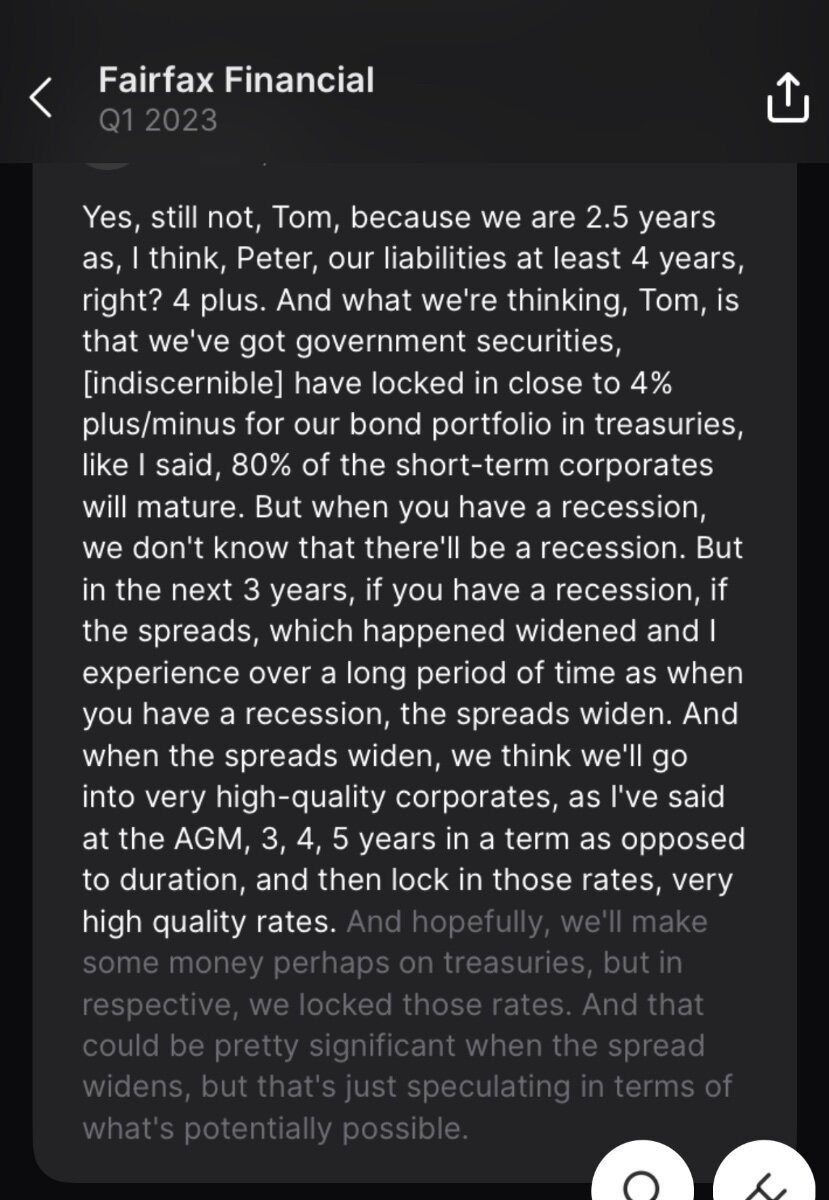
This is from the Q123 call. So all we know is at least 4 years. We should also note that the claims liabilities are in various currencies (but likely disproportionately USD) while the portfolio is in USD.

-
How long would you extend duration?
-
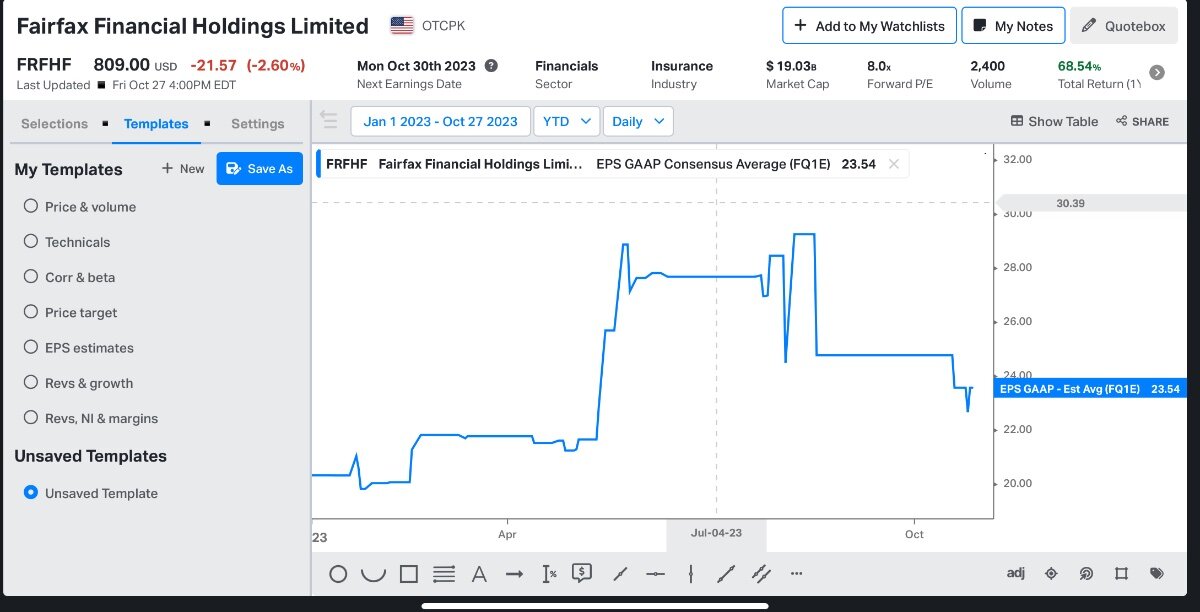
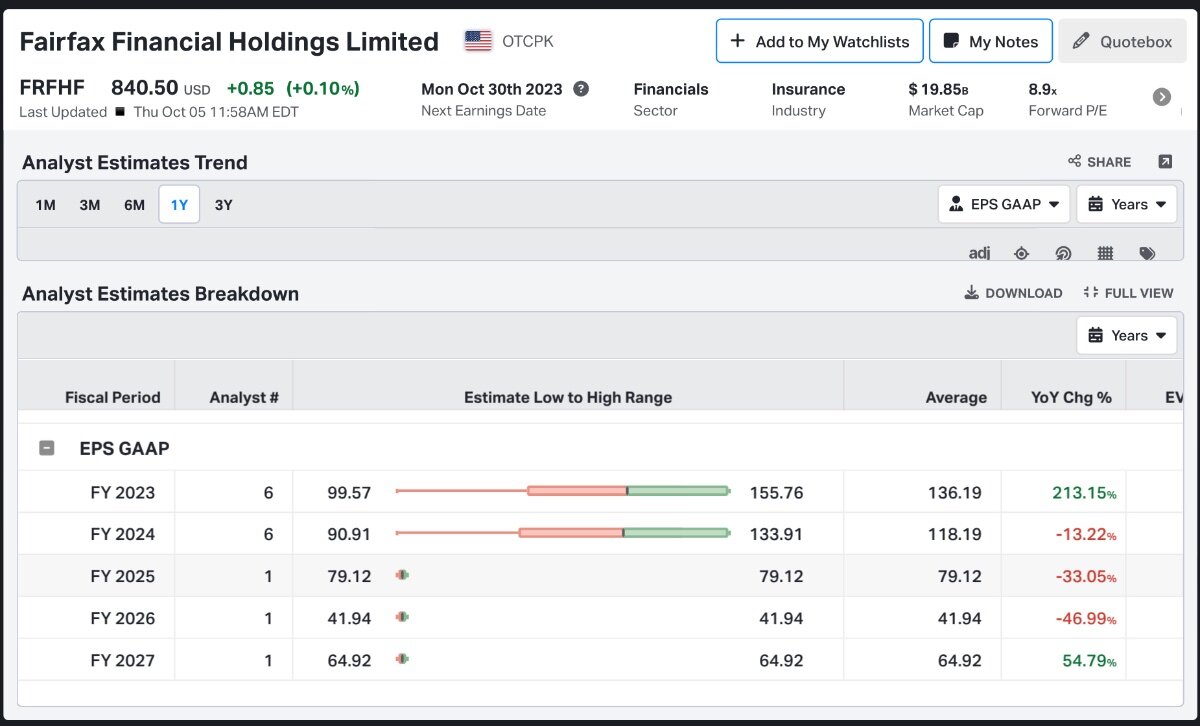
I guess if you like them realistic but that's not why I look at analyst estimates. I just want to see where expectations are. Quants really like estimates that are going up and earnings growth. Maybe analysts will get there in the next few years. I think it's part of how multiple expansion can get out of hand.
-
I pay for Koyfin.
-
I have seen a bad tick there before. I doubt its a real trade.
-
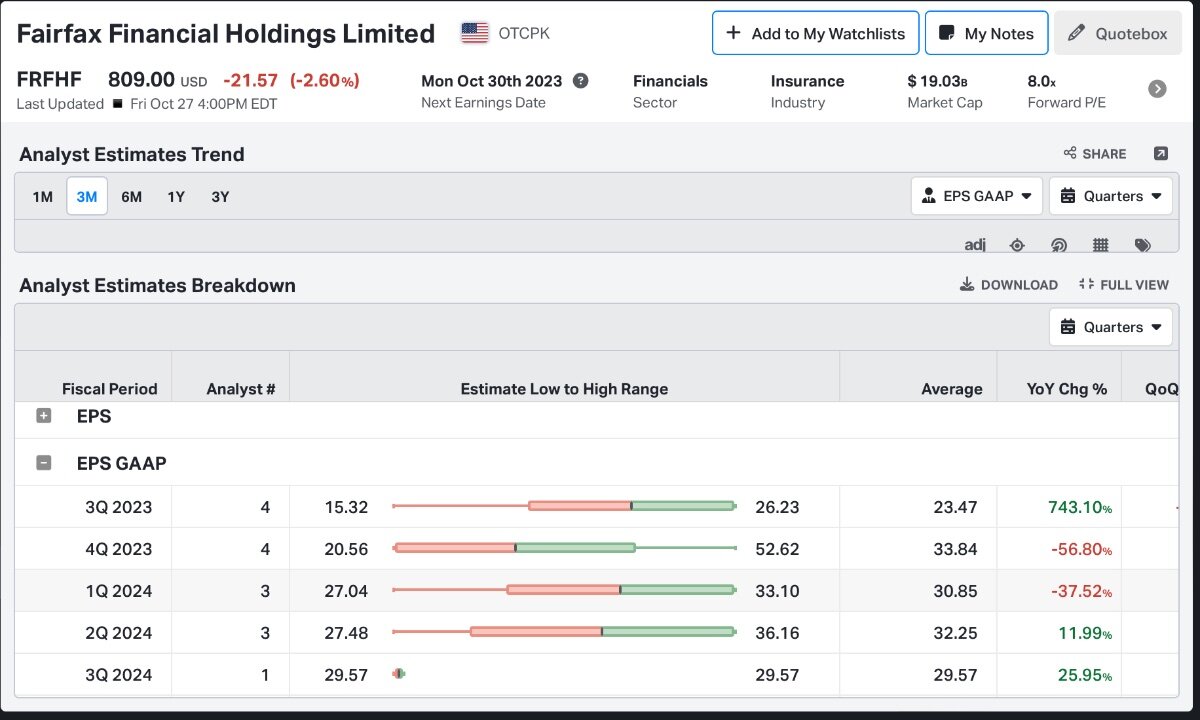
I think they can beat consensus on the back of IFRS17 which I think most analysts are ignoring. More important though will be the earnings power demonstrated in investment income, associates/dividend income and the combined ratio. Analysts will likely increase their 2024 estimates and introduce 2025 estimates which will make Morningstar’s pessimistic prognostication less relevant. It would nice to have growing earnings forecast like every other P&C insurer but FFH is too cheap and unloved for that.
-
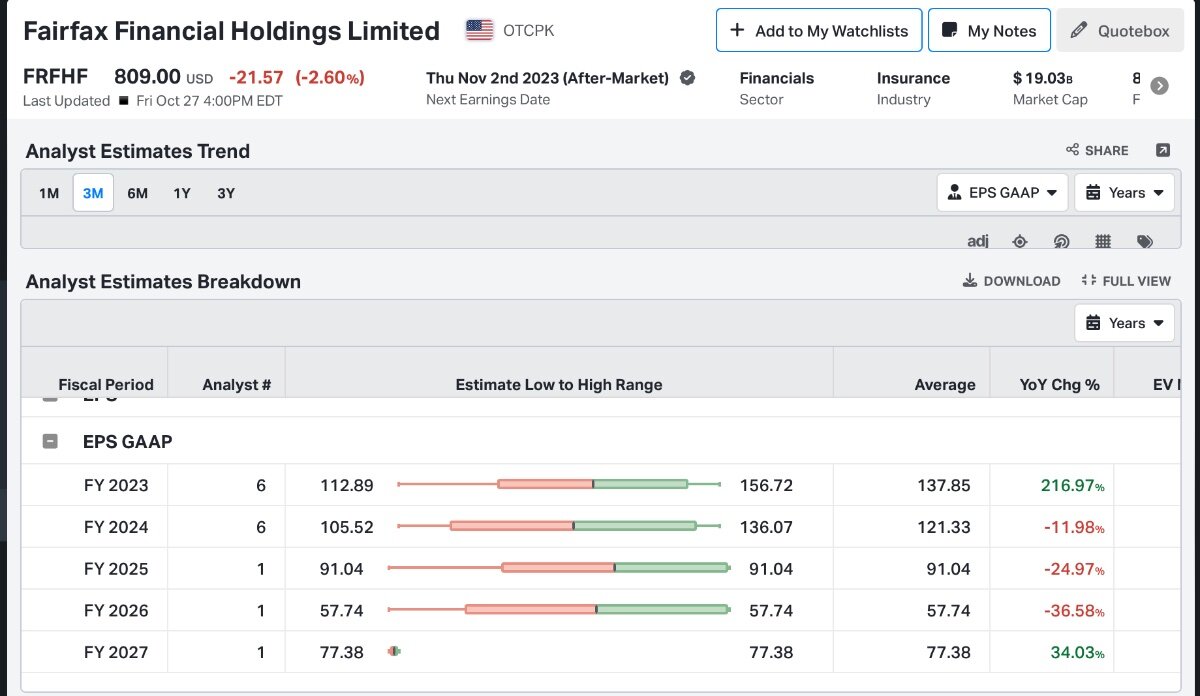
I expect we’ll get some more previews this week before they report but here’s the lay of the land with respect to analyst expectations
-
Unfortunately I can’t share the note but it’s really well done.
-
This is very interesting. Does Fairfax own the same class of shares as Blackstone directly or a different class with different terms?
-
Thanks for sharing! Probably why the stock was up almost 5% last week while the Greek market was flat.
-
I try to think about it context. Shareholders were cheering the shorting at the time and rewarded Fairfax with a 1.3x BV multiple while they issued equity for the treasury and Allied World in 2016 which was the end of the shorting. They didn’t like the shorting in retrospect because it didn’t work out and book value growth stagnated for 7 years. The share count also went up ~35% over that period while revenues were up ~2.5x. It’s not surprising a lot of those newly issued shares were dumped in the following hears with Fairfax buying back more than half of them. I think a lot of people share your view and those who have been burned may not come back. I’m sure others are selling now because “it’s had a nice run” and they don’t want to own it for Prem’s next mistake. None of that matters as long as book value growth is double digits. With the float as big as it is and interest rates where they are, it’s hard to imagine that not happening over the next three years. Nothing is a guarantee as these are all probabilistic bets after all. If Fairfax executes, institutional investors will find it again and the multiple should increase. I think a lot of investors will miss out by selling too early trying to avoid a drawdown when the path for high growth in book value seems so promising.
-
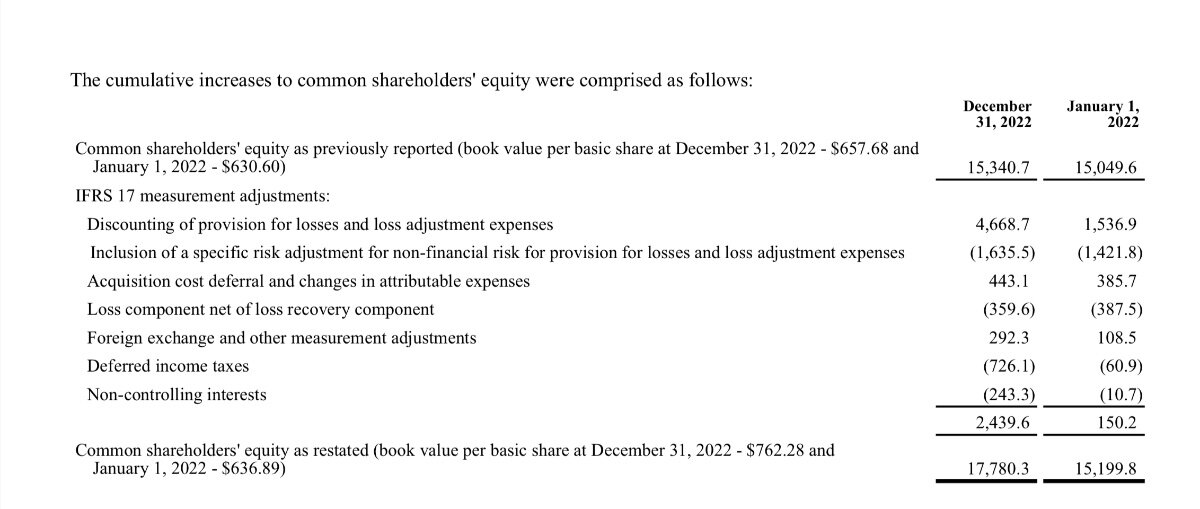
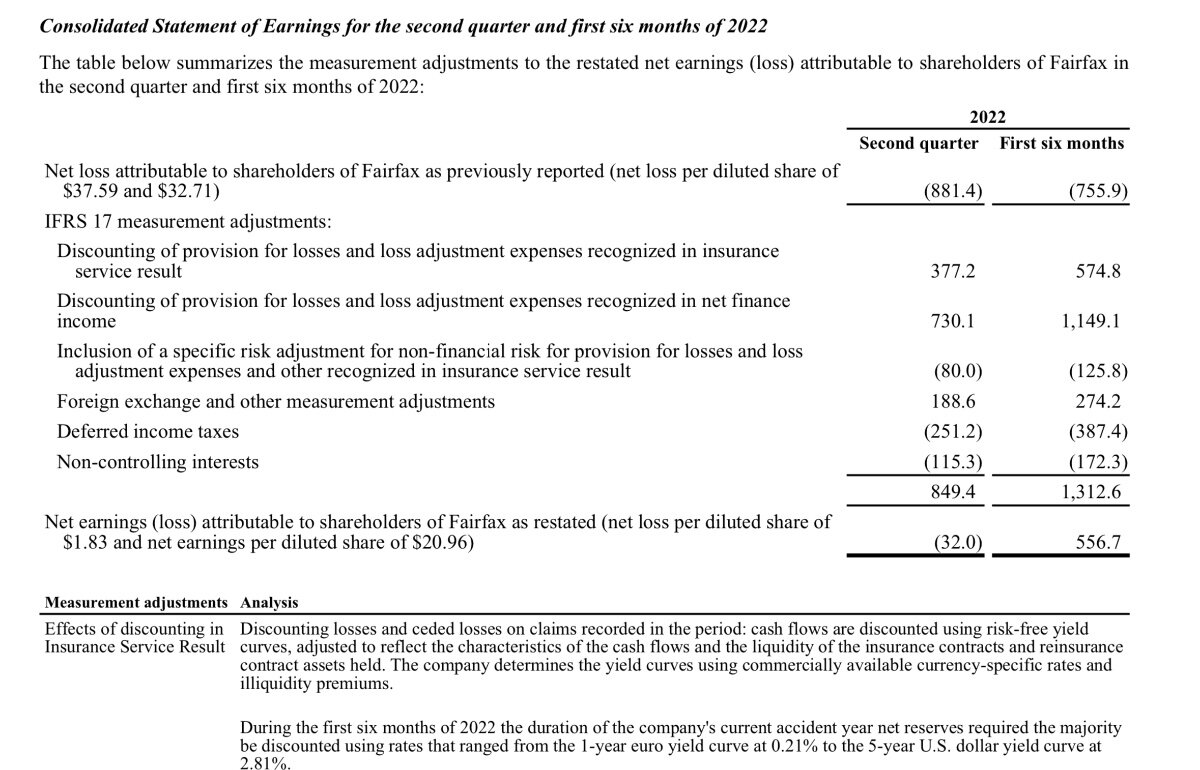
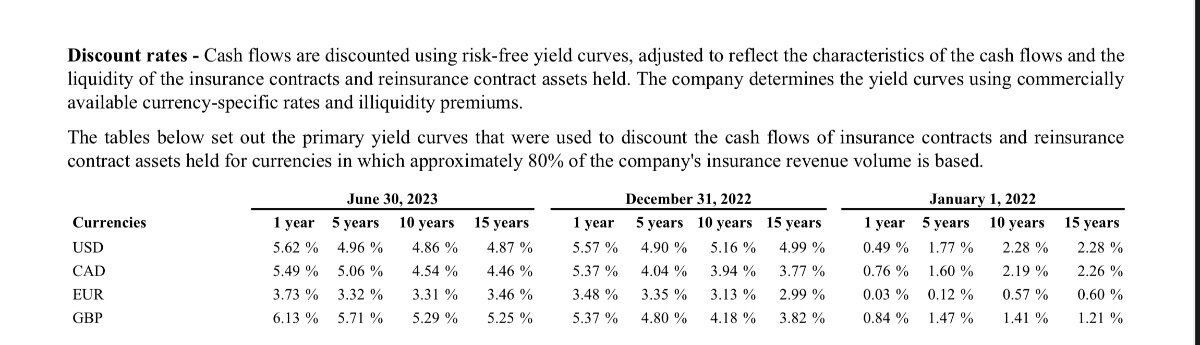
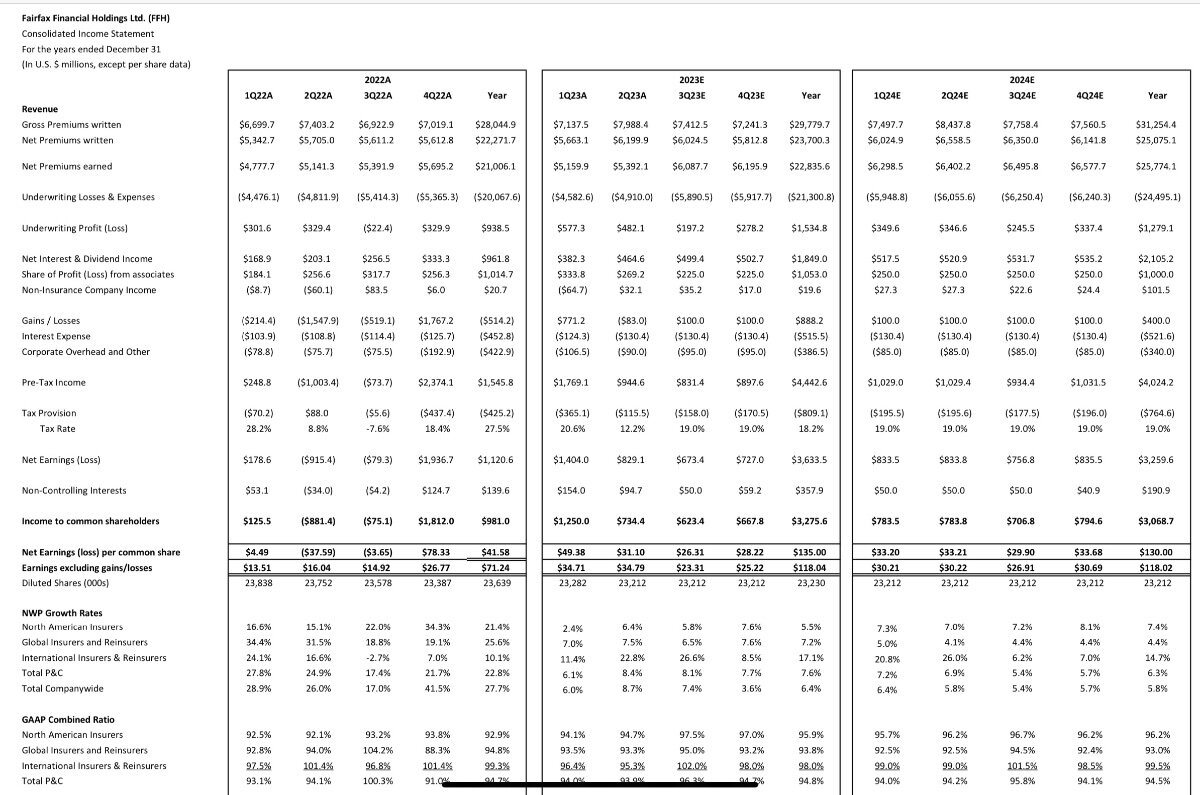
I don’t think I fully appreciated how much Fairfax would have earned last year if IFRS 17 had been implemented a year earlier. I know they got the full benefit in the book value at the beginning of year and it’s helped by half a billion or so this year (so far) but to actually report the earnings would have had a bigger impact on valuation I think. It also really highlights the spectacular macro call of keeping short duration on the bond portfolio. IFRS 17 only increased book at Jan 2022 by ~$150m. The majority of benefit actually came in 2022 as rates increased substantially. The restated H12022 results go from a big loss to a profit.
-
It’s funny, I read the same post and it made me think I was right. I think to take out the IFRS17 plug, you have to assume no premium growth which isn’t consistent with the rest of the forecast.
-
We didn’t see an SIB but the buyback picked up just over 1m shares in September
-
I want to make it clear I’m not an insurance expert, my MAcc degree is 23 years old and I let my CA/CPA expire a few years ago to save on the fees! My premise is that as long as interest rates are positive and rates are unchanged, the discounted combined ratio will be lower than the undiscounted combined ratio assuming a growing business. I assume when a policy is sold, premiums are collected and reserves are set aside. If those reserves are discounted, the underwriting profit is by definition higher all else being equal and that should happen every quarter. The quarterly offset, however, is the reserve balance must also accrete at the same discount rate. Before IFRS17, in order to model underwriting income, an analyst will most likely estimate a combined ratio based on the trend in the reported undiscounted combined ratio. After, IFRS17 that’s still all Fairfax is giving us explicitly so that’s still how underwriting income is being modelled. But there is a plug needed. I don’t know if $480m is a fair estimate. If the discounted combined ratio is 300bps lower than the reported combined ratio and Fairfax writes $25b in policies, does that mean $750m in additional profits? In theory that includes any accretion from the reserve balance. I’m not sure at all but it makes sense to me.
-
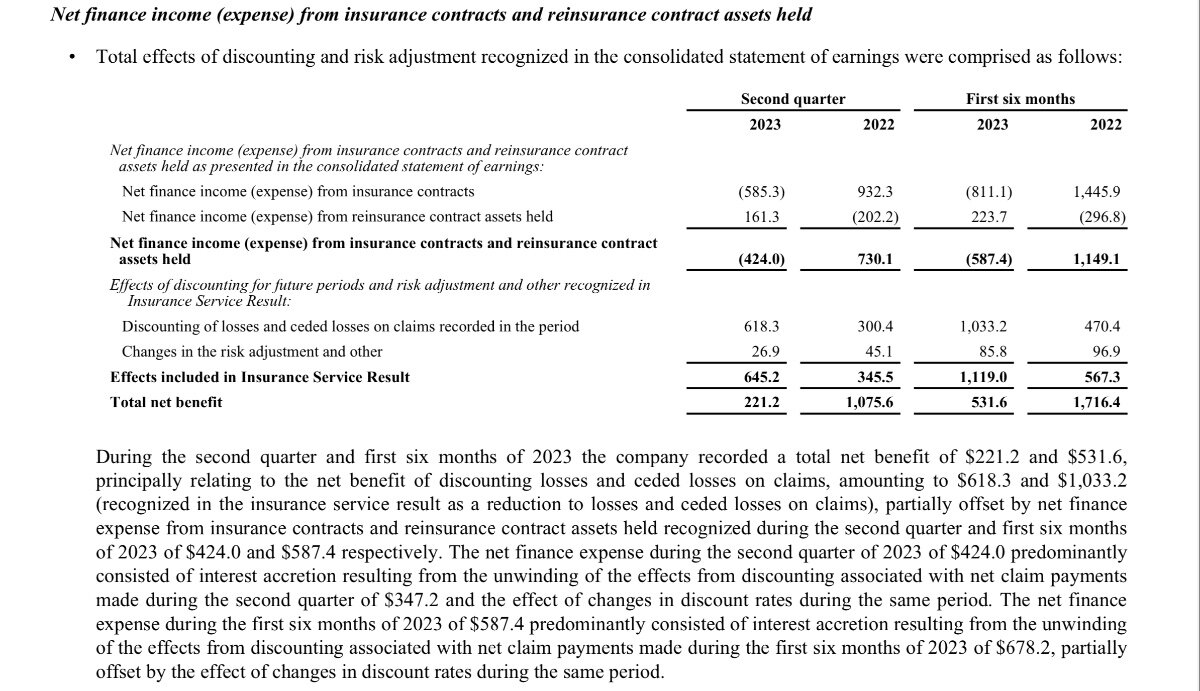
I know you asked Viking but I think about this a lot so I hope you don’t mind my thoughts. My understanding with IFRS 17 is as long as interest rates aren’t zero there will be some sort of adjustment. The reported combined ratio does not include any impact for discounting reserves. But every quarter, the existing reserve balance accretes and any reserves for new policies have to be discounted. If rates are flat or going up, that should be a sizeable benefit every quarter. If rates are going down, the reserve balance will be revalued higher but the discounting of the new policies will still be positive. I think most analysts are ignoring this and that’s part of why their earnings estimates are too low. Intact breaks out the discounted combined ratio (see below) and for them in the first half it was a 440bps difference. I’m not sure what the right number is for Fairfax but it’s not zero. That being said at some point in the future if rates fall fast enough, the discounted combined ratio might be higher than the reported combined ratio.
-
They are at US$980. The increase in interest rates means a structural increase in ROE vs the last 20 years. Should be interesting what the narratives will be when the multiple expands and how quickly holders will jump ship. There will surely be lots of drawdowns that investors will want to avoid.
-
-
I think part of is it they miss the IFRS 17 impact on earnings because they model underwriting income on the stated combined ratio while the IFRS adjusted combined ratio has been lower. Viking has something in line 4 of his model above. When I look at RBC’s model, they have the combined ratio down but also have underwriting income down year over year. When I was in equity research we would say that’s not internally consistent. For 2024, the growth in investment income is underestimated based on current rates, associates income is held flat from 2022 despite H123 at ~60% of 2022 already and gains expected on the equity portfolio are very small. He’s at $130/sh for 2024 and he might be right but the odds seem low.
-
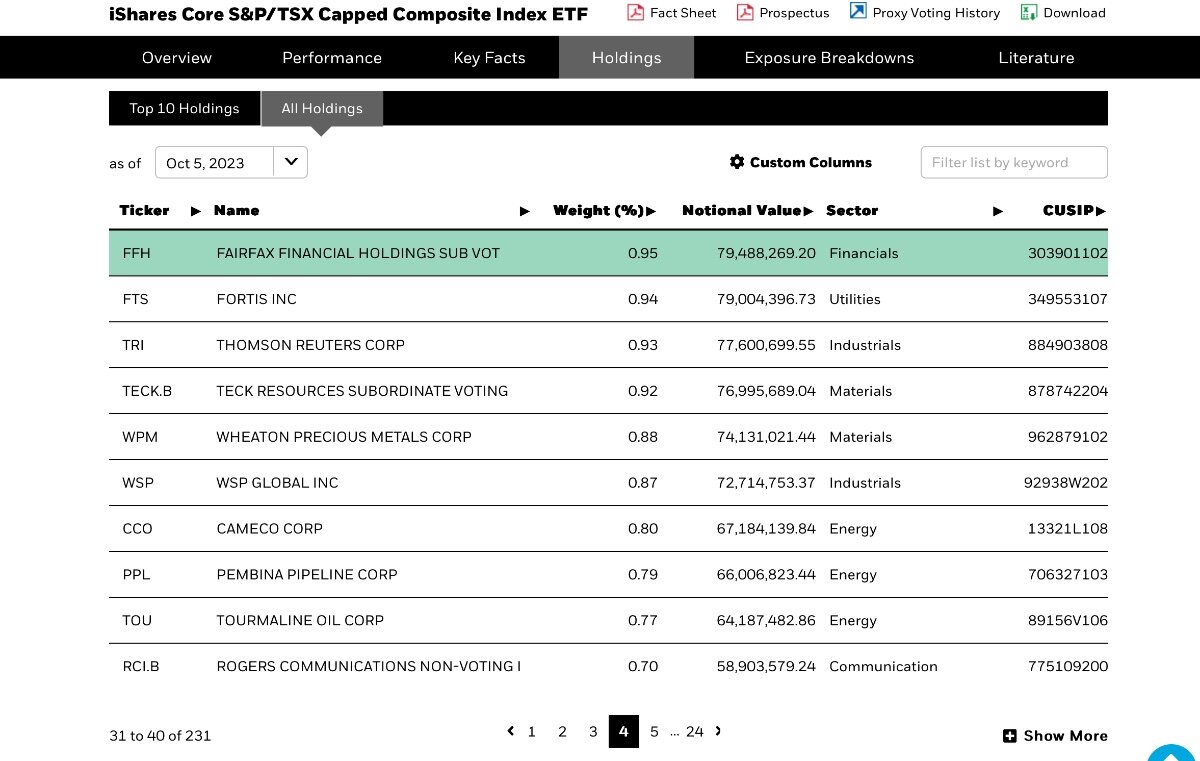
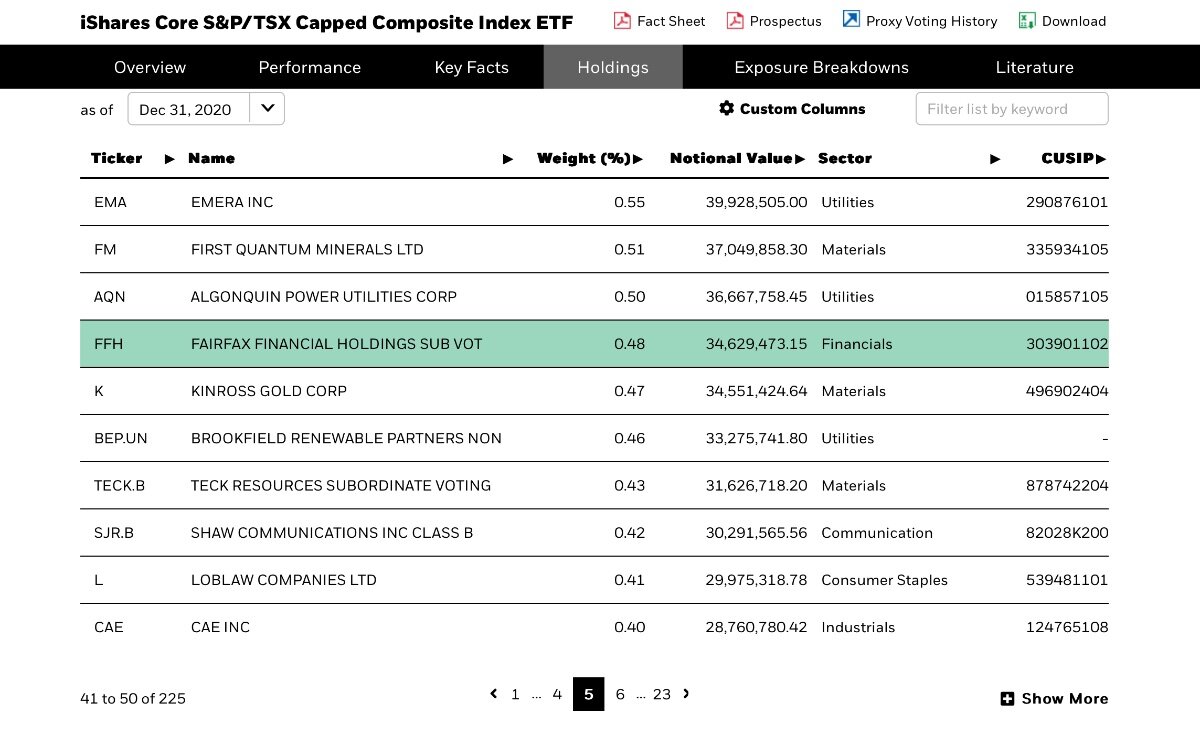
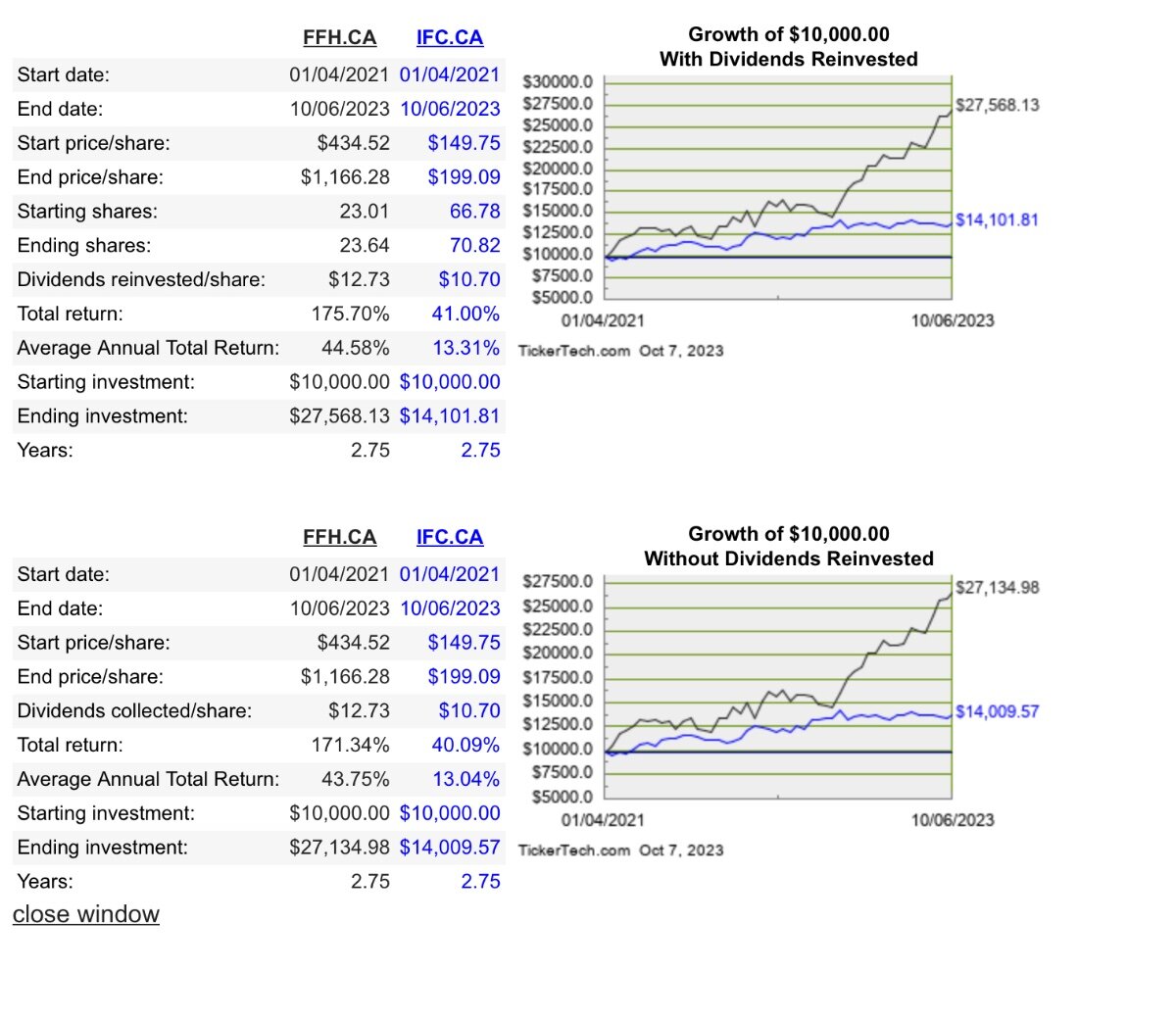
I’m more focused on the weight in the S&P/TSX Composite. While it’s counterintuitive to most value investors, the higher a stock in a major benchmark goes, the higher it will go as long as returns are consistent. For Fairfax, that seems highly probable given the proportion of income coming from investment and associates income. Fairfax has almost doubled its weight in the index since YE2020 to 95bps. My understanding is that active institutional managers benchmarked to the Composite will likely reconsider Fairfax again when it crosses 100bps. That seems likely to happen in the next month as Fairfax reports Q323. My guess is that book value is closer to $875 which will drag the shares higher as our fellow shareholders will hopefully not want to sell below book. If we go through 100bps, that I think can lead to multiple expansion finally which along with strong earnings will encourage analysts to raise their estimates and target multiples. The next step will be getting bigger than Intact Financial which is heavily owned by those benchmarked to the Composite. It sits at ~125bps. A lot of managers arbitrarily decide they only want exposure to one P&C and there is no reason to sell IFC except it has really underperformed Fairfax recently.
-
It doesn’t matter if you don’t think he’s credible. His estimates influence quants and those who use quant screens (most active management) such that they can’t even consider Fairfax. In the long run, it doesn’t matter as long as Fairfax keeps executing which seems highly probable given the sources of earnings but it’s part of the reason why the market still hasn’t valued Fairfax in line with peers. It also looks like he just cut his earnings estimates again.
-
I don’t think he speaks to any actual investors in these names or risks any of his own capital so I wouldn’t expect the analysis to be any good but it doesn’t explain why his earnings estimates for Fairfax drop so precipitously while staying kind of flat for the other comps. Also, recall, he doesn’t set the target prices, a Morningstar computer does that based on his financial forecasts and moat assessment.
-
Does it have the chance of being a hot IPO? I think stand alone IOT and Cybersecurity businesses both trade at high P/S multiples relative to where Blackberry trades. Maybe rebranding and making it a pure play will get the new ticker a big audience. M&A would also be easier for both segments once they have price discovery. It makes sense to do a marketed offering to get the multiple. It will presumably be a tight float so has meme potential given Blackberry’s iconic brand. I don’t know how to value these businesses so won’t participate but it does seem like it has event driven potential for someone with the right skill set. Could get interesting for Fairfax too.