gary17
-
Posts
1,520 -
Joined
-
Last visited
Content Type
Profiles
Forums
Events
Everything posted by gary17
-
Greek bank bailout fund picks Fairfax as anchor investor for Eurobank
gary17 replied to Nnejad's topic in Fairfax Financial
This is what puzzles me - and sorry I am not as up to date on all the stuff Prem has said -- on the one hand he sees deflation in europe, china, and a recession for 10 years....... and on the other hand he pumps in $500M into a Greek Bank & also a few years ago in Bank of Ireland.... If he is 100% convinced there will be a massive correction - why bother investing in the sector in the region that will most likely be affected negatively when his dooms day prediction comes true? :o -
Is that you Mr Buffett?
-
The only thing I'd add to this discussion is that in order for value to be realized, the unknown here is timing,,, and one thing I know john Templeton has said : to always be flexible. It's great to be disciplined and follow your own methods but be a bit more flexible with alternatives. Might serve you well. Just my two cents.
-
Corner of Berkshire & Fairfax Fund - Poll Q2'14
gary17 replied to Ross812's topic in General Discussion
what a nice abstract painting!! -
I think it's called current holdings... but if you search I suspect many hits will come out! just state it here is fine I think... cheers Gary
-
Meeting Credentials if you have electronic proxy
gary17 replied to Ravi's topic in Berkshire Hathaway
I did just that and haven't got that credential from them as of yet, im in Canada... so i wasn't going to risk not being able to get in so i haven't booked anything... but i also just learned that apparently if you get the annual report you can just request the credentials at the door... Gary -
I too got some GNCMA & AIQ - my thought was those were sold off as part of the NASDAQ going on sale today.... HOWEVER - I am not sure I am comfortable enough to have a big position in GNCMA - just looking at the 10 year chart I could just see that not a lot of value has been created, although that is not to say may be we are at the point where a lot of value could be realized.
-
Corner of Berkshire & Fairfax Fund - Poll Q2'14
gary17 replied to Ross812's topic in General Discussion
Be interesting to see how the companies not voted into the fund performs in comparison to those that are voted in -- Gary -
it it's not hurting anyone and it really is just a temporary thing and that you are only feeling a bit upset because it's 'unfair' - but really at the end of the day a temporary situation - i'd say just move on.... life is too short to be bothered by this. ;D
-
i dont know why but after reading this --- 'irrational behaviour .... positive feedback loop..." i think of facebook's recent whatsapp acquisition. in order to remain the dominant player, is FB behaving irrationally? thanks for sharing this article, quite insightful.
-
I believe this depends on your setting - in canada i didn't get them either and we had to contact the broker and they gave us a control key to enter online to download the credential request... for the meeting. i believe you can just download the annual report from warren's website. gary
-
That's the question I asked - who's paying for all this. Although all the military stuff is really all paid for as they are on salary. It's not a bad exercise for training... better than sitting at the base. and meanwhile the US sits back, get to analyze what kind of radar and military capabilities everybody in Southeast Asia have It appears a company has been trying to sell a real-time streaming flight data recorder to the airlines for $100,000 per plane: http://money.cnn.com/2014/03/21/technology/flyht-flight-data-streaming-black-box/index.html?iid=HP_Highlight Of course, the airlines won't go for that because they aren't responsible for paying for the massive search for this missing plane. Isn't this a multinational government bailout of Malaysian Airlines? Could the airline be asked to reimburse all of the nations involved for the hunt for it's own damn company's plane, especially since they could have prevented the cost for $100,000?
-
Oddballstocks, we're you in the telco industry? I'd be interested to hear your thoughts on what would be good exposures for the future where there will be more connectivity.... I wonder which player in this industry can keep raising prices.. equipment supplier, content providers, or the Internet service providers... Btw here's a recent cbc article indicating Canadian carriers have been hiking prices. http://www.cbc.ca/news/business/wireless-carriers-hike-prices-across-canada-1.2575886 I have a ton of thoughts on this, I've emailed some of this stuff to others on the board privately in the past. Some of this might be just a brain-dump, bear with me and feel free to ask followup questions. Yes, an antenna has a certain amount of bandwidth available for connections on a tower. If enough devices need access it's possible a tower might not have enough space for antennas. Towers sell space by slot, not bandwidth or use. If you wanted to put a ham radio antenna on a tower you'd be paying the same as what AT&T might be paying. The key constraint on a tower is backhaul. A tower's capacity is limited by the bandwidth available at the site. This means a tower in NYC is going to have a much higher capacity than a tower in Ruff Creek PA. Backhaul is the name of the game, the higher the backhaul pipe the more capacity towers have. The issue is no one likes towers, they're ugly and have a lot of physical limitations. The idea cell environment is a flat geography with a lot of low buildings. Hilly areas have a lot of dead spots and require many more towers to get the same coverage. Building a tower can be expensive, many of the big tower companies have towers with infinite payback periods. There are also tower that are paid back in a few years. The most profitable towers are a fascinating study in itself. I no longer have access to ARPU per tower numbers, but I remember digging into this stuff years ago. Where I live there was an obscenely profitable tower that was located in a suburban park. A number of local roads converged near this tower, and it was very well utilized. Since it was in a park the city leased the land for next to nothing. A small aside, land owners who lease land are often receiving much less than they should. There is a whole poaching industry around this. Anyways due to the limitations of the tower infrastructure the industry has been moving towards small cells. Instead of an antenna on a tower small cells are mesh networks of small antennas spread over a large area. This reduces coverage issues and dead spots. Think of a tower, you only have so many angles to hang an antenna, and antennas for the most part are directional. More antennas means more coverage. More and smaller antennas also reduces the backhaul needs. If a tower has say 30 antennas you need a backhaul to support those 30. If the antennas are spread out the backhaul for each antenna is much smaller. Spreading out users among antennas with bigger backhaul is what's enabling higher speeds. So going forward if you have an antenna with a fiber connection you in theory have a pipe that can handle 14 Tbps. The limiting factor on that is the routing equipment where the fiber terminates. I have Verizon FIOS at home, there is a fiber line to our home. I had seen a few years back that they could support up to 600Mbps with the current lines and current routing equipment. As the termination equipment improves the max speed could theoretically improve as well. I think here's the next step with this evolution. Companies start to distribute MiFi type devices to homes. The users own home network would provide the backhaul, and it would be the ultimate mesh network. Everyone in this space seems to gravitate towards the tower and bandwidth providers. The problem is they are being required to provide more product (bandwidth) at the same or lower prices. Ten years ago 768kbps DSL was acceptable, now for the same price 10x the bandwidth is available. A few other random tidbits that I learned while in the industry. Companies have created artificial pricing power over data, it really doesn't cost any more to transfer a lot verses a little data. On the whole it's something like 5% of a network's users who use the majority of the data. Rate limiting them could provide unlimited data to everyone else. The second thing is text messages are the gravy train for cell providers. A text message is encoded in the packets your phone sends to the tower to check signal strength. That's why the length is limited on them. This is "free" in the sense that your phone is always checking in with towers. Adding a text message to piggyback on that is just using the full packet instead of leaving a portion of it empty. The fact that carriers found a way to charge, and charge a lot for this is amazing.
-
I have a insensitive, but practical question: who's gonna be paying for all this searching? How much would it cost?
-
I wonder how long does it take to de-pressurize the cabin - is it instantaneous? if it takes 30s or more for the cabin pressure to reach equilibrium with the atmosphere at 45000ft - then they'd have more time to put the mask on. Unless you have a plane door that opens which would allow the equilibrium to be reached very fast, i can't imagine how else the plane can depressurize very fast as it is a very tightly sealed space. -- On a separate note - I am surprised modern commercial planes carrying that many people are allowed to turn the transponder off - why is that even an option? is there any instance when it is a good idea to turn it off?
-
We seem to have this kind of discussion every three weeks!
-
i am not doing any sort of puts or shorts... but rather been thinking about how when the market crashes what I should be buying -- Gary
-
Interesting. On the other hand though the US government owns most of the treasuries.... I believe China owns a relatively small amount.
-
there's always the scenario of the US & EU go back to pre-recession level growth and China manages this - and everybody ends up in a better place this time next year. could happen.
-
Eric I think the stimulus will Be reduced but not eliminated A lot of these folks have cash - just like throughout the euro crisis we have a lot of cash in Europe , just not deployed in the economy. Wealth if destroyed somewhere will be gained somewhere else..mi don't think money that's been created will leave the system...
-
a bit more perspective http://www.forbes.com/sites/jackperkowski/2014/01/21/chinas-debt-how-serious-is-it/
-
this is a question that i've been thinking about it seems like because the chinese government has artificially kept the chinese yuan low relative to the US dollar, over the years it had to buy US dollars (i.e., sell Chinese yuan) to keep the Yuan low.... the US dollars that they have been buying = the foreign reserve in $US..... and all this fund belongs to the Chinese central bank... So in theory, if the yuan were to collapse - they could just start buying Yuan and sell US dollars.... the reserve, at $3.3 trillion US is mostly in the form of US government bonds ... so they'd start selling the bonds.... which would increase the yield on the bonds... (?) so our current quantitative easing is about 85B at the peak per month... so 3300B would be a 3 year QE program if that's where the Chinese government wants to start inject the money back into their economy..... is it this simple? Gary
-
full time private investors who left their day job
gary17 replied to ourkid8's topic in General Discussion
Creativity and problem solving skills are also very much related to the culture... I agree the "knowledge" is spreading but I still don't think you can deliver the culture of creative minds, problem solving, and thinking out side the box that many Asian institutes don't teach. There may be few. Very few... -
full time private investors who left their day job
gary17 replied to ourkid8's topic in General Discussion
Western education will be unmatched by Asian education for a very, very long time. The biggest difference is, in my view, western education teaches creativity and problem solving not generally taught in Asia. -
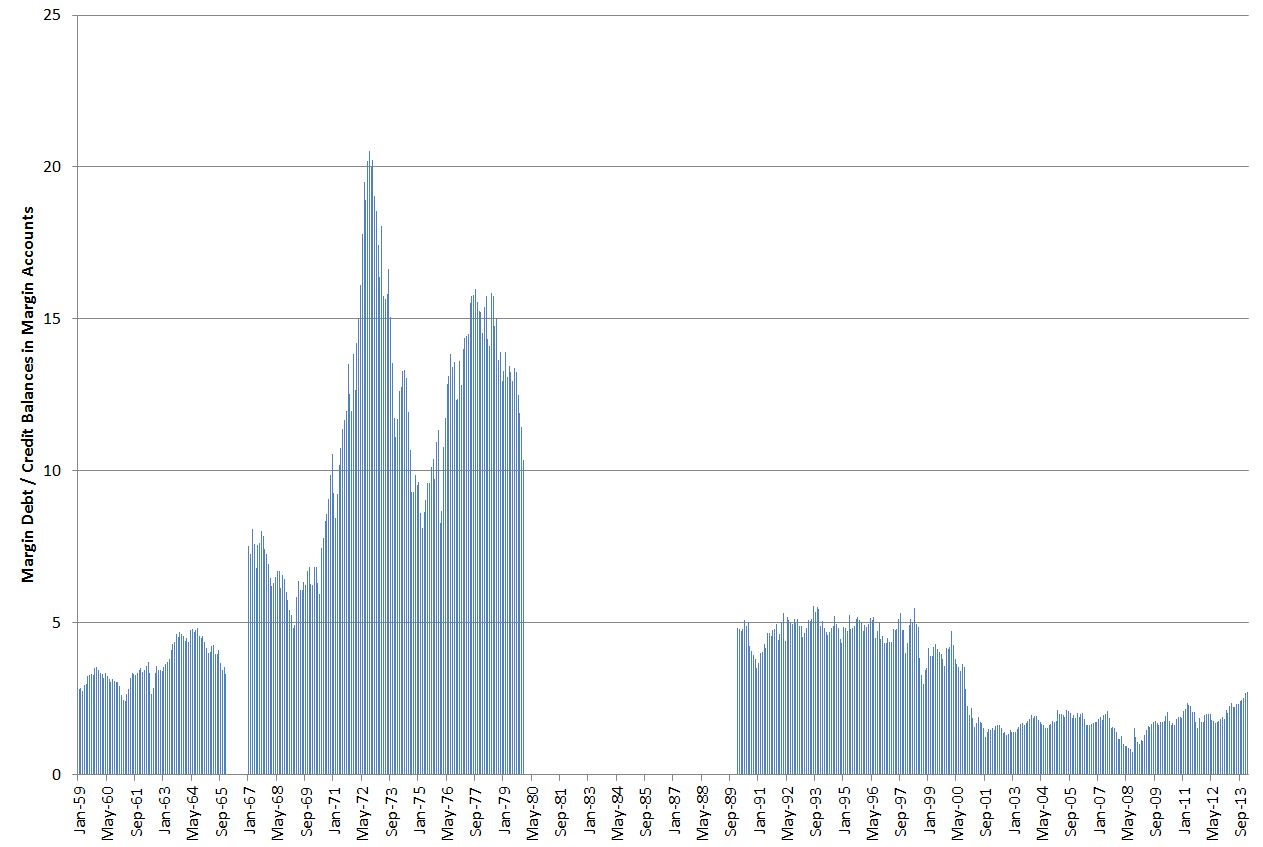
i am wondering if there's any meaning to looking at margin debt as a ratio to the credit balance... as oppose to looking at the margin debt alone. i attached a graph. also, does anyone know what 'foreign reserve' means -- i've heard that China has a lot of foreign reserve - but in very practical terms, what does that actually do? is it like cash in the bank they can use? i think the one thing China has also going for them in terms of monetary policy is they control their currency exchange rate. not sure if that's a plus or minus. not an economist here... but just thought between that and the interest rate and the foreign reserve - whatever that is - they have a few tools to play with. thanks