
UK
-
Posts
3,440 -
Joined
-
Days Won
16
Content Type
Profiles
Forums
Events
Everything posted by UK
-
https://seekingalpha.com/article/4624021-fairfax-financial-holdings-limited-frfhf-q2-2023-earnings-call-transcript And Tom, one other point on the buying back. In our annual report we said that our book value per share grew at 18.8% from inception compounded at 18.8%. Our stock price sometimes compounds above and sometimes below. Well at the end of 2022 we said what stock price Canadian dollars would make the book value compound and the stock price compound the same? And that number we put in our annual report was CAD 1375 1-3-7-5. That just makes it same. Book value is our first indication. Our book value we think is very understated and our book value -- our intrinsic value which I'll leave you guys to estimate is worth a lot more than the book value. But that's how we look at it. So at the end of the year CAD 1375, if we can buy our shares we think we're doing all shareholders that we're doing well by all shareholders by buying back the stock. Fran, next question?
-
WSJ: This has been an inflated year for natural disasters in the U.S. The number of U.S. potential billion-dollar weather and climate disasters in 2023 through June has exceeded every year tracked by that point besides 2017, with 12 such events so far, according to the National Oceanic and Atmospheric Administration’s National Centers for Environmental Information. The average from 1980 to 2022, adjusting costs for inflation, was around eight annually. FFH: The consolidated combined ratio of the property and casualty insurance and reinsurance operations was 93.9%, producing an underwriting profit of $337.5 million, compared to a combined ratio of 94.1% and an underwriting profit of $301.7 million in 2022, driven by continued growth in business volumes (net insurance revenue increased by 6.2%), prudent expense management and decreased catastrophe losses of $134.8 million or 2.4 combined ratio points in the quarter.
-
Thanks Viking! The underwriting results, which was my biggest worry (as usual:)), are just awesome, especially while considering context!
-
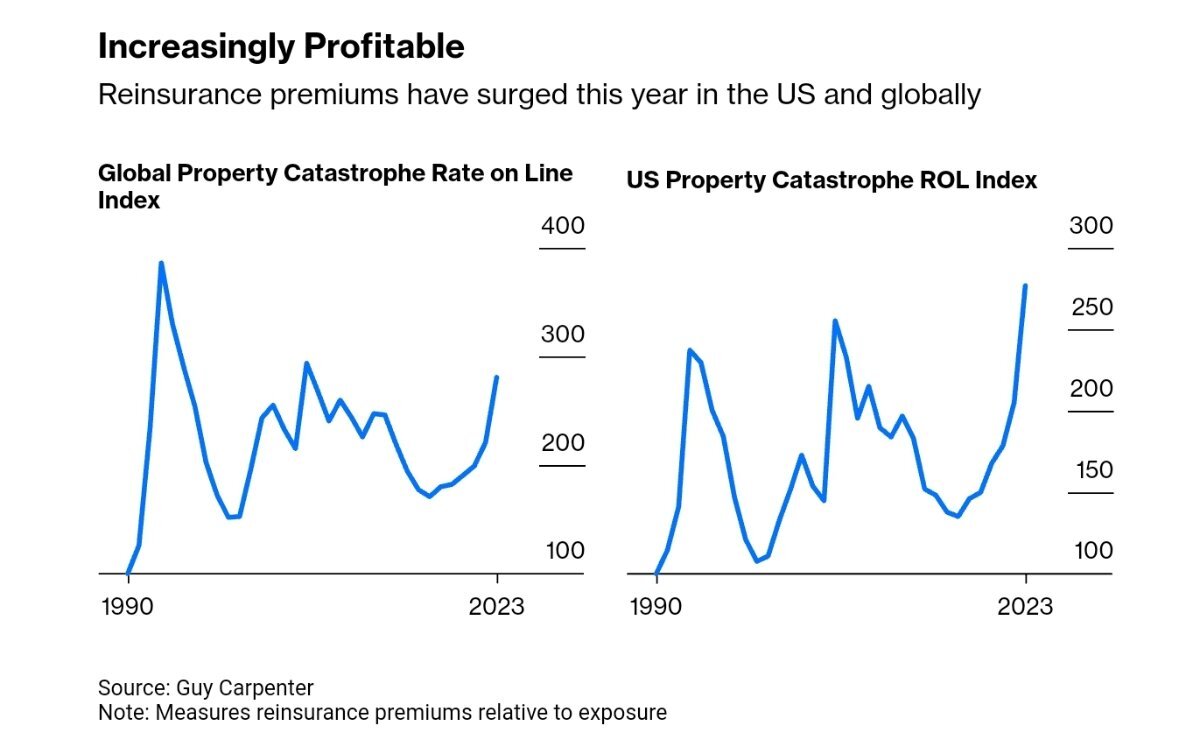
https://www.wsj.com/articles/insurers-are-facing-more-than-one-kind-of-inflation-bb925670?mod=hp_minor_pos19 This has been an inflated year for natural disasters in the U.S. The number of U.S. potential billion-dollar weather and climate disasters in 2023 through June has exceeded every year tracked by that point besides 2017, with 12 such events so far, according to the National Oceanic and Atmospheric Administration’s National Centers for Environmental Information. The average from 1980 to 2022, adjusting costs for inflation, was around eight annually. https://www.wsj.com/articles/home-insurers-are-charging-more-and-insuring-less-9e948113 “We’re still seeing the industry having an underwriting loss this year continuing out to 2025,” said Dale Porfilio, chief insurance officer at industry body the Insurance Information Institute. The institute expects that “the cycle of continuing to take rates upward is going to continue for the next two years,” Porfilio said. ... The escalating cost of catastrophes is reflected in a steep increase in premiums for the reinsurance coverage that home-insurance companies buy to pass on some of their risk. Depending on the state regulator, those higher premiums can feed directly through to the price charged to homeowners, Fox said. His firm’s data shows reinsurance premiums were up on average 33% for June 1 renewals, which includes many Florida carriers, and 50% for renewals at the start of this year. The question of whether reinsurance prices will keep rising, piling more pressure on home-insurance premiums, depends a lot on what happens in the second half of this year, according to Fox. “There’s a fork in the road ahead,” he said. “If we have another major hurricane or some medium-size hurricanes or a spate of wildfires…that [reinsurance] price will go up again.”
-
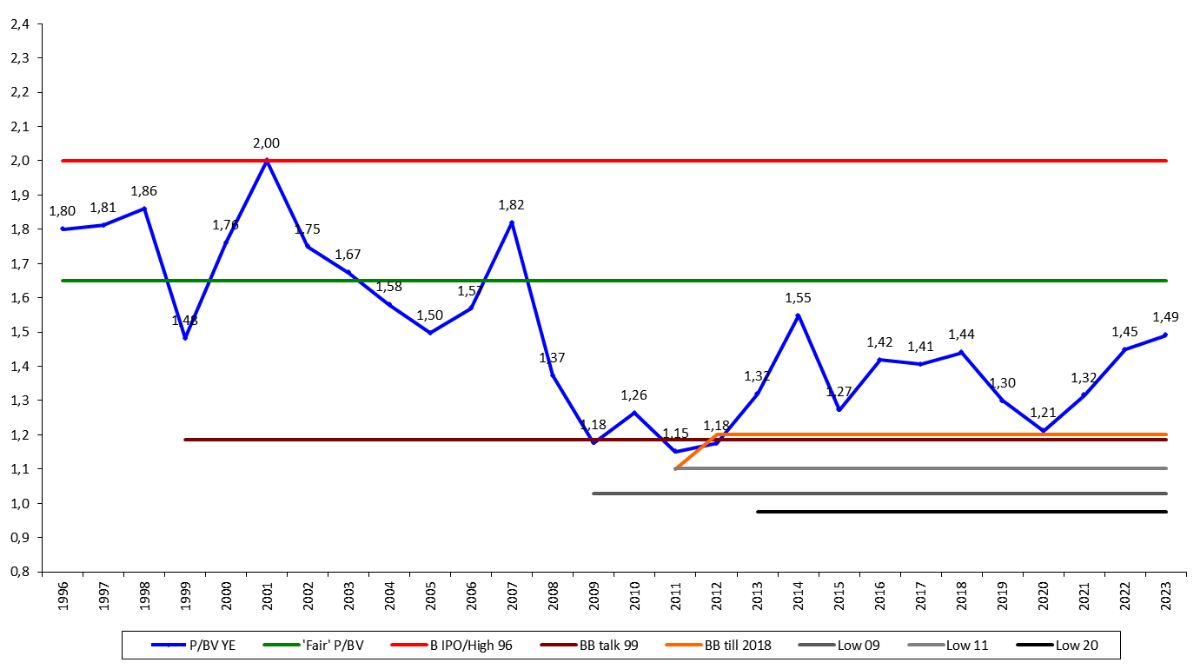
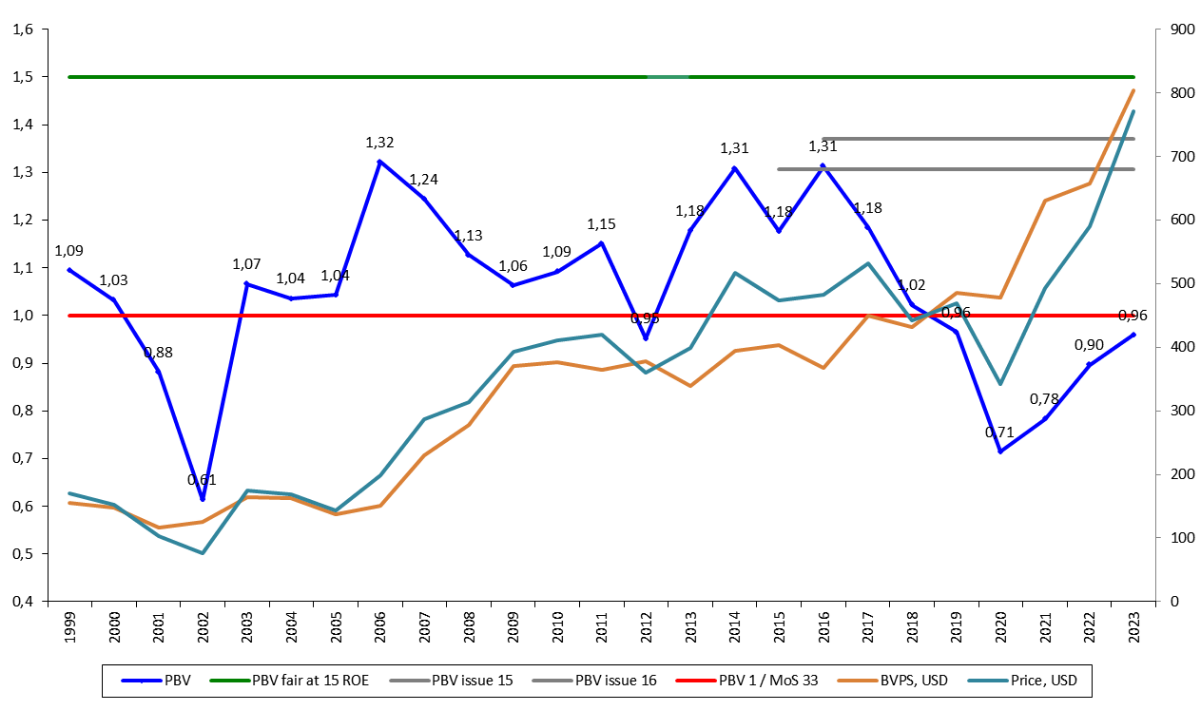
My best guess (and hope) it is because of the very good price performance of share price of FFH recently and in a last few years, but it is really hard to understand why it is still trading today at only 1 PBV and not at some 1.2 or 1.3 already. However you look, on absolute or on relative, it does not make sense.
-
https://www.wsj.com/articles/while-everyone-else-fights-inflation-chinas-deflation-fears-deepen-4045cabf
-
The value of this forum is unbelievable. To illustrate, based on recent history:), basically all one had to do is to read everything carefully and than at least to follow Parsad into META, Viking into FFH and Greg into JOE...not to mention many other great ideas and posters!
-
I think one could worry somewhat about this or maybe should in the future if market continues to do what it did in 1H: But in my humble opinion it is still to early and more importantly not at a such an extreme point yet to make any big market calls. Maybe it is the case with some AI related or other hot things (avoid), maybe already even somewhat with big tech (avoid or be less greedy/more selective), but even in case of general market (not to hot, not to cold, no opinion), but especially the universe of not so magnificent another 493 companies or companies not even in SNP500, I think you can still find/own things to be quite excited about.
-
One more: https://www.bloomberg.com/news/articles/2023-07-29/stocks-crush-year-of-bond-in-biggest-market-sentiment-shift-since-99?srnd=premium “What’s happened, particularly in the US stock market, has taken a lot of people by surprise,” he said. SentimenTrader suggests the shift may endure. Unlike in the past, corporate insiders are big buyers, while technicals like subdued volatility and bullish options are keeping equity sentiment elevated. The only other two instances when stocks versus bond sentiment were so wide apart were in 2003 and 2009 “both coming out of protracted bear markets and indicating a dramatic shift in investor expectations,” said Jason Goepfert, director of research at Sundial Capital Research and SentimenTrader, which analyzes futures positioning, surveys, options activity and fund flows. “Both preceded new bull markets.”
-
Not necessarily about such scenarios, but sure I am worried about what is going on. But then again: 'If a problem is fixable, then there is no need to worry. If it is not fixable, then there is no help in worrying'.
-
https://www.economist.com/international/2023/07/27/the-ukrainian-army-commits-new-forces-in-a-big-southward-push These factors explain why General Valery Zaluzhny, Ukraine’s top general, decided to throw in fresh legs on July 26th. He has been forced to adapt his original plan. Brigades from Ukraine’s 9th Corps had been expected to fight their way to Russia’s main line of defence. Then the 10th Corps, in essence a second echelon, including three Western-equipped brigades, were to be deployed to fight their way through the strongest defences. Finally, light, fast-moving air-assault units were supposed to exploit any breakthrough, pouring through the hard-won breach. In the event, 9th Corps struggled. Advances that were supposed to be completed in days ended up taking weeks. Ukraine was unable to deploy whole brigades, instead breaking them down into smaller units. Some experts worry that 10th Corps has now been thrown in prematurely. The main Russian line is still kilometres away and 10th Corps’s units might be worn down before they get there, leaving them too exhausted to punch through. Western officials play down these concerns. “I think they timed it well,” says one. Ukraine is in a “very strong operational position”, says another, pointing to the turmoil in Russia’s senior ranks, including the decision in early July to sack General Ivan Popov, who commanded a big portion of Russian forces in southern Ukraine. Russian military bloggers have described heavy losses of Russian artillery pieces in recent weeks. However, a fluid war of manoeuvre is likely to remain a stretch for a force cobbled together in a few months. The Russian verb peremalyvat (to grind through) is invoked on both sides. But Ukraine’s junior commanders, having seen their units gutted over the past 18 months, refuse to send their new citizen army into a meat-grinder in the way that Russia did in Bakhmut. As Ukraine has become more European, Ben Wallace, Britain’s defence minister, recently suggested, it has acquired “a Western European caution”. Some American and European military officials argue that Ukrainian commanders have in fact been too slow to strike with their new brigades, a mistake that they think Ukraine committed last year in Kherson, when tens of thousands of Russian troops withdrew east over the Dnieper river with their equipment. Ukrainian commanders chafe at the idea that they should gamble their army in circumstances that nato generals have never faced. The 10th Corps’s assault is a break with that hesitation. And the upside of the aversion to casualties thus far is that many Ukrainian units are in better shape than planners had assumed. Brigades that assaulted Russian positions were expected to be left with only a third of their original strength. Thanks in part to well-armoured Western vehicles, they have taken a lighter knock. Even so, the commitment of 10th Corps is a fateful moment for General Zaluzhny, a cautious commander with the weight of Ukrainian and allied expectations on his shoulders. “This is the last big decision for Zaluzhny to make this summer,” says the Western official. “The die is cast.”
-
https://www.economist.com/united-states/2023/07/28/joe-biden-donates-weapons-to-taiwan-as-he-does-to-ukraine On July 28th it took that reasoning a leap forward by announcing it would for the first time start to arm Taiwan from America’s own military stocks, as it has done repeatedly for Ukraine. The main difference is that it has not invoked an “emergency” to justify the move. Instead, it believes the arms supplies will help forestall a war across the Taiwan Strait. The military move may instead provoke a new crisis. China will not accept American claims that it is nothing out of the ordinary, and represents “no change” in America’s Taiwan policy. After all, America is shifting from selling weapons to Taiwan to subsidising its armed forces.
-
https://www.bloomberg.com/news/articles/2023-07-28/-dangerous-consensus-has-investors-betting-it-all-on-buoyant-markets?srnd=premium-europe#xj4y7vzkg What once was a posture of skepticism has morphed into something approaching investor euphoria. Cash and hedges are out, replaced by demand for everything from small caps to meme stocks. Fueling the surge is data showing the US economy is thriving amid mounting evidence the Federal Reserve is beating inflation. All the optimism has sent the S&P 500 to the brink of its sixth advance in seven months and pushed prices in the Nasdaq 100 to almost 35 times profit. It’s manna for bulls — even as it leaves them with precious little wiggle room should anything in the economy or monetary policy not unfold as hoped. “It’s dangerous and consensus, but it’s late July, so who feels like fighting it?” said Peter Tchir, head of macro strategy at Academy Securities. “We are now at stage where people feel obligated to fully commit capital. Hawkish Fed not an excuse right now, and claiming recession is hard to justify as well.” Good news on the economy is sucking more and more investors into risky assets. A steady expansion in speculative spirits has pushed equity positioning to the highest level since January 2022. Investors have a clear overweight exposure to stocks after long refusing to budge off their underweight positioning, according to Deutsche Bank AG. At the same time, a wide array of hedging metrics is showing low demand for downside protection. Put premiums for both Invesco QQQ Trust Series 1 (QQQ) and the SPDR S&P 500 ETF Trust (SPY) are hovering around the lowest levels in at least a decade, according to RBC Capital Markets. Additionally, investors are buying more calls to chase the rally while spending less to protect their gains. “The market is just not ready to let go of the positive narrative. Hedging is outrageously cheap,” said Amy Wu Silverman, head of derivatives strategy at RBC Capital Markets. “There’s more driving of demand of calls from folks who are underperforming than those who have done well and need to hedge.”
-
-
This is very interesting discussion! Recently there is a lot of publicity about all this climate, weather, increasing catastrophe costs and 'uninsurable' future, such as: https://www.wsj.com/articles/climate-risk-a-major-challenge-for-insurance-industry-treasury-says-6725f954 https://www.wsj.com/articles/business-insurance-roiled-by-climate-inflation-205049df https://www.wsj.com/articles/insurers-are-in-the-hot-seat-on-climate-change-74e27330 https://www.bloomberg.com/graphics/2023-us-climate-disaster-costs-wildfires-storms/?srnd=premium-europe#xj4y7vzkg https://www.bloomberg.com/news/articles/2023-07-28/treasury-s-yellen-says-extreme-weather-exposes-gaps-in-insurance-protection?srnd=premium-europe https://www.bloomberg.com/news/articles/2023-07-28/extreme-weather-risks-making-parts-of-the-worlds-un-insurable?srnd=premium-europe Climate change “has the potential of changing the insurance business profoundly and making part of the world un-insurable,” Gonzalo Gortazar, CaixaBank SA’s chief executive officer, said in an interview with Bloomberg TV Friday. “It’s not happening yet, but if we keep moving in that direction this is something we will have to face in due course.” Yet, is that represents more of a threat (unexpected losses, regulatory risks, etc) or an opportunity (increasing market, better pricing, etc) for insurance/reinsurance companies? Perhaps everything will come down even more to execution quality of any particular company? Could all this negative publicity at least help improve pricing somewhat:)?
-
-
https://en.interfax.com.ua/news/investments/924955.html The international insurance group Fairfax Financial Holdings (Canada) has increased its stake in the Ukrainian agricultural holding Ovostar (Ovostar Union) to 17.499% from 10.39%, the company announced on the Warsaw Stock Exchange on Tuesday.
-

-
-
-
https://www.bloomberg.com/opinion/articles/2023-07-21/warren-buffett-s-florida-bet-bodes-well-for-troubled-insurance-market#xj4y7vzkg
-
https://www.barrons.com/articles/travelers-stock-climate-change-insurance-investing-6a8535e1 Unusually high catastrophe losses left The Travelers , a New York-based property and casualty insurer, in the red last quarter, but the stock rose nevertheless. That underscores a misperception about insurance stocks. Investors aren’t betting on the weather and the damage it brings, which can fluctuate drastically from year to year even as climate change makes storms more intense. What matters is how insurers charge for and manage that risk over longer periods. Although insurance companies’ balance sheets have been hammered by increasingly frequent and severe natural catastrophes in recent years, their stocks haven’t plunged. Insurance shares in the S&P 500 index are down about 1% since the beginning of the year, but up by 13% from a year ago. Investors aren’t losing faith in the group because insurers have been able to boost premium rates, taking in revenue that they will invest to cover future losses. Many have also been pulling out of risky markets, including California and Florida, where they couldn’t charge high enough rates to make profits, given the storms and wildfires that plague those states. The Travelers (TRV) is an example of how it is playing out. On Thursday, the company reported a loss of $14 million in its second quarter, or seven cents per share, a sharp fall from the $551 million in income, or $2.27 per share, it recorded in the same quarter last year. The red ink was mainly due to higher catastrophe losses from “numerous severe wind and hail storms in multiple states,” according to the company. In the second quarter, the firm paid $1.5 billion in catastrophe damages, twice as much as the $746 million in the year-earlier period. “We had six events surpassed the $100 million mark in Q2, the most ever for a single quarter since we began disclosing the table in 2013,” said CFO Daniel Frey on a call to discuss the results with investors. Nevertheless, the stock gained 1.8% in Thursday trading as investors were more focused on the firm’s net written premiums, which grew 14% from last year to $10.3 billion. Net written premiums—the amount collected minus payments for reinsurance—in the business insurance segment increased by 18%, partially driven by higher rates for renewed policies. And despite the higher prices, retention was strong at 88%, according to the firm. In the personal insurance line, net written premiums were 13% higher than in the year-earlier quarter.
-
This is very interesting, thanks for sharing! This is how I feel about both these companies too. I first bought some FFH maybe in the end of 2012 (or similar time), when there was a dip and they reached 3 year or so low, after they were thrown from the MSCI Canada or some other index, but the next 10 years, due to their bearish positioning and mistakes, it was love and hate or on and of holding for me (that is more of a trading sardine) and I never get enough conviction to make it a big position. But from the last year (and I was already maybe 1-2 years to late, and many thanks to Viking, Parsad and others for sharing their analysis and thinking on FFH) I do not see it as a trading sardine anymore. And they are still cheap on absolute and 'value today', while at the same time with improving results and also in a position to re-rate at least some 30-50 per cent relatively. I also followed JOE (together with Berkowitz) from a long time ago, but until covid and later reading all discussion here (again, many thanks to Gregmal and others) last year, I also did not have enough conviction to make it a large position. What is interesting, while FFH is already cheap on current results, JOE is maybe more in a 'value tomorrow' bucket (if you insist for having a view on future results to value it), but at the same time, if you look at it through possible NAV (as per latest discussion) it seems to me also like 'value today':). So here you are, you have two understandable, owner/large investor operated companies, with perhaps little if any disruption risks, with quickly growing/improving results, still cheap and not discovered or loved by market too much (with hopefully still wrong perceptions) to buy and do not touch, if nothing unexpected occurs (or they double or triple too quickly-lets hope for this scenario:)), for at least the next 3 or 5 years. I am not sure I have enough conviction at this time to suggest owning only them two, but even if you do not have much better ideas, adding BRKB and at least one other postiion will give you a well diversified portfolio, as per Munger:))).
-
https://www.bloomberg.com/news/articles/2023-07-18/buffett-unit-s-potential-wildfire-liability-stokes-industry-fear
-
Not much on the current market temperature, but otherwise quite good memo from Marks on this whole market calling/timing issue: https://www.oaktreecapital.com/insights/memo/taking-the-temperature While on the subject of buying too soon, I want to spend a minute on an interesting question: Which is worse, buying at the top or selling at the bottom? For me the answer is easy: the latter. If you buy at what later turns out to have been a market top, you’ll suffer a downward fluctuation. But that isn’t cause for concern if the long-term thesis remains intact. And, anyway, the next top is usually higher than the last top, meaning you’re likely to be ahead eventually. But if you sell at a market bottom, you render that downward fluctuation permanent, and, even more importantly, you get off the escalator of a rising economy and rising markets that has made so many long-term investors rich. This is why I describe selling at the bottom as the cardinal sin in investing.