
UK
-
Posts
3,440 -
Joined
-
Days Won
16
Content Type
Profiles
Forums
Events
Everything posted by UK
-
Viking, again, thank you very much for sharing your work and thoughts! It is really almost impossible anything to add to it, but one thing, I am not sure if really you assumptions could be called "slightly conservative". I do not think at all that you have to be conservative or that these numbers are impossible, or that there could not be further positive upsides or surprises etc, but incorporating CR of 96 or less for longer term, I think is quite optimistic (possible but not sure if probable). Regardless I agree very much with your general thinking and however you look at FFH today (or even at CR 98 or 100), either on absolute or on relative, it is still to cheap and you still do not need scales to see if patient is way too fat here:). I also like very much that FFH (as also BRK but with lesser degree) is very well positioned if rates will stay higher/normal for longer or ever. But most importantly, it finally seems that at this stage, in order for them to do really well, say to earn their 15 per cent target for longer term, all they have to do is just not to do anything really stupid, to paraphrase Munger:). And if they will do something clever, as they did many times in different areas in recent 5 years, then even better! Given that, I do not understand how it is not selling at least 1.2-1.3 BV already and would not be shocked to see them trade at some 1.5 BV in mid term and my plan is just to hold it. Unless something really stupid is done, but I do not expect this at all:)
-
https://www.wsj.com/finance/investing/how-to-get-rich-and-famous-from-a-stock-market-crash-6914580a
-
This from older generation sounds better?
-
I agree with you on Tencent/Prosus. But I disagree with "cut off from china like with russia is unimaginable lets be serious". Maybe it is just my imagination, but especially after this whole "unlimited friendship" situation, I can imagine even much worse things than cut off. And I am just afraid to play Russian roulette here, especially with some meaningfull alocation. I tried it in 2021, but after war in Ukraine and Xi not returning to normal, changed my mind.
-
I kinda agree with you on achievements of China and its companies etc. And yet with the latest policies of Xi they somehow ended up on the ‘wrong side of history’ in the eyes of US/west. The whole thing escalates almost weekly. Tariffs, more and more sanctions, aid for Taiwan etc. Or just look: https://www.theguardian.com/us-news/2023/may/09/ron-desantis-bills-ban-chinese-citizens-buying-land-florida How can you be sure this is not going to end badly? Or badly at least for western investors in China?
-
On January 31, 1979, Deng Xiaoping, China’s paramount leader of the post-Mao era, boarded a plane for a historic visit to the United States. Deng was in very high spirits. How could he not be in such a bright mood? A few weeks prior, the People’s Republic of China (PRC) and the United States of America established diplomatic relations. This was a gigantic achievement for Deng, as it allowed him to accomplish a critical step toward his plan to launch China’s grand “reform and opening-up” project. The United States, as Deng then perceived, should play a central role in China’s drive toward modernity and beyond. Deng was not a talkative person, especially when he was with his associates. Yet he talked a lot during the cross-Pacific flight. Reportedly, Deng said something of the following effect to his associates: As we look back, we find that all of those countries that were with the United States have been rich, whereas all of those against the United States have remained poor. We shall be with the United States. Luca, is this still the same with Xi?
-
https://www.bloomberg.com/news/articles/2023-08-16/china-s-housing-slump-is-much-worse-than-official-data-shows#xj4y7vzkg
-
https://acquirersmultiple.com/2017/10/michael-steinhardt-being-contrarian-is-not-enough-you-have-to-be-right/
-
Again, a lot of focus is on what China does, with a hope that, to borrow from Tencents presentation, maybe Xi/CCP will one day "complete self-inspection and corresponding rectification" (funny line from page 14, isnt it?). However, in this whole situation China is not the only actor and it seems things are going to the wrong direction, with US and Taiwan elections on the horizon. https://www.wsj.com/articles/camp-david-summit-to-unite-u-s-south-korea-japan-c9cad067?mod=hp_lead_pos10 https://www.bloomberg.com/news/newsletters/2023-08-15/meet-the-man-who-may-be-the-next-to-lead-taiwan
-
https://www.wsj.com/articles/wall-street-is-ready-to-scoop-up-commercial-real-estateon-the-cheap-6edac64f?mod=hp_lead_pos2 Wall Street firms are raising new funds to acquire office buildings, apartments and other troubled commercial real estate, looking to scoop up properties at a fraction of the price investors paid a few years ago. Cohen & Steers, Goldman Sachs, EQT Exeter and BGO, formerly known as BentallGreenOak, are among the prominent names raising billions of dollars for funds to target distressed assets and other real estate with slumping values, according to regulatory filings. “The last few weeks, I’ve been saying, ‘holy mackerel, they’re coming out of the woodwork,’” said Kevin Gannon, chief executive of Robert A. Stanger & Co., an investment-banking firm that tracks real-estate fundraising.
-
Also: https://www.bloomberg.com/news/articles/2023-08-08/xi-speak-and-closed-doors-obscure-china-s-18-trillion-economy Taking the pulse of China’s $18 trillion economy is getting tougher for foreign visitors who previously could count on holding informative meetings with key policy makers. While “old friends” such as Bill Gates and Henry Kissinger have gained access to the highest rungs of power in widely publicized visits this year, it’s been a different story for bankers, economists and businesspeople returning after three years of closed borders. Accounts from more than a dozen people, some who asked not to be identified to speak freely, describe dinner invitations that were seen as potential ethics breaches and politely declined, silence around taboo topics such as deflation and bland party speak replacing the honest exchange of ideas. Once-familiar officials, they said, are now fearful of breaching newly broadened anti-espionage laws as President Xi Jinping grows more wary of the US and its allies. Cliff Kupchan, chairman of political risk consultancy Eurasia Group, said he was still able to meet with long-time contacts on his first trip since the pandemic in over three years, but they were more reticent about expressing their views or had shifted toward the official line. “The number of Xi Jinping quotes I got was far more than any previous trip,” he said. The deepening opacity — coming as China’s economic rebound falters — threatens to further undermine the already wavering confidence of foreign businesses and investors, rattled in part by a crackdown on consulting companies earlier this year. One gauge of foreign direct investment has slumped to the lowest level in 25 years and overseas funds aren’t buying into the stock market’s recent rally.
-
Luca, I definitely agree with you on contrarian situation here and big excitement on a micro level/valuations, especially on Prosus/Tencent. But it seems to me that all political/geopolitical/macro situation just continues to go to the wrong direction. And in order to succeed just beeing contrarian is not enought. But I hope things still could change and you will also be right in the end.
-
Funny, but yet another wrong step. Fact or propaganda:)?
-
 https://www.wsj.com/articles/canada-tests-the-limits-of-its-liberal-immigration-strategy-bc61e0de?mod=lead_feature_below_a_pos1 The country of 40 million people last year welcomed more than one million permanent and temporary immigrants, Statistics Canada said. That influx generated a population growth of 2.7%; the increase of 1.05 million people was nearly equivalent to last year’s increase in the U.S., a country with more than eight times Canada’s population. In the next two years, Canadian officials say they will boost the number of permanent newcomers by almost a third, with most being skilled migrants such as carpenters, computer scientists and healthcare workers who qualify under a merit-based points system.
 -
https://www.wsj.com/articles/global-economy-economic-losers-fba30b53 The world’s biggest economies are offering huge subsidies in a cutthroat race to win the industries of the future. The losers: all the countries that can’t pay up. New tax credits for manufacturing batteries, solar-power equipment and other green technology are drawing a flood of capital to the U.S. The European Union is trying to respond with its own green-energy support package. Japan has announced plans for $150 billion of borrowing to finance a wave of investment in green technology. All of them are working to become less dependent on China, which has a big lead in areas including batteries and the minerals to make them.
-
https://www.wsj.com/articles/wildfires-and-thunderstorms-are-throwing-insurance-market-into-turbulence-2c62ab7b?mod=hp_minor_pos19 Not only have reinsurers in some cases raised the cost of coverage, but they have also moved up the starting point for when they will begin to absorb losses. Thus, the amount of losses that primary insurers have to take before reinsurance kicks in is in many cases getting larger. Reinsurers are now typically seeking to start at the level of catastrophe losses that occur around once every 10 years, rather than the more typical starting point of one-in-three-year or -five-year events, Gallagher Re said in its January report. Clearly, the insurance industry as a whole needs to keep adjusting to worse events, more often. That won’t happen without cost.
-
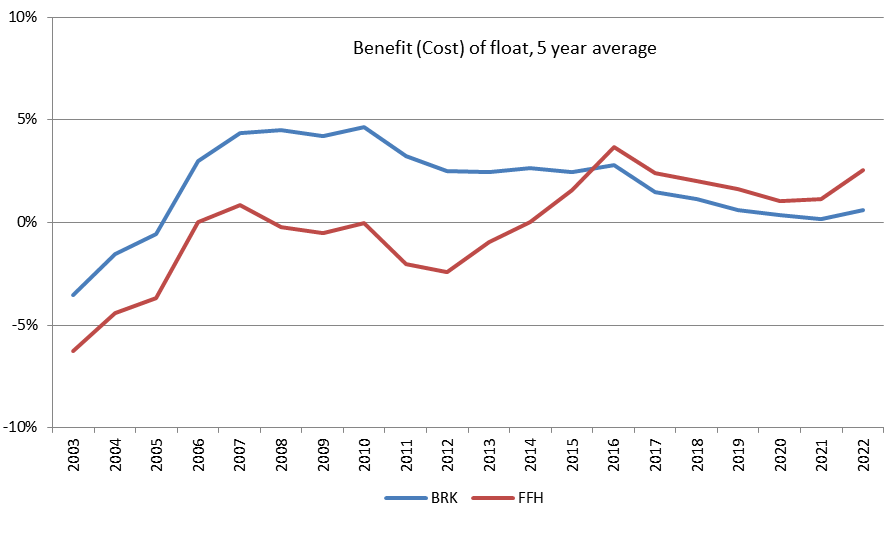
Not sure if I did it without mistakes, but it is quite interesting if you compare this data of FFH with BRK! ffh brk float.pdf ffh brk float.xlsx

-
Thanks! https://www.barrons.com/articles/jnj-kenvue-stock-price-odd-lot-rule-96aa9b74 Also: One potential positive is that arbitragers have been buying J&J and selling short Kenvue to take advantage of the 7.5% spread. This has depressed Kenvue by about 3% since the deal was announced in July while J&J is up about 2%. This could mean that Kenvue may appreciate once the deal is done and that trade is unwound. When General Electric did an exchange offer for Synchrony Financial in 2015, GE stock outperformed before the deal and Synchrony outperformed GE immediately thereafter. And: https://finance.yahoo.com/news/kenvue-set-join-p-500-224200805.html
-
https://www.bloomberg.com/news/articles/2023-08-09/sweden-needs-to-treble-nuclear-power-as-electricity-demand-soars#xj4y7vzkg Sweden said it needs to treble nuclear power capacity over the next couple of decades to meet a surge in electricity demand. At least 10 new conventional reactors need to be built by 2045, Romina Pourmokhtari, the nation’s climate and energy minister, said in a statement on Wednesday. The biggest Nordic nation has six reactors in operation today. Sweden needs all the new power capacity it can get as demand is poised to double in the next few decades amid the electrification of industries and transportation. New nuclear plants are at the heart of the government’s strategy to expand power output.
-
https://www.reuters.com/world/china/china-require-all-apps-share-business-details-new-oversight-push-2023-08-09/ A lot of "regulations are over" promises recently, yet almost every week there is some kind of new announcement.
-
Thanks very much! I guess, on the other hand, all this again is also a very good remainder (at least for me) that with an insurance business you really have to trust managment a lot. I remember I first tried to look at some insurance companies (other than BRK) in 2010 or 2011, after BRK invested in Munich RE and also when AIG was starting its second life:). This is when I also discovered this board and FFH for the first time:). Maybe WB letters and warnings on insurance had a big influence, but at that time I came to a very simple (stupid?) conclusion: no other insurance company other than BRK is investable for me at that time (good sleep), at least for big/high conviction position. I bought some FFH in 2012, but generally just went with BRK for large allocation, which was also quite cheap in 2011-2012 period. Even today, together with other leveraged financials (also after some very different expierence of investing in banks: worked generally really good with US, not so with EU:)) I do not like these companies: no traditional pricing power, high leverage and all the dangers of "creating profits" with pen, dancing till the music stops etc. More so when they are not owner operated etc. On the other hand BRK (and some other companies) has proved, that a well run insurance operation, especially combined with well run investment side of the business, could do wonders for investors. So the crux with FFH, at least for me, is do I trust them with that? I think (or hope), that the answer after the last decade is finally yes with FFH? So I would be very worried if something bad came out of their insurance operations or if they would made another very big insurance acquisition. But it seems so far so good on this side?
-
Viking, thanks for update! I am not sure I understand this IFRS 17 effect correctly (or at all:)), but wouldnt constant rates imply, that this line more likely would be a zero in the future, as only further rising rates would translate into some positive number (and vice versa)? 'On the mechanics of IFRS 17':
-
I think it is very healthy when we still have such opinions from analysts, especially when they are obviously wrong:). If you read only COBF, these days consensus on FFH almost worryingly too cheery. But when I speak about FFH with some other investors, I am still getting a lot of push back and/or very low interest. These views are usually because of expierence of the decade from 2010 and they just do not want to dig deeper, or to change the old opinion, or to dig at all, but also maybe because FFH is quite complex and in the insurance business. Anyway, if or when this Morningstar analyst will upgrade FFH to some 'medium moat' and a price with the multiple of 1.3 or 1.5 BV in the next 3 years, he probably will be another 50 or 100 per cent to late and at that time expected returns will be much lower:)
-
-
https://fortune.com/2023/08/05/black-swan-hedge-fund-mark-spitznagel-interview-taleb-credit-bubble/ I hoped that Spitznagel would help me find a simple yet practical solution to protect your portfolio from worst-case scenarios (or tail risks)—after all, that is his “bread and butter.” But his answer wasn’t what I anticipated. When you ask the man who has written multiple books on risk mitigation—his latest is called Safe Haven: Investing for Financial Storms—how retail investors can protect their capital, you expect to hear a few of the typical options: gold, Treasurys, or maybe the Swiss Franc. Instead of all that, Spitznagel warned that when it comes to safe-haven investing, “the cure is often worse than the disease.” If risk mitigation isn’t cost effective and supportive of higher overall returns in the long term, then it’s not worth it. In his view, most of the classic safe-haven strategies used by retail investors fall into this category. There is some good news, however. A recession or market downturn may come—and Spitznagel says he’s worried about what he calls the “greatest credit bubble in human history” and a “tinderbox” economy—but perhaps paradoxically, he doesn’t expect even that to be the end of the world for retail investors focused on building wealth for the future. It may take time, he said, but markets always recover, even from unexpected, economy-crushing black swan events. In spite of the potential for economic disaster, Spitznagel believes that retail investors should probably just listen to the timeless advice of Berkshire Hathaway chairman Warren Buffett: Focus on the long haul and don’t bet against America.