-
Posts
326 -
Joined
-
Last visited
-
Days Won
1
Content Type
Profiles
Forums
Events
Everything posted by Blake Hampton
-
"The United States has had a rather healthy and steady economy for years, although it was already weakening as I began writing this letter — and that was before the recent tariff announcement. The economy is facing considerable turbulence (including geopolitics), with the potential positives of tax reform and deregulation and the potential negatives of tariffs and “trade wars,” ongoing sticky inflation, high fiscal deficits and still rather high asset prices and volatility. Before I get into some of these issues, there is a really big “BUT” about what is considered America’s exceptional economic performance: Part of this performance has been driven by extraordinary deficit spending and the quantitative easing that took place. Since COVID-19, the federal government has borrowed and spent almost $11 trillion, and the Federal Reserve bought over $4.5 trillion in securities, creating huge liquidity in the financial system. Some of the results are exactly what you would expect: strong growth, inflation and higher corporate profits due to all the spending. But the U.S. deficit remains very large at just below $2 trillion, or 6.6% of GDP, which is the highest peacetime level ever not driven by recessionary needs (as, for example, during the pandemic). This high U.S. deficit also is associated with large trade deficits and is happening while our debt-to-GDP ratio is already over 100%, which is another peacetime high. The rest of the world has elevated debt levels and high fiscal deficits as well, although few as large as those of the United States. These large deficits are not sustainable—I do not know whether it will cause a real problem in six months or six years—the sooner we deal with it, the better. Tariffs and non-tariff barriers have always been hotly contested in trade negotiation. Non-tariff barriers come in many forms and have been growing over time (regulatory barriers, government procurement, export subsidies, food restrictions, etc.). Recently, value-added taxes (VAT) have entered this debate. Economists generally see VATs as a tax on domestic expenditures that does not discriminate on the source of spending. But since the VAT does not tax exports, some see them as a non-tariff trade barrier. In any event, their effect on trade may not be very large. Whatever you think of the legitimate reasons for the newly announced tariffs—and, of course, there are some—or the long-term effect, good or bad, there are likely to be important short-term effects. As for the short-term, we are likely to see inflationary outcomes, not only on imported goods but on domestic prices, as input costs rise and demand increases on domestic products. How this plays out on different products will partially depend on their substitutability and price elasticity. Whether or not the menu of tariffs causes a recession remains in question, but it will slow down growth. There are many uncertainties surrounding the new tariff policy: the potential retaliatory actions, including on services, by other countries, the effect on confidence, the impact on investments and capital flows, the effect on corporate profits and the possible effect on the U.S. dollar. The quicker this issue is resolved, the better because some of the negative effects increase cumulatively over time and would be hard to reverse. In the short run, I see this as one large additional straw on the camel’s back. I am hoping that after negotiations, the long-term effect will have some positive benefits for the United States. My most serious concern is how this will affect America’s long-term economic alliances, as I have written about in the first section. Our economy also faces the unknown effects of quantitative tightening—you must remember we have never had this much quantitative easing and, therefore, quantitative tightening before. This introduces another element of uncertainty, which, in my view—particularly in conjunction with the restrictions put on market making by primary dealers—will likely lead to much higher volatility in the treasury markets. This higher volatility is not necessarily bad for JPMorgan Chase, but it is not particularly good for the capital markets. Fortunately, there are many regulatory changes now being discussed that could ameliorate the situation. While inflation has come down, most of what I see in the future is inflationary: continued high fiscal deficits, the remilitarization of the world and the need for infrastructure investment, including the green economy and the restructuring of trade and tariffs. Another critical point: All these factors will impact interest rates. While the Federal Reserve essentially controls short-term interest rates, it does not effectively control 10-year interest rates. The Fed can take actions that can affect the 10-year interest rate in the short run, but, ultimately, the 10-year rate will be based upon inflation, the strength of the U.S. economy and expectations of the future value of the dollar, and the supply and global demand for long-term treasuries. All things being equal, the slower the growth, the lower the interest rates, and the higher the inflation, the higher the interest rates. This tug-of-war can go on for some time, but it’s good to remember that in the stagflation of the 1970s, recessions did not stop the inexorable trend of rising rates. While interest rates have come down recently due to the weakening dollar, the risk off trade and the prospect of slower growth, this trend could still reverse. Moreover, it is worth noting that we enter this time of uncertainty with high equity and debt prices, even after the recent decline. No matter how you measure it, equity valuations are still well above their historical averages. And credit spreads are still near the low end of these same ranges. Markets still seem to be pricing assets with the assumption that we will continue to have a fairly soft landing. I am not so sure. All of these cross currents and turbulence may take years to play out. It is almost impossible to confidently put them into a quarterly or even annual forecast. We always hope for the best, but we are prepared for a full range of outcomes—lower or higher rates and potentially lower asset prices, all of which could be driven by different factors, including inflation, recession, high capital demand, successful trade negotiations, regulatory and/or tax reform, or adverse effects from ongoing wars. Even with fairly extreme outcomes, our company would remain healthy. Finally, I would like to close this section by reiterating that I still have an abiding faith in America—the exceptional strength of our innovative economy and our resiliency." - Jamie Dimon, J.P Morgan Chase 2024 Letter to Shareholders
-
"The United States has had a rather healthy and steady economy for years, although it was already weakening as I began writing this letter — and that was before the recent tariff announcement. The economy is facing considerable turbulence (including geopolitics), with the potential positives of tax reform and deregulation and the potential negatives of tariffs and “trade wars,” ongoing sticky inflation, high fiscal deficits and still rather high asset prices and volatility. Before I get into some of these issues, there is a really big “BUT” about what is considered America’s exceptional economic performance: Part of this performance has been driven by extraordinary deficit spending and the quantitative easing that took place. Since COVID-19, the federal government has borrowed and spent almost $11 trillion, and the Federal Reserve bought over $4.5 trillion in securities, creating huge liquidity in the financial system. Some of the results are exactly what you would expect: strong growth, inflation and higher corporate profits due to all the spending. But the U.S. deficit remains very large at just below $2 trillion, or 6.6% of GDP, which is the highest peacetime level ever not driven by recessionary needs (as, for example, during the pandemic). This high U.S. deficit also is associated with large trade deficits and is happening while our debt-to-GDP ratio is already over 100%, which is another peacetime high. The rest of the world has elevated debt levels and high fiscal deficits as well, although few as large as those of the United States. These large deficits are not sustainable—I do not know whether it will cause a real problem in six months or six years—the sooner we deal with it, the better. Tariffs and non-tariff barriers have always been hotly contested in trade negotiation. Non-tariff barriers come in many forms and have been growing over time (regulatory barriers, government procurement, export subsidies, food restrictions, etc.). Recently, value-added taxes (VAT) have entered this debate. Economists generally see VATs as a tax on domestic expenditures that does not discriminate on the source of spending. But since the VAT does not tax exports, some see them as a non-tariff trade barrier. In any event, their effect on trade may not be very large. Whatever you think of the legitimate reasons for the newly announced tariffs—and, of course, there are some—or the long-term effect, good or bad, there are likely to be important short-term effects. As for the short-term, we are likely to see inflationary outcomes, not only on imported goods but on domestic prices, as input costs rise and demand increases on domestic products. How this plays out on different products will partially depend on their substitutability and price elasticity. Whether or not the menu of tariffs causes a recession remains in question, but it will slow down growth. There are many uncertainties surrounding the new tariff policy: the potential retaliatory actions, including on services, by other countries, the effect on confidence, the impact on investments and capital flows, the effect on corporate profits and the possible effect on the U.S. dollar. The quicker this issue is resolved, the better because some of the negative effects increase cumulatively over time and would be hard to reverse. In the short run, I see this as one large additional straw on the camel’s back. I am hoping that after negotiations, the long-term effect will have some positive benefits for the United States. My most serious concern is how this will affect America’s long-term economic alliances, as I have written about in the first section. Our economy also faces the unknown effects of quantitative tightening—you must remember we have never had this much quantitative easing and, therefore, quantitative tightening before. This introduces another element of uncertainty, which, in my view—particularly in conjunction with the restrictions put on market making by primary dealers—will likely lead to much higher volatility in the treasury markets. This higher volatility is not necessarily bad for JPMorgan Chase, but it is not particularly good for the capital markets. Fortunately, there are many regulatory changes now being discussed that could ameliorate the situation. While inflation has come down, most of what I see in the future is inflationary: continued high fiscal deficits, the remilitarization of the world and the need for infrastructure investment, including the green economy and the restructuring of trade and tariffs. Another critical point: All these factors will impact interest rates. While the Federal Reserve essentially controls short-term interest rates, it does not effectively control 10-year interest rates. The Fed can take actions that can affect the 10-year interest rate in the short run, but, ultimately, the 10-year rate will be based upon inflation, the strength of the U.S. economy and expectations of the future value of the dollar, and the supply and global demand for long-term treasuries. All things being equal, the slower the growth, the lower the interest rates, and the higher the inflation, the higher the interest rates. This tug-of-war can go on for some time, but it’s good to remember that in the stagflation of the 1970s, recessions did not stop the inexorable trend of rising rates. While interest rates have come down recently due to the weakening dollar, the risk off trade and the prospect of slower growth, this trend could still reverse. Moreover, it is worth noting that we enter this time of uncertainty with high equity and debt prices, even after the recent decline. No matter how you measure it, equity valuations are still well above their historical averages. And credit spreads are still near the low end of these same ranges. Markets still seem to be pricing assets with the assumption that we will continue to have a fairly soft landing. I am not so sure. All of these cross currents and turbulence may take years to play out. It is almost impossible to confidently put them into a quarterly or even annual forecast. We always hope for the best, but we are prepared for a full range of outcomes—lower or higher rates and potentially lower asset prices, all of which could be driven by different factors, including inflation, recession, high capital demand, successful trade negotiations, regulatory and/or tax reform, or adverse effects from ongoing wars. Even with fairly extreme outcomes, our company would remain healthy. Finally, I would like to close this section by reiterating that I still have an abiding faith in America—the exceptional strength of our innovative economy and our resiliency." - Jamie Dimon, J.P Morgan Chase 2024 Letter to Shareholders
-
This is madness
-
He also was touting that solution when our country wasn’t in a fiscal and monetary black hole.
-
S&P imo is not a good barometer for gauging valuations. I have been harping on how expensive that thing is for quite some time, and I still think it has a long way to drop. That doesn’t mean there isn’t opportunity out there though.
-
This is why you have to think long term. When everything was going great and the S&P was hitting new highs, I bet there were very few people thinking something like this might happen. The fact of the matter is that we’re trying to buy businesses that will produce for us during both good times as well as bad. This is why it’s important to buy into good businesses at good valuations. Both qualities are important. Worst case scenario, there won’t be another Great Depression in the way that previously occurred. Anything that happens in the future will almost certainly lean inflationary over time. This is the situation where you want to be an asset owner, and luckily for you, assets are currently on sale. However, this rut can still get worse.
-
As an American, I’m terrified. As an investor, I’m thrilled.
-
We will see.
-
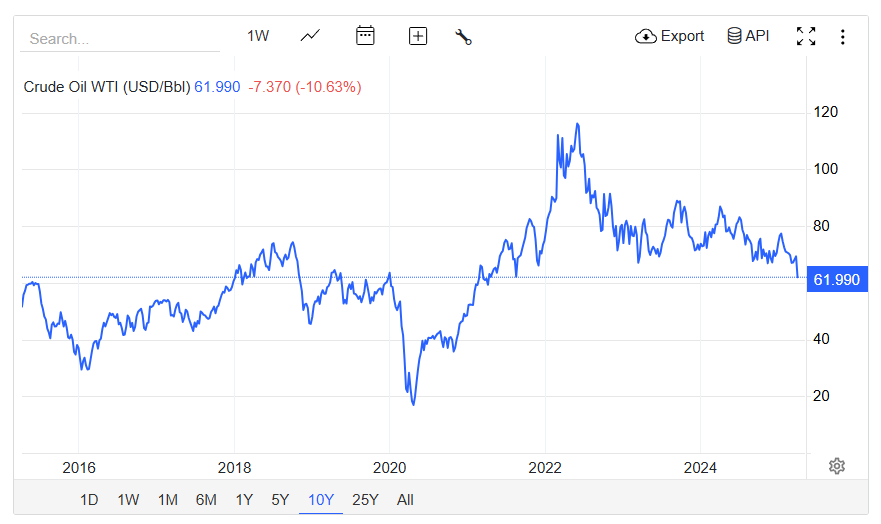
Oil broke $60.
-
I don’t personally think people are scared enough yet.
-
Futures already down 5%+
-
^ That book is not very good
-
"If he can keep forty-seven thousand spinning plates in the air, nobody can focus on any one of them." — Mary Trump, Too Much and Never Enough
-
I like this post so I'm reposting it here: The biggest problem facing our country is the federal budget. We have these enormous deficits that are growing as old debt rolls over at higher interest rates, and all of it just keeps getting piled onto the national debt. When the U.S. government deficit spends $2 trillion—approximately $15,000 for every single U.S. household—that puts additional strain on Treasury markets. Last year, the U.S. federal government ran a net deficit of $1.8 trillion, 41% of which was financed through Treasury bills. This $1.8 trillion of securities was created out of thin air. You think your T-bills are cash right? Well so does everyone else. And our country prides itself on having the "deepest and most liquid markets in the world," so a lot of longer-duration Treasury debt is viewed similarly. Imagine a large number of people suddenly sold their Treasury securities without a proportionate level of buying to offset it—who do you ultimately think fills this liquidity gap? This is nearly the exact situation the Federal Reserve faced during the pandemic, when it had to monetize trillions of dollars worth of debt to prevent a broken Treasury market from destroying our economy. That was actual cash added into the system—even if it only became bank reserves. Today, we're in an exponentially worse fiscal situation, with a manic trying his absolute best to make the whole world completely lose faith in us. And on top of all this madness, CONGRESS IS TRYING TO CUT MORE TAXES. Trade is something that should've been left unaddressed because our country can't afford the inflation that will come from trying to deal with it. Buffett has said the same thing over and over and over again: you can't do just one thing in economics. This is a zero-sum game where when money goes one place, it must come from another. These deficits are just a funny, convoluted way of printing money. And printing money is inflationary.
-
I read a WSJ article detailing how a lot of owners couldn't sell their condos because Fannie and Freddie wouldn't approve loans to buy them. I don't think I'll ever be buying one.
-
I’ve read quite a bit on the whole condo situation and my god is it screwed up. I really don’t like the economics of condos.
-
What do you imagine an attack on the insurance industry looks like?
-
Oh, and WTI oil averaged $40 a barrel in 2020 ($50 when adjusted for inflation) — during both the worst demand destruction in its history and a price war.
-
- Honest about climate change - Honest about oil and gas operations - Manages a company with low operating costs per barrel - Sees future risks and is structuring the company for them appropriately Go watch some interviews of her. She really is an interesting person to listen to:
-
Timeline for Buffett I think is forever, and I feel the same on all of it.
-
I'm Chronos, Greek god of time.
-
Theta?
-
I've thought about owning commodities but I like the companies I got quite a bit. I'm not certain that oil is going to triple or anything of the sort, I just strongly feel like $61 a barrel is quite a low price given the factors.
-

-
I always appreciate input, and I want to take a moment to talk about oil prices because it’s something I’ve been thinking about. Back in 2020, during the global pandemic that brought much of the world to a screeching halt, WTI crude oil averaged around $40 per barrel. Adjusted for inflation, that would be about $50 a barrel today. This was a time when a lot of governments were literally conducting lockdowns and not allowing people to leave their homes. Given everything happening today, I just don’t see how oil prices can sustainably drop much lower than that over the longer-term. You talk about oil prices cratering, that very well could be what's happening right now.