
Luke
-
Posts
4,269 -
Joined
-
Days Won
1
Content Type
Profiles
Forums
Events
Everything posted by Luke
-
Very Bullish for China!
-
https://www.ft.com/content/e592033b-9e34-4e3d-ae53-17fa34c16009?accessToken=zwAAAYWawEU_kdPlkgM7njROPdOuUxf6NMFgCQ.MEUCIHTIV18k06rE_s3cAG96HCMEOsQjr4R4T9w1T1POW1QyAiEA4792OHBP2_K9RcPMU61xjWM183n_SQ-evTc-BE1696o&segmentId=e95a9ae7-622c-6235-5f87-51e412b47e97&shareType=enterprise The costs of China’s chaotic exit from its zero-Covid strategy are surging. In spite of a virtually static official death toll, a slew of obituaries for elderly public figures from academics to opera singers demonstrate the impact of the virus among its vulnerable population. Hospitals in several parts of the country are overwhelmed, and a scramble for antiviral drugs and painkillers is creating shortages across Asia. Unofficial projections are putting the number of people that could die in China’s exit wave at about 1mn. Such prospects not only damage the image of Xi Jinping, China’s most powerful leader since Mao Zedong. They also leave Beijing’s propaganda organs struggling to defend policies after two years spent playing up hefty death tolls in the west as evidence of China’s superior governance. But behind the havoc, a fundamental reset is taking place in Xi’s foreign and economic policies. According to Chinese officials and government advisers, Beijing is putting together policies aimed at improving diplomatic ties that have soured badly and boosting a deeply strained economy. The motivation behind the intended resets — the success of which remains uncertain — derives from a confluence of different economic, social and foreign policy stresses that have reached critical levels, the officials and advisers add. Several of the new policies and plans represent a fleshing out of the “spirit” of the 20th congress of the Chinese Communist party in October, the most important set-piece event in the Chinese political calendar for five years that established the tone for a series of long-range objectives. After months of fierce internal politics, Xi secured an unprecedented third term as leader of the CCP and was able to pick a ruling politburo composed exclusively of loyalists. With the congress behind him, Xi is now attempting a course-correction. From an economic perspective, the main goals are to restore robust growth to China’s slowing economy, improve the lot of hundreds of millions of Chinese rural workers, stabilise the ailing property market and shore up a crisis afflicting the finances of scores of local governments, the officials and government advisers say. Chen Zhiwu, one of several leading economists who expect Beijing to push through a series of pro-growth policies, said he expects 2023’s target will be “6 per cent or higher” — much higher than the IMF’s projection of 4.4 per cent. “Given that they may aim for an average growth rate of 5 per cent and 2022 is likely to deliver about 3 per cent, they need to have something like 7 per cent for 2023,” says Chen, a professor of finance at Hong Kong University. Several other economists have predicted 2023 GDP growth at above 5 per cent. From a diplomatic perspective, China’s main aim is to improve relations with some countries in the west, after a period which has at times left Beijing feeling uncomfortably isolated. The focus is on ties with Europe, which have been badly damaged by China’s support for its partner Russia throughout Moscow’s war against Ukraine. “Diplomatically, Beijing hopes it will not become a rival to every country in the west and nor does it wish to look isolated at multilateral fora,” says Yu Jie, a China expert at UK think-tank Chatham House. “Russia’s faltering military adventure in Ukraine has significantly reduced Beijing’s return on investment in its bilateral ties with Moscow.” While Xi and Vladimir Putin, Russia’s president, pledged last month to deepen bilateral ties, several Chinese officials in private conversations with the Financial Times strove to put clear daylight between Beijing and Moscow on the issue of Ukraine — a message that has been repeated to some European diplomats. Some are scathing. “Putin is crazy,” says one Chinese official, who declined to be identified. “The invasion decision was made by a very small group of people. China shouldn’t simply Mistrust with Moscow The starting point for Xi’s diplomatic reset is a re-evaluation in Beijing about the benefits of its close relationship with Moscow. China now perceives a likelihood that Russia will fail to prevail against Ukraine and emerge from the conflict a “minor power”, much diminished economically and diplomatically on the world stage, according to Chinese officials. In addition, for all the public professions of bilateral amity, in private some Chinese officials express at least a measure of mistrust towards Putin himself. Five senior Chinese officials with knowledge of the issue have told the FT at different times over the past nine months that Moscow did not inform Beijing of its intention to launch a full invasion of Ukraine before Putin ordered the attack. Such views are at odds with the impression given by a joint statement issued by China and Russia on February 4 following a meeting between Xi and Putin in Beijing — just 20 days before Russia attacked Ukraine. It proclaimed that there were “no limits to Sino-Russian co-operation . . . no forbidden zones”. follow Russia.” No transcript of their conversation has been made public, so exactly what passed between Xi and Putin is unclear. However, one official told the FT that the closest that Putin got to informing Xi was to say that Russia “would not rule out taking whatever measures possible if eastern Ukrainian separatists attack Russian territory and cause humanitarian disasters”. This line was taken by the Chinese side as signalling the potential for some limited military engagement, not the wholesale invasion that Putin launched, the official said. Evidence to support failures of Chinese understanding, according to Chinese officials, has been the demotion in June of Le Yucheng, who at the time of the invasion was a vice-minister of foreign affairs and the ministry’s top Russia expert. Le had been widely spoken of in Chinese official circles as the likely next foreign minister. He now occupies a post as deputy head of the National Radio and Television Administration. “Le was demoted by two levels of seniority,” said one person familiar with the issue. “He was held responsible for the intelligence failure on Russia’s invasion.” Whatever the exact nature of what Putin told Xi, Chinese diplomats seeking to rehabilitate China’s standing in Europe have in private conversations maintained that Beijing was unaware of Moscow’s intention to launch a full invasion, Chinese officials and European diplomats said. This line is just one strand in a broader strategy aimed at lessening China’s sense of isolation and preventing Europe from becoming even closer to the US. Beijing’s main ploy is to attempt to reassure European counterparts that it is willing to use the closeness of its relationship with Moscow to restrain Putin from resorting to the use of nuclear weapons, Chinese and European officials say. Another aspect of Beijing’s strategy is to position itself not only as a potential peacemaker but also as a willing party in any postwar efforts to help rebuild Ukraine, Chinese officials say. Xi himself sought to portray himself as on the side of peace in remarks he made to Putin late last month. “The road to peace talks will not be smooth, but as long as the efforts are not given up, the prospect of peace will always exist,” Xi said. “China will continue to uphold an objective and fair stance, work to bring together the international community, and play a constructive role in peacefully resolving the Ukrainian crisis.” In another sign that China is seeking to dial back its antagonism towards the west, it has sidelined Zhao Lijian, one of its most prominent “wolf warrior” diplomats. A former official spokesperson for the foreign ministry, Zhao is now listed as one of three deputy directors for boundary and ocean affairs, a relatively obscure department. Zhao, who has 1.9m followers on Twitter, frequently used his account to lash out at the west. In 2019, Susan Rice, who served as Barack Obama’s national security adviser, labelled Zhao a “racist disgrace” after he sent a provocative tweet about race relations in Washington DC. As it seeks to repair ties with European powers, Beijing is insisting that its European counterparts agree to repeat a “no decoupling” mantra — marking a clear difference with Washington, which is seeking to limit US commercial ties with China in certain areas, particularly with regard to sensitive technologies. “China has realised that it has antagonised too many countries at the same time, particularly among developed countries which still today are its main trade and economic partners,” says Jean-Pierre Cabestan, a China expert at Hong Kong Baptist University. “So it is trying very hard to reach out to the EU and key European nations — Germany, France, Italy and Spain — as well as America’s Asian allies, such as Japan and South Korea and US partners such as Vietnam.” The EU is China’s biggest trade partner and Beijing runs a huge trade surplus with the bloc. Similarly, several of Europe’s leading companies rank among China’s biggest foreign investors. China’s desire for a diplomatic reset with Europe appears to be yielding significant results. Visits to Beijing in November by Olaf Scholz, the German chancellor, and Charles Michel, president of the European Council, are set to be followed early this year by French president Emmanuel Macron and Italian prime minister Giorgia Meloni. Macron is expected to follow Scholz in voicing opposition to “decoupling” from China, thereby ceding to Beijing some ground in its long-running strategy to sow division between European powers and the US. Although he has also talked about reducing dependency on China, Scholz made clear during this visit that Berlin not only rejects “decoupling” but also sees China as an “important economic and commercial partner”. “Macron, like Scholz, is opposed to decoupling. He is still promoting engagement,” says Cabestan. “China will try to utilise Macron’s strategic autonomy ambitions to drive a wedge between Europe and America.” The hope that China can help restrain Moscow from using nuclear weapons is a potent motivator in European capitals, European officials and analysts say. “China would always have opposed the use of nuclear weapons,” says Susan Shirk, chair of the 21st Century China Center at the University of California in San Diego. “But when Xi Jinping says these kinds of things to European leaders, he wants to emphasise a certain distance from Russia.” There are indications that the approach is working in Beijing’s favour. “China-Europe relations have picked up significantly because Europe is not advocating decoupling from China and demanding strategic independence,” says Ding Chun, a director at the Centre for European Studies at Fudan University in Shanghai. “Europe also faces a series of problems such as the energy crisis and the pressure on economic recovery,” Ding adds. “Relations are surely recovering but how far they can go, we should not have overly high expectations.” Regardless of Beijing’s protestations that it had no forewarning from Moscow, there is still considerable scepticism about China’s efforts to mend ties with Europe. EU officials and member state governments have consistently griped at China’s support for Putin’s war and Xi’s failure to pressure him to end it. In addition, the war’s stark exposure of the EU’s reliance on Russia for energy has accelerated a push to reduce a similar reliance on China for certain critical raw minerals and technological goods. The EU’s foreign service in October used a private paper to urge EU capitals to toughen their attitude towards China, in what one senior Brussels official told the FT amounted to “moving to a logic of all-out competition [with Beijing], economically but also politically”. A spending spree? While China’s intended diplomatic reset is starting to make waves around the world, its strategy to shore up economic growth at home is regarded as of greater importance in Beijing. The untested assumption behind the pro-growth strategy taking shape is that China will emerge from its Covid-induced economic malaise over the next few months. Han Wenxiu, a leading official in the influential Central Financial and Economic Affairs Commission, said in December that the first quarter of next year was likely to suffer from significant disruptions but the second quarter was expected to see an economic improvement at an “accelerated pace”. “We have the confidence, conditions and capacity to turn China’s economy for the better as a whole,” Han said. His words are thought to carry extra weight because the commission in which he works is chaired by Xi. Han singled out real estate and consumer spending as two areas for attention. In the case of the property market — which has been a prime driver of GDP growth over the past two decades — Han announced that “preventing and resolving the risks . . . are a top priority”. Analysts interpret his words as meaning that Beijing plans to stabilise the market — which in November suffered a sales decline of 28.4 per cent year on year — sometime this year. In addition to Han’s verbal support, China has unveiled 16 support measures for the property market, while state-run banks have pledged an estimated $256bn in potential credit to specific developers. Boosting consumer spending was also a focus that featured at the Central Economic Work Conference, which took place in mid-December. This annual conference is seen as particularly significant because it came on the heels of the 20th party congress and can therefore be seen as a statement of intent for Xi’s new administration. In the longer term, Beijing intends to realise its goal of “common prosperity” by substantially increasing the number of people in a “middle income” cohort, government advisers say. But in the short term, several analysts are expecting a “relief wave” of spending after Covid disruptions are over. Andy Rothman, an investment strategist at the Matthews Asia fund, says that a huge pool of household savings could fuel a spree of spending once the exit from Covid lockdowns is achieved. He notes that family bank balances are up 42 per cent, or $4.8tn, since the start of 2020 — an amount that is larger than the UK’s GDP. Rothman sees a return to “pragmatism” in Beijing’s economic policymaking after a statist lurch in recent years, citing Xi’s pledges at the party congress to “bring per capita income to new heights” and “provide an enabling environment for private enterprise”. Portfolio investors appear ready to embrace the idea that China’s economy is on the verge of a return to health. Hong Kong’s Hang Seng index, a gauge of sentiment towards China’s fortunes, has bounced back strongly from a recent nadir hit in October last year. But some analysts remain more hesitant, pointing to China’s chaotic emergence from its lockdowns. “With Covid-zero now in the rear-view mirror, markets expect a gangbuster 2023 recovery. That will be right, eventually,” says Derek Scissors, chief economist at Beige Book, a research company. “However, with the ongoing Covid tidal wave, investment sliding to a 10-quarter low, and new orders continuing to get battered, a meaningful Q1 recovery is increasingly unrealistic.”
-
True, at 20x and a stellar business i could still understand the buybacks. ASML as an example buys back shares at 30+ earnings as far as i read, i dont think that is a good idea
-
Thanks for sharing, exactly what i looked for. So Dividends with 0 downside and buybacks with more downside depending on when they buy back shares IRR wise? I came to the conclusion after watching pabrais uber cannibal framework that buybacks were superior compounding wise
-
Apple as an example buys back shares at 20+ earnings and Buffett still likes it, not so sure how good of an idea that is if there are bad years with a multiple reevaluation, we saw the same with Meta where the could have bought significantly more shares now . Could have instead issue dividends at a trillion dollar market cap than buying back shares.
-
Listened to Buffett on the way home, was talking about Sees Candy, dividends, opportunities to reinvest and what to do if that is not possible. Key was that when business cant reinvest, excess cash should be sent to shareholders via dividends as we know. If we look at dividends going to our pockets vs shares bought back, assuming no earnings or multiple change: If business A buys back 98% of its Stock in 25 years we will get a 50x vs business B that just sends you the yearly dividend, we wont see a 50x return on our money with the dividend. Considering that the business buys back stock at reasonable valuations (10xEarnings) and can do that for a very long time, why would one argue for dividends vs buybacks? Buybacks are only negative if they buy back overvalued shares as we know but if the business can not reinvest, would you prefer the dividend or the steady buyback compounding? Also: How difficult is it for a business to buy back more than 95% of shares outstanding? There are some businesses that have done it but what would be some problems that could occur? People not willing to sell the shares/not enough float? Let me know what you think
-
TSM, Alphabet. TSM December Sales still looks really good to me. 23.9 percent YoY growth.
-
Wrong channel my bad
-
Added to TSM, Alphabet
-
Isnt CPI on 12th of January? So Wednesday and not tomorrow? The rest, well said.
-

What do you think of Analyst Estimates and how useful are they?
Luke replied to Luke's topic in General Discussion
Thanks for sharing! -
@Viking Thanks for the insights, its a great idea. VIC had Fairfax latest in 2021, if you are not a member yet, it might be worth a shot to make it an Idea.
-
What do you think of Analyst Estimates and how useful are they?
Luke replied to Luke's topic in General Discussion
Thanks for sharing! -
What do you think of Analyst Estimates and how useful are they?
Luke replied to Luke's topic in General Discussion
I mean sure i can bunch in some numbers based on past sales but they can not be reliable. @gfp Good point! -
What do you think of Analyst Estimates and how useful are they?
Luke replied to Luke's topic in General Discussion
Yeah, i had a debate about Apple Forecast and its valuation and then Analyst Estimates came up. How on earth can you estimate cashflows for the next few years, we dont even know which kind of products will be released during those years...all one could do is look at downside, past performance, other KPI and then make some decent guess based on how the market looks like now. Just wondered really hard about a 2026 forecast and how one would come up with it -
TIKR Premium gives us Analyst estimates for a few years, what do you guys think of these estimates and are they worth anything? Whats your take? Do you use them for your thesis? Do Analyst know better? Would like to know what you think
-
I opened a very small position on Nintendo, planning to add
-
+1, also added Amazon
-
Well said!
-
Got it, sorry, i am from germany, my english is good but those metaphors i sometimes dont get Yeah, thats what i am thinking too.
-
Customer experience for Apple i agree, Nintendo does fine, Disney made some huge errors regarding their IP and i dont know if going into streaming was the right move but both nintendo and disney have strong IP that will stay for decades imo. If the current marketcap stays with us is another story and i am not yet willing to bet on disney, nintendo looks good but havent done enough DD to enter a position. I have read a decent take on alphabets chatgpt strategy aswell, i dont know how valuable your friend is as a ressource, might be valuable, but it could very well be that alphabet has an even better product but is just not coming out with it yet. They dont have to, chatgpt is funny but it does not replace google search or anything else for me. Alphabet can just come out late after everybody revealed their hand and show the royal flush: a more refined AI integrated in the search engine and the browser everybody loves+their hardware. I am not too worried since they spent a lot of money in that space already
-
Yeah, its a great eco system and i agree that with mobile phones and laptops apple has and makes the best product. Desktop pcs i still prefer my own windows machine. Now you also have the cloud, services, apple music refining the whole eco system even more. Still, I think PE of 20 is an attractive entry for sure, doesnt have to grow that much to be rewarded/minimizing downside.
-
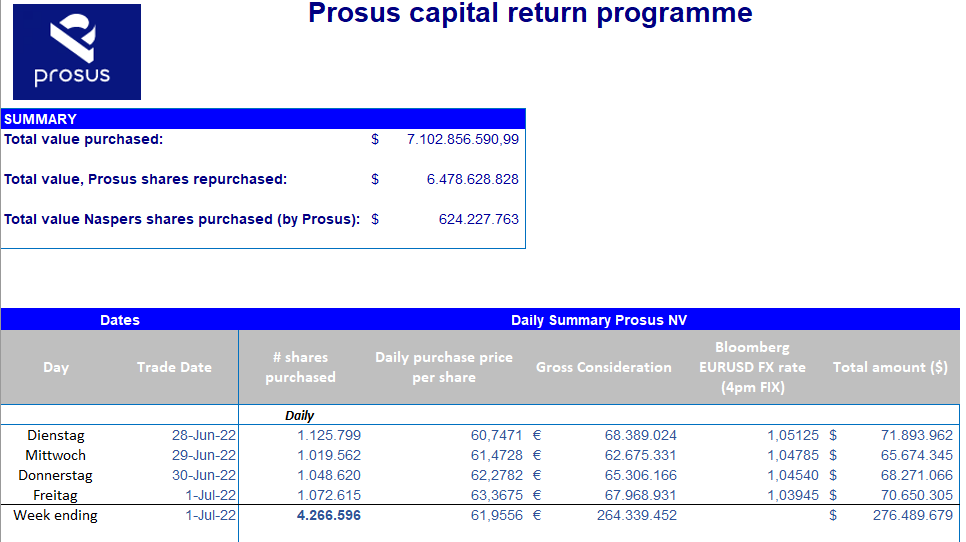
At current Valuation they bought back around 4% of shares outstanding in half a year. I think prosus knows how to do buybacks and the close contact to management of tencent gives downside protection since tencent really understands the market and regulations. I think they even have people working side by side in tencent offices, heard that in one of pabrais interviews. Prosus is just great because downside is lower thant buying tencent HK shares due to discount and additional basket+mangament that works together with tencent. One problem i had last year when shares dropped 50+% was that i could not fully understand what was going on, especially because my chinese is non existent and i dont understand the regulations there. Its nice to have a extra layer between the investment so if there are any problems between countries i expect naspers and prosus to have higher chances saving the investment if shit hits the fan+prosus has a basket of other buisnesses where some have also decent potential in interesting markets. It all depends on chinas regulations and developement, guy spier uploaded a nice video yesterday where he shares what i agree on: China is not going backwards, they are a developing nations which got used to prosperity by markets and trade and that wont change. Yes they might make mistakes and be more radical in regulations but i dont think they will kill tencent or forbid tencent to make investments out of china (which tencent does and focusses more on because they are smart). Just the venture capital arm i believe compounded north of 25% annually and they own a lot of great buisnesses. They also can navigate the chinese market better and invest in start ups there, if the chinese dont go crazy i think a lot of wealth will be created in the chinese tech markets the next decades. Lots of smart people graduating and working there. From a valuation standpoint i am most bullish on Tencent of all stocks right now, if they are let free to play out their hand. Prosus is just an extra layer that gives me peace of mind and at protects the potential downside.
-
Sorry, the explanation by bracket is not attached. You can see the daily bought back shares from Prosus since they started the open end buyback programm.
-