
Luke
-
Posts
4,269 -
Joined
-
Days Won
1
Content Type
Profiles
Forums
Events
Everything posted by Luke
-
I have shared this in the Pabrai blog before but since this thread is new i want to say it again. In general i agree with @Spekulatius description of turkey. Its not a market id like to be invested in. But now we had Pabrai sharing and essentially pumping two turkish stocks to the value investor community AFTER he made an investment in them, both with very small marketcaps where just inflows of a few thousand investors with little capital will 10x these businesses (which did happen and he praises himself for how smart he has been and how great he is with his research). Fair enough: He flew to turkey and visited some businesses his friend owns and found a buisness that was really undervalued for reasons @Spekulatius already described. Not fair enough: 100% against what buffett would do he shares these businesses on almost EVERY public speech to wealthy people and essentially pumping reysas more and more. He did it once again on the SumZero Competition end of Jan where he marketed reysas as still being investable but that the train might drive off soon (so you better call fidelity and execute that 80$ trading cost buy order!). With all my respect, i despise behaviour like that and it just smells like a pump. I would not be surprised if he sells this in a year or so after he made a 10x bagger and all the cloners are left with this buisness and very little information on its developments. I liked mohnish a lot before but since reysas and all the advertisement i get a bad feeling. Let me know what you guys think, i personally have no business i like and understand in turkey, no interest to dig through those markets aswell.
-
Well, we will maybe hear something about it at annual meeting
-
Would be my only idea, nothing changed with the buisness the last few months and china has just gotten more diplomatic and less hostile since xi secured third term. Maybe they wanted to buy more and noticed that the stock boomed after 13Fs so Buffett prefers just shopping outside of US because of all the cloners.
-
Could they have sold ADR Shares and buy Taiwan listed shares?
-
You know, although i hold a lot of Tencent/Prosus, i want to see the akward painful face of Mr. Xi Jin Ping when is own ,,people,, are leaving his ,,motherland,, because the political environment is so toxic. How Ironic, trying to bring people together while the result is the opposite. I wonder how delusional he really is.
-
Added to Samsung preferred shares
-
Yeah, Apple is not cheap but they are one heck of a buisness and i think the chances are good they will do well from current price. Netflix i wonder why it trades at the valuation it trades at...way to expensive agree...
-
@Gregmal Do you own oil stocks?
-
Apple gives you a 5% Earnings Yield at 20x and with some growth and buybacks this could still give a decent return, maybe even market beating depending on apples innovative abilities. Buffett still likes it, i would not call Apple dead but not many doubles left for sure. Microsoft at 25x doesnt look very expensive but not cheap and if growth slows i could see them maybe throwing of something like 5,6,7,8% a year with buybacks etc? Certainly not horrible. Amazon on the other hand still has a long runway and i wouldnt call them dead whatsoever, wouldnt be surprised if they beat the S P 500 at current valuation for next decade. Big tech Valuation is not extreme nor is it very cheap, they provide perhaps safer but maybe more mediocre returns with limited upside. My rank for cheapness and runway (longest runway/cheap first): Meta, Amazon, Alphabet, Apple, Microsoft, Netflix. I would never call them dead and they all have a very high specific moat that i dont see gone for a very long time.
-

Movies and TV shows (general recommendation thread)
Luke replied to Liberty's topic in General Discussion
looks really good, on my watchlist now! -
I am very excited for earnings time, lets see what Mr.Market serves us
-
Yeah definitely some growth left in the world!
-
Movies and TV shows (general recommendation thread)
Luke replied to Liberty's topic in General Discussion
@flesh Perhaps @Parsad should watch martyrs xD -
Enjoyed this one very much, thanks!
-
Movies and TV shows (general recommendation thread)
Luke replied to Liberty's topic in General Discussion
Fair enough, movie is not for everyone. It does leave an impression and for you it was a horrible one, perhaps thats why martyrs truly deserves the genre ,,horror,,. I watched it first because i heard from some people how horrific it is and my curiosity won, i also watched and was shocked etc but of course also had some distance because in the end its just a movie. But thats art, not all art makes you feel well, horrific cruelsome paintings are also worth looking at but not for some. Zdzisław Beksiński comes to mind as a ,,horror,, painter: -
Movies and TV shows (general recommendation thread)
Luke replied to Liberty's topic in General Discussion
And interesting point that they could be a recipe. I dont think there should be thrillers and murder movies at all if you go along with that argument. Its just a genre and a movie, a shocking one for sure! -
Movies and TV shows (general recommendation thread)
Luke replied to Liberty's topic in General Discussion
Its 100% not for the sensitive hearted and i recommend watching it alone or with a hardcore horror friend -
Movies and TV shows (general recommendation thread)
Luke replied to Liberty's topic in General Discussion
I understand your point of view and its certainly not for everybody. In the end there is this question: Why make a film like this and watch it? It starts at: Why watch a normal scary movie, why do we like to feel scared/excited. I think there is the human nature that likes to explore and have an adventure, for that we have the normal thriller on netflix etc. Then we have movies like martyrs etc which just go beyond all borders and take people on a horrific trip that just leaves you bonkers. I think the following reviews capture the essence of the film very well:
-
Movies and TV shows (general recommendation thread)
Luke replied to Liberty's topic in General Discussion
Ill throw in some hardcore horror for fans of the genre: Incredibly sophisticated and shocking down to the bone, brilliant acting, unbelievable story. One of the best horror movies i have seen. https://www.imdb.com/title/tt1029234/reviews?ref_=tt_urv
-
Added to Micron
-
Just to throw in some contrarian view: https://themarket.ch/interview/russell-napier-the-world-will-experience-a-capex-boom-ld.7606 In summer of 2020, you predicted that inflation was coming back and that we were looking at a prolonged period of financial repression. We currently experience 8+% inflation in Europe and the US. What’s your assessment today? My forecast is unchanged: This is structural in nature, not cyclical. We are experiencing a fundamental shift in the inner workings of most Western economies. In the past four decades, we have become used to the idea that our economies are guided by free markets. But we are in the process of moving to a system where a large part of the allocation of resources is not left to markets anymore. Mind you, I’m not talking about a command economy or about Marxism, but about an economy where the government plays a significant role in the allocation of capital. The French would call this system «dirigiste». This is nothing new, as it was the system that prevailed from 1939 to 1979. We have just forgotten how it works, because most economists are trained in free market economics, not in history. Why is this shift happening? The main reason is that our debt levels have simply grown too high. Total private and public sector debt in the US is at 290% of GDP. It’s at a whopping 371% in France and above 250% in many other Western economies, including Japan. The Great Recession of 2008 has already made clear to us that this level of debt was way too high. How so? Back in 2008, the world economy came to the brink of a deflationary debt liquidation, where the entire system was at risk crashing down. We’ve known that for years. We can’t stand normal, necessary recessions anymore without fearing a collapse of the system. So the level of debt – private and public – to GDP has to come down, and the easiest way to do that is by increasing the growth rate of nominal GDP. That was the way it was done in the decades after World War II. What has triggered this process now? My structural argument is that the power to control the creation of money has moved from central banks to governments. By issuing state guarantees on bank credit during the Covid crisis, governments have effectively taken over the levers to control the creation of money. Of course, the pushback to my prediction was that this was only a temporary emergency measure to combat the effects of the pandemic. But now we have another emergency, with the war in Ukraine and the energy crisis that comes with it. You mean there is always going to be another emergency? Exactly, which means governments won’t retreat from these policies. Just to give you some statistics on bank loans to corporates within the European Union since February 2020: Out of all the new loans in Germany, 40% are guaranteed by the government. In France, it’s 70% of all new loans, and in Italy it’s over 100%, because they migrate old maturing credit to new, government-guaranteed schemes. Just recently, Germany has come up with a huge new guarantee scheme to cover the effects of the energy crisis. This is the new normal. For the government, credit guarantees are like the magic money tree: the closest thing to free money. They don’t have to issue more government debt, they don’t need to raise taxes, they just issue credit guarantees to the commercial banks. And given that nominal growth consists of real growth plus inflation, the easiest way to do this is through higher inflation? Yes. Engineering a higher nominal GDP growth through a higher structural level of inflation is a proven way to get rid of high levels of debt. That’s exactly how many countries, including the US and the UK, got rid of their debt after World War II. Of course nobody will ever say this officially, and most politicians are probably not even aware of this, but pushing nominal growth through a higher dose of inflation is the desired outcome here. Don’t forget that in many Western economies, total debt to GDP is considerably higher today than it was even after World War II. What level of inflation would do the trick? I think we’ll see consumer price inflation settling into a range between 4 and 6%. Without the energy shock, we would probably be there now. Why 4 to 6%? Because it has to be a level that the government can get away with. Financial repression means stealing money from savers and old people slowly. The slow part is important in order for the pain not to become too apparent. We’re already seeing respected economists and central bankers arguing that inflation should indeed be allowed at a higher level than the 2% target they set in the past. Our frame of reference is already shifting up. Yet at the same time, central banks have turned very hawkish in their fight against inflation. How does that square? We today have a disconnect between the hawkish rhetorics of central banks and the actions of governments. Monetary policy is trying to hit the brakes hard, while fiscal policy tries to mitigate the effects of rising prices through vast payouts. An example: When the German government introduced a €200 bn scheme to protect households and industry from rising energy prices, they’re creating a fiscal stimulus at the same time as the ECB is trying to rein in their monetary policy. Who wins? The government. Did Berlin ask the ECB whether they can create a rescue package? Did any other government ask? No. This is considered emergency finance. No government is asking for permission from the central bank to introduce loan guarantees. They just do it. You’re saying that central banks are powerless? They’re impotent. This is a shift of power that cannot be underestimated. Our whole economic system of the past 40 years was built on the assumption that the growth of credit and therefore broad money in the economy was controlled through the level of interest rates – and that central banks controlled interest rates. But now, when governments take control of private credit creation through the banking system by guaranteeing loans, central banks are pushed out of their role. There’s another way of looking at today’s loud, hawkish rhetoric by central banks: Teddy Roosevelt once said that, in terms of foreign policy, one should speak softly and carry a big stick. What does it tell you when central banks speak loudly? Perhaps that they’re not carrying a big stick anymore. Would that apply to all Western central banks? Certainly to the ECB and definitely to the Bank of England and the Bank of Japan. These countries are already well on their path to financial repression. It will happen in the US, too, but we have a lag there – which is why the dollar is rising so sharply. Investment money flows from Europe and Japan towards America. But there will come a point where it will be too much for the US as well. Watch the level of bond yields. There is a level of bond yields that is just unacceptable for the US, because it would hurt the economy too much. My argument for the past two years was that Europe can’t let rates go up, not even from current levels. The private sector debt service ratio in France is 20%, in Belgium and the Netherlands it’s even higher. It’s 11% in Germany and about 13% in the US. With rising interest rates, it won’t take long until there will be serious pain. So it’s just a matter of time before we all get there, but Europe is at the forefront. Walk us through how this will play out. First, governments directly interfere in the banking sector. By issuing credit guarantees, they effectively take control of the creation of broad money and steer investment where they want it to. Then, the government would aim for a consistently high growth rate of money, but not too high. Again, history shows us the pattern: The UK had five big banks after World War II, and at the beginning of each year the government would tell them by what percentage rate their balance sheet should grow that year. By doing this, you can set the growth rate of broad money and nominal GDP. And if you know that your economy is capable of, say, 2% real growth, you know the rest would be filled by inflation. As a third prerequisite you need a domestic investor base that is captured by the regulatory framework and has to buy your government bonds, regardless of their yield. This way, you prevent bond yields from rising above the rate of inflation. All this is in place today, as many insurance companies and pension funds have no choice but to buy government bonds. You make it sound easy: The government just has to engineer a level of nominal growth and of inflation that is consistently somewhat higher than interest rates in order to shrink the debt to GDP ratio. Again, this is how it was done after World War II. The crucial thing is that we are moving from a mechanism where bank credit is controlled by interest rates to a quantitative mechanism that is politicised. This is the politicisation of credit. What tells you that this is in fact happening today? When I see that we are headed into a significant growth slowdown, even a recession, and bank credit is still growing. The classic definition of a banker used to be that he lends you an umbrella but would take it away at the first sight of rain. Not this time. Banks keep lending, they even reduce their provisions for bad debt. The CFO of Commerzbank was asked about this fact in July, and she said that the government would not allow large debtors to fail. That, to me, was a transformational statement. If you are a banker who believes in private sector credit risk, you stop lending when the economy is headed into a recession. But if you are a banker who believes in government guarantees, you keep lending. This is happening today. Banks keep lending, and nominal GDP will keep growing. That’s why, in nominal terms, we won’t see an economic contraction. Won’t there come a point where the famed bond market vigilantes would step in and demand significantly higher yields on government bonds? I doubt it. First, we already have a captured investor base that just has to buy government bonds. And if push comes to shove, the central bank would step in and prevent yields from rising higher, with the ultimate policy being overt or covert yield curve control. What if central banks don’t want to play along and try to regain control over the creation of money? They could, but in order to do that, they would really have to go to war with their own government. This will be very hard, because the politicians in government will say they are elected to pursue these policies. They are elected to keep energy prices down, elected to fight climate change, elected to invest in defence and to reduce inequality. Arthur Burns, who was the Fed chairman during the Seventies, explained in a speech in 1979 why he lost control of inflation. There was an elected government, he said, elected to fight a war in Vietnam, elected to reduce inequality through Lyndon B. Johnson’s Great Society programs. Burns said it wasn’t his job to stop the war or the Great Society programs. These were political choices. And you say it’s similar today? Yes. People are screaming for energy relief, they want defence from Putin, they want to do something against climate change. People want that, and elected governments claim to follow the will of the people. No central banker will oppose that. After all, many of the things that are associated with financial repression will be quite popular. What’s the endgame of this process, then? We saw the endgame before, and that was the stagflation of the 1970s, when we had high inflation in combination with high unemployment. People are already talking about stagflation today. That’s utter nonsense. They see high inflation and a slowing economy and think that’s stagflation. This is wrong. Stagflation is the combination of high inflation and high unemployment. That’s not what we have today, as we have record low unemployment. You get stagflation after years of badly misallocated capital, which tends to happen when the government interferes for too long in the allocation of capital. When the UK government did this in the 1950s and 60s, they allocated a lot of capital into coal mining, automobile production and the Concorde. It turned out that the UK didn’t have a future in any of those industries, so it was wasted and we ended up with high unemployment. So the endgame will be a 1970s style stagflation, but we’re not there yet? No, not by a long shot. First comes the seemingly benign part, which is driven by a boom in capital investment and high growth in nominal GDP. Many people will like that. Only much later, when we get high inflation and high unemployment, when the scale of misallocated capital manifests itself in a high misery index, will people vote to change the system again. In 1979 and 1980 they voted for Thatcher and Reagan, and they accepted the hard monetary policy of Paul Volcker. But there is a journey to be travelled to get to that point. And don’t forget, by the time Thatcher and Reagan came in, debt to GDP had already come down to new lows. That enabled them to introduce their free market policies, which would probably not have been possible if debt to GDP were much higher. So that’s why we’re in for a long social and political journey. What you have learned in market economics in the past forty years will be useless in the new world. For the next twenty years, you need to get familiar with the concepts of political economy. What will this new world mean for investors? First of all: avoid government bonds. Investors in government debt are the ones who will be robbed slowly. Within equities, there are sectors that will do very well. The great problems we have – energy, climate change, defence, inequality, our dependence on production from China – will all be solved by massive investment. This capex boom could last for a long time. Companies that are geared to this renaissance of capital spending will do well. Gold will do well once people realise that inflation won’t come down to pre-2020 levels but will settle between 4 and 6%. The disappointing performance of gold this year is somewhat clouded by the strong dollar. In yen, euro or sterling, gold has done pretty well already.
-
Bought some Tencent
-
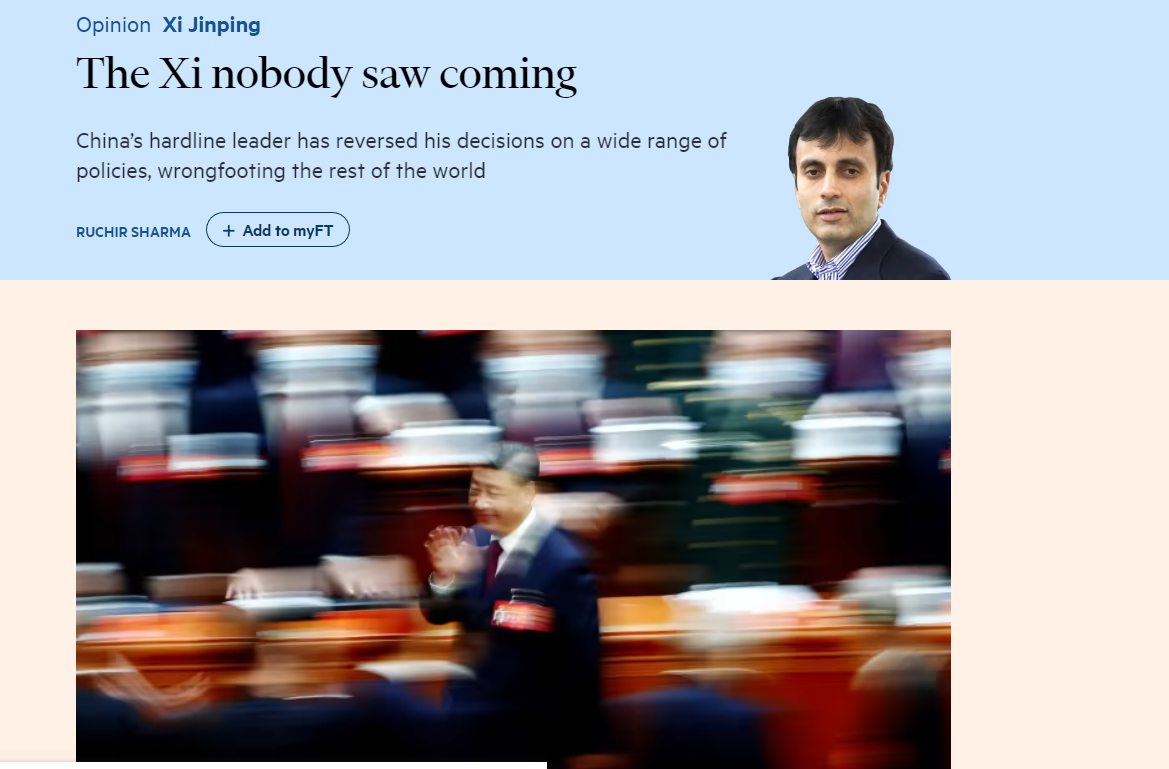
In late October, when Xi Jinping consolidated his hold on China’s communist party at its five-yearly congress, the world cringed. Xi seemed determined to push China back to the age of Mao Zedong, his role model. Hardline ideology would tighten its grip on the world’s second-largest economy, with dire implications for the rest. The last thing anyone expected from a strongman president entering his 11th year in power was a sudden about face. Yet within weeks, Xi’s government has reversed its efforts to control Covid-19, Big Tech companies, the property market and more. It has shown signs of reduced support for Russia’s war in Ukraine while easing tensions with the US and in its territorial disputes in the South China Sea. This softening seemed so uncharacteristic of Xi, some even speculated that he no longer set government policy. That’s unlikely — at the congress Xi had purged enemies and installed allies throughout the party. Yet the 180-degree turn on multiple policy fronts was unmistakable and raises doubts about everything the world thought it knew about Xi, the unbending hardliner. Was he now bending to pressure from worried officials, the public, the deteriorating economy? The answer may be all of the above. Xi’s Covid policy, the tech crackdown and the property bust had brought the economy to a standstill in 2022. The economy appears to have contracted in the fourth quarter, which is likely to bring growth for the year down to 3 per cent. That is according to official Chinese data — the reality was probably worse. China has not grown this slowly since the late 1970s and is growing no faster than the rest of the world, also a first since the 1970s. A performance that weak was a serious threat to an authoritarian state that rests its legitimacy on promises to restore China’s prosperity and its global stature. As the slowdown fuelled street rallies against the pursuit of “zero-Covid”, some protesters dared to call for Xi to step down. Officials in his own government were reportedly urging him to save the economy. Still, few if any China watchers thought the paramount leader would change course. Those who last more than 10 years in power often grow less flexible, and have worse effects on the economy over time, even in democracies. Many dictators, from Cuba’s Fidel Castro to Mao, have been snowballing disasters. The rare, steady reformers include the likes of Singapore’s Lee Kuan Yew, and Deng Xiaoping, who dumped Maoism for pragmatism and set China on the road to prosperity after 1980. Xi now appears to have moved into a grey area on the spectrum of ageing leaders — willing to reform, at least in the depths of a crisis. Aiming to revive the economy after the congress, Xi’s government started sounding less Maoist. It has dropped the “three red lines” on borrowing by developers, and announced that the “rectification” campaign against fintech firms is nearly complete. After tightening state control for years, it is sending out messages of support to the private sector, even offering details of its new global data market that suggest respect for private data ownership. The irony: Xi may be trying impractically hard to revive growth. His plans to build “a modern socialist economy” imply an annual gross domestic product growth target of 5 per cent, which is no longer possible. China’s population growth has slowed sharply, as has productivity growth. With fewer workers and slumping output per worker, the country’s potential growth rate is 2.5 per cent. Beyond this year, when spending by Chinese consumers released from lockdown may temporarily boost growth, 5 per cent is an unrealistic target. And more debt-financed spending will only increase China’s already massive debt load. Global investors, who so often blow hot and cold on China, have again flipped — this time to embrace the new Xi. Before November, the country’s stock market was tanking with the economy. Fund managers were launching emerging market mandates excluding China. Now, they are bullish on hopes of a post-pandemic “reopening” bounce and have been pouring money into Chinese stocks. The benchmark MSCI China index is up a staggering 50 per cent since the late October lows. Yet the questions about China’s policy direction remain. Xi’s pivot is a pragmatic course correction, but it raises doubts about his steadiness. His impulse to control may reassert itself when the economy starts to recover — a reflex much more common in ageing leaders than a full rebirth as a steady reformer. Still, we should celebrate this new Xi, if he lasts — he’s a lot better for the world than the old one.
-
I bet there could be some equally extreme measures like the one child policy to increase the birth rate. Good Article:
-
Not a podcast but really enjoying RV Capital 2023 QA