All Activity
- Past hour
-
The first time I met Tilson in 2002 at the Berkshire AGM, I attended an open gathering he had where a bunch of young investors and fund managers attended. I went up to speak to him just to thank him for everything he was doing for young investors and managers...and literally his eyes glazed over, he turned around, and started speaking to someone else. Never said a word to me, never turned back as I stood there. Perhaps it was an emergency...though he didn't move or go anywhere...perhaps he didn't hear me, but my cousin and other friends were right there and heard/watched everything. I don't know...but I've never done that to anyone in my life...even in an emergency, I apologize to them first and excuse myself. So something small, but it showed a flaw in his character...to me anyways! When Fairfax stock was getting batted around by payroll journalists and hedge funds in 2003, Tilson was a defender of their behavior. He was friends with some of them and vocally shorted stocks himself. Go read up on his past history from back then. So from a Fairfax shareholder perspective...strike two for me! Lastly, ask Gregmal what he thinks of Tilson's research...or many others from the past who used to watch Tilson literally copy short positions and long positions from many of his friends...Einhorn, Ackman, etc. For me...strike three...no originality as an investor! Cheers!
-
You are very sure of yourself and I have never seen you back down, that’s all, so I didn’t expect you would here, nor did you. But if you were there, and saw the eyes rolling, ok. Still doesn’t explain why you would be so negative about Tilson, but many others share your opinion, and of course you are entitled to it, even if in my opinion it seems totally unfair.
-
Seriously? You expect Chinese to pay anyone tribute?
-
Maybe, but we haven't heard or seen that with other reinsurance companies so far in Q2. Cheers!
-
$800M-$1B gain? Did we miss something that may have increased tangible book value dramatically? Cheers!
-
I don't have to prove it...I was there! Tilson whenever he would ask questions, they were long winding questions. Over time, everyone knew who he was and on one occasion, he got up to ask a question and it went on for like 30-40 seconds and Munger's eyes were rolling and glazed over...nothing to do with his blindness! Many in the audience started groaning when we saw Munger's face screw up over the question. As for some people's animosity to Tilson...maybe you should talk to those people on why they feel that way. Also, your attitude towards me about "not holding my breath"...first, what the fuck is that about, second, whatever reasons you may have, I'm not asking you to withdraw your accusation or comment...you are free to express yourself? But ask yourself how is that any different than another person's opinion on Tilson?
-
Maybe an early very large reserve release this Qtr? Fairfax should be releasing reserves from the early stages of the previous hard market now, although Fairfax has stated in the past that this is usually done in Q4. That is the only thing that I can think of that would move the needle. A $1B reserve release.
-
Added to LEN-B (Lennar Corp.)
- Today
-
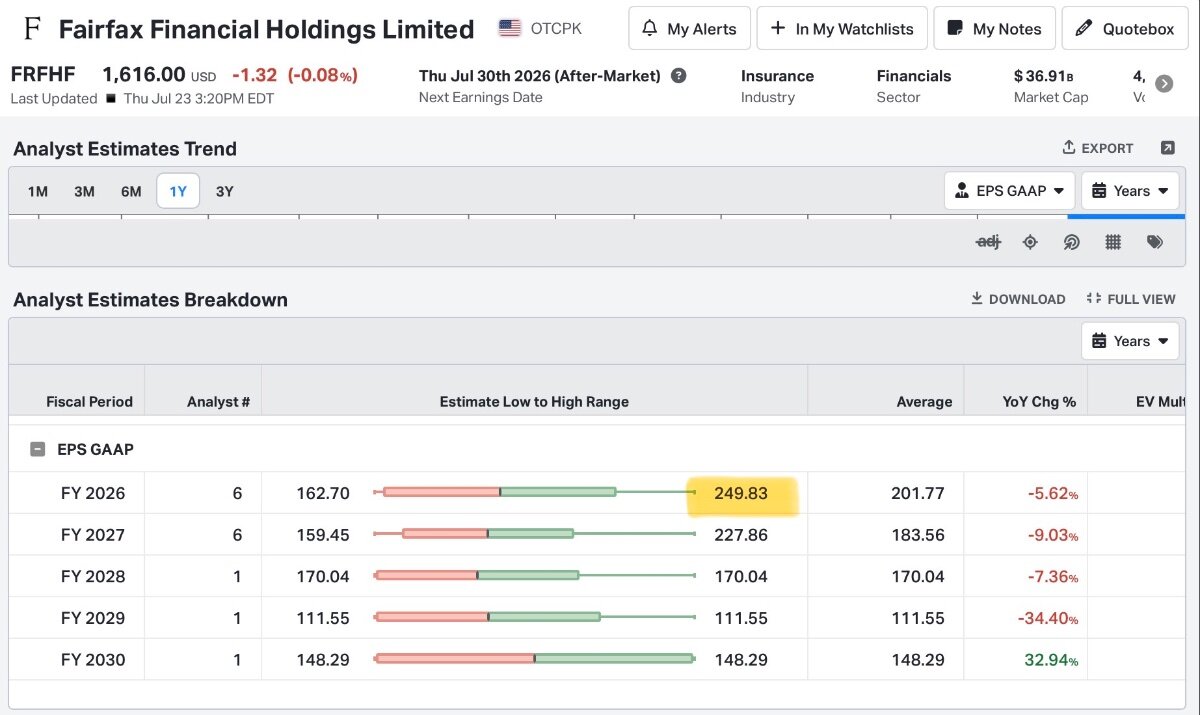
Highest estimate is $250. Lowest estimate is $160 so it essentially trades at 7-10x P/E which reflects the variability in earnings.

-
How big is a whopper?
-
It's probably due to the same reason I said expect an earnings surprise in Q2...higher than what Viking is estimating and he's usually damn close! I cannot see why they would buy so much stock back in Q2 unless there was some adjustment to book value...maybe we missed something in terms of realized gains or mark-to-market of the associates. I think a whopper quarter is coming and that's why BMO also hasn't changed their target significantly, since it is a one-off for now. But it does affect book value and that's why Fairfax bought back a ton of stock. Either that or someone offered them a large block privately! Cheers!
-
Adding to Tencent <$55. Tencent, Coupang and Nintendo may be permanently impaired by widening Western/Asian cultural chasms in spite of the quality of the businesses. My job is to buy great businesses at reasonable valuations; the rest is out of my control. Buffett wisely steered clear of this bs by sticking to US based companies.
-
Near term, most would expect that Murban, Brent, and WTI will be going up. Higher, faster, as Trump flounders, global inventories are materially lower, and China has resumed buying. It would also seem that China bound tankers are being allowed out of the Red Sea; most would expect for a fee ... paid in weapons delivered to the Houthis and Somalis. Longer term, there will eventually be a practical arrangement that works for all. But years away still, not until many of the existing heads of state have changed, and security guarantees have been 'modernised'. The inflation thing is very 'iffy'. Sure, gasoline may cost more (inflation), but net of driving less and keeping the tank only 1/2 full (substitution), no clear direction. Trump loses the midterms (chaos), tariffs get reimbursed (inflation), tariffs get rescinded (deflation) .... all very uncertain, situation specific, and hard to generalise. SD
-
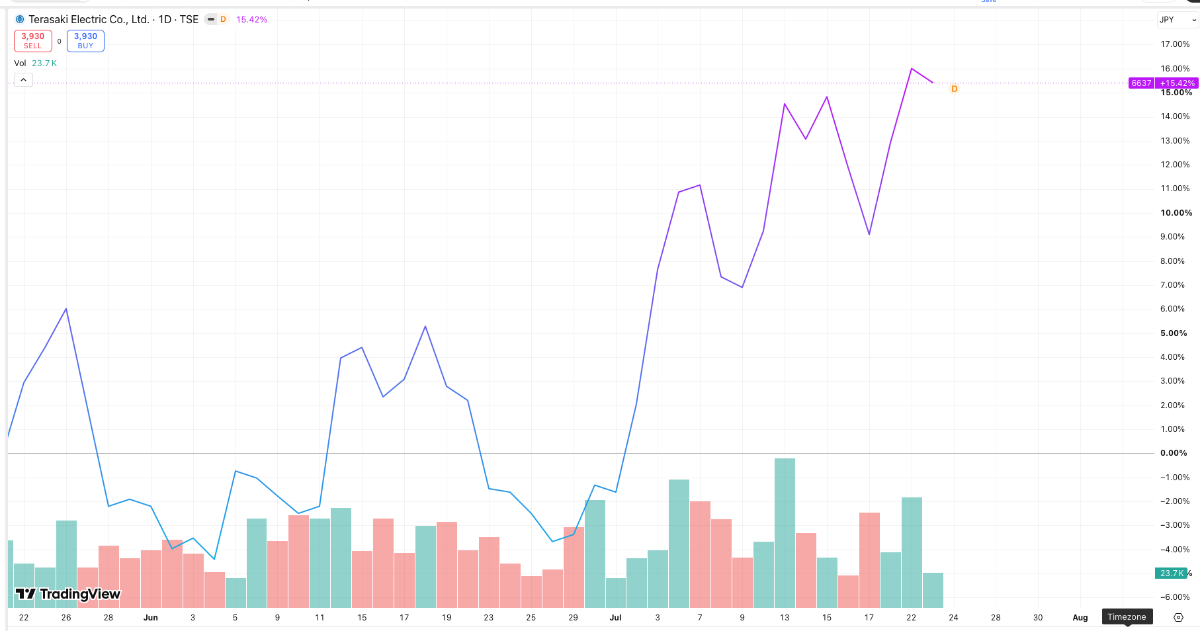
Anybody see the news that caused this to pop 20% today on 3x average volume? Saw it at the open, assumed it was fluke but didn't see any news, so put in a limit order for my small position to sell and it filled. And price seems to have remained elevated the whole day so now curious what is driving it.
-
Is Europe becoming uninvestable? European regulators and leaders sure seem to want it to be uninvestable as far as technology (and chemicals, oil & gas, heavy industry) is concerned...
-
Love it! So their target price is for the share price to go from 12.5 to 13.7 x Q2 earnings? Anyone know what their earnings forecast is for the whole year?
-
I have a follow up question for the board. How many business engines do you think Fairfax has? Is it two: Insurance Investments Or is it three: Insurance Investments: fixed income + mark to market equities Non-insurance associate + consolidated companies Or is it some other number? I keep going back and forth on the question (between 2 and 3). We know Fairfax has no desire to become a full-blown conglomerate like Berkshire Hathaway. My guess is Fairfax views non-insurance associate + consolidated companies primarily as investments - not permanent holdings. They will likely be monetized one day (like the recent sale of 50% of Poseidon). So on a practical basis my current view is Fairfax has two basic business engines: insurance and investments. However, in terms of understanding the business, I think it is helpful to use three business engines, and split investments into two buckets. How do you analyze Fairfax?
-
Which is the highest in ~18 months, but still below the highs set in 2023 and has topped out in this range multiple times since. Additionally, it's not the 10-year that matters to Fairfax, but more so the 3-5 which are also below 2023 highs and have consistently been setting "lower highs" on each subsequent spike - this current one included. Not to say they can't go higher, but they haven't been for three years and I think energy and war inflation, like we're seeing today, precedes economic contractions and not inflationary expansions. I tend to agree it's a good time for bonds - 3% real yields have historically been great buying opportunities for TIPS even if not immediately. You can get 2.25-2.5% in shorter duration TIPS which is still pretty good historically. 5-6% on agency mortgages with limited prepayment risk at this time given home values falling/stagnating? You're getting mid-single digit returns before even considering any sort of credit/duration/pre-payment/leverage pick-up and a 5-year TIP is going to have quite a bit less duration/inflation risk than equities @ 20x + earnings. We saw in 2022 that it takes YEARS for index earnings to recover in real terms - and much of that recovery was in AI infrastructure/chip spend which is still up in the air if it was real earnings or is just gonna come out in depreciation/write offs over the next 5-years.
-
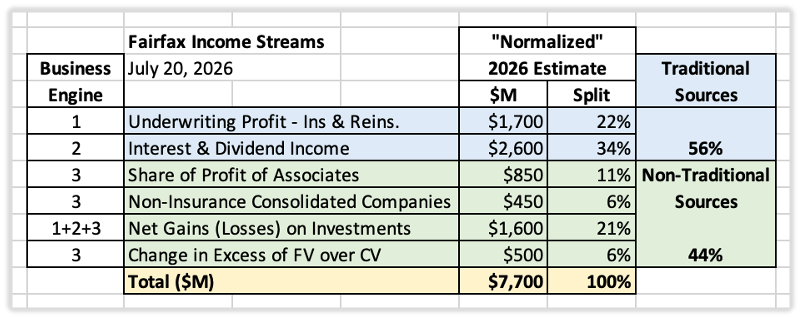
Article 4 in our deep dive into Fairfax's business model. This is the final article in the series. An Income Stream View of the Business Model Following the Money The previous articles explained how Fairfax's business model works. This article examines the same business from a different perspective: where it earns its money. Understanding Fairfax's income streams provides an accounting view of the business model. It connects insurance, investing and capital allocation to the company's reported financial results. Most investors analyze Fairfax as though it were a conventional property and casualty insurer. That framework is incomplete. Another way to understand the business is through its six income streams. Viewed through this lens, Fairfax has multiple sources of earnings and multiple drivers of long-term intrinsic value. The Six Income Streams Fairfax generates six distinct income streams. The first five are recognized in reported earnings. The sixth is an economic measure of value creation that accounting rules do not yet recognize. Together, these six income streams map directly to Fairfax's three business engines. Accounting Income Streams Engine 1: Insurance Underwriting profit Engine 2: Investments – Fixed Income and Mark-to-Market Equities Interest and dividend income Engine 3: Associates and Non-Insurance Operating Companies Share of profit of associates Earnings from non-insurance consolidated companies Generated by All Three Business Engines Unlike the other income streams, net gains (losses) on investments can be generated by all three business engines. Net gains (losses) on investments As Fairfax creates value across its insurance operations, investment portfolio and operating businesses, management can choose when to realize that value. When assets are sold, the accumulated gains are recognized in reported earnings. Importantly, realized gains are not limited to the investment portfolio. Fairfax has also generated significant gains by monetizing insurance businesses. Recent examples include the sale of its pet insurance business, Ambridge, and the public listing of Digit Insurance. Beyond Accounting Earnings As Warren Buffett has often observed, accounting earnings provide an excellent starting point. They do not, however, capture all of the value a business creates. Fairfax therefore reports another measure that deserves attention: 6. Annual change in excess of fair value over carrying value (FV–CV) for associates and publicly traded consolidated companies. Like income streams 3 and 4, this measure is generated by Engine 3. It captures value that has already been created by Fairfax's associates and publicly traded consolidated companies, but has not yet been recognized in reported earnings. Importantly, this is not management's estimate of intrinsic value. It is based on observable market values and is reported every quarter. Although this measure captures an important source of hidden value within Engine 3, it does not capture all of the unrealized value being created. As a result, it provides investors with a transparent and conservative measure of economic value creation that is likely to become reported earnings over time. Mapping the Income Streams The exhibit below illustrates how Fairfax's three business engines generate the company's six income streams. "Normalized" 2026 Estimate: This is not my forecast for Fairfax's actual 2026 results. Rather, it is a thought exercise that estimates what the company could earn in a normal year. Fairfax Versus a Traditional P/C Insurer Most property and casualty insurers rely primarily on two sources of earnings: Underwriting profit Interest income That is the traditional insurance model. The objective is stable, predictable earnings generated through disciplined underwriting and conservative investment portfolios. Fairfax's earnings profile is fundamentally different. Today, underwriting profit together with interest and dividend income account for approximately 56% of normalized earnings. The remaining 44% is generated through capital allocation activities, including associates, non-insurance operating companies, investment gains and the realization of hidden value. Insurance remains the foundation of Fairfax's success. Increasingly, however, long-term shareholder returns are driven by how management allocates the capital generated by that insurance platform. The Investor Takeaway Many analysts continue to evaluate Fairfax using the framework applied to a conventional property and casualty insurer. As a result, they focus primarily on two income streams: underwriting profit and interest income. That approach is incomplete for two reasons. It overlooks four income streams that together account for roughly 44% of Fairfax's normalized earnings power. More importantly, it underestimates the role of capital allocation in driving long-term shareholder returns. For Fairfax, the insurance cycle is important. Capital allocation is even more important. During soft insurance markets, capital does not remain trapped inside the insurance business. Management can instead redeploy it into public equities, private businesses, credit investments, acquisitions or share repurchases. Fairfax's six income streams demonstrate that management has built a diversified set of capital allocation capabilities, allowing it to pursue attractive opportunities wherever they arise. This flexibility has been a defining characteristic of Fairfax throughout its history. It also helps explain why comparisons with traditional property and casualty insurers are often incomplete. In many respects, Fairfax's economic model more closely resembles Berkshire Hathaway during the 1980s and 1990s than it does a conventional insurance company. Soft insurance markets did not prevent Berkshire from compounding capital over that period because insurance was only one component of a broader capital allocation model. The same principle applies to Fairfax today.
-
I have trouble believing that this is true. Tilson’s questions were always sensible, in marked contradistinction to 90% of the audience questions which were puerile or which had already been answered so many times previously. Tilson actually wrote chapter 3 in the book about Munger, and it seems unlikely that he would have been asked to do so if anyone thought Munger harboured any personal animosity against Tilson. For some reason I have never been able to fathom, many people seem to harbour an intense dislike of Tilson, despite his pretty good track record, his sensible ideas, and his strong support of value investing and Berkshire in particular. Nor does he have any association with the attack on Fairfax. I don’t expect you to be able to prove that Munger ever rolled his eyes at Tilson’s questions, just as I can’t prove that he didn’t, but I find it highly unlikely. I think you should prove it, or withdraw your accusation, which is beneath you, but I’m not holding my breath.
-
Whatever average mix they have they've been generating 5% without reaching too much for duration. Thats from a mix of maturities, the Pacwest portfolio impact and other corporates. Thats a perfectly good outcome without too much duration risk in this volatile environment, if you ask me. Whatever they do they will be fairly measured so as not to take on too much risk and keep optionality open in case of a market dislocation. I think as long as they keep generating cash, from their 3-4 engines. Deploying it in this environment will continue to be a nice problem to have.
-
-
Maybe China can find a way to manufacture some brain cells and send em our way.
-
Why can't Trump just stick to the funny stuff, like posting pictures of himself as AI Jesus? That is so funny. The Iran war is not funny.
-
While I'm extremely bullish on oil prices over the long term, the more immediate concern to me is how surging inflation might affect credit markets.