All Activity
- Past hour
-
 I know a bunch of you have done great things in 2026 (Officer with Liquidia, GFP picking stuff up with amazing timing etc.), but it just hasn't been working for me. There have been one or two mistakes (e.g. trying to play oil - seemed obvious at the time) but generally longer-term holdings have just not had a great time. Decent chunk of FFH, decent chunk of CSU & subsidiaries, TVK (unfortunate situation) and not trimming enough Gold & Royalties. Recently buying Exchanges as they've continued to go down. Not seeing the switch up at the end of March. Ooof. Other things have worked, thankfully, but I'm pretty flat for the year, which is quite the underperformance to the S&P. Anyway, I know it's only 6 months, and I'm happy to leave these things to do their thing, as I'm not really a trader. Just good to get it out sometimes. Anyway, hopefully I'm the only one, but please grumble alongside me if you've struggled too.
 -
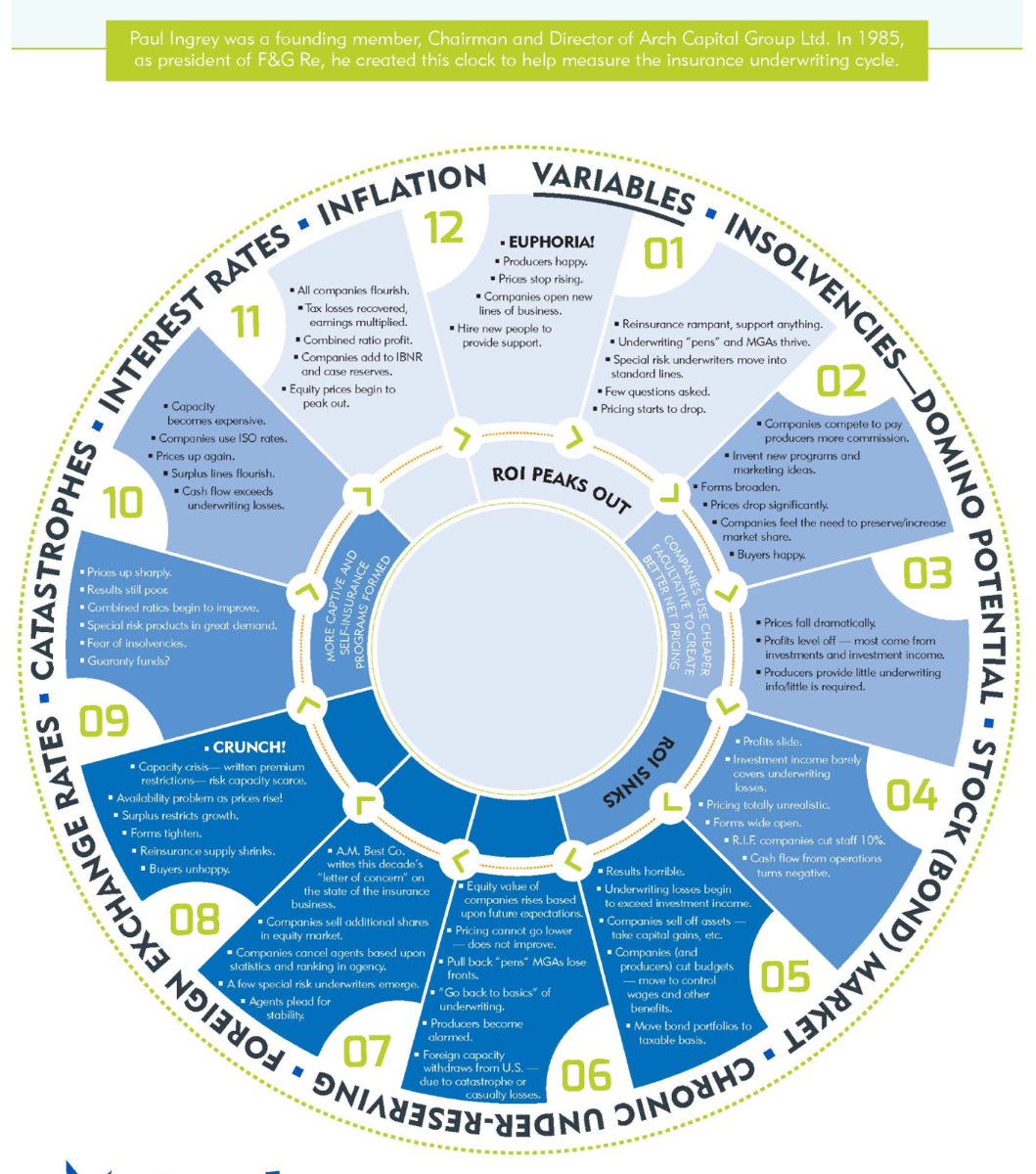
Article 3 in our deep dive into Fairfax's insurance business. The Insurance Cycle: How Great Insurers Exploit Opportunity The P/C Insurance Cycle Understanding Hard Markets, Soft Markets, and Why They Matter Before investors can understand Fairfax's growth history, they first need to understand the property and casualty (P/C) insurance cycle. Unlike most industries, insurance pricing moves through long periods of expansion and contraction. These cycles influence growth, profitability, capital allocation, and ultimately shareholder returns. They also help explain many of Fairfax's most important strategic decisions over the past forty years. Understanding the insurance cycle is therefore essential to understanding Fairfax. What Is the Insurance Cycle? The property and casualty insurance industry moves through recurring periods of strong and weak pricing. These two phases are commonly known as hard markets and soft markets. Hard Markets Premium rates rise. Underwriting standards tighten. Capacity becomes scarce. Profitability improves. Soft Markets Premium rates fall. Competition intensifies. Capacity becomes abundant. Profitability deteriorates. These cycles often last for many years and can swing to extremes. Successful insurers therefore manage their businesses with a long-term perspective rather than reacting to short-term conditions. Understanding where the industry sits in the cycle is important because it affects an insurer's growth opportunities, profitability, and ability to create long-term shareholder value. Why Does the Cycle Exist? The insurance cycle exists for much the same reason financial markets experience booms and busts: human behavior. When profits are strong, insurers become increasingly willing to compete for business. New capital enters the market, underwriting standards loosen, and pricing gradually weakens. Eventually, profitability deteriorates. As returns decline, the process reverses. Capital leaves the industry, underwriting standards tighten, and pricing improves. The result is a repeating cycle driven by greed and fear. Like Benjamin Graham's Mr. Market, the insurance cycle provides investors with a useful mental model. Markets are not always rational, and neither are insurance companies. Reinsurance executive Paul Ingrey captured this process in his well-known Underwriting Cycle Clock, which illustrates how insurers repeatedly move through periods of discipline, optimism, overexpansion, deteriorating profitability, and recovery. The cycle persists because industry participants repeatedly make the same behavioral mistakes. Exhibit: Paul Ingrey's Insurance Underwriting Cycle Clock Reinsurance executive Paul Ingrey developed the "Underwriting Cycle Clock" to illustrate how strong underwriting profits attract capital and competition, eventually leading to weaker pricing and deteriorating underwriting results. As losses mount, capacity leaves the market, discipline returns, and the cycle begins again. The lesson is straightforward: the cycle is driven by human behavior. Companies that remain disciplined while competitors chase growth are often the long-term winners. Source: Arch Capital Group Limited Why the Cycle Matters The insurance cycle creates opportunities for disciplined insurers. During soft markets, the best companies focus on underwriting profitability and preserving capital. Growth becomes secondary to maintaining discipline. During hard markets, those same companies can deploy capital aggressively, write more business, and earn attractive returns. Many insurers struggle because they do the opposite. They pursue growth aggressively when pricing is weak and profitability is poor. By the time a hard market arrives, they often lack the capital needed to take full advantage of the opportunity. The most successful insurers are therefore not those that grow the fastest. They are the ones that remain disciplined throughout the cycle. For investors, the key lesson is simple: the insurance cycle itself is not the risk. The real risk is owning an insurer that cannot navigate it effectively. The Berkshire Hathaway Model No company has exploited the insurance cycle more successfully than Berkshire Hathaway. Warren Buffett understood that insurance companies possess a unique advantage. They collect premiums today while many claims are not paid until years later, creating float that can be invested until it is needed to pay future claims. Most insurers invest this float conservatively, primarily in bonds. Buffett combined disciplined underwriting with superior capital allocation. Because insurance cycles unfold over many years, Berkshire never felt compelled to chase premium growth simply to satisfy quarterly expectations. When pricing became unattractive, Buffett was willing to let business shrink and patiently wait for better opportunities. That flexibility became one of Berkshire's greatest competitive advantages. During hard markets, capital flowed into insurance. During soft markets, it could be allocated to stocks, wholly owned businesses, acquisitions, or share repurchases. A soft market therefore changed where Berkshire invested capital—not its ability to create value. Fairfax and the Insurance Cycle Fairfax has followed a remarkably similar approach. During the prolonged soft market from roughly 2014 through 2019, Fairfax expanded primarily through acquisitions. Purchases such as Brit and Allied World significantly increased the company's insurance platform while industry valuations remained depressed. Fairfax was effectively buying insurance assets when they were on sale. When the market turned in 2020, management shifted its emphasis toward organic growth. Strong pricing allowed Fairfax to expand premiums while maintaining underwriting discipline. As a result, Fairfax grew successfully during both phases of the cycle. Acquisitions drove growth during the soft market. Organic underwriting drove growth during the hard market. Equally important, the company improved the quality of its insurance operations throughout the process. Like Berkshire Hathaway, Fairfax is more than an insurance company. It is also an investment company and a capital allocator. Prem Watsa's significant ownership stake and voting control have allowed Fairfax to manage the business with a long-term perspective. That has helped the company remain disciplined through multiple insurance cycles while allocating capital wherever opportunities have been most attractive. When underwriting opportunities become less attractive, Fairfax can redirect capital toward acquisitions, public equities, private investments, debt reduction, or share repurchases. A soft market may slow premium growth, but it also creates opportunities elsewhere. What It Means for Investors As the insurance market begins to soften, investors often assume the industry's best years are over. For many insurers, that concern may be justified. But Fairfax is not a traditional insurance company. Like Berkshire Hathaway, Fairfax combines disciplined underwriting with investing and capital allocation. Changes in the insurance cycle influence where capital is deployed, but they do not determine whether value can be created. Poor insurers become victims of the cycle. Great insurers use the cycle to their advantage. Fairfax's forty-year record suggests it belongs in the latter group. Throughout multiple insurance cycles, management has followed a consistent approach: remain disciplined when opportunities are scarce, act decisively when opportunities are abundant, and allocate capital with a long-term perspective.

-
Are you buying via Prosus or the ADRs/HK listed shares? I’m buying via Prosus for a few reasons, but dislike the company outside the Tencent investment..
-
https://finance.yahoo.com/markets/stocks/articles/tencent-ramps-buybacks-share-rout-002809157.html This is best price/quality thing I see now alongside Nintendo. The flaws of both are well-known. Pick your poison.
-
"People who live in glass houses shouldn't throw rocks" Strains credibility when a Trump supporter complains about corruption elsewhere. I know you think Trump can do no wrong but some might view the present level of corruption in the 'first family" will likely be found to have been unprecedented.
-
I went long the Iran sell off in spring this year and I had decent sized position in the June 2026 ES with average price in 6400s but I sold that shit like a dumbass at 6640 and watched as the ES rallied another 800 points. Sure I picked off 30 points here and there jumping in and out during the vertical rally but it was like getting the vacuum cleaner consolation prize when I could have won the brand new car on Price is Right For second half I am hoping there is a decent sized crack in the markets that I can take advantage of - coming into this year I thought after 3 straight years of double digit returns in the SPX, this could be a year when the markets are UNCH and I still think that
- Today
-
Hey if Berkowitz wants to hand you cheap stock, all you need to do is hang on. The historical migration to Florida will go on for years. It's the happiest state I know!
-
Sold all the VOO I bought earlier this month
-
Thank you, Mike [ @cubsfan ], Yeah, it's also about trying to relate to the issues at hand discussed in in the JOE Investment Ideas forum, especially related to time horizon. The plan to execute on going forward presented at the JOE AGM looks good to me.
-
Another idiot academic loses her University teaching position: https://jbhe.com/2026/06/indiana-university-lecturers-contract-ends-following-lesson-linking-maga-to-white-supremacy/ https://indianacapitalchronicle.com/2026/06/11/iu-lecturer-disciplined-for-white-supremacy-lesson-faces-termination/ Jessica Adams, a full-time lecturer on IU’s Bloomington campus, found herself in trouble in September when a student said she used a graphic identifying “Make America Great Again” as an example of covert white supremacy in her class on diversity, human rights and social justice.
-
-
Exactly - they've absorbed the lessons of opportunity, hard work and individual accountability - and left the "experts" that tell everyone else what to do, like teachers and social justice warriors - to ruin those important concepts. Those useless degrees could just as easily be earned by watching TV all day.
-
+1 I wouldn’t have even heard of the company without @whatstheofficerproblem
-
Sold remainder of $PSMT. Small position that I didn’t have a lot of confidence in that worked out really well, Cost basis $60.
-
A lot of it too comes from useless educations and degrees. How many engineers, accountants, physicians (who actually treat patients), builders, tradespeople, business owners and entrepreneurs support socialism? The common thread among all these groups is they don't make excuses or apologies for who and what they are.
-
It is a bitch, but a very smart move John!
-
The movement is brought on by the corruption of our teacher's union and universities - particularly the social sciences. For decades, while most Americans were out working their butts off, raising their families and moving upward quickly in economic terms - our children were being brainwashed by toxic academics who taught the young to hate the very system that has given them so much prosperity. It's so much easier to confiscate wealth rather than to put in the long time and hard work to earn it yourself over a lifetime. Such is the intoxicating dream the young swallow from the education system about socialism/communism.
-
Today, I got an order on JOE filled, just under USD 63 to up the position 50 percent measured in number of shares. - - - o 0 o - - - Edit : Averaging up is just such a bitch.
-
I ended up buying Spice and the book on Venice. I ended up reading both of them before my wife had a chance to do so - fun books. Thanks for the idea!
-
Yeah, it has never worked and everyone who supports it is not stupid, just naive. The wealth gap has existed for my entire life and many years prior; it is nothing new and will likely continue on forever. The current political socialist movement will run its course. Otherwise we could have another civil war and we already survived that.
-

Best Ideas 2026 - Half Time Report
phil_Buffett replied to phil_Buffett's topic in General Discussion
No other Ideas or analysis of the own ideas from the start of 2026?? -
That pretty much hits the nail on the head. The current open call for "Democratic Socialism" by Mamdami and associates is waking up many Americans - Democrats included. It's not going to work - it will always be a fringe movement that repels most Americans.
-
So I finished reading Gambling Man. it is short, yet thorough. I highly recommend it. Alongside Money Trap. Softbank has a lot of issues (governance, leverage etc). But no one can deny the wealth that Masayoshi Son created for himself and long term shareholders.
-
sorry just saw this now. I myself really enjoyed the one about Portuguese and the other book on Venice. Both of which I am planning to reread.
-
That is true. However a two-party system works because the pendulum rarely moves too far in either direction before it changes course. I don't agree that the US is moving toward socialism because its greatest support comes from the young and inexperienced who eventually grow older, more experienced and value their hard-earned savings. No different that any time in the recent past when welfare, government handouts and subsidies were always supported by the same groups who now support socialism. The main issue is immigration reform. Once we stop allowing anyone into this Country indefinitely, what many of us would now call "common sense" may well return.