Thrifty3000
-
Posts
683 -
Joined
-
Last visited
-
Days Won
6
Content Type
Profiles
Forums
Events
Everything posted by Thrifty3000
-
In what universe are you given ONE make-or break-question on a company’s conference call - where everyone knows your intent is to take down said company - and your ONE question is WHY DON’T YOU DISCLOSE MORE INFORMATION?? Oh brother, that was really pathetic. FFH is worth $1500 to $1800 USD per share. Kudos to Prem & Co. for a job very well done!
-
Raised the earnings guidance floor from $100 per share to $125 per share, excluding investment gains, for the next few years. (Prem said “of course there are no guarantees.”)
-
Excellent. Thank you.
-
This is. Four years is an eternity in Mr. Market years. This stock is going to be worth SO MUCH more 4 years from now.
-
I’m assuming it only impacts balance sheet (and book value).
-
Quick question: Do reserve releases flow through the income statement?
-
If you want to see what legit short cases look like I recommend getting on the Hindenburg email list. Here is their short du jour (for a company called Temenos): https://hindenburgresearch.com/temenos/ And here’s the 25%+ beat down on the Temenos market cap. Notice after extensive research - including dozens of insider interviews - Hindenburg lists over 20 specific questions for management that it is confident management can’t answer favorably. These guys do a lot of quality work. I’ve never taken a short position, but I find the Hindenburg reports interesting. Key takeaway: MW’s work on Fairfax is amateur-hour in comparison to Hindenburg.

-
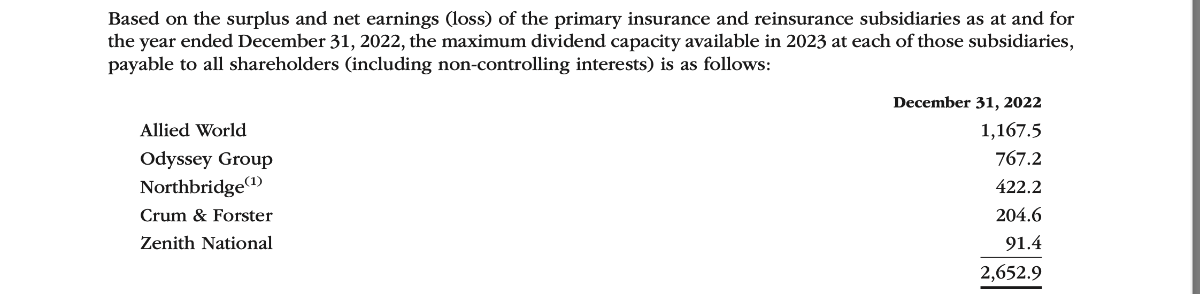
I don't think there's a risk of getting burned by the TRS. According to the annual report there's over $2 billion of subsidiary dividend capacity. Also, there's more than enough undrawn capacity on the credit line.
-
If you want to know if a short has teeth take a look at the bonds and preferreds. Example, look what happens to bonds after a Hindenburg hit.
-
+1. It’s unusual how little command of the facts Block has when asked to comment on things falling outside the scope of the written report. Imagine if you’re the counterparty sitting on $150 million of losses on your FFH TRS position and you’re worried about FFH reporting a blowout quarter. What’s it cost to get a guy like Block to pump a short thesis so you can reverse the $150 million loss and exit? $10 million? The ROI is pretty irresistible. Follow that money. (Who are the counterparties now?)
-
Curious if MW will be making anymore media rounds today.
-
I bought more today too. Reinvested the dividend.
-
In 2011, when Jefferies was under attack, I remember the CEO, Richard Handler, started posting daily updates of their financial statements on the Jefferies website to show customers and investors the short thesis was wrong. I'm curious if Prem could expedite the earnings release to today, open up the books for regulators and welcome them in with open arms, and then announce a million share buyback. Gotta pull out that elephant gun.
-
Busch league. It barely qualifies as a short thesis. Even if MW's claims are valid, what's the downside? A $20 million regulatory slap on the wrist, where FFH neither admits nor denies wrongdoing? One of the best investments I ever made was in Jefferies during their 2011 short attack. At least the Jefferies attack was existential. The MW attack on FFH is just toothless noise. A comparison to Jack Welch's GE (and GE Capital) is just silly. #buyingOpportunity
-
Pre-COVID I had about a third of my portfolio in an all-world (ex US) ETF. The only other ETF I’ve ever owned has been S&P 500. Currently, I don’t own a meaningful amount of ETFs or mutual funds. Right now I prefer individual equities and cash over broad indexes. I basically look at the S&P 500 index as risk free over the long term. I assume it will compound at 6 or 7%. So, since I consider it risk free I usually won’t invest in an individual company unless I’m confident the investment will outperform the S&P 500 by at LEAST double. In other words if I don’t think I can earn at least 14% on an individual company I’d prefer to own an index. (However, if cash is yielding 5% I’ll take the cash.) These days if I sell stock I’m parking proceeds in cash, which is about 10% of my portfolio.
-
That will be up to the board of directors, and will probably be based on overall performance against the S&P 500 over rolling five year periods. Greg has been reporting to Buffett and the board on company results and his initiatives for several years now. So the board should have a good level of confidence by now on his grasp of the overall machine. I have a hunch Todd is being groomed to succeed Greg. By the time he takes the reins I think he’ll be about as good of a fit as investors could hope for - sans the personality.
-
So, for this simple look through earnings spreadsheet the most important fields I track are: Ticker # of Shares I Own Per Share Cost Basis Normalized Earnings Estimate Per Share Normalized Dividend Per Share Total Cost Basis (Cost Basis Per Share X # of Shares Owned) Total Normalized Earnings (Normalized EPS X # of Shares Owned Total Normalized Dividend Current Share Price Current Value of Investment (Current Share Price X # Shares Owned) Normalized Earnings Yield Normalized Dividend Yield Price to Normalized Earnings Multiple 10 Yr Estimated Growth Rate Year 10 Normalized Earnings Forecast (Based on current normalized earnings and my estimated growth rate) % of Portfolio Allocation Unrealized Gains % Unrealized Gains Normalized earnings is the field I focus most on getting right. I don't have a one size fits all approach for this one, though. I'm mostly focused on understanding what free cash flow will look like through a full economic cycle. I also try to understand and adjust for key risks - like super cats. For some investments I have to adjust for things like big, temporary, expenses - like major litigation costs/settlements that will take a few years to burn through (think post-GFC Bank of America). With some investments that have highly reputable managements I've learned that management forecasts are plenty reliable. So, if I'm really comfortable with a manager, I'll start with their forecast, try to poke holes in it, and adjust accordingly if I come up with anything. As far as making adjustments, I review my estimates annually at a minimum. However, anytime I learn about a material change, or think of a material risk, whether from company updates, CoBF, or otherwise, I immediately update my estimate. I probably make a handful of small adjustments to the model every quarter. I rarely have to make major adjustments at this point. I may make 1 or 2 major adjustments to the model each year. Usually, I get to just bump up the earnings estimate for the next year, which is fun. Since I started maintaining this spreadsheet in 2019 I've been able to increase my total normalized look through earnings by six figures every year just by replacing lower yielding investments with higher yielding ones whenever clear opportunities arise.
-
Yes, earnings quality and growth are essential. (Ideally, you have a high quality present value estimate.)
-
In the 1960s the top marginal tax rate in America was 91%!! Apparently there were 24 tax brackets, of which 19 were higher than today's top marginal rate. That was some SERIOUS anti-capitalistic wealth redistribution. By the time Reagan took office, two decades later, the rate had been reduced to around 70%. And, during the 1980s the rate was reduced further to 50%. We've got it real good today by comparison. Just shows the tug of war between the greedy capitalists and the bleeding heart liberals swings back and forth pretty widely over time.
-
They can fire up the printers and inflate those debts away Weimar-style. Apparently China doesn't have much of a safety net for the elderly, and with real-estate imploding bigly, the current generation of retirees is already pretty screwed. I assume elderly will be working longer and their children (err child) will be tightening the bootstraps to help care for mom and dad. Consumer staples will be fine, but commodities, discretionaries, durables, etc need to downshift a good bit. If a third of China's $18 trillion GDP has been tied to housing (and infrastructure to support housing), and another third derives from government-run entities that are one seventh as productive as their US contemporaries (so not super cash flow positive), then there's not a whole lot of horsepower left in the economy to service the interest on $48 TRILLION worth of debt (slap a 5% interest rate on that and you have to wonder how they can possibly afford to fund the debt AND pay for a sprawling government). Could be a REALLY hard, deflationary, landing. Assets could get REALLY cheap, even from here (think GFC). Once the dust really starts settling on the economic deterioration a billion or so Chinese people may stop taking so kindly to ol' Xi (queue insurrection). Assuming China doesn't devolve into a failed state like Russia, a real doozy of a downturn could prove to be the opportunity of a lifetime for cash rich companies like Tencent to hoover up competitors and talent for pennies on the dollar, and emerge much larger and stronger than they are today (think Berkshire during the GFC). Lots of ifs. Will be fascinating to witness from afar.
-
I almost never buy or sell. I have a handful of core investments that I’ve owned and followed for years. I have about 3% of my portfolio in some tracking positions that I’ve held for over 2 years while getting to know them better. I have a watchlist of companies I’m either trying to learn more about or waiting for the right price to buy. I find it very hard to find companies that I like better than my core holdings. Though it does happen. I’ve exited 7 or 8 positions in the last 5 years. Half were core holdings and half were trackers. Looking at equity earnings like a salary makes me think much more like a business owner when I’m buying parts of the businesses that are paying my “salary.” Also, once you give yourself enough “raises” - via more and better investments - you’ll be able to replace your actual salary with your equity “salary.”
-
Don't forget about the big risks of doing business with strapped-for-cash commies: 1) Big bro takes the free cash from the company for the good of the many. 2) When there's no free cash left big bro takes control of the company and appoints his buddies to all the paying jobs. Eventually Atlas Shrugs and the capital either fights or flees.
-
Selling an asset to buy a cheaper asset is a perfectly logical thing to do (assuming you’ve rationally factored in taxes and relative risks). It sounds like you’re overly influenced by price, which will make investing very uncomfortable at times. I recommend focusing more attention on learning how to appraise the value of a business. The more confidently you can estimate how much a business is worth to a rational buyer the less emotionally-attached to prices you’ll become. A trick that has been incredibly helpful for me… I created a spreadsheet where I track MY portion of the look through earnings from my equity investments. So, for example, If I have 100 shares of Fairfax and I estimate the normal earnings to be $150 per share then in my spreadsheet I would show MY total Fairfax earnings as $15,000. If I have 1,000 shares of BRK and assume $25 per share of look through earnings then I would add $25,000 to my spreadsheet. With Fairfax and BRK combined I would have $40,000 of earnings. (I look at those earnings almost like my salary. I want my “salary” to be big, steady and growing over time.) Notice I haven’t mentioned stock price, because my number one priority is the quality and growth potential of MY earnings. With that mentality, if I can at anytime sell all my Fairfax and BRK shares to buy assets producing significantly more than that $40,000 of look through earnings then I am happy to do it. I treat that like getting a pay raise - which is fun and motivating. This approach helps ensure that the only way I can confidently sell one asset for another is if I’m confident in my analysis and able to transact at attractive prices.
-
I wouldn’t be surprised to see the share price increase 35% this year - barring any black swans.
-
Regarding the China real estate crisis I’ve recently read/heard fun facts along the lines of: - China has approximately 80 million vacant homes, which is MASSIVE relative to the country’s 450 million households. - building 80 million excess homes is by far the biggest overallocation of resources in modern history. - Over 90% of the Chinese population already owns one or more homes. - Only 7% of the population has investments in securities/financial assets. - 30% of China’s economy has been tied to real estate. - The vast majority of household wealth is tied up in real estate. - Due to fear of the consequences of housing price declines, the CCP has instituted price controls on vacant houses. - Because prices aren’t allowed to decline, retirees and others are unable to sell the properties to fund their retirements, etc. - When the prices eventually adjust, homes in key areas of China could be worth 70% less. (By comparison the GFC was a nothing burger). - Also, because prices are artificially high, hundreds of millions of people don't know how much life savings they have left. - And, the major state-run banks are loaded up with real estate loans. - Because of price controls and an imploding economy, a large and growing percentage of the population is increasingly disgruntled. So, that sucks.