Spooky
-
Posts
1,520 -
Joined
-
Last visited
-
Days Won
2
Content Type
Profiles
Forums
Events
Everything posted by Spooky
-
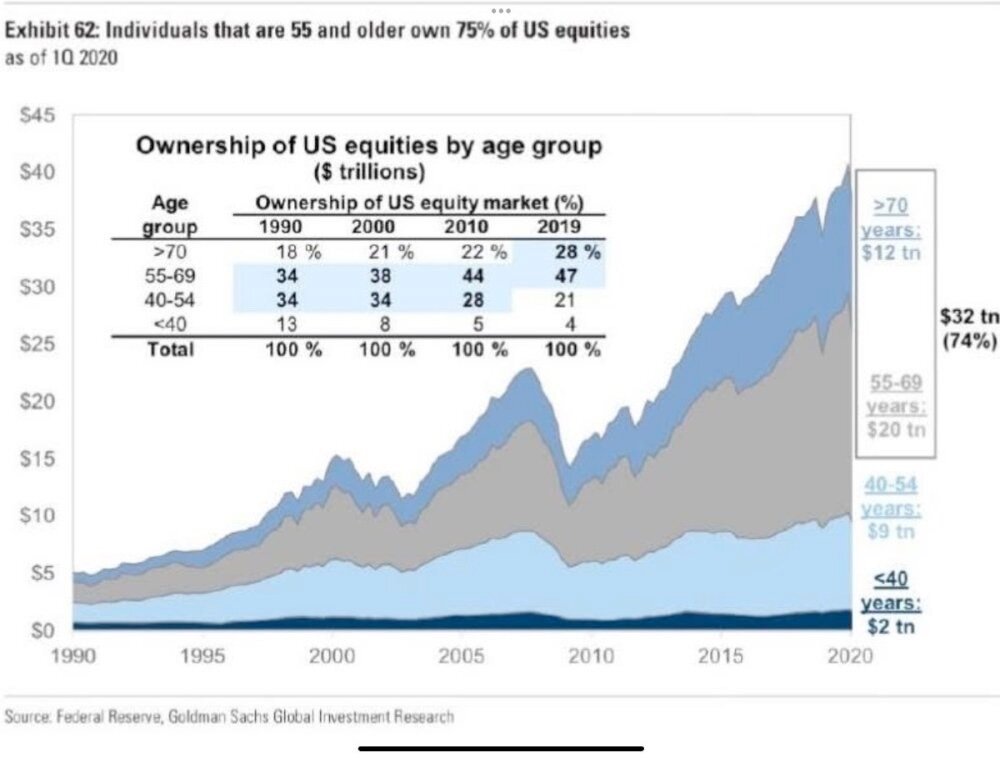
This chart shows the breakdown of ownership of stocks by age bracket at different periods of time. Older generations increasingly own a higher proportion. Sub 40 went from 13% in 1990 to 4% in 2019.

-
I don't own a house or a car. Need to make sacrifices.
-
https://fortune.com/2024/10/03/boomers-wealthiest-generation-millennials-biggest-losers/
-
This was just the first chart I pulled up in a google search. There is so much data out there on this topic.
-
?? Feels like you are misunderstanding my point and the current reality for a lot of people in the USA. If you are in the top 10% that holds stocks and other assets you have done amazing, the people who don't just keep falling further behind.
-
I generally agree - we are living in the best time to be alive. My point is just that traditional wealth generating asset classes like the S&P 500 and housing are expensive relative to history so a young person trading their labour for capital will have a hard time building wealth that way. There is so much capital out in the world today that finding opportunities to invest in takes a lot more work.
-
This exactly is the point I was trying to make. Need to think outside the box.
-
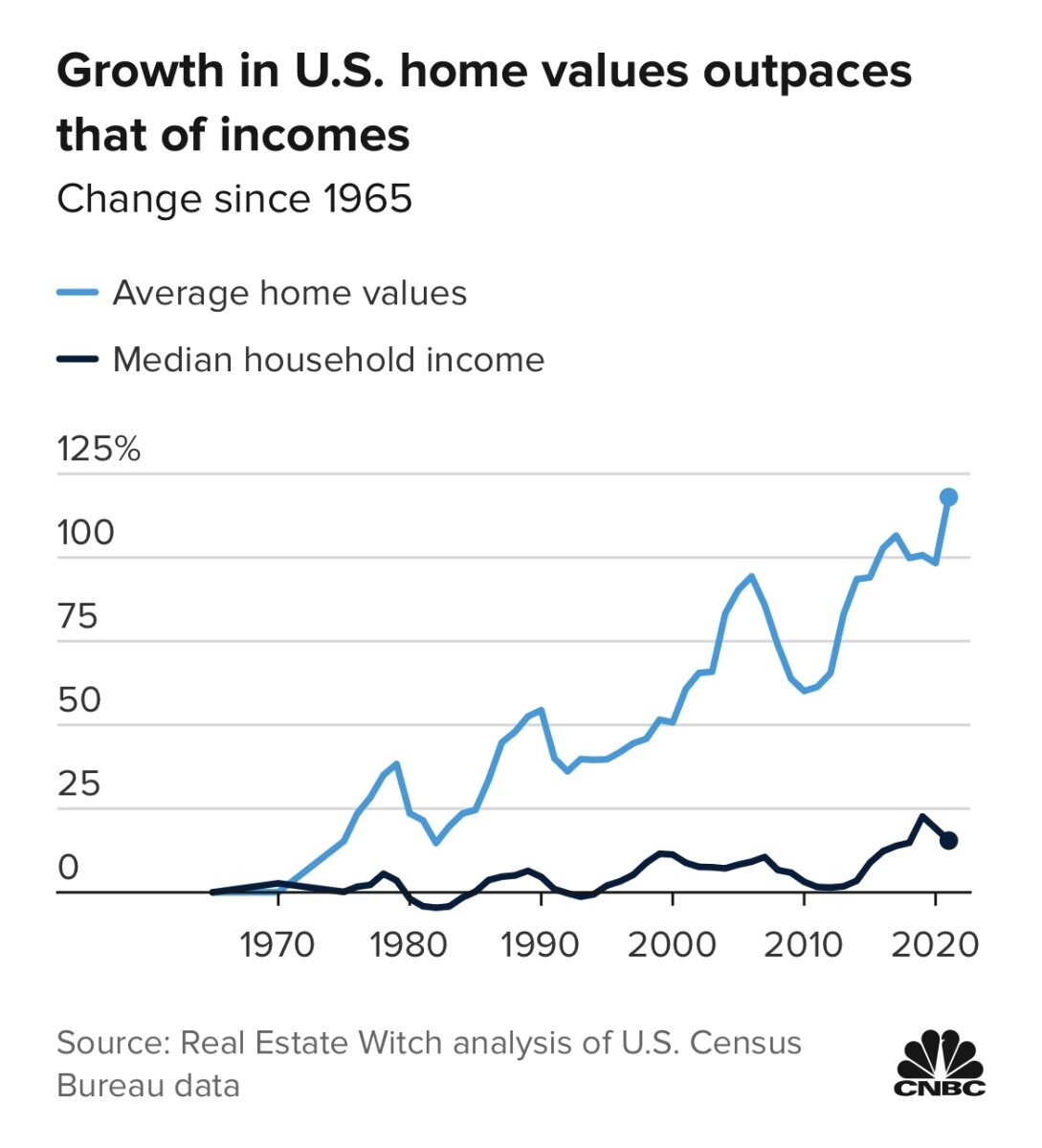
There is certainly an element of that where people are seeing extravagant wealth through social media which makes them unhappy but that’s not what I’m talking about. I’m just looking at data like this which applies to a lot of countries:
-
Did you read my whole post? I am still an optimist and I am in the top 1% of income but I am lucky to be blessed with a lot of talent and parents who could provide me a decent education. It is just a fact that Millennial and Gen Z have less wealth at this stage than the baby boomers. Salaries have not risen as fast as the price of housing, stocks, education etc. and a lot of young people are locked out of the housing market or are in huge debts from college.
-
The world is currently stacked against young people in terms of creating wealth. Stocks, housing, etc. are all expensive relative to historic norms. It is not nearly as easy to build wealth as in the post-world war two period. I have been struggling with this issue for a long time now. The reality is that there is so much capital out there chasing a finite set of assets / investments which raises the prices of assets / lowers the cost of capital. There are also a lot of heightened geopolitical risks and uncertainties - but this has always been the case. Regardless, there is still a lot of opportunity in the world, it just takes more work and you have to look further afield. Look at individual companies where you have high certainty on their future performance. Look at international opportunities. You also need to be prepared to capitalize on a big market crash - these can be life changing opportunities so be resilient and patient.
-
I am pretty optimistic about the two spin-off companies. Generally studies show that spin-off companies tend to outperform their market peers and also benefit the parent company. They are also much smaller than CSU so have a longer runway. That being said, I have a soft spot for investing in diversified conglomerates so I still prefer the mothership. I don't have to think too hard about geographies or industries and I would prefer to simplify my portfolio as much as possible. CSU also retains a significant economic stake in the spin-outs and my guess is that there will be more spin-outs in the future.
-
If you look at long stretches of time this is probably better for most people than the alternative. The average person in my opinion should not be selecting individual stocks. It is extremely difficult to beat the S&P 500 consistently over long stretches of time, only a small number of people are able to do so. There will definitely be crashes and twists and turns in the market, it is impossible to predict what will occur. The key is to think long term and dollar cost average, especially when the market reverses. Invert your thinking, volatility is part of the game and when we are young it would be better for us if the market crashed. If you haven't yet check out the book stocks for the long run. There is lots of interesting data in there. In the short term stocks can go anywhere, but in the long run they tend to go up.
-
Howard Marks is a smart guy but all of his stuff is getting repetitive.
-
Can't remember where I heard this but the founders of Danaher are getting involved in the software space. Might have been on the podcast with Mitch Rales on the Art of Investing.
-
The charts above caught my eye as well. Saw it and sent some funds to my Spouse to put in her Wealth Simple account which is more globally diversified equities. S&P non-tech and financials looks interesting and so does the S&P 600.
-
Latest Eye on the Market from JPM is pretty interesting: https://am.jpmorgan.com/ca/en/asset-management/institutional/insights/market-insights/eye-on-the-market/outlook-2025/
-
No they don't, this is a misconception.
-
I started buying in 2017 when it was about $650 a share and at that point it still looked expensive. I have now kept it at 50% of my portfolio for a long time but I have not been adding to my position in the open market for a while but part of my bonus needs to be put into the company's shares. I was also buying consistently back when it unjustifiably got caught up in the market sell off in 2022. It is a hard company to value since it is hard as an outsider to know what is going on or how the company works, especially now with minimal communication to investors. You can't really use P/E without making a lot of adjustments since IFRS earnings are kept as low as possible via amortization of acquired IP in Canada to minimize cash taxes. You have to look at FCF and then make a lot of assumptions. They way I approach it is by separating current economic value from the value generated by future growth. The key question is really how long can they keep re-investing / compounding their FCF at very high rates of return. So I approach it more from the angle of how many software companies exist in the world, how many are being created, how many CSU could acquire, etc. Also, if you haven't yet, read the letters from Mark Leonard that are available to get a better understanding of how he thinks about the company. At some point there will be a limit to the potential growth of the company since it has grown so much. There is more competition from private equity and others focused on the VMS space including from the founders of Danaher. There have also been some recent insider sales so the signal now is that it is overvalued. However, it is a wonderful company with excellent management / capital allocation skills as well as management and directors with a significant portion of their net worth in the stock who are aligned with shareholders. VMS is also a great industry with high switching costs and margins. I'm in the Phil Fisher camp that the right time to sell a company like this is probably never, not to mention the tax bill I would receive.
-
All investing is value investing - value investing is just buying something for less than it is worth.
-
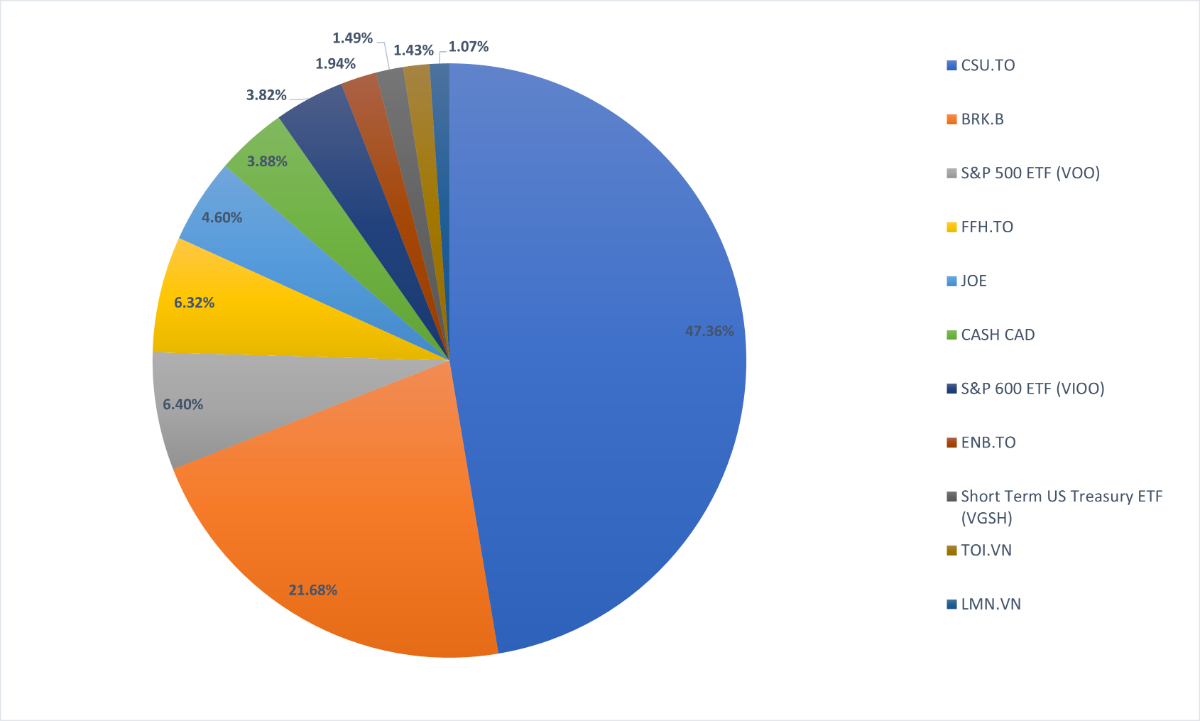
Portfolio as it stands today. Not a lot has changed, still about 50% in CSU. Over the course of 2024 I rotated out of BAC, BN and PARA and into FFH, JOE, VIOO and ENB.TO Very happy with my performance in 2024 and prior, beat the S&P by a good margin. Not sure where to take things from here, need to spend some time thinking.
-
Thanks for sharing Flesh. Glad that you are able to spend time doing what you enjoy. If you don't mind me asking, where do you live and how is your portfolio structured to cover the cost of living? Lately I have been craving adventure, this capitalist life is getting pretty boring.
-
I miss Twitter before they started implementing an algorithm - you could just get a raw data feed of the accounts you follow with no manipulation.
-
I joined but haven't been using it much to be honest. Any recommendations for good accounts to follow?
-
Listened to an interview with Brett Kelly recently at the Constellation Software M&A conference. He was really impressive.
-
Definitely feels like the narrative is shifting. Everyone and their brother writing about how US stocks are overvalued. Investor psychology going to shift and all that momentum will work in reverse.