
UK
-
Posts
3,440 -
Joined
-
Days Won
16
Content Type
Profiles
Forums
Events
Everything posted by UK
-
More HALO assets...whats not to like:)?
-
I think generally it is not a bad thing, especially for a buy and hold investors, because of the more atractive bb alternative, but also because of the lower risk of occational drawdown caused by multiple compression. And I think going forward FFH is in no need (or in less of a need) of the overpriced shares tool anyway. But maybe this is not ideal for more active investors, because greater volatility (I mean something like 1.2-1.7 BV range vs 1.3-1.4), would allow us to juice these 15 percent expected returns a bit:). But I think this will happen, even BRK in the last 15 years provided the opportunity to do this two times (2011-2012 and 2020).
-
Also:
-
If it is not AI video it is nuts! Meanwhile:
-
I think he owned big position in gold as far as I can remember:)
-
I think it is reasonable bet. Also, US is one of the big countries, which are blessed with farm land and being more than enough food self sufficient.
-

Guy Spier Op-Ed: "The Golden Age of Value Investing Is Over"
UK replied to charlieruane's topic in General Discussion
The letter is very sad, but brilliant at the same time. Nothing to add... -
+1
-
https://archive.is/I1D3d Prabowo Fury on Market Rout Shows Growing Divisions in Indonesia Indonesia’s president ordered the firings of regulators after warnings about MSCI’s concerns went unheeded.
-
https://archive.is/3Ld6J Indonesia Tightens Grip on Resources with Switzerland-Sized Land Grab More than 4 million hectares have been seized as President Prabowo Subianto cracks down on malfeasance in the commodities sector.
-
I do not disagree, but at the same time, many people who says this, sits in all these passive ETF with a huge M7 exposure. Hell, one of the bigest, largest and most succesfull fund of the last 5 years in my little country, where nobody even knows what FFH is, is a technology fund, taking 1+20 for puting you into M7 and software exposure:)
-
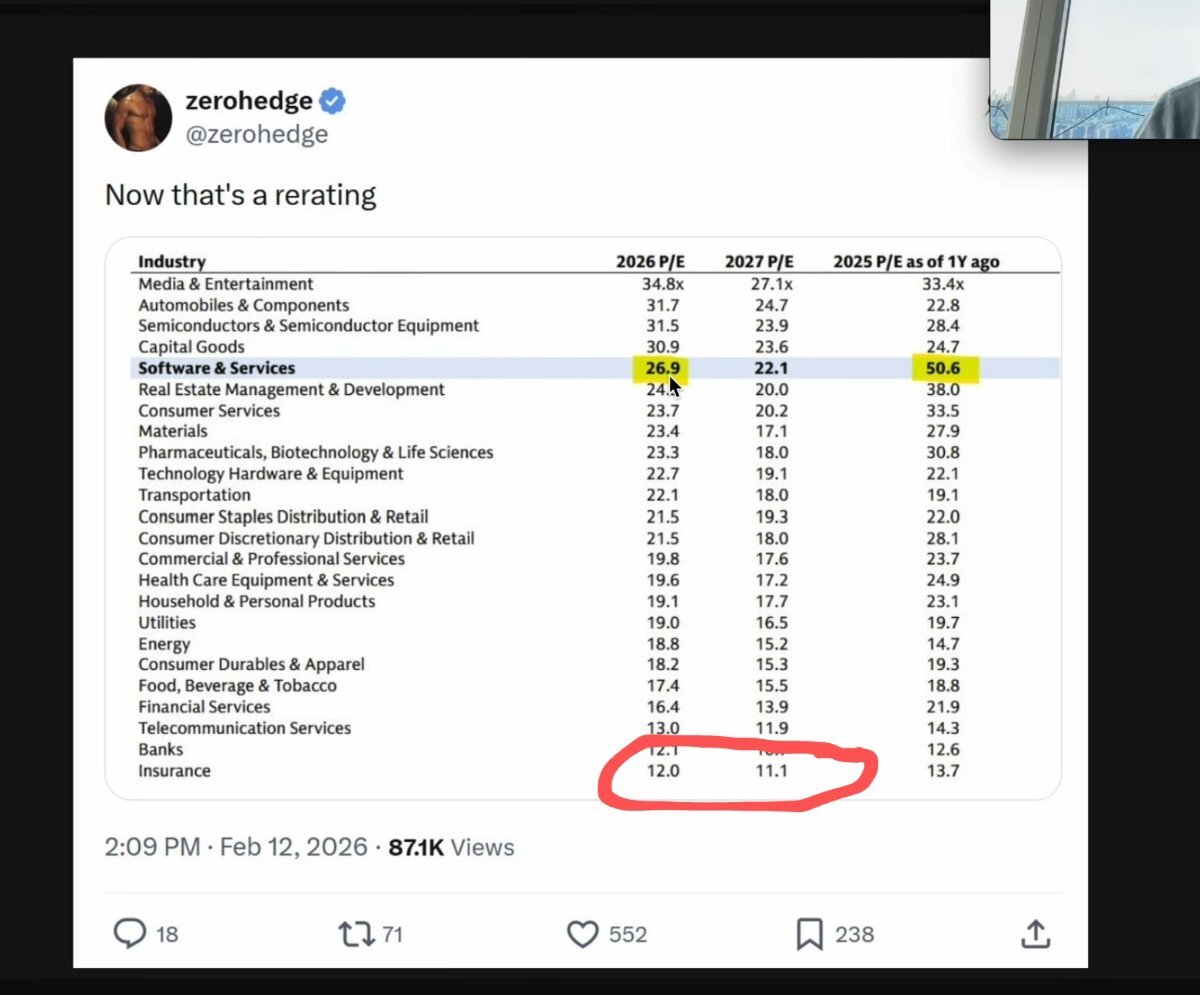
So I am nowhere as smart as gfp or Jordi, but this is my thinking (in progress): The main take away for me from him (and this literally already saved me quite some money) is to be careful with bottom fishing in software and saas. My first instinct was to approach this as the usual garden variety sector scare, but I am not sure about this anymore. You do not need to listen only to Jordi to check you feelings about this, but he was a nice catalyst for me to do this (ant thanks again to gfp for bringing him up). Probably there will be opportunities, but you have to be very selective and i am not sure it is possible to have a large conviction on anything here, including MSFT or maybe even any other M7 company. Not like in 2022. Now if you listen to some of his concrete suggestions, you will end up owning things like only TSLA from M7 (really?), PLTR (have no idea) and BTC (this one is interesting, but hard to stomach for productive assets aficionados, like me) AND all these bottleneck story stocks. The bottleneck story stocks thesis is the most interesting, is in the center of this rotation, but I have some questions and problems with it. The biggest problem for me, is that not all, but these are mostly companies from the shitty industries (commodities, low roe, no pricing power, well maybe not currently:)), usually a businesses you do not want to hold for a long term. So yes this could work for a while, but good luck figuring out how and when it ends. Also i see a contradiction here a bit, because if AI is so potent, why would it spare disruption in some of the currently perceived bottlenecks, like chip design, chips and AI computing becoming more energy efficient, or even energy itself, I mean if you have near God like AI, likely you even do not need Elon's datacenters in space. And if you do not want to bet on human ingenuity to solve all this, well bet on AI's then:). And as particular with energy, I do not understand how there could even be a lasting bottleneck here with oil plenty and trading at such a price (at a time US is about to attack Iran). And if you have plenty and cheap oil/energy, longer term this solves many things, even without some technological breakthroughs . So here perhaps also you have to be very selective (maybe TSMC itself, maybe all these gas turbine blades etc) or to bet that we in still in a very early stages with things like metals etc. Maybe the later is the case, not sure it is possible to bet a farm here though. Which lead me to a conclusion (or is ti confirmation bias?), that you just have to stick with these really visible but also quality businesses as much as you can. These, as always, will benefit from the productivity and general economy if AI is like internet and if not, as someone already told, who cares then, no matter if it is Wall E or Matrix scenario (I would prefer Wall E, but with GLP:)). Personally for me, and perhaps many on this board, the biggest question is how the insurance sector in general and FFH in particular, relates to all this AI disruption. Because it is kind of obvouils value and so perhaps could even benefit from all this rotation from saas or M7, but if this also about to be disrupted, maybe it is not too late to sell FFH at 8x and buy KO at 24x:))? Also I have no idea if this rotation could end up taking general market down (probably, because of the weightings and perhaps causing some minor financial crisis too), but again, even if it is as violent as in 2000, some old economy/value sectors and names worked very very well at the time and for the next 10 years, including BRK.
-

-
Sure, you are right re my a bit hyperbole comparison to a payment networks, historically though, and what bring us next 10 years, is the question.
-
Some very good points, thanks! I agree, they a not "crazy cheap" yet. But in my opinion, these are one of the better businesses ever, with a quality perhaps even on par with V/MA? Durable, low capex,. inflation resistant, in the consolidating industry, ran by capable operators/owners. What it is not to like here even at 15x? But what I am afraid (and could be wrong here), there is perhaps a decent chance (50/50) these can actually get to a crazy level (lets say 10-12x?), because if the softness in the insurance market materializes down the road this year (as it seems will be the case), combination of it (temporary cyclical slowdown) with all this AI disruption fear craze could provide us with more/really exciting happy hour:). So as always, timing is a bitch, and I have no idea how to approach this problem. But under the right circumstances, especially if FFH would go up some 10-20+ percent (or even stays flat) and these will go more down (10-20), I think I could even imagine rotating my extra FFH allocation to brokers easily. This is an awesome time to be in a market for an active investor:), lets see how it goes!
-
+1
-
Yea, I thought that it what this discussion was about, not that I expect any sort of such things to happen, at least in US:).
-
Gemini: This video by Drew Cohen (former Goldman Sachs and Capital Group analyst) provides a deep dive into Microsoft's current business transformation as it shifts from a traditional software company to an "AI-first" company. Core Business & Financial Overview Revenue Streams: Microsoft generated $35 billion in revenue over the last 12 months, with a 47% EBIT margin [06:24]. Segment Risks: The "Productivity and Business Process" segment (Office 365, LinkedIn) holds a $70 billion profit pool that is now at risk as AI agents potentially replace the need for traditional software seats [07:16]. The Valuation Gap: There is a significant discrepancy between its trailing earnings multiple (25x) and its free cash flow multiple (46x), largely due to massive capital expenditures (CapEx) for AI infrastructure [01:52]. The AI Transformation & Competitive Risks Software "Collapse": CEO Satya Nadella has suggested that software apps may "collapse" because AI agents can create their own logic and bypass traditional software interfaces [21:20]. Platform as a Service (PaaS) Threat: Historically, Microsoft’s cloud (Azure) has been "sticky" because developers build on its platform layer. AI agents can now circumvent this layer to go directly to databases, potentially reducing this competitive advantage [22:00]. The "Existential" Risk: The primary threat is if a single competitor achieves "godlike AI" that is so superior it renders Microsoft’s distribution and existing tools irrelevant [29:41]. Infrastructure & Accounting Realities The "Fiber Optic" Parallel: Microsoft is spending ~$150 billion on data centers. There is a risk of overcapacity—similar to the fiber optic bubble of the 90s—where massive investments are made before demand fully arrives [39:30]. Earnings Headwind: Due to accounting rules, the depreciation of these massive hardware investments will eventually catch up to the income statement. This will mathematically act as a drag on earnings, regardless of revenue growth [43:36]. Five Key Takeaways for Investors [52:24]: Cannibalization: AI agents are replacing human "seats" in the software business. PaaS Vulnerability: The stickiness of Azure's platform layer is under threat. Overcapacity Risk: The risk of overshooting demand for data centers. Accounting Headwinds: Depreciation will inevitably impact future earnings. Commoditization: Microsoft’s success depends on AI models becoming a commodity so they can win through their massive distribution network.
-
But this was the exact asset targeted and what get people in trouble, so perhaps I do not understand what do you mean the last property taken. Lots of things were not taken at all. This was also nothing to do with starving, Holodmor was in Ukraine. But anyway, I guess the real problem with land or real estate is that in all really bad scenarious you just can not move it, take it with you, even sell and have to protect it from god knows who, because it is an obvious target, not unlike many other valuable things, you can hide, barter etc.
-
Gemini: Conclusion: The Strategic Imperative for the "Bionic Broker" The insurance brokerage industry is not facing an "existential threat" from AI and digital transformation, but it is undergoing a fundamental "structural reset".17 The competitive moat that protected the sector for a century is being rebuilt. The "data moat" of the past is being replaced by a "speed-to-quote" and "analytical insight" moat. The "relationship moat" is evolving from one based on personal familiarity to one based on the delivery of "fair value" and "resilience-as-a-service." The "bionic broker"—one who successfully blends human expertise with agentic technology— will be the winner in this new landscape. By automating the routine, specializing in the complex, and pivoting to holistic advisory, brokers can not only defend their existing moats but expand into new areas of value creation. The 2026 market volatility should be viewed not as a sign of the industry’s decline, but as a "catalyst for its evolution".26 In an era of climate change, cyber warfare, and geopolitical instability, the world’s need for a high-performing insurance industry has never been greater.34 The brokers who thrive will be those who recognize that their role is not just to sell a policy, but to provide the strategic guidance that helps individuals and businesses navigate an unforgiving world.23 The path forward is clear: leverage modern solutions, embrace the power of AI, and remain the indispensable partner that clients trust to protect their future. Broker Moat.pdf
-
This is a good point. I personally came to the conclusion, that I can only share my data with Google, because it has mostly all my data anyway:)
-
+1+1+1! Thanks!
-
+1
-
The deportation of land owners in Lithuania refers primarily to the mass repression, forced exile, and confiscation of property carried out by Soviet authorities between 1940 and 1953, with major waves in 1941, 1948, and 1949. During this period, owning land or a farm was considered "kulak" status or "anti-Soviet" activity, making landowners prime targets for exile to Siberia. Key Aspects of Land Owner Deportations The Targets: Victims included farmers, landowners, and their families. The Soviet regime targeted them to eliminate private land ownership and enforce the collectivization of agriculture. Major Operations: June 1941: Roughly 17,500 people, including many landowners, were deported just before the Nazi invasion. May 1948 (Operation "Vesna"): Focused on removing "kulaks" (wealthy farmers) and supporters of the "forest brothers" (partisans), resulting in over 40,000 deportees. March 1949 (Operation "Priboi"): Targeted the remaining independent farmers to force them into collective farms (kolkhozes), with around 30,000 people deported. Property Seizure: Upon deportation, land, livestock, and homes were confiscated, transferred to kolkhozes, or sold to cover state expenses. Conditions: Many, including those deported simply for owning a small farm, were sent to Siberian labor camps (Gulags), where only a fraction survived. Post-Soviet Restitution: Following the restoration of Lithuanian independence, laws were implemented to return confiscated property or provide compensation to deportees and their heirs.
-