james22
-
Posts
3,423 -
Joined
-
Last visited
-
Days Won
1
Content Type
Profiles
Forums
Events
Everything posted by james22
-
America Just Hit the Lithium Jackpot The world’s largest known deposit was just discovered in Nevada. What does that mean? https://archive.ph/rCmJZ
-
A much better comparison would be dollar-cost-averaging over the period.
-
Auto CEOs Struggling With Whether To Replace Striking Workers With Robots Or Mexicans https://babylonbee.com/news/auto-ceos-struggling-with-whether-to-replace-striking-workers-with-robots-or-mexicans Spoiler: At publishing time, automaker leadership elected to compromise and go with the robots but hire Mexicans to build them.
-
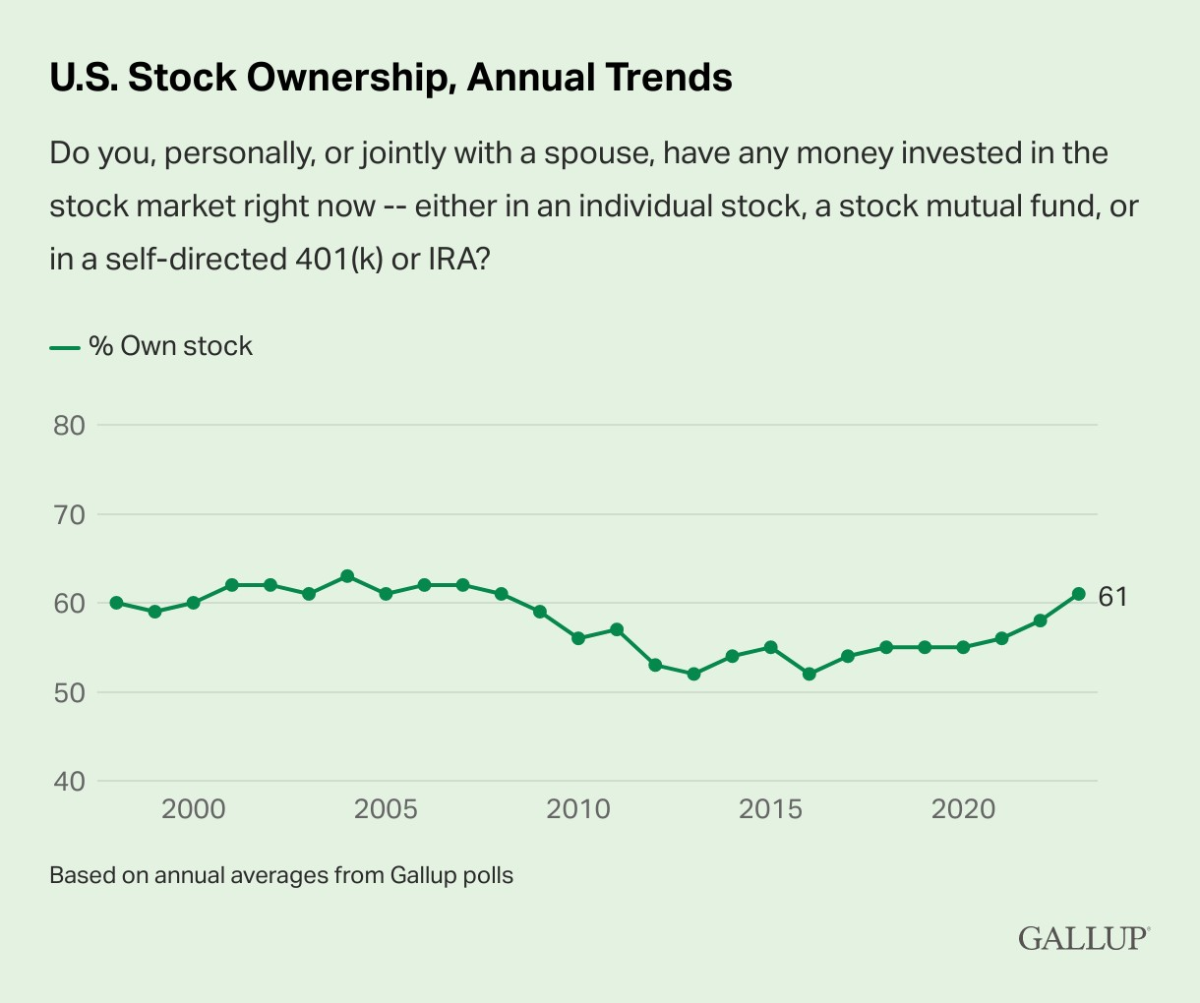
Only ~30% invested in the market in 1980, double that since late 1990s. https://news.gallup.com/poll/266807/percentage-americans-owns-stock.aspx

-
I believe so, yes. For all the same reasons.
-
No, you're right. The take-away is that at the recommended 4% SWR, up to 50% bonds make little difference when it comes to ensuring survival, and over 50% hurts. Why you'd prefer the 100/0 over 50/50, knowing the survival risk the same, lies in the terminal value (multiples difference).
-
A 50-year old has to plan to live to 90. That's 40 years. He'd better allocate a significant fraction to equities. See any of the withdrawal rate studies. They all show bonds riskier than stocks over a 30-year period. https://www.whitecoatinvestor.com/the-4-rule-safe-withdrawal-rates/ First of all, you need stocks! You need a significant allocation to stocks to sustain your lifestyle. Unless you plan a withdrawal rate of less than 3%, you will need at least 50% stocks in your portfolio. https://thepoorswiss.com/trinity-study/ And that's with sequence-of-return risk. In accumulation, that's not an issue.
-
Most everyone working is investing for 20 years. And those near retirement and retired are investing a fraction of their portfolio for 20 years. As investors recognize this, the equity (risk) premium will fall (and valuations will rise). Of course you can do better if you can guess right. But why bother? Buy-and-hold (better yet, dollar-cost-average) an equity index fund and you'll most likely do better.
-
Sure. But again: The lowest annual return over any 30 year period going back to 1926 was 7.8%. That’s what you got had you invested at the peak of the Roaring 20s boom in September 1929. You would have lost more than 80% of your investment in the ensuing crash and still made more than 850% in total over 30 years. The past 30 years were up 9.8% per year. The most recent 30 year period since 1993 includes: The Asian currency crisis, the dot-com crash, 9/11, the Iraq/Afghanistan wars, the Great Financial Crisis, the biggest global pandemic since 1918, the war in Ukraine and 9% inflation not to mention flash crashes, a few recessions, government shutdowns, trade wars, an insurrection, multiple impeachment hearings, 4 legitimate bear market crashes, 9 other stock market corrections and a whole bunch of other crazy and/or bad things I can’t think of right now.
-
Buy-and-hold the S&P500 for over ten years and there's little risk. The lowest annual return over any 30 year period going back to 1926 was 7.8%. That’s what you got had you invested at the peak of the Roaring 20s boom in September 1929. You would have lost more than 80% of your investment in the ensuing crash and still made more than 850% in total over 30 years. https://awealthofcommonsense.com/2023/02/deconstructing-10-20-30-year-stock-market-returns/
-
The addition of retirement accounts and automated contributions was a game-changer for financial markets. https://awealthofcommonsense.com/2023/09/how-individual-retirement-accounts-changed-the-stock-market-forever/
-
Fair enough. I think most are Tech/Growth or Value investors though. Not many can shift orientation with the environment.
-
But why would anyone look at only the past three years? No doubt.
-
If he'd been in Tech for even just several years at that time, he'd have a lot to give back before hurting. 5-year returns: VITAX (IT) +113% BKR +69% Buffett and Berkshire aren't irrelevant, but let's not kid ourselves.
-
From a boating forum I frequent: Well after 20+ years of doing this job my body hurts in ways I never thought. it’s not just driving around delivering shoe boxes Like most people think. Covid really changed so many things for us also. Not only because everyone started ordering online, but many of these shippers started putting everything from furniture to appliance to gym equipment into boxes. people are looking at what our total compensation package is valued at now and thinking that it’s bullshit and that we are way over paid. But another thing they don’t understand is we are the only carrier in the industry that has the production standards that we do, vehical Telematics and safety standards that we have to answer for on a daily basis, and service expectations that’s we do. Believe me when I say we earn our pay and benefits. as far as what it takes to get to a top scale pay driving position, it really depends on alot of factors. What area you live, what hub you work at, seniority employees ahead of you, job creation, retirees, current volume, ect. Everyone starts at part time and is promoted based on seniority. when I started it at $8.50 an hour it took me about 4 1/2 years to go full time, then another year or so to get top scale pay. There were some guys who waited upwards of 10 years to get promoted . it’s just the way it goes sometime. but nobody is hired as a driver and even if you do start driving within a couple of years you still have a pay progression to go though. What you are seeing on the news as far as us making $49 an hour for top scale drivers is at the 5th year of our new contract. So for those wanting to come work for us with the hopes of getting that right off the bat be ready to be very disappointed https://www.riverdavesplace.com/forums/threads/what-can-brown-do-for-you.272887/#post-4898167
-
Mauldin this week, echoing the first post in this thread: Long-time readers will know that I am bullish on energy (oil and gas in particular), precisely because the ESG movement, including numerous governments, is limiting both the amount of money and places that can be drilled for oil and gas. Economics 101 says that if you reduce a supply of something that has an increasing demand the price is going to rise. Felix Zulauf and others at my conference were talking about $120-$150 oil next year. In a normal world, that shouldn't happen, yet it is.
-
*Like*
-

If the AI bubble like the Internet, in what year are we now?
james22 replied to james22's topic in General Discussion
How good is AI in generating new ideas? The conventional wisdom has been not very good. Identifying opportunities for new ventures, generating a solution for an unmet need, or naming a new company are unstructured tasks that seem ill-suited for algorithms. Yet recent advances in AI, and specifically the advent of large language models like ChatGPT, are challenging these assumptions. https://archive.ph/e6L3N#selection-4423.0-4429.345 -
https://cleantechnica.com/2023/09/10/lithium-deposit-in-extinct-nevada-volcano-could-be-largest-in-the-world/
-
It's not quite so simple. If you consider the possibility of a one-time jump in equity valuations as investors increasingly recognize stocks aren't much riskier than bonds (followed by bond-like returns), there's risk in missing the move and then being unable to support a historical SWR with what has become an essentially 100% bond portfolio.
-
They did. Did you bet on bonds at the beginning of 2022? How did that inform your decision at the beginning of this year to hide out the forecast 2023 recession in bonds rather than equities?
-
You could have bet on stocks at the beginning of the year, yeah? Yet you bet on bonds. YTD, that bet isn't paying off: VMBSX (Mortgages) +.23% VICSX (Corporate) +2.18% VWEAX (HY) +5.46% VEGBX (EM) +6.01% VFIAX (S&P500) +18.71% VITAX (IT) +36.43% It may have been the smart bet ex-ante, but . . .
-
At least in my case, it's also that I could credit myself with patience if I stuck with it. And I could defend the previous allocation by reference to the smart guys. Whereas changing strategy means admitting I'm both giving up the chance of eventually being proven right and am now assuming the risk of being proven whipsawed wrong. Now I'm alongside every other drunk at the party bragging how they're killing it in tech.
-
No benchmark?
-
I was pretty much all Small Value (factors), Emerging Markets (Modern Portfolio Theory), and Cash (valuation) from the Great Financial Crisis to retirement in 2020. Because that was what all the smart guys (Fama-French, DFA, Swedroe, Hussman, etc.) recommended. I've all the books. (Despite working in Corporate Planning and spending my time forecasting the impact of technological change.) That was costly. The Covid dip allowed me to shift from 50/50 to 90/10, and more recently I've made a significant allocation to Information Technology. Admitting I've been off-sides has been difficult, but like Templeton conceded: when people say things are different, 20% of the time they are right. All the history-informed smart guys miss that. Don't want to be the value investor who capitulated in 1999, but optimism seems to carry the day. I'll defend my optimism with the Dow 36,000 and "second half of the chessboard" arguments, but really it's just a belief that the Wall of Worry will continue to be climbed.