NnnnotSoSmart
-
Posts
764 -
Joined
-
Last visited
Content Type
Profiles
Forums
Events
Everything posted by NnnnotSoSmart
-
Is ‘Trump Derangement Syndrome’ Real? No therapist would render such a derogatory and partisan diagnosis, but I’ve seen it in my practice. Is “Trump derangement syndrome” real? No serious mental-health professional would render such a partisan and derogatory diagnosis. Yet I’ve seen it in my own psychotherapy practice. Patients across the political spectrum have brought Donald Trump into therapy not to discuss policy but to process obsession, rage and dread. Their distress is symptomatic, not ideological. Clinically, the presentation aligns with anxiety and obsessive-compulsive disorders: persistent intrusive thoughts, emotional dysregulation and impaired functioning. Patients describe sleepless nights, compulsive news checking and physical agitation. Many confess they can’t stop thinking about Donald Trump even when they try. They interpret his every move as a threat to democracy and to their own safety and control. Call it “obsessive political preoccupation”—an obsessive-compulsive spectrum presentation in which a political figure becomes the focal point for intrusive thoughts, heightened arousal and compulsive monitoring. I initially viewed this as an ideological reaction, an understandable response to a polarizing figure. But over time the symptoms took on a more clinical shape. What once looked like outrage now presents as a fixation that distorts perception and consumes attention. One patient told me she couldn’t enjoy a family vacation because “it felt wrong to relax while Trump was still out there.” Others report panic attacks or trouble sleeping after seeing him in the news. Their anxiety has outgrown politics and become a way of being. At the group level, the pattern functions like a culture-bound syndrome, a condition shaped by shared social triggers within a specific context. From a diagnostic standpoint, it overlaps with obsessive-compulsive disorder, generalized anxiety disorder and trauma-related syndromes. While not a formal diagnosis in the Diagnostic and Statistical Manual of Mental Disorders, it reflects the same symptom patterns and behavioral mechanisms used to define emerging conditions. By that measure, this presentation merits serious consideration. The clinical importance of distinguishing this pattern lies in treatment. When it is coded simply as generalized anxiety or OCD, patients often receive reassurance or validation that briefly soothes them but ultimately reinforces the fixation. In this presentation, anxiety has fused with identity. The therapeutic work is to help patients regain psychological distance so they can separate internal fears from the political figure onto whom they have projected them. That requires limiting compulsive information seeking and disrupting the social feedback loops that sustain the preoccupation, rather than merely reducing anxiety. We make similar distinctions in conditions like body dysmorphic disorder and hoarding disorder: The meaning of the preoccupation determines how we treat it. The same principle applies here. What makes obsessive political preoccupation distinct is its collective reinforcement: Social media, partisan news outlets and aspects of modern therapy have turned emotional validation into moral virtue. Each act of outrage delivers short-term relief that reinforces the cycle, maintaining the compulsion rather than resolving it. At its core, it isn’t much different from other OCD-like presentations I see in my practice. The term “Trump derangement syndrome” emerged as a tongue-in-cheek partisan label. The joke obscured the psychological reality in which a political figure becomes a symbolic stand-in for threat and loss of control. Mr. Trump himself isn’t the pathology; he is the trigger. For many, he functions as a psychological screen onto which unresolved fears and insecurities are projected. Political disagreement turns into perceived personal threat. A smaller group of Trump supporters have similar responses of opposite valence: They experience anger and feelings of persecution whenever Mr. Trump is criticized, as if an attack on him were an attack on them. In both cases, emotion replaces reason, and psychological distance collapses. Therapy, once a space for cognitive restructuring, has in some quarters become an echo chamber for emotion. Rather than challenging distorted thoughts, many therapists affirm them, mistaking empathy for effectiveness. The language of trauma and safety has migrated into everyday discourse, pathologizing discomfort and politicizing distress. Political anxiety serves as moral performance instead of a cue for regulation. For many Americans, what began as a stress response has become a chronic state of hyperarousal and vigilance. In 2016 the reaction was acute: disbelief, anger, panic. By 2020 it had hardened into identity. Now it has become a way of life. During the 2024 campaign and into 2025, many patients have spoken with fatalistic dread about Mr. Trump’s continuing presence at the center of national life. Even hearing his name can trigger a physiological response. They aren’t reacting to Mr. Trump the man but to Trump the symbol—the embodiment of chaos, threat and loss of control. The clinical challenge is to engage without reinforcing the obsession. Helping patients limit information intake, identify cognitive distortions and tolerate uncertainty restores psychological flexibility, the capacity that obsession erodes. As with other anxiety disorders, exposure and cognitive reappraisal are more effective than reassurance. The goal is perspective, not persuasion. Psychologically, the treatment is differentiation. Patients must learn to separate internal anxiety from external reality and to see Mr. Trump not as an emotional projection but as an external figure whose significance can be managed rather than magnified. For therapists, the task is to resist moral contagion, restore perspective and help patients regain cognitive distance. The goal isn’t to feel safe from Mr. Trump but to feel stable despite him. We can’t have a healthy democracy if half the country experiences the other half as a trauma trigger. The challenge, clinical and cultural, is to rebuild psychological distance—to see the difference between what we feel and what truly is. Only then can people engage politically without losing their mental balance. Mr. Alpert is a psychotherapist practicing in New York and Washington and author of “Therapy Nation,” forthcoming in 2026. https://www.wsj.com/opinion/is-trump-derangement-syndrome-real-a603e4a1?st=YZ7rSN&reflink=desktopwebshare_permalink My non professional advice? Get help!
-
-
Your comments are so spot on. Please keep them coming.
-
New Wharton Study (apologies if previously posted): Gen AI Fast-Tracks into the Enterprise, a 2025 report published by the Wharton Human-AI Research Initiative in collaboration with Global Business Knowledge (GBK). It's based on a multi-year survey of over 1,000 enterprise leaders across U.S. corporations, focusing on generative AI (Gen AI) adoption, investment trends, ROI measurement, and broader impacts like productivity and workforce dynamics. The report was released in October 2025 and highlights how AI spending is accelerating amid positive early returns, though human capital challenges remain a key bottleneck. Key Findings on AI Spending and Investment Budget Increases: 88% of leaders expect to boost Gen AI spending in the next 12 months, with 62% anticipating at least a 10% rise. Over 2–5 years, budgets are projected to grow moderately or substantially, especially in IT (75%), product development/engineering (73%), and finance/accounting (64%). Current Allocation: Two-thirds of enterprises already dedicate $5 million or more annually to Gen AI tools and solutions. Spending is shifting toward new tech/systems (21% of budgets) and internal R&D (17%), with 30% of IT budgets going to custom solutions. About 11% fund this by reallocating from legacy IT or HR programs (up 7% year-over-year). Priorities in Spend: Scalability and security top the list when selecting Gen AI vendors, followed by ease of use and data transparency. Cost, once the biggest concern in 2023, has fallen to seventh place. ROI and Financial Impacts Measurement Practices: 72% of executives formally track ROI, prioritizing productivity gains (47%), profitability (46%), and operational efficiencies (42%). HR and finance functions lead in rigorous tracking. Reported Returns: 74% report positive ROI so far (39% significantly so), with tech/telecom (88%), banking/finance, and professional services (83%) seeing the strongest results. Retail (54%) and manufacturing (75%) trail due to integration complexities. Looking ahead, 80% expect positive ROI within 2–3 years, with smaller enterprises (Tier 2/3) more optimistic (79–86%) than large ones (Tier 1 at 71%). Broader Economic Effects: The study notes Gen AI's potential to drive efficiency and quality improvements, with 70% of leaders expecting a "major or revolutionary" industry impact in 2–5 years. Usage and Adoption Trends Frequency: 82% of leaders use Gen AI at least weekly (up 10% year-over-year), and 46% daily (up 17%). Adoption is highest in IT (73% daily), purchasing/procurement (80%), and legal (93%), and strongest in tech/telecom, banking/finance, and professional services (90%+ weekly use). Expertise Growth: 77% report familiarity with Gen AI, and 32% consider themselves experts (up 8% year-over-year), with the fastest gains in legal (+23%), procurement (+14%), and IT (+11%). Laggards: 16% use it less than weekly, mainly in retail (21%) and manufacturing (23%), due to restrictions, skepticism, or slow integration. Challenges and Risks Human Capital: The top hurdle is recruiting advanced skills (49%), followed by training (46%) and morale maintenance (43%). 43% worry about "skill atrophy," especially for junior roles, with 71% agreeing Gen AI replaces some skills (though 89% say it enhances others overall). Governance and Trust: Security risks are the biggest barrier, but 64% now have data policies (up 9% year-over-year), and 61% offer training programs. Employee resistance and lack of trust affect laggards more (+10% year-over-year), with mid-managers showing higher caution (46%) than executives (28%). Training Declines: Confidence in training as a path to fluency has dropped 14% year-over-year, and training budgets are down 8%. Overall Corporate Impacts Positive Shifts: Gen AI ranks as the top driver of employee efficiency, followed by work quality and customer experience. It's used for risk management in 62% of firms (e.g., fraud detection), and executive involvement has surged (67%, up 16%). 70% allow open access, fostering innovation. Workforce Dynamics: While skill-enhancing, it may reduce intern hires (17% expect fewer) but increase others (49% expect more). Smaller teams (<10 people) in IT and finance show the biggest strategy focus growth. Strategic Advice: Success hinges on leadership alignment, team skills, and governance. The report emphasizes shifting from "exploration" to "accountable acceleration," with human capital as the linchpin for scaling ROI. You can download the full 50+ page report (including charts and methodology) here: https://ai.wharton.upenn.edu/wp-content/uploads/2025/10/2025-Wharton-GBK-AI-Adoption-Report_Full-Report.pdf
-
Bloom Energy (BE) There is a investment board on COBF where some have been posting. Updated - Bloom Energy Investment Thesis [Oct 27_2025].pdf
-
Think you'll be fine if you don't impede Federal Agents from enforcing US immigration laws. You may want to stay out of the general area as ANTIFA have been flinging feces on said agents. I'm not speaking about the verbal "feces" that are being flung on this board.
-
Watch CNBC’s full interview with Brookfield CEO Bruce Flatt Bruce Flatt, Brookfield CEO, joins ‘Squawk on the Street’ to discuss the company’s $80B deal with the U.S. government, the future of nuclear and much more. Flatt comments on the AI data center build out. (starts talking about data centers at approximately 4:00 min) "We're not in an AI bubble" "We can't build enough of them." "This can't be done by everyone." - Huge amounts of capital required. To countries outside US: "If you don't build AI infrastructure in your countries, your companies will leave." https://www.cnbc.com/video/2025/10/29/watch-cnbcs-full-interview-with-brookfield-ceo-bruce-flatt.html
-
Please point us to your previous objections to the long list of pardons given to (murderers, drug dealers, drug abusers, tax evaders, gun law violators, traitors, embezzlers, bank fraudsters, criminal family members, vaccine fraudsters, etc.. ) by our former president Joe Biden: https://www.justice.gov/pardon/pardons-granted-president-joseph-biden-2021-2025
-
One too many blows to head for Bryce.
-
How is this good for the future of Germany? I suppose the "Greens" are celebrating in the streets. Never thought France (my mother's birth country) would have more common sense than Germany. Vive le nucléaire français !
-
Ya think...? Trump Reaches Trade Pacts With Southeast Asian Nations The U.S. will exempt some products from tariffs in exchange for lower levies and purchases of U.S. goods across Malaysia, Cambodia, Thailand and Vietnam https://www.wsj.com/economy/trade/trump-reaches-trade-pacts-with-southeast-asian-nations-e51b3627?st=1v7V2P&reflink=desktopwebshare_permalink U.S. and China Reach Trade ‘Framework’ Ahead of Trump-Xi Meeting https://www.nytimes.com/live/2025/10/26/us/trump-news?unlocked_article_code=1.wk8.5FXh.l3CluW7eqBOB&smid=url-share For those those who have not read it (assuming you're not suffering from TDS) I'd recommend Trump's book: https://www.amazon.com/Trump-Art-Deal-Donald-J/dp/0399594493 “Donald Trump is a deal maker. He is a deal maker the way lions are carnivores and water is wet.”—Chicago Tribune (before it went woke) Explains a great deal on how/why Trump operates the way he does. P.S. If the facts change I'm willing to change my opinion.
-
Integrity? But I get your point. Many of them censored Trump and his followers during the Biden disaster.
-
If it wasn't for Silicon Valley, California would be doomed. A large number of Tech leaders have seen the graffiti on the wall (see quotes above) and are moving more toward the right. Some have left but many remain. On the one hand I'm hopeful there will be significant change in CA, on the other hand I've also recently become aware of Dietrich Bonhoeffer 's theory of stupidity: "There are human beings who are of remarkably agile intellect yet stupid, and others who are intellectually quite dull yet anything but stupid. We discover this to our surprise in particular situations." ....end quote like politics. https://www.onthewing.org/user/Bonhoeffer - Theory of Stupidity.pdf
-
A man hears what he wants to hear... The longtime senile king/emperor Biden was shoved out when the grand charade could no longer be perpetrated upon even the lowest IQ cohort of Americans. The cardboard props holding up his effigy kept blowing down - or wandering off stage. That said, his incompetence had been clearly obvious to almost everyone early in his career/presidency. In a last minute panic, the "much loved and admired queen" kamala was decreed successor by the king's court. No primary process was deemed necessary. After all, that's "so 21st Century". Makes one want to be ruled by a king again...
-
Capitalism is fundamentally important to the United States—it's the engine that has made the US the world's largest economy (with a GDP exceeding $27 trillion in 2023) and a global leader in innovation, from the Industrial Revolution to modern AI and space exploration. Without it, the US would likely lack the dynamism that has lifted living standards, reduced poverty (from over 20% in the 1950s to around 11% today), and enabled consumer choice. imf.org +1 Proponents argue it's the "greatest economic system ever" for empowering individuals, fostering self-interest that benefits society, and outpacing alternatives like socialism in wealth generation. I'd argue the Biden administration was anti-capitalism. Here's what business leaders have recently said about Trump's pro business policies: John Stankey (AT&T Inc. (T) CEO): "I would even say the alignment of those policy things that are going on right now, the direction that’s occurring, and the lack of friction in getting some changes done, is even more significant than when the Telecom Act of 96 was passed." "Thanks to the policies in this legislation, we intend to invest more rapidly in next generation networks." Context: Stankey highlighted tax provisions in Trump's "One Big Beautiful Bill Act," projecting $6.5–$8 billion in cash savings (2025–2027) to fuel fiber and 5G expansions, calling it a pro-investment accelerator. Marc Bitzer (Whirlpool Corporation CEO) : "However, once the already announced tariffs fully kick in, this will turn into a significant tailwind for Whirlpool as a domestic producer." "No matter how you look at it, Whirlpool, with its 10 large US factories, is a net winner of a new tariff policy." "The tariffs will finally help create a level playing field for Whirlpool." "The new trade policies are finally putting an end to these disadvantages and will level the playing field." Context: Bitzer emphasized tariffs closing loopholes exploited by Asian competitors, positioning Whirlpool (80% US production) as a major beneficiary. Lourenco Goncalves (Cleveland-Cliffs Inc CEO:) "The Trump administration has prioritized two sectors: steel and automotive. That are critical to the strengths of our economy, to the resilience of our supply chains, and to United States national security." "We appreciate that and fully expect that the administration will keep in place and enforce the Section 232 tariffs." "The import data that has been published thus far makes it very clear that the 232 tariffs are having a positive impact not just on steel, but also on the automotive sector." "It will be one of the biggest accomplishments of the Trump administration when we look back in three or four years into the future. It will be the resurgence of automotive production in the United States." Context: Goncalves credited 50% tariffs on imports (e.g., from Canada and Brazil) for rebounding steel volumes and curbing unfair trade, directly boosting Q2 results Bill Ackman (Pershing Square CEO): "Trump has been the most pro-business president we’ve ever had... It’s been an incredible Presidency." Lisa Su (AMD CEO): "The incredible work that your administration has done to support the semiconductor industry… the amount of acceleration that we’ve seen just in the few short months that the Administration has been in place — we’re so grateful for that support." Sundar Pichai (Google CEO): "The AI moment is one of the most transformative moments any of us have ever seen or will see in our lifetimes, so making sure the U.S. is at the forefront — and I think that your Administration is investing a lot already. The AI Action Plan, under your leadership, I think is a great start, and we look forward to working together — and thanks for your leadership." Greg Brockman (OpenAI President): "We’ve been just very impressed with how this Administration has really embraced AI. In addition to the most massive infrastructure building in history… There has been a choice of whether to approach it with optimism, and I think that that’s what I’ve really seen from this Administration, so I just wanted to say thank you for that." Sergey Brin (Google Co-founder): "It’s a real incredible inflection point right now in AI and the fact that your Administration is supporting our companies instead of fighting with them — it’s hugely important. It’s a global race and I think we’re at the cusp where these AI models are about to become profoundly useful… so we’re very grateful for your Administration’s support." And yet many here on this board call him a "moron". Ok, got it.
-
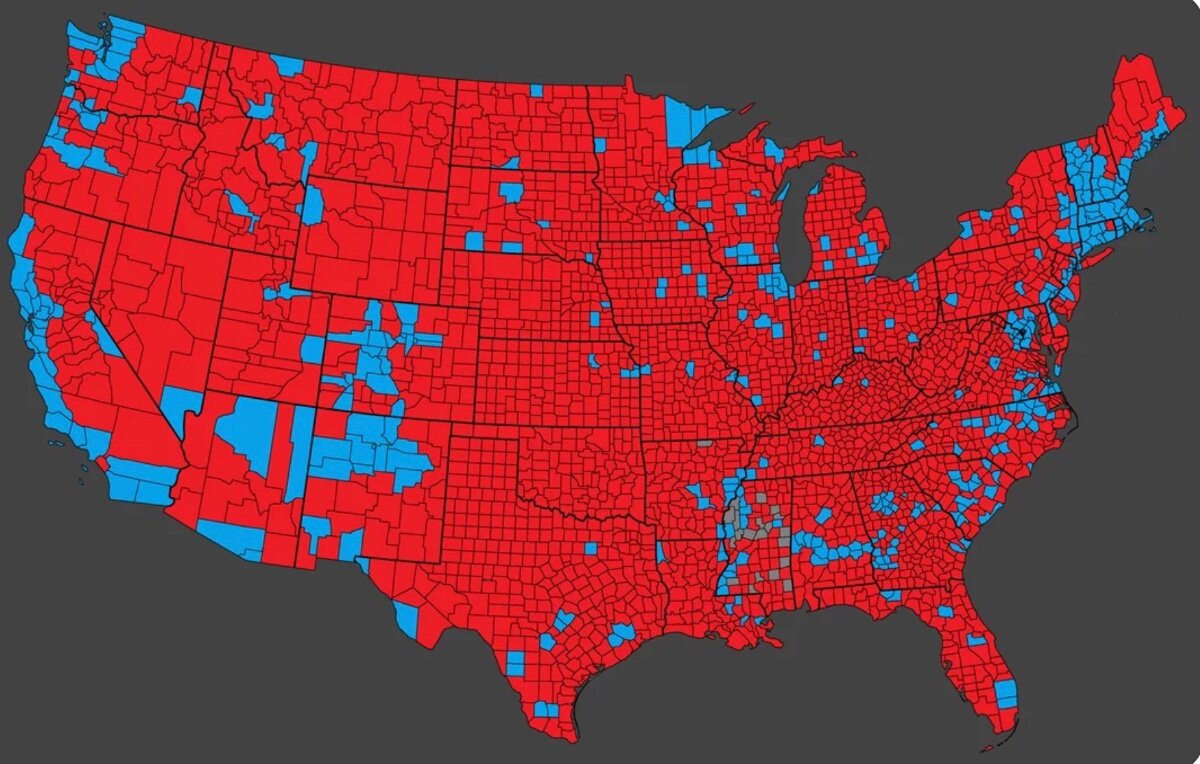
This is the map I love the most. From the New York Times. Massive swing to the right last November. What victory looks like. US citizens across the country tired of incompetent DEI hires in the administration pushing a "woke" agenda, getting nothing done, with a vegetable president and his "coke" snorting son in the Whitehouse. Would be more pronounced today after 10 months Trump administration getting things done (otherwise known as oligarchy by the lefties). Winning!

-
Remember that 77+ million American citizens legally voted for him. Suspect more citizens would vote for him today. Maybe he should run again in 2028? What do you think? That's what kings do. Wait, emperors and kings aren't elected. A landslide victory. Stock market up 20% YTD with so many here running for the hills in April when fear and anxiety (mental illness) got the best of them. Loved watching it. DJT was able to close our sovereign border in weeks (previous admin couldn't/wouldn't in four years), and in 9 months arrest thousands of criminals, make peace and trade deals, and generally gets things done. He assembled arguably the best cabinet in decades - business leaders and achievers instead of govt bureaucrats and DEI hires. But he's a "moron" a "king" an "emperor". I can only presume it's because he gets things done. I'll take it compared to four years of a dementia patient in chief, who didn't know where he was (had to be rescued by the easter bunny) and couldn't complete a coherent sentence. With some here on this board TDS runs very deep.
-
Joe Manchin on the Fight for America’s Future: Term Limits, Bipartisanship & the 2028 Election (0:00) Chamath and Jason welcome Senator Joe Manchin! (4:20) Blocking Build Back Better, defending the filibuster while dealing with paid protestors and death threats (19:39) How Biden's staff pushed him to the far left, mental acuity, how he "lost the will to fight," why Obama was an "elusive" president (28:12) Why socialism is on the rise in America, entitlement culture (37:06) Importance of term limits in Congress, Joe's favorite current senators, cascading issues from the loss of bipartisanship (52:25) Breaking the Dem/Rep duopoly by opening up primaries, thoughts on midterms in 2026 (57:18) Expectation vs reality for Obama, Trump and Biden presidencies; thoughts on the 2028 election
-
Posting this here because Climate Change seems largely to be a political issue: Richard Lindzen, PhD, is Professor Emeritus of Earth, Atmospheric, and Planetary Sciences at the Massachusetts Institute of Technology. William Happer, PhD, is Professor Emeritus of Physics at Princeton University. Doctors Lindzen and Happer are recognized for questioning prevailing assumptions about climate change and energy policy.
-
Echoes of Howard Marks (8/14/25): "An aside regarding the valuation of the S&P 500: A bit over half of its jaw-dropping 58% two-year total return in 2023-24 was attributable to the spectacular performance of just seven stocks, those of the so-called “Magnificent Seven” – Apple, Microsoft, Alphabet (parent company of Google), Amazon, Meta Platforms (parent company of Facebook), Nvidia, and Tesla. These are great companies – some are the best companies ever – and these seven stocks have grown to represent a startling one-third of the total market value of the 500-stock index. (Please bear in mind that I don’t claim to be an expert on stocks in general or tech stocks in particular.) Because of these companies’ greatness, their stocks are highly valued, and there’s a popular perception that their elevated valuations are responsible for the S&P 500’s unusually high average p/e ratio. The fact is their p/e ratios average out to roughly 33. This is certainly an above average figure, but I don’t find it unreasonable when viewed against what I believe to be the companies’ exceptional products, significant market shares, high incremental profit margins, and strong competitive moats. (A lot of the Nifty-Fifty stocks First National City Bank owned when I got there in 1969 were selling at p/e ratios between 60 and 90. Now that’s high!) Rather, I think it’s the average p/e ratio of 22 on the 493 non-Magnificent companies in the index – well above the mid-teens average historical p/e for the S&P 500 – that renders the index’s overall valuation so high and possibly worrisome." https://www.oaktreecapital.com/insights/memo/the-calculus-of-value
-
Bought overvalued spec BE on the drop today.
-
13F Season and New or Outlier Positions
NnnnotSoSmart replied to Saluki's topic in General Discussion
Baupost (Klarman) increases GOOG position by 46% in Q1 2025: https://dataroma.com/m/holdings.php?m=BAUPOST He's added while many reduced and/or eliminated their Alphabet position. -
Bought more GOOGL over the last several days. Now loaded up to the gills. Rumors of LLMs killing Alphabet's search business are greatly exaggerated.
-
Trump Exempts Smartphones, Other Electronics From Chinese Tariffs The step back was announced in a late Friday filing with Customs and Border Protection https://www.wsj.com/tech/trump-exempts-smartphones-other-electronics-from-chinese-tariffs-dd8eb31f I wouldn't want to be short AAPL on Monday. I'm loaded to the gills with GOOGL. Maybe they'll benefit as well even though they are less hardware dependent..
-
Good discussion by Veriten this morning: "This Is Like Quantum Mechanics: If You Think You Understand It, You Don’t” Featuring Dr. Lars Schernikau and Rob West Dr. Lars Schernikau, energy economist, entrepreneur, commodity trader, strategic advisor, and the author of “The Unpopular Truth about Electricity and the Future of Energy” AND Rob West, Founder and Lead Analyst at Thunder Said Energy (TSE). Rob started TSE in 2019 and provides unique and thought-provoking analysis on energy transition research and technologies. https://veriten.com/stream/cobt-212/