Munger_Disciple
-
Posts
2,360 -
Joined
-
Last visited
-
Days Won
3
Content Type
Profiles
Forums
Events
Everything posted by Munger_Disciple
-
The problem is Company A's cash flows maybe almost impossible to estimate a priori in your example DCF. This type of companies tend to be very cyclical like commodity companies and IV tends to fall in a very broad range as opposed to B type companies. For FFH, the cash flows are mainly from its investment portfolio (& not from operating subs like Berkshire) and can only be estimated in the near/medium term of 2-3 years and hence (rightly so as @Parsadexplained) the valuation discount relative to BRK.
-
I agree book value & its growth are excellent metrics for FFH which resembles early years of Berkshire before its transformation into a collection of cash flow generating operating businesses in addition to the insurance mother ship with its associated marketable securities. I don't think ROE is a good metric to use for insurance companies because earnings can be so volatile. Instead, I just focus on the rolling 5-year rate of growth in book value.
-
+1, Excellent post @Parsad! Clearly summarizes the difference between BRK & FFH.
-
@Viking I think you need to make allowance for the fact that FFH now reports book value based on IFRS unlike US domiciled insurers which still use GAAP, so head-to-head comparison needs to take the differences into account. Not disagreeing with your overall thesis but the P/B differences are narrower than they appear in your table. I wish FFH reported their book value according to both GAAP & IFRS as we digest this accounting change.
-
Buffett/Berkshire - general news
Munger_Disciple replied to fareastwarriors's topic in Berkshire Hathaway
Sorry that's a typo. I meant selling naked puts not calls. The main problem I see is that you will go into debt if stock gets put so it can be risky depending on the amount of leverage. With interest rates being this high, we agree that it doesn't make much sense. But even if rates were lower, one needs take into account leverage & additional risk before writing naked puts. -
Buffett/Berkshire - general news
Munger_Disciple replied to fareastwarriors's topic in Berkshire Hathaway
If you are selling naked calls & the stock gets put, you have to buy the underlying stock on margin & carry it forward with the associated debt + added risk. It seems like naked put writing isn't all that attractive with margin rates going up. -
Yeah that's a good point.
-
I agree with you that FFH will likely do better than BRK (mainly because it is cheaper) from this starting point over the next 5 years with the following caveats: (1) FFH insurance underwriting results produce a decent combined ratio (I would take 98% but I know you think it will be 95%), and they don't get their head handed to them in the case of a catastrophic event (2) the Fed doesn't cut rates too much which it would in the case of a rough recession.
-
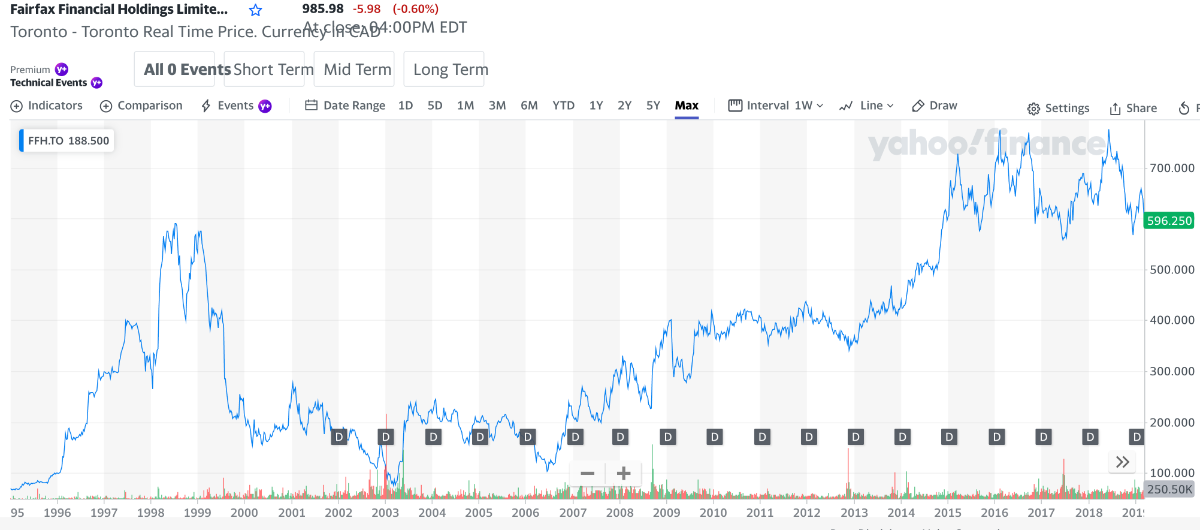
Of course the price you pay counts. The surprising thing is that even after 25 years, the returns were really poor after the purchase in 1999. I guess FFH was way overvalued in 1998-1999 time frame.
-
In the case of Fairfax, the CAGR seems to a very strong function of the start date of one's investment even in the very long term. If you zoom out a bit further, the chart looks like this in CAD (it hit a local peak of $540 CAD in 1998). If one invested in Fairfax on 1/1/1999 and kept it until 6/30/2023 for example, the CAGR after 24.5 years is only 4.54%. On the other hand, if you invested in FFH on 1/1/2003 and kept it till 6/30/23, CAGR jumps to 13.4% over the 20.5 year period.

-
Buffett/Berkshire - general news
Munger_Disciple replied to fareastwarriors's topic in Berkshire Hathaway
@boilermaker75 If I understand your strategy correctly, you are writing short dated, cash secured puts on a few stocks like BAC, WFC & BRK. So you are effectively trying to earn a decent short term profit on idle cash in excess of ST T-Bills. If you get these stocks put to you, what do you do? Hold them (if so how long) or sell them immediately and take a loss? -
That's outstanding @glider3834, great detective work!
-
Buffett/Berkshire - general news
Munger_Disciple replied to fareastwarriors's topic in Berkshire Hathaway
Its like picking up pennies in front of a steamroller. As long you make it, you keep the pennies. Plus it adds hidden leverage & a potential liability that comes due at usually the most inconvenient time. You can win a few pennies many times which tend to get wiped out with one big loss. IIRC many smart people blew up (example: Victor Niderhoffer blew up twice) with variations of this put writing strategy. -
Thanks @Parsad, makes sense to me. I would think that even in the current hard insurance market, they are likely writing more short tail insurance.
-
I was re-reading Prem's 2022 annual letter & he shows a table of gross premiums written and float from 1985 to 2022. I noticed that the ratio of float/gross premiums written has shrunk from 2.4 in 2010 to 1.1 in 2022. It used to be roughly 1.6 in the decade prior to 2010. Dos this mean that Fairfax is writing a lot more short tail insurance these days compared to the past?
-
"The modeled probability of aggregate catastrophe losses in any one year exceeding this amount is generally more than once in every 250 years." Very weird sentence. So they will lose 15% of their book value for catastrophic events that can occur with > 0.4% probability with no upper limit. That's how I read it. I agree, not very reassuring. At best, very clumsy wording.
-
Buffett/Berkshire - general news
Munger_Disciple replied to fareastwarriors's topic in Berkshire Hathaway
I am trying to work out the math on Buffett's charitable giving. It looks like he gave at an annual compounded rate of 4.23% of his yearly holding of BRK stock since he first pledged in 2006. The interesting thing is that he initially pledged that he would give 5% every year of a total commitment of 401,667 A shares (though he owned 474,998 A shares at the time of the pledge) in 2006. He must have increased the amount of shares that he committed along the way. BRK stock compounded at an annual rate of 10.69% over the 17 years he began charitable giving in 2006. Also, I estimate that BRK bought back slightly over $2 Billion in stock since 4/25/23 until 6/21/23 based on the filing. I estimate that BRK currently has 1,445,609 A shares outstanding as of 6/21/23. -
Buffett/Berkshire - general news
Munger_Disciple replied to fareastwarriors's topic in Berkshire Hathaway
I think it is still related to fractional share trading which pretty much all brokerages offer these days (I know Schwab offers it). It is hard to believe that there was more dollar volume in A shares than B shares. 7,000 A shares are roughly equal to 10.5 million B shares. -
Buffett/Berkshire - general news
Munger_Disciple replied to fareastwarriors's topic in Berkshire Hathaway
Buffett the -
@Viking One thing I would like to know is what % of FFH book value gets impaired in the case of a big (close to a worst case scenario) CAT event. Have you investigated it and do you have a reasonable estimate? As an example, Ajit estimated that BRK would lose a maximum of $15B across all lines of insurance business in the event of a horrible super CAT type situation.
-
@Viking FWIW I own a tiny bit of FFH (relative to net worth) so I would like to see them do well also . I hope to get more comfortable over time with them. Plus I have to root for a fellow IIT (Indian Institute of Technology, Madras) alumni Prem. I own a lot more BRK though primarily because I can sleep very well with BRK and I owned it for a very long time.
-
@Viking In my mind, the key for concentration is that there must be almost 0 chance of ruin. I don't disagree that FFH has higher potential upside compared to BRK but it also has a much higher probability of downside. Prem can wake up one day and put in a crazy macro bet and stick with it for 10+ years despite huge losses for instance ...... Plus it is impossible to ignore risk caused by FFH's much higher leverage, both operational and financial. I suppose the risk is a bit reduced in your case because you don't plan to keep FFH forever unlike a lot of BRK shareholders do with their holding.
-
+1 Ironically I think it is easier to have a bigger allocation to BRK than FFH. In my mind, % concentration in a single stock/business should be more a function of how much downside risk there is, not so much how much upside potential it has. The lower the downside risk, the larger the allocation can be assuming the expected returns are acceptable.
-
Rate the overall quality of the management team at Fairfax
Munger_Disciple replied to Viking's topic in Fairfax Financial
I voted 6. Too many investment decisions based on macro (sometimes they get it right, sometimes not). Sub-optimal capital allocation decision with respect to dividend. Too many cigar butt type investments which require trading in & out and incurring taxes as opposed to buying quality businesses and keeping them for very long time. Succession plan very unclear. On the plus side, excellent FI investment team & improving underwriting which I hope is permanent. -
Buffett/Berkshire - general news
Munger_Disciple replied to fareastwarriors's topic in Berkshire Hathaway
+1. I don't care for cream fillings at all. Other than the peanut brittle & the dark chocolates I mentioned before, I don't like most of See's chocolates or candies. They are way too sweet for my taste.