Munger_Disciple
-
Posts
2,360 -
Joined
-
Last visited
-
Days Won
3
Content Type
Profiles
Forums
Events
Everything posted by Munger_Disciple
-
What's your thesis on New England Realty?
-
Buffett/Berkshire - general news
Munger_Disciple replied to fareastwarriors's topic in Berkshire Hathaway
Many BRK subs have minority interests. For example, the Blumkin family members who still run NFM (Nebraska Furniture Mart) are minority owners in NFM. -
Buffett/Berkshire - general news
Munger_Disciple replied to fareastwarriors's topic in Berkshire Hathaway
BHE -
Buffett/Berkshire - general news
Munger_Disciple replied to fareastwarriors's topic in Berkshire Hathaway
Berkshire now owns 100% of BHE; there are no other minority shareholders. -
Buffett/Berkshire - general news
Munger_Disciple replied to fareastwarriors's topic in Berkshire Hathaway
For a regulated utility, pretty much all capital expenditures including any maintenance expenses have to be approved by the regulator since they affect the rate base. -
Buffett/Berkshire - general news
Munger_Disciple replied to fareastwarriors's topic in Berkshire Hathaway
Wow! After reading the filing, BRK paid $650 per BHE share, a very big mark-down from $1,174 per share they paid for Abel's shares in 2022. That's a 45% mark-down!! This may very well mean that BHE may be pulling back on utility investments significantly. -
But that's nothing new.
-
I saw that but why would the Saudis do that if they expect more normal demand from China going forward?
-
I find it odd that oil is sucking wind while everyone thinks China is back. There is something wrong with this picture.
-
Excellent post! Thanks for sharing your experience.
-
Buffett/Berkshire - general news
Munger_Disciple replied to fareastwarriors's topic in Berkshire Hathaway
He tends to shoot first and ask questions later. You are correct of course, Jain would have disclosed if he gifted the shares. Not only that it wasn't a gift, but Bloomstran got the sale price wrong. -
Buffett/Berkshire - general news
Munger_Disciple replied to fareastwarriors's topic in Berkshire Hathaway
It is possible that Ajit is making a private personal investment (for example in India) that would be too small to move the needle for Berkshire. And being the best odds maker in the world, he sees a strong likelihood of capital gains taxes going up in the near future (especially under KH). So he might be selling now at a very attractive valuation for Berkshire. If one thinks about it, the above scenario is not that different from Buffett's rationale for selling Apple. -
Buffett/Berkshire - general news
Munger_Disciple replied to fareastwarriors's topic in Berkshire Hathaway
They corrected it:
-
Buffett/Berkshire - general news
Munger_Disciple replied to fareastwarriors's topic in Berkshire Hathaway
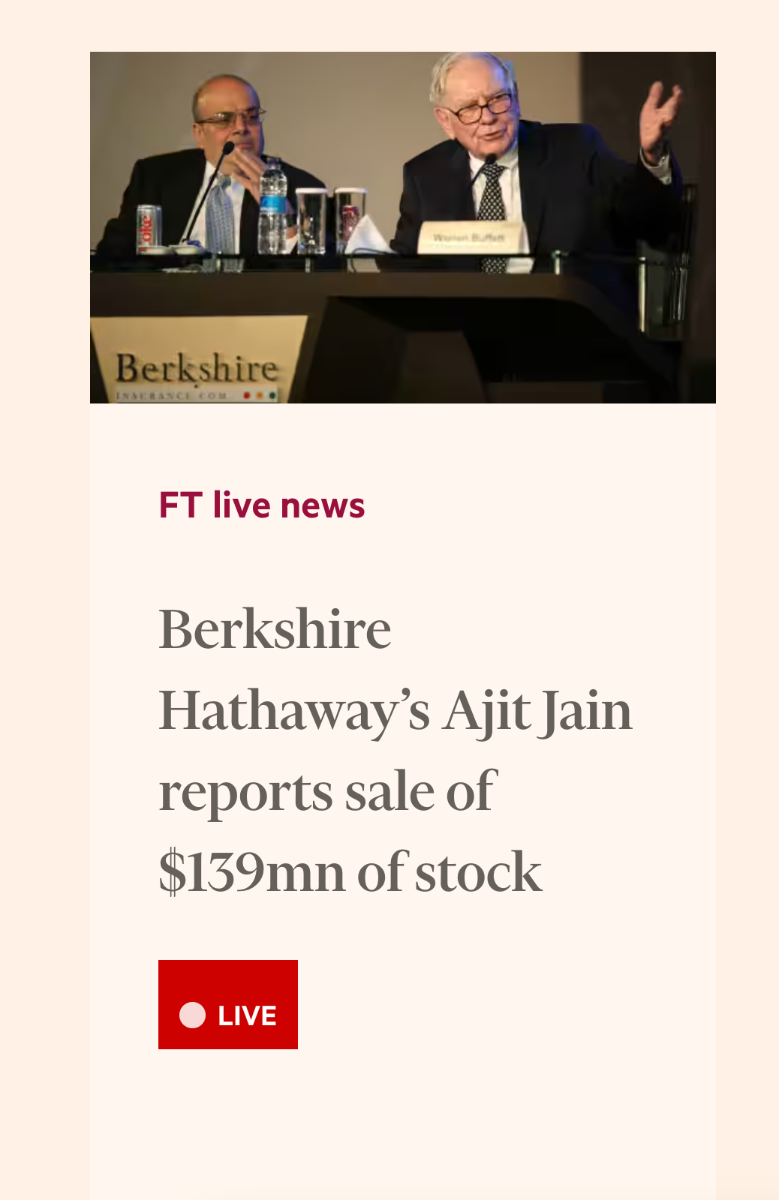
FT had a funny screenshot of Ajit Jain:
-
Buffett/Berkshire - general news
Munger_Disciple replied to fareastwarriors's topic in Berkshire Hathaway
Ajit's sale is not related to charitable giving (he could have gifted shares to avoid capital gains taxes), but it is highly unlikely that it is related to estate planning. My own guess is that Ajit (the best odds maker in the world) sees future capital gains taxes (especially under a democratic administration) going up significantly so he is taking some chips off the table at a high end of Berkshire's intrinsic value if not higher. This thinking is in line with Warren's own stated thinking on higher future corporate tax rates which is one of the reasons he sold Apple stock. -
Buffett/Berkshire - general news
Munger_Disciple replied to fareastwarriors's topic in Berkshire Hathaway
Why would estate planning involve selling stock? That makes no sense. -
Buffett/Berkshire - general news
Munger_Disciple replied to fareastwarriors's topic in Berkshire Hathaway
Perhaps Ajit is planning to move insurance HQ to FL ? He sure would save a few million in taxes every year! -
Buffett/Berkshire - general news
Munger_Disciple replied to fareastwarriors's topic in Berkshire Hathaway
Based on my math, Ajit sold 200 A shares out of his total holdings of 449 equivalent A shares prior to the sale. So the press is wrong. Ajit sold 44.5% of his Berkshire stock and retains 55.5%. Still a significant sale though. Even after this sale, Ajit owns more Berkshire stock (249 A share equivalents) than Greg (229 A share equivalents). -
Buffett/Berkshire - general news
Munger_Disciple replied to fareastwarriors's topic in Berkshire Hathaway
Wow! Didn't see that coming. -
I think Bloomstran is saying that FFH has a lot more insurance leverage (so higher risk, possibly higher return potential but more subject to negative surprises) and generally is not as a high quality insurer as BRK which is true. He is also saying that BRK has a lot more flexibility in investing insurance capital (so can have a much higher allocation to higher yielding assets like stocks and entire businesses) because it is so over capitalized. But what he is missing is that it is already more than priced in the relative valuations of the two companies.
-
Thanks. These results make sense and agree with my intuition. I agree with your conclusion that 4% WR is too high if one retires close to the peak of an overvalued market.
-
Good work! I especially like the 2nd scenario as the first one is mostly hypothetical since no one knows when or how long a bear market will last beforehand. For the comparisons to be more fair, I would suggest your simulations of various scenarios with the same amount of total capital of $1mm. So you would start with $130K in cash + $870K in S&P 500index in both scenarios you outlined and run the simulations again. This gives a more accurate comparison to the baseline case of starting with $1mm in S&P 500 index with periodic withdrawals.
-
Well, the sequence of return risk is independent of whether one receives dividends or not. It's just that large, consistent dividend payers tend to be in the defensive sectors like consumer staples and healthcare which outperform in bear markets and that explains the graph more so than they pay dividends.
-
Very few people are aware of sequence of returns risk with periodic withdrawals, let alone understand it. Great post & I wish I could give it more than 100% emoji.