Trophicdynamics
-
Posts
34 -
Joined
-
Last visited
Content Type
Profiles
Forums
Events
Everything posted by Trophicdynamics
-
Rethinking my 100% active portfolio
Trophicdynamics replied to Zemergefen's topic in General Discussion
I am not certified to provide portfolio advice, so I will not comment on yours. I will tell you this, learn to walk before you try to run - which means learn as much as you can about markets before going headfirst inton investing(learn from the people who have done exceptionally well especially over a long period of time, the longer their streak of winning the more weight you should put on their teachings). Nobody can accurately predict the short term direction of stocks or markets on a ongoing basis, you may get lucky once or twice but generally speaking it's fools errand. Instead focus on the long term and the longer the term the better. Understand that investing is more about psychology and emotional control then anything else. Learn qualitative analysis, the quantitative part does not matter as much as it is unlikely that you will have a competitive advantage against quants or Algos. create an investment philosophy and continuously refine that philosophy with new learnings and teachings. -
Robotics - The New Frontier
Trophicdynamics replied to whatstheofficerproblem's topic in General Discussion
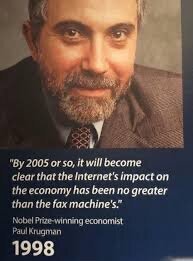
@Milu this quote is hilarious. This is precisely why predicting the future is pointless. However, like a fool I still try to do it.
-
To add to my Depflation theory. China shock 2.0 is here. In the first China shock we lost low value added manufacturing work, this time around we are going to loose jobs in high value add work, technology, research and design, engineering, etc.
-
Valuations are stretched in almost every asset class. Equities, Gold, Bitcoin, private equity, real estate, commodities, to name a few. As the saying goes, the market can stay irrational longer than you can stay liquid so don't short the market. I do think it's prudent to start building a cash reserve. My macro view is that we are going to see recession potentially depression type situation with inflation to boot. I call it deplation or we are getting stagflation at the very least. Consumer and Financial institutions balance sheets are not looking good (huge refiance risk), Shadow banking and private equity is mostly a illiquid market (assets are not being marked down to reflect market reality) Global supply chains are being destroyed (increasing input costs & devastating trade dependent economies), and the money printer is going brrrr (QE is back) while financial repression is happening with interest rates (interest rates below inflation rates). So anyways that's my take
-
Well, I am for diversification once a fortune is built for now I am highly concentrated. If statiscally you want to outperform the market you have to take greater risk to be the the right tail of the distribution curve. Risk can be taken by different means, geographical risk, concentration risk, leverage, currency risk, sovereign risk, macro risk, political risk, Inflation risk, many other types of risk. I try to stay away from thinking about risk to much as it will necessitate me prioritizing safety over returns. The only risk I like to take is concentration risk, and try to stay away from the others. It keeps it simple for me and allows me to focus on the upside more than the downside of a company.
-
I'm selling out of Baytex BTE.TO has been terrible for me. It has turned me off from investing in low quality business. I was hoping oil would go up which would have made this a great trade due to price volatility of stock (cash flows are highly sensitive to price of oil). It has turned into a dog so I am cutting my losses and redeploying my capital elsewhere.
-
Sify the only Indian Datacenter company that is available to purchase at the moment, they also have a large Marketshare approximately 15%. Tailwinds include large captive domestic market (1.4 billion domestic consumer market), deploying technologically advanced datacenters in Tier 1 and Tier 2 cities, low starting valuation, head start over domestic competitors. Leading player in South India, majority of Indian tech industry is located in South. Domestic market is the only large economy in world that is growing at a rapid pace (6-7 percent year over year). Economy is not trade dependent but rather consumer driven (US tarriffs can only slow not derail growth).
-
Buffett & Munger Unscripted - Alex W. Morris
Trophicdynamics replied to John Hjorth's topic in Books
This is the next book I'm gonna read. I have gone through as lot of video footage of the meetings as well. I wonder if there is any older wisdom that I might have missed. -
I'm extremely bullish on India. I did study a fair bit of developmental economics and have been visiting India since the early 1990's. India has been transforming from a economic backwater to a great power status over that time, and I strongly believe it will transform from a great power now to a Superpower by 2060. I believe American economic hegemony is in decline (from the top and bottom) and it is only a matter of time before this will be evident to the world. Economic hegemonies are established from the top and the bottom. From the top means having the largest aggregate GDP. Having the largest GDP means that USA has large thunen world centers/core which create economic growth and dynamism. With Global periperhery (regions and countries) orienting there economies towards feeding raw inputs to the cores. USA has had the largest and most dynamic cores the world over since 1945, these cores are being challenged by new Asian mega regions (pearl River Delta, etc). USA economic hegemony is also declining from below which relates to having one of the highest total factor productivity and technological lead over competitors. China has been busy stealing tech and know how from the west, similar to what the west did to Asia during colonial times, if they won't share the technology/IP then steal it is the mantra. Out last 20 centuries 17 have been dominated by India or China, and the world is going to return to the World's Natural powers in this century. Why India, because when democracies develop there economies they do so in a messy manner while simultaneously tackling all issues, corruption, law & order, low productivity, low skill labor force, infrastructure, capital mobilization/formation issues, unemployment, etc. Although democracies take longer to resolve issues, accurate information is available for decision makers, transparency is greater than other systems, institutions help to maintain the internal balance of power. India has some additional features such as a dominant religion which accepts that things will change and puts knowledge at the level of divine, a reverance for capitalism, largest & youngest population in the world.
-
Putting numbers on Buffett's principles
Trophicdynamics replied to ratiman's topic in Berkshire Hathaway
I think there are distinct quantatiave and qualitative aspects to equity analysis. The moat, pricing power, circle of competence are qualitative points of analysis and most likely should be based on your understanding of the respective topic. There is alot of subjectivity and assumptions involved in this analysis. I would put predictive DCF modelling in this category, even though there is some math involved. Quantitative analysis should focus on real numbers. Numbers which are based on historical performance and are hopefully free from fraud.