-
Posts
296 -
Joined
-
Last visited
-
Days Won
1
Content Type
Profiles
Forums
Events
Everything posted by Blake Hampton
-
Great post @dealraker. I agree. I, for one, like being able to use my legs. But there will be more minefields nonetheless.
-
Think long-term.
-
If you get excited by rising prices and depressed by falling ones, specifically when you’re a net buyer of securities, you are not investing. You’re simply just another person within the crowd.
-
I live in Oklahoma. I think I'm qualified to talk about the current sorry state of the average Republican's brain capacity.
-
Upon further reading of past policy, it's starting to dawn on me that a lot of the problems we're now experiencing were born from poor Republican governance. Many past decisions made by Republican-led Congresses strike me as incredibly stupid. Hopefully, our current Trump state is an apex. Guess who voted down TARP in 2008 right when our country was teetering towards economic collapse? Guess who repeatedly voted down intelligent immigration reform? Guess who has continuously cut taxes into burgeoning fiscal deficits, while at the same time cheering their own fiscal prudence? Of course those are only a few examples. There are many, many more. This is a party has completely abandoned data and logic. Makes for some dumb policy. This is the party of no more wars, free markets, and law and order folks. They get mad because the so-called "elitists" call them stupid. I wonder why? What this country really needs is a massive forced reading campaign onto Republican-led states. I'm not saying that Democrats don't produce their own stupid stuff, they do, sometimes hilariously so. But it seems to me the Republican party is operating on a whole new level of stupid.
-
An interesting thing I learned the other day is that the SPR actually requires a minimum of 160 million barrels simply to maintain the structure of the salt caverns the oil is stored in.
-
 Jamie Dimon's Letter to Shareholders, Annual Report 2025 Some of my highlights: "The challenges we all face are significant." "Now, because of the war in Iran, we additionally face the potential for significant ongoing oil and commodity price shocks, along with the reshaping of global supply chains, which may lead to stickier inflation and ultimately higher interest rates than markets currently expect." "And we also continue to buy back enough stock so as not to increase total excess capital, though we have a number of options on how to deploy our capital and are clear-eyed that many asset prices, including bank stocks, are fully valued." "One of the huge risks for a bank has always been a “run on the bank,” which occurs when people think that their uninsured deposits are at risk. The FDIC only covers insured deposits, and the run risk is driven by uninsured deposits, particularly nonoperating uninsured deposits. In recent bank failures, regulators have had to invoke the systemic risk exception (SRE) to protect uninsured deposits at the point of failure. That is a problem — no one should want this as an emergency mechanism. It creates moral hazard, and the process to invoke the SRE is chaotic and involves multiple agencies, including approval by the Treasury Secretary in consultation with the President. Bank runs can happen quickly, and relying on that type of action to avoid contagion is simply not a good idea." "It is also good to remember that the United States remains the world’s best investment destination, particularly when things are going badly." "Liquidity itself is a complex concept and can also change with sentiment. Often when people talk about liquidity, they are talking about the ability to readily buy or sell in the marketplace, e.g., when spreads are high and volumes are low, this would be considered low liquidity. Sometimes people are referring to the money supply. Money can be created by the central bank when it buys securities or by banks when they expand their balance sheets. In both cases, they create deposits (more liquid assets) in the short run. But all investors, from individuals to companies to major asset managers and banks, have their own liquidity needs and requirements, usually driven by their policy or regulatory policy, working capital requirements, collateral needs and sentiment (for example, the desire to be more conservative). When asset prices drop and all of these other factors change, the “need for liquidity” can change dramatically, too. When people get scared, they generally sell risky assets to buy safe ones, e.g., essentially T-bills or deposits at safe banks. And when they sell risky assets, they usually start with their most liquid positions." "High and increasing government debt will eventually have to be dealt with — the right way would be to deal with it now before it becomes a problem; the wrong way would be to let it become a crisis, which, in my opinion, is probably the likely outcome. Importantly, almost 60% of government spending is for entitlements and is not discretionary. This makes the job that much harder." "Rapidly decreasing asset prices can sometimes create a self-reinforcing loop. It’s always good to remember that prices are set by the marginal buyers and sellers — which, on the average day, is only a small fraction of asset owners. And it’s also good to remember that foreigners own almost $30 trillion of U.S. equities and bonds." "In the great scheme of things, private credit probably does not present a systemic risk." "Some political leaders have said that there is a “rupture” between America and the Western world —that the red lines have been crossed and there is no return to the prior system. I completely disagree. There is no practical replacement to the prior system. It has not ruptured, but it needs reform. The middle-sized nations do not have real alternatives in terms of building a unified military or a unified economy that can compete effectively with the United States and China. If these middle nations did, the result would look a lot like what Europe is today: dysfunctional. The only practical alternative is to fix the current situation." "I do not want to contemplate the opposite. Without American leadership, there would be a huge vacuum. If not us, who? We are the only country that has the capability to do it. Fragmented relationships with and among our extensive allies could lead to an “every nation for themselves” mentality. America would become more isolated, the U.S. dollar would no longer be the world’s reserve currency and autocratic nations would rejoice. Need I say more?" "While we should acknowledge America’s flaws, they should not be used to pull apart our country. We need to believe in ourselves and get back to work, not tear each other down. Many of the blind ideologies being bandied about run counter to our fundamental principles. Ideologues often adhere to rigid beliefs and, when extreme, seek to impose those beliefs on others; in radical forms of fanaticism, there is no room for individual differences. While we should listen to all people and all viewpoints, we should not allow ourselves to become weaponized." "I believe we have gotten a little too soft."
 -
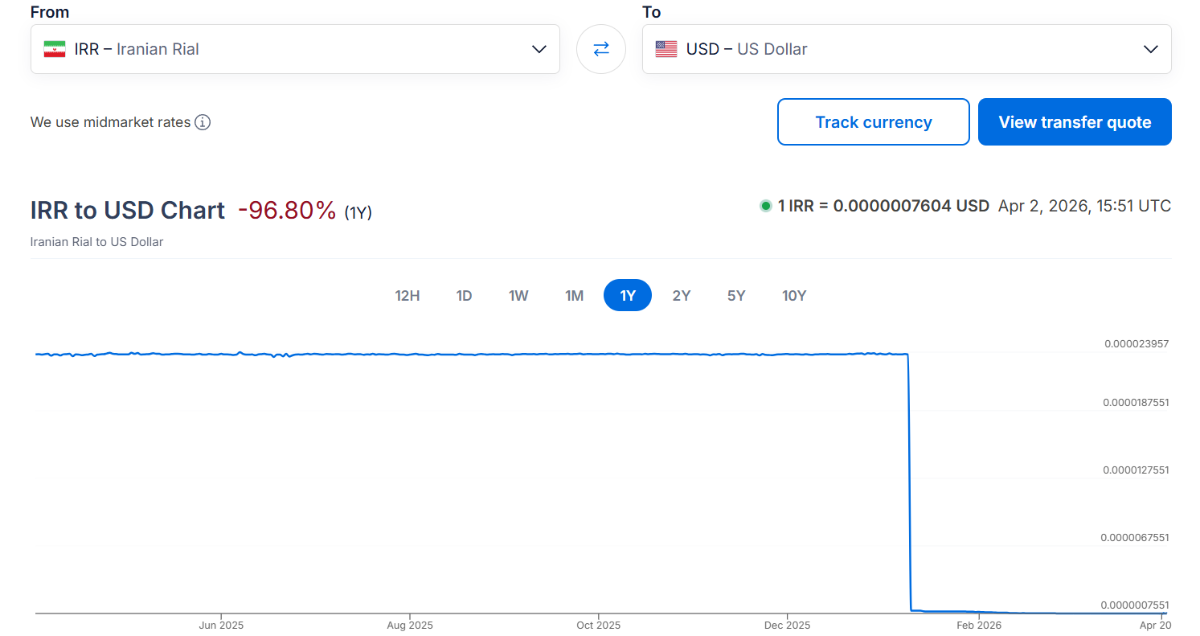
Currency collapse is a happy little side effect of that.
-
FT: ‘Utter sense of disappointment’ in Saudi Arabia over Trump’s strategy
-
Trump: The man who was born with everything but yet has learned nothing. Sounds like America to me.
-
I agree. The primary reason behind the protests Trump likes to bring up so much was actually their currency collapsing. I believe it initially had something to do with a large bank and nepotism: WS: The Obscure Bank Collapse That Sent Iran Into a Tailspin. I even read an article a while back that described living in Iran even before all that started, and it still sounded absolutely terrible: rolling blackouts, no access to water, extreme poverty, etc. But America on the other hand... lol. I hate Trump, but goddamn it if he isn’t a good reflection of us, I don’t know what is.

-
But how will Warsh respond during a crisis?
-
A Treasury auction will never fail. But yields very well may spike to levels people previously thought were impossible. Powell's approach is to flood the system with money. Warsh seems to me more of a disciplinarian. I think those are important topics.
-
I don’t think betting against Buffett is a winning strategy over time. Buffet knows what he’s talking about, and he likely understands the financial plumbing better than anyone else in the world; he’s the one Treasury secretaries and Fed chairmen call for advice. The Fed printing money to save the system is a choice that must be made. It is not some automatic switch that flips. During a severe situation, it becomes a manual decision between sacrificing the currency and saving the system. The Banking Panic of 1907, which resulted in John Pierpont Morgan saving the country from systemic collapse, convinced Congress that the financial well-being of the country couldn't be dependent on any one individual. Thus, in 1913, the Federal Reserve was born. One of their founding principles was to help avert banking panics. They became the lender of last resort. They're the firefighters that arrive to save everyone when all other options have been extinguished. They do not move until they have to. With each new systemic crisis, the Federal Reserve has had to move into new areas that were formerly thought of as far outside of their actual mission: to protect the banking system. In 2008 it was AIG and investment banks. In 2020 it was corporate credit. Go and read some of what Kevin Warsh has had to say about "mission creep." He is the incoming Chairman after all. Another aspect of this that I think is important is that the Federal Reserve is technically not allowed to lose money. All of the Federal Reserve's loans are supposed to be secured by "good collateral." When the Fed has to move on deep-end items like corporate credit, they're legally supposed to go to the Treasury, and in-effect Congress, in order to get equity backstops so that they don't lose money. That takes time. Today, we have a system that is incredibly leveraged as well as a Congress that seemingly couldn't get anymore stupid. Like Buffett said, when you get right down to it, a lot of Congressmen think that they know more about the financial system than those at Treasury and the Fed. They're truly one dumb bunch, and in my opinion, a good reflection of the electorate they're supposed to represent. So we have a system that it sort of just-in-time when it comes to money, and lawmakers who have little understanding of how to properly respond to a crisis.
-
Hopefully Iran decides to open up. Who knows what will happen. But one thing I know for certain is that America is quickly losing any remaining credibility we had abroad. The world is increasingly disgusted with us at the same time that we’re increasingly reliant on their imports and financing. No one can say it’s not interesting.
-
“Build up some delayed courage, go to the Strait, and just TAKE IT. You’ll have to start learning how to fight for yourself, the U.S.A. won’t be there to help you anymore, just like you weren’t there for us,” Trump posted on his Truth Social network. “Iran has been, essentially, decimated. The hard part is done. Go get your own oil!” — Donald Trump Crude oil is an extremely globalized commodity. Even though the United States is a net petroleum exporter, this large of an energy shock will still cause large price spikes that we’ll not be able to easily escape. A fifth of the world’s total petroleum supply is cut off from getting to market. There’s also other large disruptions in forms of important energy such as LNG and fertilizer. We started this conflict. It seems now that Trump’s best idea for a solution is to simply walk away because it won’t affect us, Asia and Europe be damned.
-
I will likely never be able to convince you of anything. If you actually care, go read more about it.
-
-
“If you aren't thinking about owning a stock for ten years, don't even think about owning it for ten minutes.” ― Warren Buffett What do you think the world is going to look like in 10 years?
-
I believe our situation today is quite different than the one we've had over the last 50 years. Bonds are a terrible long-term investment. No argument there. Some of them might. Overall though, I think it would be a period of extreme financial turmoil all over the world. We're running $2.1 trillion fiscal deficits alongside the greatest energy shock in history. I wouldn't be so certain. I'm not disagreeing that business is the best place to be over time. Maybe that's where a lot of people get me wrong. There's really only four primary types of productive assets to own that exist outside of speculation: Stocks, bonds, cash, and real estate. I already told you I believe bonds are a wash, so that only leaves three. We all here know which of those three have demonstrated the best performance over time. I just believe it's important to understand the environment in which you're heading into. I think it gives you the proper understanding of what it is to do. For example, different types of businesses DO NOT all perform well during a period of extreme inflation, most don't actually. Another is that there can be quite large consequences politically. Lastly, having a good amount of cash preceding a historic debt crisis may offer you generational opportunities.
-
I would agree with this for the vast majority of modern American history. But not with all. The United States used to be plagued by financial panics. Countries around the world who weren't blessed with a reserve currency like ours have faced repeated instances of both extreme inflation and economic collapse. I would argue these concepts were important to them. I think the United States today has been lulled into a state of ignorant bliss. We believe that we can simply print our way out of all our problems. Money no longer has a cost.
-
I simply disagree.
-
I think investors would be wise to stop listening to Trumpers. The difference between now and the 1970s is that the country that holds the world reserve currency is facing a fiscal crisis.
-
See the problem I fear with the United States is I fail to see a scenario where inflation doesn't spin out of control. I don't think the system as it currently stands leaves the Federal Reserve any real options to address it. They call that fiscal dominance. I call it an increasingly braindead electorate.
-
^ Powell could probably be replaced with Warsh there ^ Also, I do not think you're an idiot. I thought it might be funny.