Hamburg Investor
-
Posts
229 -
Joined
-
Last visited
-
Days Won
2
Content Type
Profiles
Forums
Events
Everything posted by Hamburg Investor
-
Thank you! That makes sense to me. That seems perfectly reasonable and understandable to me, logical. Just one comment: I have always found Munger and Buffett to be very forceful in their assertion that buybacks above intrinsic value are ‘capital-destroying’. But is that really the case? Isn't that oversimplifying? One example: Now let's imagine a company with a sustainable ROE of 40%. Munger would say, ‘No matter at what price you get in here, over a very long time horizon you will get roughly the ROE (assuming everything is reinvested in the company).’ And now let's assume that management buys significantly above intrinsic value, so that the repurchased shares ‘only’ yield 35% (instead of 40% as ROE is 40%) in the long run. I find Munger's judgement that (all) share buybacks above intrinsic value are always ‘capital-destroying’ somehow questionable. By the way, it can't be both ways: Either you get a return over the long term roughly in line with the ROE, regardless of the purchase price for the shares (in other words, regardless of whether you bought above or below intrinsic value), or purchases above intrinsic value are always ‘capital-destroying’. Or would anyone disagree that an average return of 35% per year for most of us doesn't exactly fit the definition of ‘value destruction’? To stay with the image: management would reinvest the surplus with a return of 35%; you have to achieve that yourself first (many of us would also have to pay tax on the dividends first; so we would have to achieve above 35% just to match the management). But that's how I read your formula, @nwoodman: Share buybacks above intrinsic value do not destroy capital; they only lead to lower returns than the company's ROE. In other words, companies with very high ROEs can buy back a large amount of shares above intrinsic value, and yet these are still sensible buybacks (unless you have better reinvestment opportunities). You can also turn it around: If a company with a ROE of 10% buys back shares below intrinsic value, the share buybacks will hardly achieve such a high return for the investor, as in the first example. But how can that be, if Munger is right. For the investor holding both stocks (50/50), it would be better to have the company with a 40% ROE buying back shares (slightly) above intrinsic value than to have the other company with a 10% ROE buying back shares below intrinsic value. In the best case (assuming these are the only two stocks available), the 10% ROE company pays a dividend and the investor uses that to buy more shares of the 40% ROE company, even at a 35% CAGR return. This way, the better company would come to dominate the investor's portfolio more and more. Or am I wrong?
-
I plan to sell my stocks, when retiring regularly ("4% rule" - so step by step); hopefully in around 7 years. I'd sell/reduce Fairfax before in the following cases: 1. if I feel the need for diversification, which I just did, as FFH was near 50% and the weighting of the insurance within my portfolio pushed above 67%. So I sold MKL and FFH and bought some small caps I like. I think I begin not feeling comfortable, if FFHs at its current valuations is above 50% of my portfolio and if less than a third of my portfolio isn't insurance (while 10% is BRK and I like it for the float, but I don't see BRK as an insurance company with stocks and wholly owned businesses, but more like a fund of different businesses, including insurance). 2. A function of 1 is, if Fairfax outperforms my other investments by a lot and pb ratio grows e. g. into the direction of 2, than a. the concentration of my portfolio in FFH grows and at the same time b. my hunger for such a concentrated bet would go down a bit (maybe to a maximum of 30% or 40% of the portfolio), so I probably would sell step by step and buy other things. 3. if I find something much more compelling as a bargain (e. g. sustainable roe around 30% or above in the small cap world) and Fairfax is much more expensive in comparison. 4. if valuation gets absurd (minimum pb ratio of 3.0, maybe 5.0. 5 if the insurance sector gets structurally into a crisis or disrupted (something like "AI is disturbing the moat of BRK, MKL, FFH, which I don't see).
-
@Viking Thank you for your answer, which I really appreciate, but I think I haven't made my question clear: 1.There's a roe on the surface, let's call that "face roe". But - as you pointed out and I totally agree - that's understated. 2. So you come up with an adjusted ROE on the basis of FV. That's 19%. 3. Okay, nice. now we have it. As Munger said many times (from memory) "If you have a business with a roe of 20% and you hold it over decades, your return will be roughly 20% - regardless, if you over- or underpay! In other words, if we have the adjusted roe, we know how the intrinsic value grows over time. Perfect, no more questions! But... No... wait?! We forgot the buybacks! Even over 2 decades there's clearly a big difference, between two businesses, where: BUSINESS A never bought back any stock nor sold out any dividends etc. and BUSINESS B, which bought back 99.9% of all stocks outstanding (okay... that never happens, I know ... but I want to illustrate my point... so let's just say for a moment 999 of 1.000 stocks have been bought back). So here you have it, that's my question: How can we take your "adjusted ROE" one step further to get to a number that shows the "growth of intrinsic value per share" (let's call that "givps"). It clearly must be above 19% - but where exactly? My thinking begins with something like: If in a given year we have 19% roe and 5% of stocks are bought back in that year I just divide 19% through 0.95 and get 20%. So the buyback activity would translate a roe 19% into a "givps" of 20% in that specific year. And if you buy back 5% of stocks in the next year and you have a roe of 19% again - is "givps" then 20% or 21% in the second year? I tend to the latter, as now I'd have to divide 19% through 0.9025. But is it just as simple? I don't think so, as e.g. buybacks above book value disturb the "e" in ROE. But how do we adjust the "e"quity back? And the growth in intrinsic value can't be agnostic to the price being paid for the stocks in the process of buybacks, but my simple formula ignores the price. And then we all know, that buybacks at a price below intrinsic value create new value, while above they destroy it ... Maybe it's just not possible to take that step from roe to "givps", not even roughly?! And maybe my idea is just wrong and I am just having knots in the head and I write nonsense here?
-
Thank you, @Viking, that way of thinking is so good and important! I have one further question, and hopefully you might bring light into the dark: Doesn‘t even this adjusted ROE understate the value creation of Fairfax on a per share basis? Why? Buybacks. There‘s clearly more value creation, when a lot of shares are bought back (way) below intrinsic value. But I don‘t know how to calculate that, not even roughly. There are so many moving parts and variables - price of the shares, when bought, roe of the company in the specific year and in the future, (I’ll bet there’s even a price move, if a lot of shares are bought back over long timeframes, which affects the TRS, but let’s leave that away). Do you have any idea, roughly, or am I totally wrong with that thinking?
-
Buffett's Early Investments - my new book
Hamburg Investor replied to Brett's topic in Berkshire Hathaway
+1 order to Germany. to the author: What have you learned or was the biggest news for yourself when doing the analysis? -
In Germany government oftentimes steps in, if the economy gets hit badly (covid…). My gut feeling is, that in the US they are more market oriented and let things go without too much intervention; but at some point they would I guess. But I am not an expert, any thoughts from someone else?
-
If I get you right, than buying on the cheap site isn’t an option for you as for the risk?! So you could get into the situation to buy a security, that is priced reasonable, but if it gets cheaper over time, than you sell, even though the gap to intrinsic value widens…?! I get your point and I‘d agree, that liquidity is all important and you make a good point. Still it leaves you with less opportunities and you would have to sell at points, where I‘d see most value. Think of FFH when it was valued at 0.4 book just 3 years (or so) ago. Have you sold at that point; if not, why? Looking at Prems investment style, doesn’t he invest just totally contrary to you? Thinking about Eurobank and others.
-
To me, that‘s the key point. Buffett said something like - from memory - crisis is good for a good business, as the crisis wipes out the competitors. A good business WINS through crisis, as it wins market share. Not only, but especially in those times. Gayner wrote about that topic some years ago in his annual report too, saying something like, that it‘s an advantage for its subsidiaries, that Markel will always be there to e. g. buy a new machine, if it gets broke at one of it’s subsidiaries. So management is able to always think for the (very) longterm. So how will the world look like some years after a 600 bn dollar event? BRKs and FFHs market share should have grown AND the premiums within the sector as a whole should have grown too (as prices within the insurance sector would have grown). So both BRK and FFH would get a bigger piece of a growing cake, some years after such a scenario and I wouldn‘t be surprised, if CR would go down a lot. So, yes, there are tail risks, that will ultimately hit BRK and FFH; but in the long run those risks are in fact not risks but chances.
-
That‘s just a theoretical scenario. I like to think about the downside. Most, if not all, of us are implicit thinking the stock price of FFH should go up in the next years. I wouldn‘t bet against that. Still from time to time things happen and the world changes within a moment. Think Covid, think FFH trading at 0.4 book value. So by this scenario I try to get a rough idea about „What if I am wrong and Mr. Market is go crazy within the next years? After all you‘ll NEVER know, where rhe stock price goes to in the short term (and 3 1/2 years to me is shortterm). So why not think about that „bad“ scenario? Would it be as bad as I think? Often things turn out to be way better even (or: especially!) in a bad case scenario than one thinks in the beginning. E. g. in the other thread about the question if FFH would reach 2.000 dollar until 2027 I just bet „yes“. But I don‘t hope for that outcome. For every longterm holder (net seller or holder) of FFH it would be even better, if the share price would be way below 2.000 dollar. As shares can be bought back way cheaper. So in a nutshell: No, I don‘t think, that the share price will stay where it is. But if anything, than I would hope for such an unlikely scenario, as my share of FFHs earnings would only go up. And I like to lean to the downside. Having shares of a business with a pe ratio of 8 today, and having zero return over 8 1/2 years and than owning a business with a normalized pe ratio of 2 and a normalized roe of 15%- if that‘s the bad case scenario, than that’s a scenario I buy. (Again: ignoring buybacks, which would make the scenario even better). Thank you for the work, which I really appreciate! Gives a lot of colour.
-
I like the way you think. Mine is a bit similar: The rule of 72 tells us, that at 15% ROE equity doubles in around 5 years, at 18% it doubles in 4 and at 24% it needs 3 years. Of course ROE can be less or more in the upcoming 3 years (and thereafter hard to say), but I wouldn't bet on less than 15% or more than 24% for the next 3 years. My best guess is around 20%. So that's around a double in 3 1/2 years, isn't it? Than I try to find a comparison of FFH to the market. It doesn't make a lot of sense to me to compare the book value of the market (think: S&P500) against book of FFH, as most companies of the index are better understood with pe. So how to come up with a normalized pe for FFH? I just pick a normalized ROE of FFH (my best guess is 15+% over the long run, so I take 15%). If FFH earns 15% on book and I can buy it at less than 1.2 book, than that's a normalized pe ratio of 8, compared to nearly 30 for the S&P500. Wow, that's cheap and I am pretty sure the average S&P500 company won't make 15%, not even 12%. That's my definition of Quality at a cheap price and of GARP. Thinking one step further: Assuming a double of FFHs equity in 3 1/2 years and the price stays where it is, than FFH would be valued below a pe ratio of 4 (!). I would love that, as the buybacks would bring returns even higher. Assuming 15% after the next 3 1/2 years, would bring pe ratio down to 2 after 8 1/2 years.
-
What companies do you see on a worldwode scale that do mimic Buffetts approach? I see BRK, MKL, FFH and Protektor Forsikring, a small Norwegian company There are other good companies, but as far as I can see they miss one of the points: - e.g. RLI is a very good underwriter; but they fail the value / active / stock / whole company approach. - Some do invest a tiny bit into stocks, but its so less, that it doesn’t move the needle. Anyone with further suggestions?
-
So just for my understanding: As Fairfax isn't an American business Markel doesn't have to show them in their 13F, right? It wouldn't have been a bad timing to exit Fairfax in 2015, if I remember correctly. What do you think, why they could have voted for not showing Fairfax any more? I mean, 1st they did, than maybe not any more - so, why...?!
-
Okay - Markel held Fairfax from 2006 and 2015, and it was between 3% and 8% of the portfolio. https://dataroma.com/m/hist/hist.php?f=MKL&s=FRFHF#google_vignette
-
I am pretty sure that Markel owned Fairfax stock. But that’s mabe more than a decade ago, maybe before the financial crisis. If I remember correctly, then it wasn’t one of the biggest top4 positions of Markel, but at the same time not one of the smallest.
-
couldn‘t agree more! Just posted something similar @ seekingalpha a few minutes ago. cheers!
-
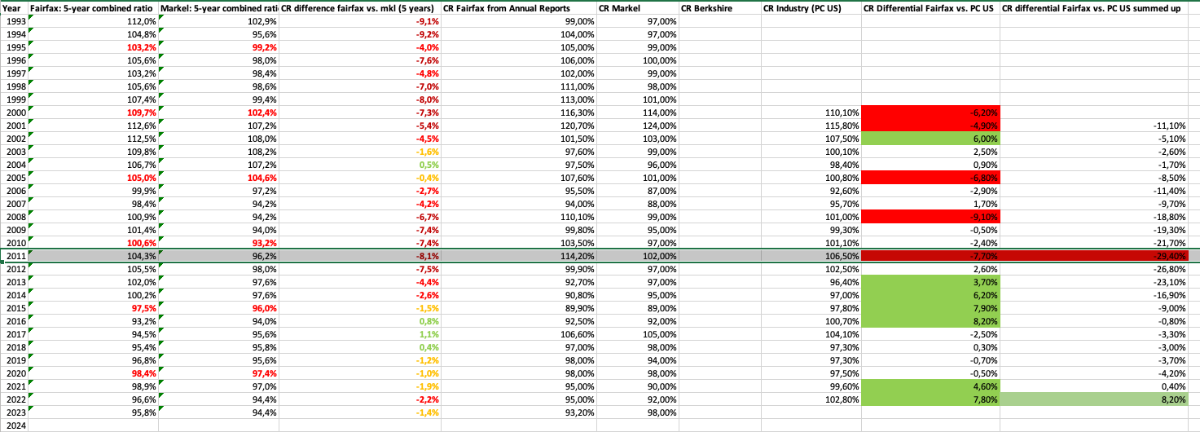
This is really really interesting, thank you again, @Viking! I shared a similar analysis here a few months ago, I think it was overseen (I just posted an xls file probably no-one opened; so this time with a picture). Essentially, I wanted to understand how Fairfax compares to Markel and to the US PC industry as a whole. I basically compared the following things after researching the annual combined ratios: Made the average combined ratios from 5 years (without weighting the premiums). This gives you smoothed figures Then I calculated the difference between FFH and MKL. You can see: Until 2011 - with exceptions - Markel was usually well ahead of Fairfax, mostly between 4 and 9 percentage points. In the following years, Fairfax caught up massively and for the last 10 years has been in a narrow range, with Markel usually only just ahead or even Fairfax in the lead. If you want, you can either see a slight trend in the opposite direction since 2017 (so Markel improving against Fairfax again) or a levelling off in very slightly negative territory from Fairfax view since 2014. In any case, Fairfax combined ratio has been catching up in large steps since 2011 and 2012 against Markel, probably above 5 percentage points on average. In comparison with the PC sector as a whole, I have created a difference on an annual basis. Years in which Fairfax cr was 3% worse (red) or 3% better (green) are marked accordingly. In this way, we can see where particularly large deviations occurred. You can see that 2011 was the last red year, with a total of 5 red and one green year up to 2011. Since 2013 there has been no more red year, but 6 (!) green ones. Of course, this is still episodic, but an initial picture emerges. To gain a better picture of the entire period I added up the yearly differences between Fairfax and the PC sector over the years. So if Fairfax lagged 5% in year 1 and 2% in year b, I summed that up to (7%). The result: you can clearly see that from 2000 to 2011 the crs add up to (30%). Unweighted, this results in an average of (3%). Fairfax was therefore around 3% worse than the average PC company. After that until today (2011 to 2022), (30%) has become 8%. In other words: On average, Fairfax has beaten the PC market by about 3% / year. Comparing the periods before 2011 and after 2011, there is a difference of about 5% to 6% / year by which Fairfax cr has improved to the market. Fairfax has also outperformed Markel by roughly the same difference if you look at the 5-year differences; this means that Markel would have moved roughly in line with the market, while Fairfax would have made up considerable ground on both the market and Markel (and Traveller's, as I learn here and now). Comparing what I found - Fairfax relatively improving by 5 percentage points against a. Markel and b. the American PC industry as a whole, I find it astonishing, that the comparison against Travellers seems to tell nearly exactly the same story: In 2014 Fairfax cr was 5% behind Travellers; and in 2022 they are head to head. As if nothing changed between Travellers, Markel and the market; they all moved parallel into the same direction. Only Fairfax improved by about 5 percentage points against all three.. Please note my figures: In Germany we write "-5%" where in America you would write (5%), if I got it right. The cr figures are manually researched from the annual reports. It may be that errors have occurred there. Premium growth is not included. The mathematically correct way to calculate an average would have been "per dollar of premium over 5 years". Corresponding criticism is also appropriate when adding up against the PC industry etc. This is not perfect science, I check, only roughly ideas and theses. Is Fairfax a (purely American) PC insurer? Definitely not. This comparison is very flawed. I am not an insurance expert and have taken, what I could find easily and found relatively plausible ("Ok, let's do it and see if we could see an uptrend"). You could certainly take it further and compare each insurance line of Fairfax individually with suitable industry indices. That would also be desirable, but I don't have the time and it was enough for me for these purposes. Assuming that profitability trends in industries often occur worldwide, such a comparison can at least help to find general theses on trends - and that's all I was interested in here. In combination with the Markel comparison (and the Travellers comparison), an overall picture emerges, albeit a rough one. I have no idea how to get that fancy graphs, like the traveller one here, out of an excel. Has anybody a hint for me? That would certainly be easier to understand than my table.

-
I don't think, you'll find a lot of people here, who are looking for 18% or 26% returns when investing in Fairfax. As I have already explained here, I don't do that. You describe the challenge very well: it is much easier to achieve extraordinary returns when you are smaller. Together with Markel, Berkshire is my second largest investment. As happy as I am about Apple's performance, even that is only a small part of Berkshire as a whole. Berkshire would be worse off without Apple, but it wouldn't be in a completely different league. However, my general thesis is that the investment decisions at Berkshire, Markel and Fairfax will never be so bad in the long run that they use up the advantage of the float. Whereby the float advantage is greater at Fairfax than at Markel and Berkshire (which also uses other levers, such as tax deferral) due to the greater leverage. In any case, Prem can make even more stupid investments than Gayner and still Fairfax will do better. I think there are insurance companies that have the secret sauce. Geico is one of them, RLI too, Markel was also doing very well for many years; unlike Fairfax. But since 2011, Fairfax's combined ratio has regularly improved massively compared to Markel and the PC market as a whole. So I do believe that Fairfax has found a bit of the special sauce. The interesting thing is that Fairfax achieved the CAGR of 26% at a time when the combined ratios were not particularly good compared to the market. Now the insurance business is structurally better (since Andy Barnard has been there; he started as COO in 2011). So while Fairfax grows and that surely depresses the outlook, the improved insurance gives tailwind. I think you have to differentiate between two things: The structural change that Fairfax has gone through: The Fairfax insurance portfolio is much better today than it was in 2011, but not as good as, say, RLI. Also, the many new smaller insurance companies scattered around the world will improve the learning curve and provide opportunistic opportunities. And on the other hand, we have had and continue to have exceptionally good times in recent years (hard market). But I think that with interest rates above 4%, insurance companies in general will benefit, and the good insurers even a bit more of course. And if interest rates go down again? Then things will be worse. And if they rise to 8%? Then insurance companies will fare much better than the market. And where are interest rates going now? Well, nobody knows. But just because they were so low now doesn't mean they have to go there again. That would be the first time they went back to a point just because they were already there, wouldn't it? In the end, the question is whether or not one interprets the combination of 1. favourable float (which Fairfax did not have in the past, but now has in my opinion), 2. the willingness to invest one's own equity in shares and companies and 3. having a value investor from Graham and Doddsville as CEO is a corporate advantage. If this is a clear advantage, then outperformance against an average company should be possible. If 10% roe is the average, then Berkshire, Markel and Fairfax should outperform. If Fairfax doubles twice times from here, then I am also sceptical as to whether 15% will be achievable in the long term. But until then I think it is absolutely possible. You can already see that Fairfax is focussing more on quality than Berkshire. Fairfax should therefore be able to follow the path outlined in the "Buffett Alpha" study, i.e. investing in large quality companies.
-
I don‘t think, that 1.5 times book value is a high valuation. Of course it‘s not at a roe of 15% (so at 1.5 pb ratio, at a pe ratio of 10 than); but I even don’t find a lot of companies with a roe of 13% at a pe ratio below 11 or 12 these days (than again you come to 1.5 pb ratio). Do you? Okay, at 10% roe, a pe ratio of 15 - that‘s not interesting. But how likely is that? FFH realized a cagr of book value of 18% over 38 years. That 18% is the average after the worst decade in its history; before that bad years kicked in, the cagr was of course higher. That was a cagr of 26% from 1985 to 2009. 26% over a quarter century. Being in the top 1% (0.1%?) over a quarter century - was that luck or skill? If you think (like me), 26% over 24 years (and 18% over 38 years) has to be skill - how likely is it, that a value investor after that totally looses his skills? Those following bad years in my view had at least something to do with the low bond yields; you could say the reason for the bad decade was only one factor (Prem doing bad). Than it would just be a coincidence, that a lot of other insurers did bad (although not that bad) in those years too, like MKL or BRK. But than: What’s your reasoning about those managers, as they at least haven’t outperformed the S&P500 over that decade too: Have Buffett and Gayner lost it too? Anyway its reasonable to assume the roe was around that 18% over that 38 years too, and 26% over the forst 24 years, or? Looking at the change within Fairfax beginning in 2017 and assuming at least another 3 or 4 years being safe to go with 15+ % roe (so that’s 6 years in a row with a roe of 15+%), my question would be: What’s your scenario for a hefty and longlasting downturn at FFHs roe after - looking from the standpoint in 3 or 4 years - 41 years with a cagr of around 18% roe? What makes you think, that the roe would go down to - say - 10% after 41 years with 18% on average? Low bond yields over the next 20 years? If that happens - okay, I go with you. It should get lower a bit, as FFH grows and gets bigger. Okay. But apart from external and from size factors, what should happen? Prem getting irrational? Loosing his skills after 41 years (again, if you’d see the last decade as a result of only one factor - Prem - and you think, that he‘s not anymore able of learning from mistakes - than that makes sense somehow; bit is that likely?!)? How reasonable is that - a value investor, who understood the power of float and having Bernard on his site - loosing all his skills after 4 decades of outperformance? I know, I know: Nothing is for sure. But that’s true for all stocks, so we should dig for reasonable risks, but I don’t see longterm risks other than Prem and Bernard getting hit by a bus, bonds going back to zero for 1 or 2 decades (but nobody knows… could go up to 8% with the same risk), a once in a century insurance risk materializing, galopping hyperinflation or deflation etc.; but most of that risks are just normal risks you have with any investment.
-
Totally agree with your conclusion about what 0-2% interest rates mean for insurance. Just some remarks: - Haven‘t you forgotten premium growth as an important part for how to reach 15% roe? (I don‘t mean acquisitions but internal growth). Another point: The equity returns are not taxed every year; so the overall tax is lower than 26%. And you forget the earnings through a profitable insurance business (cr of e. g. 95) - You claim 4% roe Bonds / 16% roe stocks. Shouldn’t the bond portfolio yield way higher? Treasuries are higher (and logged in for nearly 4 years) and the corporate bonds even yield higher (like 10%). - That logic (which I don‘t share) - needing 16% returns on the inherent stock/business part for getting an overall 15% return for the holding company - seems structurally absurd to me. The whole idea of FFH (and the other insurers investing part of their equity in businesses/stocks) is it to get overall higher returns than the inherent businesses (stocks, wholly owned businesses) returns. So you have two parts (insurance + businesses), both yielding less than the whole. Possible through the magic of float leverage. If one part alone would yield better than the whole - why than not sell the lower yielding one, as that would only be a drag to returns? In other words: If Prem in his own plan would need 16% in the equity part for getting 15% for the holding: Why shouldn‘t he sell the insurance part than and invest the outcome into stocks/wholly owned businesses alone? After doing that he would have a holding with a roe of 16%, before he would have one with a roe of 15%.
-
That's a terrific discussion between both of you, @Viking and @petec, that really resonates to me. I think both of you really hit it. Fairfax was under pressure on several levels during the low-interest phase: - Low interest rates are not good for the insurance business. BRK, MKL and FFH (also Geico) were not only stronger compounders in earlier years because they were smaller; interest rates were also higher. This discussion has been held many times and you can disagree. - Low interest rates = low, eroding moats. I'll take Blackberry as an (absurd?) example. Blackberry was a bad idea (no discussion about it!). But in times of 10% interest rates, competitors would probably have invested less quickly and heavily in tech; Blackberry's moat and brand would have eroded more slowly; maybe it wouldn't have turned out so badly. Eurobank and other investments haven't exactly benefited economically from low interest rates either. - Stock market valuations: = Growth beats value. Strong sales growth led to high stock market valuations in times of low interest rates, regardless of how profits developed. Was that exactly Prem's investment style? Probably not. So were FFH's stock market investments valued rather low on average during the low-interest phase? I think so. And at the same time, this should not be overestimated: Prem made many mistakes. Hedges are one of them (he has sworn off them - I call that improvement) If you look at how Fairfax's CRs have developed compared to Markel or the PC market as a whole, you will see that Fairfax was a below-average profitable insurer until 2011. Since 2011, Fairfax has been catching up relative to Markel and the market; massively so. That is a difference in quality between then and now. India is new. TRS is new and smart etc. I think FFH has gotten a really good bit better in recent years; there's good evidence of that. But they were also never as incredibly bad as they looked; they were just always "speculating" that interest rates would become "normal" (whatever that means; 0% doesn't mean it) and that growth wouldn't outperform value for all eternity. But for me this also means: FFH was always better than it looked for many years after 2009; the visible compounding in these years always suffered from an unusually deep and long headwind; and not only from this, but - yes, of course - also from the mistakes of the management. But that's just it: Not only. Now it is more "normal": interest rates are more normal than they were at 0% to 2% for so long. The hard market is still a tailwind - but in contrast, "growth beats value" is still active, i.e. a headwind. One normal, the other a tailwind, the other a headwind - this is certainly not an extreme scenario but a balanced one altogether. However - and that's what I want to add - I think that many still underestimate or have forgotten how well insurers like FFH (and BRK and MKL) can, indeed have compounded in normal times due to the "decade of headwinds". The combination of cost-free, growing float, a value investor at the top, diversification of corporate assets was a good idea and remains a good idea. But float was almost worthless and value was dead. But now interest rates are becoming normal. And there is the fact that the rest of the market is historically highly valued with a P/E ratio of 27 or so and we have higher interest rates; but insurers are historically rather lowly valued; so the spread is enormous. And Fairfax has gotten better. Yes, it's more about compounding now, but I can't find anything that should be 15+% (my best guess is more like 18%) compounding and buyable at a P/E below 7.
-
Thank you, @Viking, again a great perspective. „I have nothing more to add“, but I have one question. With a roe of 15% for the next two years (and probably some more… and maybe for the very longterm, if Prem finishes his outspoken goal) and using the pb ratios from 1.1 to 1.4 you use in your analysis - what pe ratios would that be? PE Ratios of 7 to 9 (1.1 divided through 0.15…) Are those typical pe ratios people pin on the wall, when analysing other companies with a 15% roe in the last years? PE Ratios of 7, 8, 9? I don‘t think so. Why is that? When looking at Berkshire, it has been valued above a pb ratio of 2.0 since 1985 only in very rare cases; and that time, when that hallend (until mid 1990ies) were times, when BRKs roe was well above 15%. The picture would be similar for Markel I think and for Fairfax (there were higher valuations at some points; but since over 2 decades valuations above 2.0 were really rare). How can this be? The average S&P500 company has been valued at pe ratios of around 15 to 30 most of the time since the 1990ies (https://www.multpl.com/s-p-500-pe-ratio). And the strong insurance growers, outgrowing over 90% (99%?) of stocks since the 1980ies with roes between 15% and 19% since the mid 1980ies (or longer) have nearly never been valued as the average S&P500 company. How can that be? Why is that? A PB Ratio of 1.3 feels normal for an insurance company. But it shouldn‘t. Are we all biased due to a „pb ratio anchor effect“. So something like „PB Ratios between 1.0 and 1.5 is normal for an insurance company“ Even though that‘s like saying „insurance companies should be valued at a pe ratio of 8; that’s less than a third of the average S&P500 company, which is valued at a PE Ratio of 27 these days. Insurance companies are not worth more, even though insurers have higher roes. Somehow this doesn‘t make any sense to me, but that’s how insurers are seen over decades. I can live with that, as I jever feel any pressure selling an insurance stock for its rich valuation and it helps the company to buy back stocks on the cheap site. Still it doesn‘t feel consistent that insurers often don’t get compared to other investements on an apples to apples basis.
-
Regarding TRS you are actually calculating share price being nearly flat (or up 25 dollars, so 2.5%) until end of 2024 for the next 3 quarters and two weeks, or do I misunderstand how the TRS works? Of course the share price could be higher or lower within such a short timeframe, but of course you have to assume something. But what’s the rational behind $250 for 2024? Wouldn‘t it be rational to e. g. assume a share price end of 2027 (whatever that would be) and than draw a straight (or compounding) line to that point? Than it would maybe be rational to readjust that line each time you recalculate your forecast? Otherwise you maybe would come to the point, where you would have to assume a negative return to the end of the year, if you assume a fixed return per calendar year and the share price gets above that?! I am just asking Why are net gains in investments lower in 2025 than in 2024? Intuitively I‘d think one would assume Fairfax to get 7% again but on 107% of 2024 equity, so it should be higher. Same with the TRS: If shareprice goes up algorithmic, than it should be higher 2025 than 2024; or is this a function of the good start of Fairfax share price in 2024, so you adjusted 2024, but not 2025? In general I totally understand, that you have to be conservative with your assumptions the longer you look into the future (that’s what all good investors do - margin of safety) at the same time looking at the numbers I ask myself: If Fairfax just manages a roe around 15% in 2024 and 2025 like in your foecast (so for times with a hard market, good hand with equity investments and bonds, very good crs…) and Prem at the same time gives out the goal of a roe of 15% on average (he said stock return or book value compounding should be 15%; but roughly that’s the same as having a roe of 15% as a goal. Or am I wrong?), than the question occurs: Is that goal doable if he just manages 15% as a roe in such good times, where not only management performs near perfection, but the circumstances (hard market etc.) give an extra tailwind? If Prem doesn’t manage 18%, or 20% or more on average in such good times, he won‘t make 15% over time. My best guess is, that this difference to 18% or 20% or even more is just a function of you being conservative with your estimates (which is very fine!). What do you think?
-
One could see, what you meant; and I agree, that compounding within that 4 years is a factor, that Prem hasn‘t adressed in his letter, but we should be always be aware of. The $125 per share in 2024 will give extra returns in 2025. And the result of that will give extra returns the year after and so on. This is not linear.
-
You have done a terrific job in the last years and here again laying out management decisions of Fairfax were really bad from 2010 to 2016. I totally (!) agree with that. And I am exactly referring to that in my post, while I have to admit, not having named those again. But the reason why I haven’t is simply, that those bad management decisions have been dicussed here so many times and most people gere (including me) seem to share this critic. So why repeat once again? And there is a lot of use in looking first and foremost at the business itself and on management; in fact this is, what we can understand and make analysis and decide, if we want to invest or not. At the same time there are external factors that - at least in my view - can‘t be predicted, regardless how deep our analysis goes. Nobody knows were interest goes to in the next few years - and yet it has a big influence on businesses and on markets and valuations. It’s hard to predict, where interest rates are heading to. The reason is simple: It makes a big difference, if 9/11 happens or an oil shock, a world war occurs (or just a local war), if a bubble bursts or if a financial crisis occurs. There may be some people that can predict some of those things a few years before they happen, but I clearly can’t and I think I am not alone with that view on my competences. That’s why I see no use in trying to predict interest rates etc. And that’s the reason why I don’t build my investment decisions on such external things. A good stock with a moat, a high roe over the longterm etc. will perform good over time, regardless the swings of interest rates etc. Still there is some use in looking back, especially when people try to interpolate the business and stock results of a decade into the future. People bought the Nifty Fifty in 1972 at pe ratios of 50 and more, thinking that the decade before had shown, that those were good investments. But those strong growers of the 1960ies weren’t performing perfectly good, when the oil price shock came, interest rates exploded in the next decade etc. So all I wanted to say is this: The 2010s clearly weren‘t the decade of the insurance sector (especially for the ones investing in non-growth-stocks like BRK, MKL or Fairfax) in terms of a. business performance and b. of stock returns. Anybody trying to interpolate the returns of the next ten years on the basis of the last ten years in my eyes misses an important point: The years after the financial crisis were the opposite of supportive for the insurance sector as a whole. You won’t find another decade were the three were performing that poor in comparision to the market since the 1980ies; both in business and in stock performance. And yes, all three named were much smaller in the 1990ies and that too helped the three outperforming the market (with the exception of the internet bubble times; Buffett was critized than; but that wasn‘t a whole decade). But there’s another layer and that’s a cocktail of low interest rates (making float nearly worthless), a long soft market, (tech) growth beating value. Fairfax was the worst performer of the three due to bad management decisions; but a second part of the story is, that neither Berkshire nor Markel left the S&P500 in the dust like in the decades before 2007. And the same headwind Berkshire and Markel faced, Fairfax had to face too. And for all three the headwind of after 2007 has changed direction and has changed into a tailwind now. Not only has Fairfax done the right things; on top of that the soft market has changed to a hard market and I wouldn‘t describe Prem being a tech growth investor historically (look at his annual reports of the last years, where he laid out his view on tech stocks and their valuations), so this clearly was a headwind too. And yes, the growth stocks again dominate the media, but e. g. Eurobank is performing good now too and not in the years before with lower interest rates.
-
Agreed, @dartmonkey and @Dinar. Just to be clear: the nine times earnings is without the gains on the stock portfolio, without TRS and without (maybe) gains on selling of wholly owned businesses like the pet insurance businesses or IPOs. Assuming normalized earnings of 200 dollar per share (125 dollar in OE isn’t a normalized, but a minimum number) or a little bit less in year 1 gets us to a pe ratio a little bit below 6 and an roe of 21%. If stock markets tank in year 1 it will be way less of course. If Watsa doesn’t reach roe way above 15% in times like these (hard market, value beating growth), than he won’t reach an average of 15% (that 15% isn’t tied to OE, @dartmonkey, so 15% of 29bn or 6bn would be including stock gains etc… That’s your point, isn’t it?!) over the longterm. Regarding that goal of compounding at 15%, I again and again read, that Prem hasn‘t reached it and Buffett hasn‘t reached his (former) goal and that these two and Markel won‘t reach returns like in the years up to 2007/2009 again, as they are e. g. too big. I think what those people miss is, that the years following 2007/2009 until 2019/2021 were really special and giving strong headwinds to all insurers (that’s why the valuations of those three came really down compared to pre the financial crisis). Soft markets, bad returns for value versus growth, low interest rates were a toxic cocktail for those three (and others). It was a very long soft market, growth has never underperformed value by such a margin and for such a long time (am I wrong?) and interest hasn‘t been lower (especially for such a long time). And yes, in case of Fairfax Prem wasn‘t really executing well; but that’s only part of the story. BRK and MKL weren’t either shooting the lights out and even if Prem would have done a perfect job between 2010 and 2016 (which he clearly hasn’t), the returns in those years would have been subpar in relation to historical returns too. And that’s not a coincidence, that all three performed with low CAGRs in those years, it’s structural. It’s the other side of the startup boom, it’s the other side of house prices and oldtimer prices booming, the other side of the tech boom, the other side of businesses not earning a dime getting as much cash as they wanted. What’s the point of float, if you get cash everywhere and as much as you want? What’s the point of float, if you have to pay the bank for holding your cash instead of getting a return? Historical float was a driver of roe at all three businesses, but that special sause literally disappeared in the lost decade. But now hopefully it again all makes sense. Without that decade Fairfax wouldn’t been valued so low. I really feel lucky having found an above average business, reinvesting at 15% (or more) at a pe ratio below 6, while the market is valued 5 times higher.