Leaderboard


Popular Content
Showing content with the highest reputation on 10/12/2025 in all areas
-
I totally agree. If extreme things do happen (like a 1% to 3% rate on average over 20 years), CAGR of ROE (of intrinsic value) should be less than within a (in my eyes more lilely scenario of) an average yield of 4%, 5%. Okay, maybe 3% is not extreme, but 2% on average over 20 years would mean e.g. around 1% for nearly 7 years, 2% for 7 years and 3% for 7 years to get. And if interest rates would be above 3% for some time in those 20 years (we‘re at 4% today), then the rest would have to be even lower; in my eyes that’s really extreme (and you might feel it being normal and that’s just fine, we don’t have to agree on this one!) Interest rates will always act like a gravitational pull on returns. Similarly, there will be other outcomes if the global and US stock markets diverge significantly and deliver negative results, for example. Or if growth outperforms value over 20 years in a meaningful way. The whole idea is based on "between 15% and 20% / 16% and 18%" – i.e. on average – in reasonably normal times. If interest rates rise to an average of 7% over 20 years, then a result of "only" 15% would certainly be disappointing. Or if the stock market rises by 12% per year and value beats growth by a further 5% per year (and interest rates are relatively normal). The point is: I dare not predict whether the future will be more like the 1970s and 1980s (especially inflation and interest) or 1929 (and what came after) or the great booms. Over 20 years, however, I expect the average to be reasonably normal. That's why I'm looking at 20 years; 10 years can quickly end up being completely different. If someone knows what the next 20 years will actually look like, then it is certainly possible to find better investments than Fairfax, especially when it comes to extreme outcomes. But if you were in my shoes, it would be speculation to base investments on a scenario in which interest rates stabilise at 1%, 2%, (8%, 9%).1 point
-
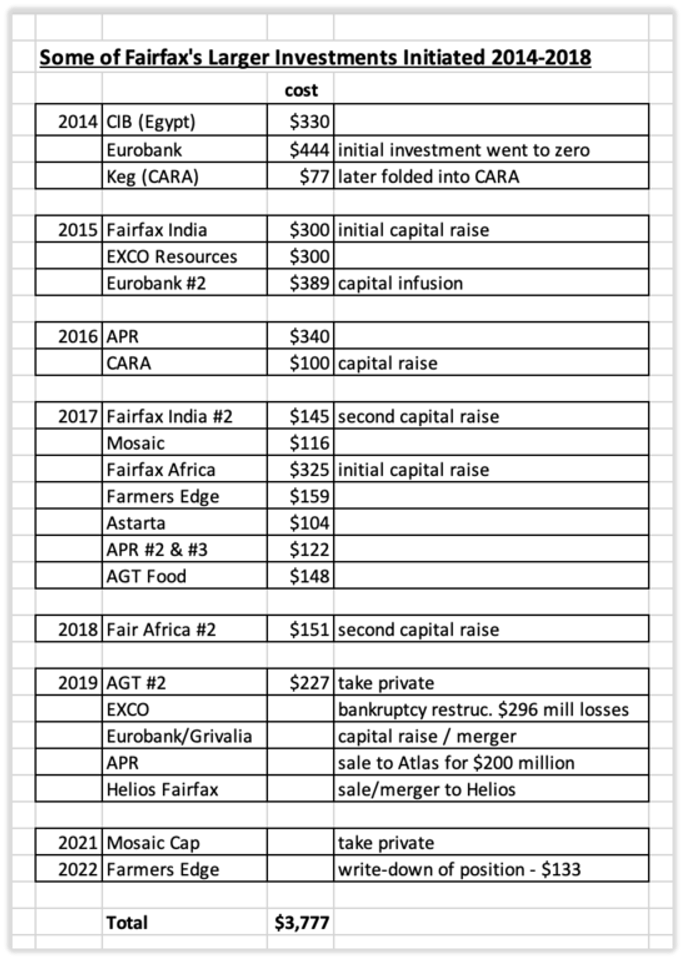
@petec, I love it when others disagree with me. I have moved more in your general direction. But I continue to think that Fairfax is a very different company today than it was in 2018. All three parts of the business/organization are making better decisions and as a result the performance of the company is much better: Senior management P/C insurance Investment management On the investment management front, here is a post that I wrote a while back reviewing many of their large investments from 2014-2017. Boat Rocker could be added to this list. (I didn't discuss large legacy investments like Blackberry and Resolute Forest Products). This list is how Fairfax was thinking and executing on the capital allocation front from 2014 to 2017. It is a shit show. Many of these companies had terrible management. Many had terrible balance sheets (they needed bailouts from Fairfax to keep the lights on). Other large shitty investments like Blackberry and Resolute Forest Products I did not include on my list because they were legacy investments. Now look at Fairfax's collection of equity holdings today. Most of these companies have good/great management. And they have strong balance sheets (the exceptions in recent years were Farmers Edge and Boat Rocker... investments from the 2014 to 2017 vintage). Fairfax has spent the past 7 years fixing all of the problem children. And the new investments made since 2018 have been good to outstanding. Their hit rate from 2014 to 2017 was terrible (Fairfax India being a notable exception). And Eurobank has transformed into a wonderful investment. Their hit rate on investments made from 2018 to today has been stellar. My view is something changed at around late 2017/early 2018 at Fairfax. They recognized they were not staffed to be a turn around shop. They changed their investment framework. They put a premium on: Management quality Fiscal responsibility (Fairfax would no longer be a piggy bank for bad businesses). It has taken Fairfax 7 years of hard work to clean up all of the messes (the Boat Rocker clean-up just happened). My view is there has also been changes in the P/C insurance business. Not as much as what has happened in investment management. A big part of run-off was sold (the good part). Fairfax has reduced its exposure to catastrophes. Reading the book Once and Future C&F I was struck by how long it takes to change an insurance business (more than 5 years). My thesis is Fairfax's insurance business is better today than it was in 2017... I just don't know how to explain it (yet). (And I don't know how much better...) This is really important because - if I am right - we have not seen this version of Fairfax before. =========== A Review of 2014 to 2017: Old Fairfax – too many ‘chronically-leaking boats’ April 14, 2023 “My conclusion from my own experiences and from much observation of other businesses is that a good managerial record (measured by economic returns) is far more a function of what business boat you get into than it is of how effectively you row (though intelligence and effort help considerably, of course, in any business, good or bad). Some years ago I wrote: “When a management with a reputation for brilliance tackles a business with a reputation for poor fundamental economics, it is the reputation of the business that remains intact.” Nothing has since changed my point of view on that matter. Should you find yourself in a chronically-leaking boat, energy devoted to changing vessels is likely to be more productive than energy devoted to patching leaks.” Warren Buffett – Berkshire Hathaway 1985AR Fairfax’s equity portfolio looks very well positioned today. Most of the equity holdings purchased since 2018 have been performing well. And, after years of hard work, the poor performing equity holdings (many purchased from 2014-2017) have largely been fixed and are now performing well. In fact, the equity portfolio looks better positioned today than at any other time in Fairfax’s recent history. We are increasingly seeing the benefits in improved reported results. A good recent example is ‘share of profit of associates,’ which spiked to more than $1 billion in 2022; the previous high was $402 million in 2021. What happened? Three things: 1.) Fairfax learned a few important lessons from the poor purchases they made from 2014-2017. It looks me like Fairfax has tweaked the methodologies used when allocating capital. · They are putting a premium on management. Hamblin Watsa has decided it is not a turn-around shop - looking to actively run poorly lead/challenged businesses. · They are also looking to invest in better balance sheets. Fairfax is no longer a piggy bank for poorly run companies in search of cash. Others on this board have pointed this out. 2.) The Fed and the ending of easy money (zero interest rates/QE) is likely a driver of the stronger performance the past two years of Fairfax’s equity holdings. Value investing is back. 3.) The timing of the cycle is finally working in Fairfax’s favour and is driving stronger performance of the equity holdings. Value, resource, and commodity stocks appear to be in a secular bull market. At the end of the day, all the above is likely partly responsible for the improvement we have seen in Fairfax's equity holdings in recent years. ————— It can be instructive to look into the past so we can learn. This helps us understand what has been baked into past results. In turn, this can help us understand what might happen in the future. What happened with the purchases from 2014-2017? A total of 10 investments are reviewed below. Fairfax invested a total of about $3.5 billion in these investments over the years. Over the past 8 years my math says Fairfax booked losses of about $1.5 billion on these holdings. That is almost $200 million, on average, each year. For example, in 2022, Fairfax wrote down its investment in Farmers Edge by $133 million. Stuff like that. The bigger cost to shareholders has been the opportunity cost. Prem tells us that Fairfax expects its equity investments to deliver returns of 15% per year. Applying a more modest 10% target, the $3.5 billion in investments (made 2014-2017) should have doubled in value by now to $7 billion. The opportunity cost of the poor investments made from 2014-2017 is likely an additional $2 billion. This is actually a good news post. The good news is: 1. The equity purchases made from 2018 to April 2023, as a group, look very good and are performing well. 2. As I will review below, the problem investments from 2014-2017 look like they are not only fixed - they are also poised to deliver solid returns for Fairfax shareholders moving forward. An 8 year-long headwind has now become a tailwind. As a result, I expect Fairfax’s $16 billion equity portfolio to generate a higher total return (percent and absolute) in the coming years than it has delivered over the last decade. Given its current construction, it could well compound at 12% over the next couple of years = $1.9 billion/year: dividends = $120 million share of profit of associates = $900 million consolidated earnings = $240 million mark-to-market investment gains = $650 million (not including fixed income) —————- Below is a short review of 10 large investments made over the 4 years from 2014-2017. 1.) EXCO Resources (2015): Fairfax’s initial investment was $300 million in 2015. We have since learned that shale was a bubble and it eviscerated something like $5 billion in capital up until 2020. Fairfax reported cumulative realized losses of $296 million on EXCO in 2019 (as per the AR). Learning: the old economic model for shale was a sham. The good news: energy looks like it is in a structural bull market; the new economic model for shale looks good - focussed on shareholder return. 2.) APR (2016): Fairfax invested a total of $462 million in APR in 2016 and 2017. In 2018 they sold it to Atlas for $200 million (in Atlas stock). The first thing Atlas did was replace the CEO. Learning: Terrible business. Poorly managed. The good news: APR is now Atlas’ problem. 3.) Fairfax Africa (2017): launched with much fanfare in 2017, Fairfax invested a total $476 million. Two short years later Fairfax exited its management of the business and moved the assets to a fund managed by Helios. The value of the Helios fund today is about $100 million. I am not sure what the total financial loss was for Fairfax on this investment, but it was significant. The damage to Fairfax’s reputation was also significant. Learning: Hubris on steroids? Terrible idea. Worse execution. The good news: Fairfax is partnered with Helios and looks well positioned moving forward in Africa. This is now a small investment for Fairfax. 4.) Farmers Edge (2017): Fairfax invested $159 million in Farmers Edge in 2017. Farmers Edge completed its IPO in 2021 and in the 2021 AR Fairfax said their total investment in Farmers Edge to that point was $376 million. The CEO ‘stepped down’ in April of 2022. In the 2022 AR, Fairfax said Farmer’s Edge had a carrying value of $71 million, after taking a $133 million write down in 2022. The market value of Fairfax stake was $5 million at Dec 31, 2022. My guess is this investment, because it performed so terribly post-IPO, has caused Fairfax some damage to its reputation (given Fairfax was the majority shareholder). Learning: Yup, SPAC’s were a bubble. The good news: carrying value is $71 million. This is now a small investment for Fairfax. 5.) Eurobank (2014): Fairfax invested $444 million in Eurobank in 2014. This initial investment went to close to zero later that year when the ECB mandated a 1-for-100 reverse share split. What was the problem? Greece was in the midst of a depression. What did Fairfax do? It doubled down and invested another $389 million in Eurobank in 2015. In 2019, Eurobank did a capital raise/merger with Grivalia. Greece elected a pro-business government in 2018. Eurobank fixed its balance sheet. Learning: Because the strategy worked in Ireland doesn’t mean it would work in Greece. The good news: Greece’s economy is well positioned. Eurobank, always well managed, is executing well and earnings are spiking. Share of profit of associates was $263 million in 2022, up from $162 million in 2021. Prem estimated Eurobank could earn €0.20/share in 2023; if so, Fairfax’s share of profits for Eurobank could be +$300 million in 2023. This investment is turning into a home run for Fairfax - a Greek tragedy turns to a triumph! 6.) AGT (2017): Fairfax invested $148 million in AGT in 2017. In 2019, as AGT was experiencing financial difficulties, Fairfax took AGT private, spending another $227 million (I think). Learning: It takes much more than a dynamic Canadian founder to succeed. The good news: from 2022 Fairfax AR: “AGT, run by founder and CEO Murad Al-Katib, had a record year in 2022, with EBITDA of over Cdn$150 million. This is a dramatic improvement from the time of the take-private transaction almost four years ago when the business was generating slightly over Cdn$60 million in EBITDA… Fairfax has an approximate 60% stake in AGT.” 7.) Commercial Industrial Bank (CIB) Egypt (2014): Fairfax invested $330 million in CIB in 2014. Today the position is worth about $240 million. Great company. Solid management. What is the problem? Egypt’s economy has been a slow-moving train wreck for decades - with constant currency devaluations. Learning: Constant currency devaluations (like 50% in the last year) hurt equity values. The good news: the bank is well managed. 8.) Mosaic Capital (2017): Fairfax invested $116 million in Mosaic in 2017. In 2021, Mosaic was taken private (not by Fairfax) with Fairfax owning 20% of the new investment. This investment went sideways for many years (that opportunity cost thing). Learning: not every investment you make is going to work out. The good news: Fairfax found a partner where Mosaic will hopefully be a better fit. 9.) Recipe/CARA (2014 & 2016): Fairfax made a couple of restaurant investments from 2014-2017: $77 million in the Keg in 2014 (merged with CARA in 2018) and $100 million in the CARA capital raise in $2016. Recipe/CARA was a poor investment for minority shareholders over its lifetime. Learning: the restaurant business in Canada is a tough business. Consolidating it proved to be even tougher. The good news: In the take private deal in 2022, Fairfax purchased Recipe at a Covid-low price. Recipe has a solid collection of assets that should be able to produce a solid amount of free cash flow for Fairfax moving forward. 10.) Astarta (2017): Fairfax invested $104 million in Astarta in 2017. Today that investment is worth around $45 million. I know very little about this investment. I wonder if it is not a similar situation to CIB, with opportunity cost being the big issue. Honorable mention: Torstar was initiated as a position before 2014 so I did not include it. However, Fairfax added to its position in 2014, 2016 and 2017 (yes, small amounts). In 2020 it sold the business and booked a $52 million loss. I see lots of self-inflicted wounds in the investments listed above – reading the list reminds me of the Monty Python skit “tis but a scratch".
 1 point