
DooDiligence
-
Posts
5,732 -
Joined
-
Days Won
7
Content Type
Profiles
Forums
Events
Everything posted by DooDiligence
-
The Truth About Inflation: Why Milton Friedman Was Wrong, Again "Milton Friedman has been dead for more than a decade, but his ghost still haunts us. In the 1960s, Friedman declared that inflation is ‘always and everywhere a monetary phenomenon’ — a problem of printing too much money. Since then, whenever inflation rears its head, you can count on someone to reanimate Friedman’s ghost and blame the government for spending too much." "The idea that averages should be reported together with a measure of variation is a basic part of empirical science. And yet when economists study inflation, this practice is conspicuously absent." "The real story of inflation — the one that goes largely unreported — is of wildly divergent price change among different groups of commodities." "For some reason, economists didn’t listen to the memo given to all other scientists — the one that said ‘thou shalt report an average alongside a measure of variation’." "Like most good ideologies, this argument contains a devious trick. What monetarists won’t tell you is that the money supply gives meaningful insight into inflation only if price change is uniform." "Having seen that price change varies greatly between commodities, you might wonder why this matters. Well, it matters because it means that inflation is not purely a ‘monetary’ phenomenon. Inflation redistributes income." "Nitzan and Bichler have discovered, for instance, that inflation systematically benefits big business." "So it seems that in the real world, inflation looks nothing like it does in economics textbooks. Yes, inflation is a ‘monetary phenomenon’ — as is anything to do with prices. But more importantly, inflation is a power struggle over who can raise prices the fastest." https://evonomics.com/the-truth-about-inflation-why-milton-friedman-was-wrong-again/ I'm not sure whether such a complex phenomena can be treated so easily without a rearview mirror and a well constructed narrative.
-

Movies and TV shows (general recommendation thread)
DooDiligence replied to Liberty's topic in General Discussion
Oh, I thought you were talking about The Forgotten Battle. -
Movies and TV shows (general recommendation thread)
DooDiligence replied to Liberty's topic in General Discussion
Is this book written in an academic style or is it more of a dramatized version like Band of Brothers? I couldn’t tell from the reviews. -
That's friggin brilliant! I was totally unaware of the backdoor II V. You've hit on the very genre that has captured all of my recent attention, jazzy soul / R & B. It suits my abilities. I'm not a fancy right hand soloist but do have respectable ability to run right hand chord progressions in a variety of voicing's, and I've been developing my left hand for bass lines (I'm left handed so, duh). Here's a cover I learned tonight. It's a pretty simple progression in C# minor and goes C#⁻7 (RH plays it in 2nd inversion) then a simple chromatic walk down to root position G°7 > F#⁻7 > F#⁻7/B and back to C#⁻7 (left hand plays all the roots). I've got to find a woman who can sing this at an open mic. I'm going to watch that Stevie Wonder tutorial again in the morning. I should probably stop highjacking this thread and start one in the personal category.
-
Thank you for your condolences. I spent a lot of years doing everything I could for, and with, my Mom and was fortunate to have been able to hold her hand until the end. Regarding the production of tension in harmony. Tension is produced by moving away from tonic (the point of rest). Whether a chord is minor or major is not so relevant as its position within the harmony. Is it leading away or towards tonic? Functional harmony in a major key runs from iii vi ii V I, where the IV can sub in for the vi (2 common pitches), and the vii° can sub in for the V since the vii° also performs a dominant function (both present instability and consistent voice leading which sends you back to the tonic). Functional harmony provides a smooth progression which leads the ear away from tonic (where tension gets created), and then heads back to tonic resolution (the point of rest). This is a simplistic view which doesn't take into account tonal shifts created by secondary dominants, and altered and borrowed chords. In jazz, you find ii V I's rather than the IV V I progression that dominates pop music. You'll also hear a lot of extensions and alternate voicing's which give jazz its distinctive color. I'm currently working on a loop song which uses a basic minor jazz harmonic progression (i9 ii11 V⁺b9), with some added tension on the dominant. The right hand plays rootless voicing's and the left plays the roots with some non-harmonic tones thrown in. The altered (augmented dominant with a flat 9), adds additional tension that really hammers home what key you're in and points the ear to a tonic resolution. (see and hear the attachments, if you dare) The EP part is my Yamaha P121 Rhodes voice. The beats come from an arpeggiated Yamaha MOXF6 drum kit. The guitar is an arpeggiated MOXF6 voice, and the bass is played on both the P121 & the MOXF6. It's designed to be a loop performance with the parts being brought in separately. The piano parts will; NEVeR be arpeggiated! Disclaimer: I'm terrible at mixing & mastering tracks so turn your volume down a few notches for the full recording. Also the transcription of the 1st 2 systems is poor. I can't seem to dictate the rhythms as I'm playing them. The 3rd system is not on the recording but the transcription nails the syncopation perfectly. I also spell the V⁺b9 using an F instead of a correctly spelled E# because who the F wants to read an E#? Back to the economic discussion. I realize that I will likely never understand Fed / Treasury operations or their effects, and will just stick to my low level gazes at individual businesses and make up stories regarding their futures. edit: I just realized that the end of that recording didn't resolve to tonic. It does when the looper starts the phrase again, which is the nature of loop performance. Kind of leaves you hanging and illustrates the tension of not resolving to tonic though. Funky Bumps.mp3 E Piano only.aif Funky Bumps.pdf
-
I've always struggled with understanding TGA, RRP operations and the effect on liquidity and markets. Thank you to a few posters here who've chipped away at my ignorance. This substack made the game of musical chairs a little bit more clear to me; but the question still remains, who get's the chair that's too soft / hard and will there be one that's just right? https://thelastbearstanding.substack.com/p/draining-the-repo?r=6gq23&utm_medium=ios&utm_campaign=post edit: I'm already firmly planted in my chair with the knowledge that I may have to sit on the floor for a while if it collapsed. I think my carpet is thick enough to endure the indignity.
-
Sold the remainder of T and put a bit of it in EW.
-
2022 Like a Splash of Cold Water For...
DooDiligence replied to Parsad's topic in General Discussion
I’ve been considering that. Portugal is also an option. -
Sold about 1/3 of ATT on todays bounce. It's been dead money for a long time and I don't see that changing. They unloaded a lot of debt and now they're going to re-lever in a game of catchup. www.fiercetelecom.com/operators/at-t-s-elbaz-says-fiber-deployment-costs-are-getting-better www.reuters.com/technology/att-talks-with-investors-expand-fiber-optics-network-report-2022-10-19/ I'll probably put the funds from this sale into BRK, which is what I tried to talk my Mom into doing a long time ago.
-
Which activities in life brings you the most fun?
DooDiligence replied to Charlie's topic in General Discussion
Music, specifically keyboards. Progress is glacially slow but I've been taking lessons from a jazzy / funky keyboardist and love this kind of music. I have 5 songs that I've written which are designed to be performed solo, using a looper pedal. I'm inching closer to doing some open mics. The biggest impediment is that I use 3 different boards on 2 stands and porting all my gear is a chore. It's a mental impediment, of which I have a few. I've been going to open mics to view setups and meet other musicians and have met quite a few talented and like minded individuals. I hope to wow a few of them and start playing together. I envision a Becker Fagen type of arrangement where we write material with certain additional ad hoc musicians in mind. I've also been experimenting with video, specifically, stop motion video and intend on producing short clips to go along with recordings. I get through with my AA next Summer. We're nearing the end of this semester (Descriptive Astronomy is taking more time than I expected) & (Spanish requires damn near zero study). Next semester I'm signed up for Contemporary Literature and Spanish II. After that, I'll be able to devote a lot a lot more time to pulling together musical projects. Playing music puts me in the flow. -
I miss Paul Kangas and Louis Rukeyser.
-
This is a worthwhile read, especially when attempting to plumb the depths of current market sentiment. I love the way this guy writes and the way he invests. "We didn’t own the FANG’s last year and as such, didn’t reap their 75% gain. We’re ok with that. Did the underlying value of those businesses compound by the same 75% rate? We don’t think so. We have never had a problem watching others get richer faster over short periods of time. For some that’s hard to do. If you owned the S&P 500 last year, those four FANG’s added 4% to the portion of your net worth in the S&P. Investors in the S&P 500 should know that for every $100 invested in the index, $7 are now a bet on the FANG’s. Berkshire gets less than $2. Facebook alone gets more than Berkshire. Would we be better off with a company like Facebook than with Berkshire Hathaway?" (page 11) --- I remember reading through a compendium of Berkshire Letters to Shareholders and it seems like WEB has always underpromised and over delivered. (page 19) --- I know a lot of members here already understand this valuation method so I won't bore you with anything but the summary / preface to his exercise. "Berkshire leaves the investor to determine fair value using the two data points they supply in most years. Our valuation hinges on Berkshire earning an underwriting profit averaging 5% going forward, on Berkshire paying taxes at a cash rate far below the nominal corporate rate for many years, and on the consolidated business commanding a premium valuation due to utilization of little debt, ownership of high-quality assets, extraordinarily low cost of capital, and conservative accounting, among other intangibles." "While simply capitalizing a pre-tax earnings number and adding that value to the value of a portfolio of securities is easy and a great way to come up with a shorthand value for Berkshire, it isn’t sufficiently thorough. Our preferred way to value Berkshire, and the only way to really understand the nuances of the business, is to use a sum of the parts approach." (page 22) --- I just started reading this morning and will continue when I get back from classes. Even though I finally understand the all the reasons for Berkshires enormous advantage in terms of low cost financing, especially in times of high interest rates. I still have a nagging doubt that at some point it will become too unwieldy (and yes, I'm also imagining some kind of unlocked value). WEB has used a forest analogy to describe the business segments, "He divides Berkshire’s holdings into five "groves": its non-insurance businesses that it controls; its collection of marketable equities; its controlling interest with other parties in several businesses; its cash and fixed-income instruments; and its insurance business." https://www.morningstar.com/articles/915303/buffett-says-focus-on-the-forest-forget-the-trees --- Is there a a point at which the forest needs to be managed to avoid a huge fire, and could it include a pruning that throws shareholders a bone (aren't mixed metaphors fun)? I'll keep reading when I get back home and will likely have more idiotic ideas to annoy members with.

-
www.statesman.com/story/news/politics/politifact/2022/09/06/fact-check-ppp-loans-forgiven-republicans-matt-gaetz-marjorie-taylor-greene/65470173007/
-
I like this one for the long haul when paired up with my Disney holding. In my imagination, if Disney has to pony up for the rest of the Hulu stake, I still win.
-
Thoughts and prayers, right?
-
More SMH because damn, semi designers, fabs and semicaps look cheap, and more importantly, necessary. There will be lumpiness. FWIW, I'm all in now and have set aside a generous pile of untouchable / un-investable cash to cover expenses until early to mid-2025. Those who've been hoarding investable funds can now fully expect to be accommodated with a huge overall market drop.
-
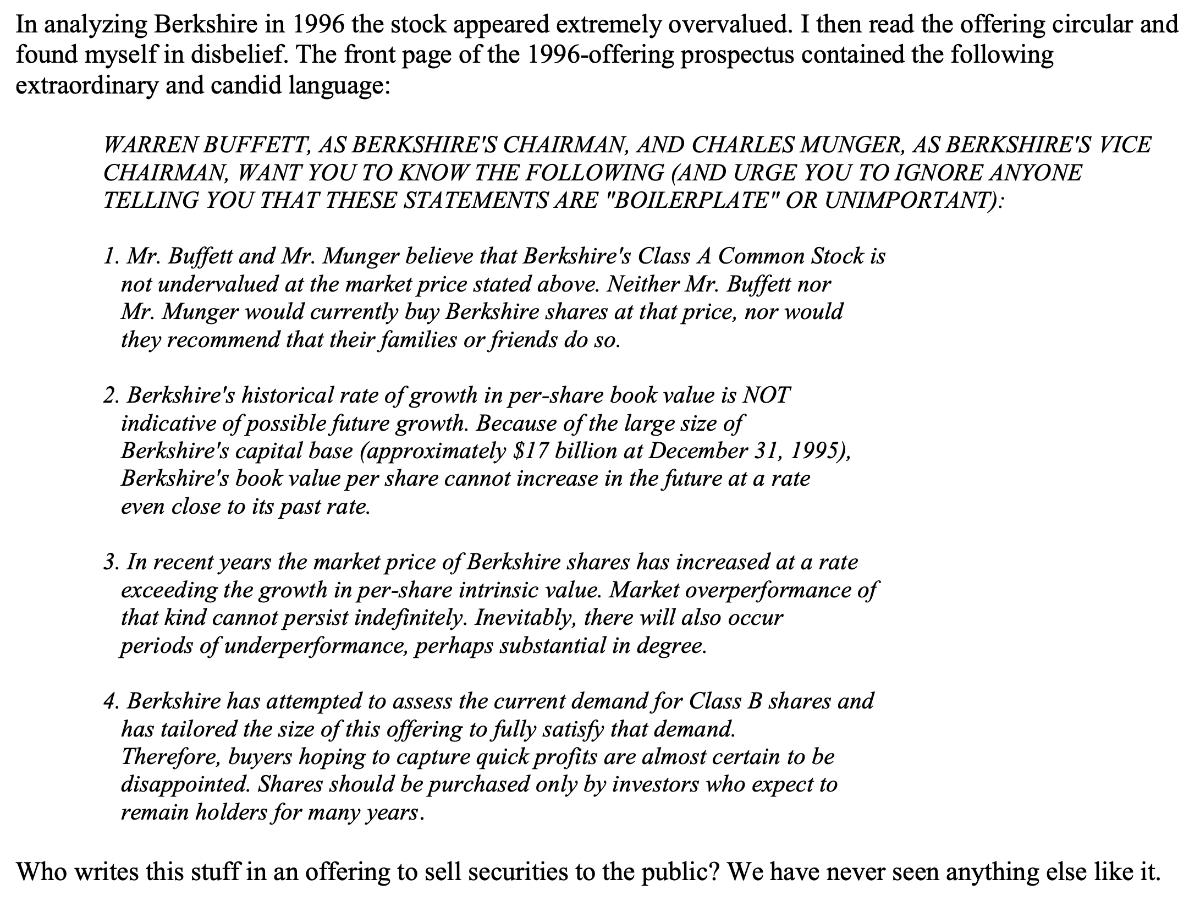
Would this make a decent summation of the reasoning behind artificially low BV, and the case for not breaking BRK up? A big factor in Berkshires low BV appears to be due to its commitment to offer permanent homes to businesses. Many subs have been owned for a very long time (Sees, Clayton, GEICO, etc.), and are heavily depreciated on the books. IOW, they’re worth a lot more than the value they’re held at (grammar police please). https://en.wikipedia.org/wiki/List_of_assets_owned_by_Berkshire_Hathaway - (a good quick reference list with purchase dates.) Allowing insurance subs to hold equities (part of the zero cost "float" which they get to invest, while knowing they'll have to pay a large portion out in claims at some point). WEB knows that this "money" does not belong to BRK, but to future insurance claims against GEICO, General RE, National Indemnity. Some of these equities have been held for a very long time. I haven’t tried to figure out how recent mark to market rules affect the balance sheet but I’m guessing it causes them to reflect current value on the books. I know there are revolving tax consequences and this rule seems like a great way to muddy the waters to no good purpose. Aside from the book value discussion, a big advantage of the holdco structure is that they get to redeploy cash from subs which have little or no reinvestment opportunities, to those which warrant it and can reinvest at higher ROI's. As assets grow, and they will, the overall intrinsic value will also grow. Breaking Berkshire up would spin out subs at much higher multiples but would also trigger a tax burden that would partially offset the gains. I have my doubts about how significant the offset would be, but I don't question the disadvantage that some businesses would be put due to being cut off from zero cost financing with Berkshires ability to move cash around where it's needed. There’s a significant bit of magic in this. Critics be damned. I started looking at Berkshire back in 2010, when the price was around $70/sh., and look where it is now a mere 12 years later. Not a bad deal!
-
More BRK.B, DPZ and GOOGL
-
I forgot what happens when you offer a permanent home for businesses. I'll just enjoy my slice of Omaha.
-
In a semi-traditional sense, BV should reflect what's left over in an orderly liquidation. Berkshire is obviously an ongoing concern. The replacement value of BRK's individual businesses is not reflected in BV and I'm curious if, and how much, hidden value exists based on the assets. I'm also trying to figure the factors that keep BV so low in comparison to other metrics, which seem reasonable based on the business. I've been reading through old BRK threads and think I kind of understand, and I should probably just forgo the mental accounting gymnastics. If more members with bonafide street cred (you are one such individual), responds with, "just keep adding, never sell and be happy", I'll drop the subject.
-
Is it due to the way the capital base is structured? I understand the zero cost "float" which Omaha gets to invest, and I get how a lot of this "money" does not belong to BRK, but to future claimants. I get the advantage of the holdco structure, which allows Omaha to redeploy cash from subs which have little or no reinvestment opportunities, to those which can reinvest at higher ROI's. I can see how breaking Berkshire up and spinning subs would rerate them at higher multiples, but might also trigger a tax burden that some argue would offset the gains. I have my doubts about this, but I don't doubt the disadvantage that some businesses would have due to being cut off from zero cost financing due to Berkshires ability to move cash around where it's warranted. My "semi-autist" confusion comes in not understanding why Berkshire trades barely above book while P/E and FCF yields look fair for the overall business. Is book value artificially low due to the capital structure or is there some other reason? Did I already answer my own question but fail to connect the dim witted dots? There are those (I think they're either idiots or hucksters), who deride Omaha's performance. I started looking at Berkshire back in 2010, when the price was around $70/sh., and look where the assets, IV and equity price are now (just a mere 12 years later). Full disclosure: I am NOT a finance pro (obviously), and BRK is a bit over 16% of my portfolio.
-
I hope you kill it with these. I have stinker bids in on the equity of both.
-
100 plus year chart inflation/earnings and stock worries
DooDiligence replied to dealraker's topic in General Discussion
Can you understand me Baby don't you hand me a line Although it doesn't matter You and me got plenty of time Hold me, hold me, hold me… -
I Need a Laugh. Tell me a Joke. Keep em PC.
DooDiligence replied to doughishere's topic in General Discussion
A little something for the inflation is transitory crowd.
-
Word. What worked before will not any more.