Parsad
-
Posts
16,250 -
Joined
-
Last visited
-
Days Won
64
Content Type
Profiles
Forums
Events
Everything posted by Parsad
-

2014 FFH Shareholder's Dinner - Less Than 25 Tickets Left!
Parsad replied to Parsad's topic in Fairfax Financial
Got your purchase Gio. Really, you are bringing her! Wonderful! Cheers! -
Cardboard, no reason why you can't do both. Help those that you can now, while whatever is left at the end that your family can't consume can go to help others as well. That's what I'm trying to do...I can compound capital quite well, but I have this urge and desire to help those that I can now as well...be it with a cup of coffee or referral for a job, toys for the toy bank or food for the food bank, sitting on a board of a non-profit or being an angel investor for a great entrepreneur...you CAN do it all, as well as leave a fortune at the end. I might not live as long as Buffett or I might get hit by a bus tomorrow...so how can I just sit on a pile of capital and not do anything now! Cheers!
-
He may not have felt entitled that way. Perhaps he felt like Buffett, that he was wired a certain way that gave him an advantage, and that he was just a steward of the capital...not the entitled. Personally, I can relate to him quite well and can understand why he did the things he did...the frugality, using public transportation, hiding the wealth, not spending extravagantly, and then donating the bulk of it. You come into this world alone and with nothing, and you go out the same way. The man understood that! Cheers!
-
Seriously? You'd admire him more if he'd spent it on himself instead of saving and growing it for charity? It also says that he visited the hospital regularly, visiting and listening to the patients. Palantir, who do you admire, the Kardashians and Kanye West! ;D Cheers!
-
Also Happy Hanukkah, as it falls on the same day...or Happy Thanksgivikkah to those that celebrate both events! ;D Cheers!
-
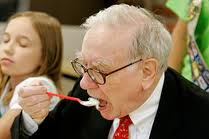
It's the closest thing I could find to Buffett looking like he was eating a Thanksgiving dinner! Plus I didn't want to offend the vegans and vegetarians on the board...you know who you are...by putting a picture of a cooked turkey dinner on here. ;D Cheers!
-
Meet The Man Who Has Worked At Goldman For 80 Years
Parsad replied to Parsad's topic in General Discussion
Geez! Just 3 months after they wrote that article. Cheers! -
To our many U.S. boardmembers, have a safe and happy Thanksgiving! Cheers!

-
Bruce, err Loki, was the only reason to watch that movie. I was falling asleep every time Tom Hiddleston wasn't on the screen. Cheers!
-
Nice job Packer and Norm! Cheers
-
Maybe he never sells? Anyone know the details? Regardless, you'd expect someone, somewhere, to achieve this. You get enough people flipping coins, someone's bound to come up heads 100 times in a row. Vito is no luck of the draw type. In the last 13 years, he's only been fully invested at one time...the bottom of February 2009! Those results you see were done with significant amounts of cash. His fund isn't for the person looking for the highest absolute results. It's for the senior who has lost a bundle in mutual funds, index funds and underperforming hedge funds...the guy who doesn't need 15% annualized, but needs 7-10% annualized year in, year out, with no permanent loss of capital. Vito understands Buffett's rule probably better than almost any other investment manager out there...don't lose money! Everyone is out there to make the big, quick score...highest absolute results with little in the way of managing permanent capital loss risk. You look at a guy like Chad Wasenlikoff at Fortress. Smart guy, swung big, had huge success...then you see what that permanent loss of capital does when risk isn't managed properly and you overleverage or swing maybe too big on the wrong pitch. You've seen these things over and over, yet people only cheer for the guy getting 18-20% annualized...until they burn...think Bill Miller...or possibly it looks like Sprott might be next. In those terms, Vito offers something very few do...steady gains with near zero loss of capital on any idea. In his own way, that's extraordinary! Cheers!
-
While the long-term annualized results may not be quite as impressive as some other hedge fund managers, you have to be quite amazed by someone who has not had a single down year. If you are a widow or orphan, investing with Vito may be a much better alternative to anything out there. Cheers!
-
I don't think Vito would try and do anything unethical. Probably putting both numbers would be better, but I think he's just trying to show the value they are adding on top of the respective index. Cheers!
-
I have a terrific all-in-one HP desktop for my home office, and I love it. Nice to have that big screen for reading late into the wee hours. I also have a very light laptop for work between my home office and work office, as well as when travelling. But I'm thinking of switching to a Surface tablet...almost bought one today on The Home Shopping Channel, but then decided not to buy until Boxing Day. While my laptop is small (13"), it is still much more cumbersome on the plane or commuter train than a simple 10" tablet. In terms of Apple or Microsoft, I love my iPhone, but for business I'm not happy with Apple or Google Docs. Microsoft still has a huge advantage with Office, but the problem is now IE which seems to run slower and have more problems than Chrome, Firefox or Safari. I often have sites that don't load properly or slowly on IE, but run smooth and fast on Chrome or Safari. If you do decide to go the tablet way, you have to find one that has enough connections to work properly as a laptop...such as USB ports, Powerpoint/Video port, etc. As well as enough memory, storage and processor speed to work effectively as a laptop. I'm going to go and try a few out this weekend at Best Buy. Cheers!
-
No friends and family other than a couple in the Canadian Fund. Almost all of our partners came through referrals. I've found that many friends and family tend to treat the fund as a personal piggy bank..."Oh, I need money to start a new business", "Oh, I'm going to buy a new car", "Oh, I'm thinking of buying another investment property", etc. Once we cut back on the friends and family, we found the fund grew much better. All of our partners are individuals, families, family trusts or personal corporations. No fund of funds, no endowments, etc. We are also terrible at marketing, thus the small size of our funds. Fortunately, I don't have to live off the incentive fees in our funds, so I can do this forever. Instead, they get reinvested back into the funds and our investment gets bigger. I think I'm going to be like Francis...grow slowly for 20 years and just blow up to $1.2B after! ;D Cheers!
-
This raises another interesting point that I'm sure I'll be lambasted for... I would argue that actual investment acumen doesn't matter, it's marketing and sales skills that matter. You have ETF's raising billions of dollars and guaranteeing that people will not outperform. Hot money does flow to managers with great records, but not if people don't know about them. If you look at opening a fund management business as a business you need to serve two things, serve your clients and make a profit. You maximize your profit by accumulating assets, you serve your clients by not losing them money. If you have the greatest track record in the world then have three years of 30% losses you will have no clients. If you have an absolutely average track record but haven't lost client money you will be able to sell the heck out of your fund and gather assets. There are brokers who I know who've raised 10s and 100s of millions of assets and investing them in average value funds. They all tell me the same thing, clients don't care about performance, they care about the story, and not losing money. I feel there's a giant disconnect at times on this board, and in this thread. There's this ideal that if you establish a great track record you will attract assets and be successful. If you establish a great record you will be looked up to by other investors, but it doesn't guarantee assets. I would argue that sales technique regardless of track record is much more important. If people are able to gather assets with terrible track records why are those with great records having trouble attracting assets? I think it's sales and marketing. It's both Oddball...performance and marketing. But marketing can sure hide a lot of underperformance, as you can see it through the industry! Whereas if you underperform, and are not good at marketing, then you may be done. Cheers!
-
Thanks Nate! You know, if I only knew how hard it was going to be, and not what the final outcome is like now...I might not have done it back then! ;D It's only worth it once you've actually gone through it and come out the other end. I can't imagine doing anything else now. Cheers!
-
Thank you for the compliment! ;D Not really if you do it frugally. We launched our company with about 150K$ initially. It cost 7K$ all in all to set up and costs around 3K$ to maintain annually, including all fixed costs. Actually, thinking about it, knowing what I know today I could do the same thing for 3K$, and 2K$ in annual maintenance. No need to go for expensive fund structures before you have at least a few M$ AUM. Hi Edward, The $3K doesn't include your audit costs does it? Do you do the books yourself? What about K-1's for the partners and the fund tax return...do you do them? Way to keep it lean! Cheers! 3K$ annually is a very minimalist structure. No auditor fees (as substitute we attach the bank and broker balance statements to the financials as these include 99% of all assets). No trustee, no administrator. What it does include is annual company maintenance fees, and fixed annual bank/broker fees. No general/limited partners structure - we incorporated in BVI as a "C" corporation with one class of shares. As a result we do not deal with tax authorities on the behalf of shareholders as a company but advise shareholders to file their own returns in their country (as the company is a separate corporate entity). The upside is that there are almost no expenses/hassle in general. We set our own rules and avoid unnecessary expenses. Essentially, we leapfrogged towards the "Berkshire" structure without first going through a limited partnership route. The obvious downside - it makes for a harder "sell" to prospective investors and advisers who are used to traditional, domestic, full fund structures. Also there are some possible international taxation repercussions that vary from country to country and these have to be carefully examined before attempting this setup. I see, that makes sense. Cheers!
-
Thank you for the compliment! ;D Not really if you do it frugally. We launched our company with about 150K$ initially. It cost 7K$ all in all to set up and costs around 3K$ to maintain annually, including all fixed costs. Actually, thinking about it, knowing what I know today I could do the same thing for 3K$, and 2K$ in annual maintenance. No need to go for expensive fund structures before you have at least a few M$ AUM. Hi Edward, The $3K doesn't include your audit costs does it? Do you do the books yourself? What about K-1's for the partners and the fund tax return...do you do them? Way to keep it lean! Cheers!
-
Yes, and doing part-time contract work for Alnesh's accounting firm. It was hard, but I wouldn't change anything and well worth it at the end. I built it from scratch, making a ton of personal sacrifices, and fortunately with very good results over 7 years and now on our 8th! Would have been very hard if I had a spouse and children. Cheers!
-
The $25K was just to start Corner Market Capital and fund the original financing of the U.S. fund...we gave our family and friends 5% of the company for that! The total set up costs for the U.S. fund were actually quite reasonable for the time...about $12.5K...and it was amortized back to partners over five years. All three of our funds have been set up that way...the costs are amortized back to the partnership over 5 years. So essentially, we had about $12,500 left in Corner Market Capital when we launched that had to pay for all of our operating costs not paid by the actual funds. I also had a couple of good years with that $12,500, so essentially I grew it to about $20K in two years, while still using about $5K a year for operating costs. Now we have more than enough in investments and incentive fees in just the Canadian fund, where we can operate for the next ten years...and that's without bringing up any money from the U.S. general partner. So when these large hedge funds go out of business, I haven't got the foggiest clue where exactly they spent their money...must be on lavish parties, travel, office space and excessive staffing. Corner Market Capital and the MPIC Funds will not go out of business unless we choose to close and liquidate the funds...it certainly won't be because we can't afford the costs! Cheers!
-
Valuesource, With insurance going out the window, what is the main strategy for YAK? Ownership of rental and commercial properties? Do you see operating costs decreasing over time as rental income increases...is that sort of the expectation? Thanks and cheers!
-
I like the idea of a manager who is already financially independent. Because if he has a track record that is worthwile, he'll be already a long way towards financial independance. Secondly, as a partner, you don't want your manager to be pressured to take unnecessary risks because he needs the fee money to survive. For an investor, patience is no luxury, it is a neccessity, and if your manager is being pressured by debt or by income problems, the first thing to go is the patience, and with it the rationality and prudence. This is the current reality, the only people who can get into investment management either are young and have no expenses, or those who are older and already made enough money that day to day expenses aren't an issue. This eliminates anyone who decides they'd like to have a family, which is probably why working all of the time is lauded for investment managers, they're either young or beyond kids. Why would someone who's financially independent take on someone else's money to manage? Managing money for someone else is not the same as managing your own money, it's much more stressful, with more responsibility. If you are well off why add that to your life. If I were financially independent I would not be managing outside money as something fun, I would probably manage my own money and spend time on things I wanted to do like skiing, biking etc. The way for someone to manage money who has a family on their own appears to be as a RIA who builds a considerable book of business and earnings a straight fee, or for someone who's wealthy parents/relatives bankroll their living expenses while they build up AUM. The second route is all about connections, if you come from a wealthy family I'd imagine it would be easy to collect assets which means you wouldn't need to live on your parents money for long. There is actually a third way, as suggested by Pabrai : you can combine a day time job with investing for some years until you have the needed funds. That's the way we did it. We are not from wealthy families, haven't been supported, didn't have a financial background, we never inherited anything and we now have 4 children to support. But after some 10 years of combining a day time job with investing, we could choose to do whatever we wanted. I agree with you however that it wouldn't be as easy to replicate this if you already have the kids. We could combine my day time job with managing the partnership and my wife's job until the 4th child came. Then I had to choose and give up my day time job. Same thing! No family money...no inheritance. I used the investments I had saved up over the years as the backup support, and I did work on the side for Alnesh's accounting firm while launching and running the funds. We launched Corner Market Capital with $25K raised from family and friends, and Alnesh and I initially only put $100 into the U.S. fund...just like Buffett did with his original partnerships. I also lead a very lean and frugal life for the first five years...even got rid of my beloved Mini! Brown bagged it or ate very cheaply almost every day, public transport, office was at no or low-cost as I was doing some work for Alnesh, no fancy trips other than the usual Pabrai Funds/Fairfax Financial AGM's, no administrative assistants, and worked very hard to build a great track record. We also had some great service providers that made our life easier! Now we are the largest investors in the U.S. fund, and one of the largest in the Canadian fund. We generated incentive fees pretty consistently this year in both funds. I don't brown bag it anymore, but I still live a frugal life, including still taking public transport to the office...no stress, I can answer emails or read. I only do occasional work for Alnesh's firm and run the funds from my terrific home office 2-3 days a week. It's almost the perfect life for me now...just need to double our assets under management in the next couple of years and life could not be better! Cheers!
-
We have a fee structure of 0.5% - 10% in our company. I absolutely agree with the sentiment voiced by oddballstocks and this is the reason we chose this structure. If you take only a performance based fee and bear the expenses, it is a very risky proposition. You might be unlucky for a few years and if your cost structure isn't very low you're going to be under massive pressure, not to say anything about trivial stuff such as food and shelter while you're at it. True, but like any real entrepreneurial endeavour, risk and sacrifice play a very significant part. We run our business very lean, because if we didn't, we would have been out of business by now. I think those habits are learned very quickly when everything is at risk. A fixed expense ratio of any sort to cover the manager's office and living expenses somehow strikes me as a less efficient way to learn that experience. And if you somehow manage to get through the first few years, especially when they came during the worst crisis in 70 years, you know you can probably get through anything going forward. There's some definite value in that. Cheers!
-
Fairfax agrees to acquire majority stake in The Keg
Parsad replied to ourkid8's topic in Fairfax Financial
LOL! Don't forget the Teuscher Chocolates in William Ashley and East Side Marios. Cheers!