vinod1
-
Posts
1,765 -
Joined
-
Last visited
-
Days Won
7
Content Type
Profiles
Forums
Events
Everything posted by vinod1
-
I made the same argument as you about DCF in the past. "DCF to is sort of like Hubble telescope - you turn it fraction of inch and you're in different galaxy" But I have changed my mind. Any valuation work you do is based on DCF with the exception of relative valuation or valuation of options. Let me explain. DCF does not mean you have to do spreadsheets. When you say a company is worth 10x earnings, you are doing a DCF valuation. The fact that you did not use a growth rate or discount rate or explicitly model cash flows, does not mean you are not making assumptions about these. You have just assumed away all these variables. You do not even know what you have assumed away. When you do DCF you are forced to think through these and it gives you a chance to make sure they are reasonable and consistent. If you are honest with yourself, this can make the valuation more robust. The fact that Buffett does not put this on paper should not mislead us into thinking we can do the same. He probably can model that in his head. Not so for most of us who have much less practice with DCF. I think it would be helpful for most of us to do a few hundreds of DCF valuations before resorting to shortcut of multiples. It would give one an idea of how cash flows, reinvestment rates, return on reinvested capital, dividends, buybacks, debt, etc impact business value. This is very hard to get an intuitive understanding of these without putting them on paper and looking at the results. These does not have to be complex. Actually these are much better if done by hand on paper at least for the first few. Vinod Hi Vinod, I agree with you probably more than you realize. I distinguish between the theory of DCF (which I agree with 100%) and the practice of DCF (which I think has serious shortcomings). Part of the reason I went through this exercise is to find a middle point between an all-stops-out DCF and the sort of ratios many of us use. The former incorporates all the variables but usually suffers from incorrect inputs. The latter is oversimplistic but, through its ease of calculation, enables the experienced investor to establish appropriateness in different situations. Buffett often says he can decide whether he wants to buy a company in 5 minutes, which means he's using pattern recognition as you say. I use probably 10-20 different ratios to value a stock. The most important are MC/ Cash, Price/ Tang book, Debt/ Equity (more risk means less value) EV/ Rev, EV/ EBITDA, EV/ FCF, Operating PE, PE, ROA, ROE, ROIC, revenue growth, tang book growth. But the most difficult thing is always figuring out how much value I should attribute to different levels of growth. I have used the PEG in the past because it produces numbers that pass my "whiff test" based on experience, at least for growth rates in the 10%-30% range. But I dislike the PEG because it's clearly a tool pulled out of thin air. It seems like the formula: P/ E > 2/(G+R)*ln(g0/r0)-1 provides a better estimate of the appropriate PE, so I plan to start using it rather than the PEG. Hi Graham, To me, once you have a fix on the moatiness of the company, usually the next most difficult issue is estimating the growth. The way I approach is to estimate the the earnings 7 years down the line and put a multiple of those earnings at that time and then discount it back. The multiple would depend on what I conservatively estimate to be how the market would be valuing the company. A 14x multiple if the company is an average business that can grow somewhat in line with the economy, pass on inflation, a decent level of free cash flow conversion and low disruption potential. Adjusting the multiple up or down. But I bother with looking out 7 years only for those companies that have strong moats. Vinod
-
A good critique of PEG which I agree with http://people.stern.nyu.edu/adamodar/pdfiles/peg.pdf Vinod
-
I made the same argument as you about DCF in the past. "DCF to is sort of like Hubble telescope - you turn it fraction of inch and you're in different galaxy" But I have changed my mind. Any valuation work you do is based on DCF with the exception of relative valuation or valuation of options. Let me explain. DCF does not mean you have to do spreadsheets. When you say a company is worth 10x earnings, you are doing a DCF valuation. The fact that you did not use a growth rate or discount rate or explicitly model cash flows, does not mean you are not making assumptions about these. You have just assumed away all these variables. You do not even know what you have assumed away. When you do DCF you are forced to think through these and it gives you a chance to make sure they are reasonable and consistent. If you are honest with yourself, this can make the valuation more robust. The fact that Buffett does not put this on paper should not mislead us into thinking we can do the same. He probably can model that in his head. Not so for most of us who have much less practice with DCF. I think it would be helpful for most of us to do a few hundreds of DCF valuations before resorting to shortcut of multiples. It would give one an idea of how cash flows, reinvestment rates, return on reinvested capital, dividends, buybacks, debt, etc impact business value. This is very hard to get an intuitive understanding of these without putting them on paper and looking at the results. These does not have to be complex. Actually these are much better if done by hand on paper at least for the first few. Vinod
-
“Our results in 2017 were the best in our thirty-two year history, in spite of some of the largest catastrophe losses in history as a result of Hurricanes Harvey, Irma and Maria and the California wildfires,” said Prem Watsa, Chairman and Chief Executive Officer. “We achieved record earnings of over $1.7 billion, resulting in a 22.4% increase in our book value per share to $449.55." I cannot imagine Buffett or Mark Leonard would ever say such a thing with the results achieved. Vinod
-
Consumer Packaged Goods Industry. Not for cyclical reasons but more for structural changes. Many of the changes brought about by Internet are chipping away at almost all of the advantages these companies used to enjoy. In addition these guys have increased margins considerably over the last 20 years compared to their previous 50 years. It seems likely that margins would be significantly compressed for many of these companies over the next couple of decades. Vinod
-
Thank you! Gamecock-YT, mhdousa, rb - Very impressive how quickly you guys figured it out. GE and Allergan (industry wide pressure likely means generics segment) fit the description. Vinod
-
Longleaf referred to two investments they made in Q4, 2017 which they did not name: We purchased two undisclosed positions in the quarter. One, like Mattel, was a time horizon arbitrage opportunity where past mismanagement and a dividend cut obscured the longer term value and prospects for industry-leading businesses. The other was an example of how complexity often leads Southeastern to investments. A more traditionally associated segment of the company was under pressure industry-wide, taking the stock to a multiple similar to peers within that segment. In the case of this company, however, its most valuable segment consists of leading, protected brands that are growing in strength and demand. I am not able to figure these out and hoping some enterprising board members might be able to fish them out. Thanks Vinod
-
You guys had me hook, line and sinker. I was at a science event for my son when I read this thread. Not wanting to read the letter just standing, I searched and chose a comfy spot to read, and when the link too me to YouTube, I turned on cellular which I turned off for YouTube and vola, the song comes. Determined I try it a couple of more times. Vinod
-
The link goes to YouTube song. Can you please repost the link. Or am I missing on the joke. Thanks Vinod
-
I am attaching a chart of 10 year treasury rate from 1790 onwards. Data from 1871 onwards is more reliable but this is the data we have. 1790 to 1870 rates are 5% to 7% 1870 to 1960 rates hovered around 3% 1960 to 2000 rates shot up from 5% to 15% and then back to 5% 2000 to 2017 rates kept dropping from 5% to 2% When people talk about "Normal" they are primarily referring to the 1960 to 2000 period. When people talk about "New Normal" they are primarily referring to the post 2000 period. But what is normal, is really a matter of how far back you are looking. If we consider rates from 1870 ("Old Normal"), then current rates are nothing unusual. If we consider rates from 1790 ("Really Old Normal"), then current rates are indeed low but not exceptionally so. Vinod

-
I have been very closely following Buffett's comments on interest rate impact on stock valuations. Buffett has said that stocks would look cheap in three years time if interest rates were 1% higher, but not if they were 3% points higher. I think he made these comments when the 10 year is in the 2.2% to 2.3% range. I think only if bonds start hitting the 4% range it would start impacting stock valuations. Vinod
-
A week ago, I was helping a relative to come home after surgery. He was given general anesthesia for the procedure. As I was picking him up, all he can talk about is crypto-currencies. It seems he was talking to the nurses about it as well while is is half awake. The entire 30 minute drive home is talk about Ripple and that it has a very good potential and that I should look into it. My relative has shown the least bit of interest in investing over the last several years. I would implore him to get started with investments and he has never shown any interest. Now his wife tells me that instead of playing with his less than year old baby, he would be looking at all these charts about Ripple on his computer. As I took a quick look, crypto-currencies to me is close to a certainty as one can get in investing, that it is a bubble. Crypto-currencies are of course wonderful inventions and are of great use - for drug dealers and terrorists. All it takes is one terrorist attack financed using crypto-currencies for governments to crack down hard on these. Vinod
-
What are within your Circle of Competence? Be brutally honest.
vinod1 replied to DooDiligence's topic in General Discussion
I started with P&C and Banks/Similar Financials. But I realized it is better to focus on companies with moats at least those you can understand and build up CoC in them. This way you have an answer and working backwards. Much more productive. Rather than learning about industry after industry only to find that it does not offer up many companies with moats. Nothing wrong with learning about industries and at some point you need to do that, but working from a company with moat then learning about its industry seemed to me to be more productive. This applies more to investing in companies with moats. Vinod -
What are within your Circle of Competence? Be brutally honest.
vinod1 replied to DooDiligence's topic in General Discussion
+++ a million A lot of wisdom in there. Learning about an industry and building a circle of competence around it is one thing and probably which anyone who has the inclination would be able to do so. This mental aspect is really so much more difficult and more likely to cause problems. A few years back coming off the psychological high of BAC LEAPS and then SD LEAPS paying off, I invested speculated in HP LEAPS with very limited analysis (along with a host of other biases) and after Léo Apotheker mess sold them at a loss. Then after it tanked and I got so pissed off at management for their stupid acquisition, that I refused to consider buying them at their lows. Fortunately it is less than a 0.5% portfolio position for me. That taught me the lesson that I hope I would never forget and which Gregmal mentioned above. Vinod -
The End of Coca Cola, P&G and the traditional distribution model
vinod1 replied to vegaseller's topic in General Discussion
The moat of the consumer packaged goods (CPG) companies is being weakened due to many technological changes. For one, entry barriers for new firms has been lowered. Now it is easy for a company to do many of the basic functions: 1) Easy to startup a new company with low capital. Use AWS for your IT infrastructure. Outsource manufacturing to a Chinese company. 2) Lower cost to promote the company. Use YouTube to distribute the video at low cost. Use Facebook to promote the product. 3) Sell directly online. These small companies have much lower cost structures. What this does is enable small companies to develop either niche products or lower cost products and strip away users from the big CPG companies at the margins. Some of these niche products might even make it big. A second factor is that at least in developed countries, there is little quality difference between many of the branded CPG products and generic store label products. These factors are going to be a headwind for the CPG companies. This is what I think is happening to P&G as well. Vinod -
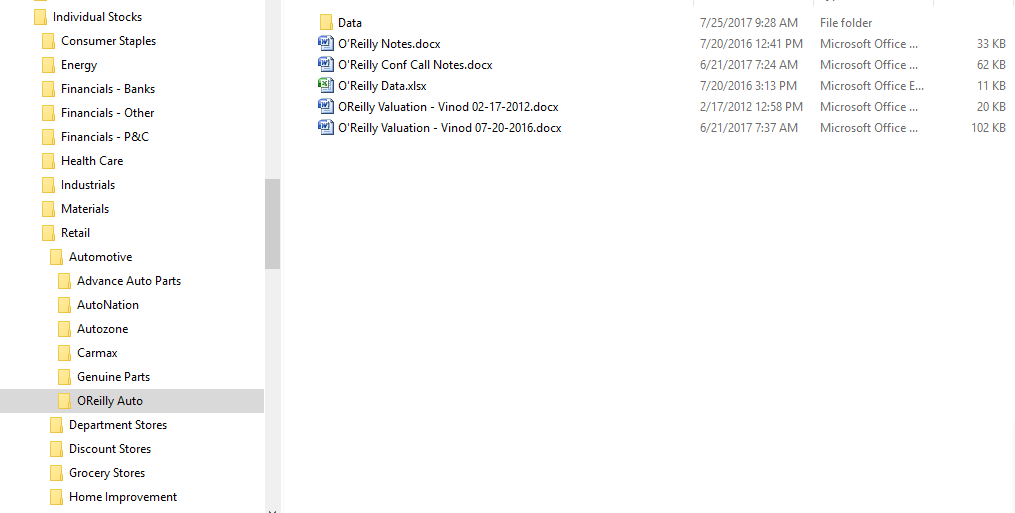
Not using paper anymore. Organize folders by Sector and then sub-sectors and then one folder per company. I use specific naming conventions for folders and documents and it makes it easy to get to what I am looking for. Each company folder has 1) A valuation document that follows a template. I update it periodically. 2) A "Notes" document where I gather all the notes about the company. 3) A "Conf Call" document where I copy paste important parts of quarterly conference call transcripts. 4) Sometimes, if there is data that I need to analyze, then I have a "Data" excel spreadsheet. 5) A Data folder where I put all the documents I gather about the company. This is sometimes broken down into subsections. Have a google spreadsheet of key things about all the companies I track organized into "Compounders", "Wide Moat", "Low Quality". This is mainly for me to check daily to see if anything is in the buy range. Have an Investment Dairy where I document what I researched, what I bought or sold, my rationale, etc. Vinod
-
Thanks KCLarkin for the excellent analysis. Broadly, the way I am thinking about this, is that technology is eroding the competitive advantage of many of these businesses. To be viable businesses, they must be providing a compelling value proposition to the customers. In retail that means (a) price (b) convenience and © selection. The most important of these is price. If a business can consistently deliver on low prices, it is highlly likely to be a viable business. Coming to Best Buy. To me the main reason for the successful turnaround has been the introduction of "Low Price Guarantee". Of course, to deliver on this they have to do lot of heavy lifting in terms of store redesign, productivity improvements, etc. So one way of generalizing this to other businesses is to ask the question: Can the business offer a low price guarantee or something close to that? Or does it rely on some friction or gimmick to make the customer pay a higher price? Others factors might be more important in some cases. Say parts availability for auto retailers. But even in this case, I think they cannot just get away with charging high prices like they do now. Vinod
-
I think where I'm not following is that you are willing to pay for the float. If Berkshire has it and you would buy the float for face value, then not only is the float not a liability for Berkshire, it is an asset (since they can sell it). Thus, the logic seems to me to tilt to more than calling the float zero liability. My thought experiment is not very "thoughtfull" :) I mean it more as discounting the liability that is going to be paid out over a very long time. Vinod
-
This would only add about $90 billion in float value which the float amount at end of 2016. Part of this float value shows up in the goodwill so you have to account for that. Part is always held in cash equivalents always. This part would not have full face value. If you make these adjustments, I think the market is valuing BRK in this manner, at least implicitly from the P/BV multiple. When you estimate value of BRK from various methods they tend to cluster together closely. So float based valuation does not radically increase BRK valuation. Vinod Perhaps I'm being dense here, but if we take $90 billion in float liability and then call it $50 billion in asset (after your adjustments above), it would have well over $100 billion effect in value change from book value, wouldn't it? In other words, it isn't just discounting it as a liability if you would be willing to pay someone to get it, so it seems like it would be a big swing. I probably did not explain well. Float can be considered as equivalent to debt. Unlike debt, however, float is never really paid back unless the company liquidates or shrinks its insurance business. So we are discounting the debt to a near zero value. Not adding another asset. Vinod
-
This would only add about $90 billion in float value which the float amount at end of 2016. Part of this float value shows up in the goodwill so you have to account for that. Part is always held in cash equivalents always. This part would not have full face value. If you make these adjustments, I think the market is valuing BRK in this manner, at least implicitly from the P/BV multiple. When you estimate value of BRK from various methods they tend to cluster together closely. So float based valuation does not radically increase BRK valuation. Vinod
-
To put it more concisely, if you are given $100 today and every year going forward you would be given another $3 to $4 for the next 100 years with the caveat that you might also have to give back $3 to $5 once every 10 years (to simulate underwriting loss), what would you pay for that privilege? I would pay $100 for that. Note that, you would get that $100 back immediately to be paid back in 100 years. Vinod
-
“[if] I were offered $7 billion for [$7 billion of] float and did not have to pay tax on the gain, but would thereafter have to stay out of the insurance business forever—a perpetual noncompete in any kind of insurance—would I accept that? The answer is no. That’s not because I’d rather have $7 billion of float than have $7 billion of free money. It’s because I expect the $7 billion to grow.” —Warren Buffett, 1996 Annual Shareholders’ Meeting, as quoted in Outstanding Investor Digest. “If you could see our float for the next 20 years and you could make an estimate as to the amount and the cost of it, and you took the difference between its cost and the returns available on governments, you could discount it back to a net present value.” —Warren Buffett, 1992 Annual Shareholders’ Meeting, as quoted in Outstanding Investor Digest. I wrote up BRK in 2010, here is the extract related to the float valuation: The key question concerns the value of float. Float is money an insurance company holds but does not own. Float arises because premiums are received before losses are paid and this interval can be of several years. During this interval, the insurer can invest the money for its own gain. The premiums are often not sufficient to cover all the costs and insurance company has to part with some of the returns generated out of float to make up for the shortfall. To get an understanding of the theoretical basis for assigning value to float, let us take an example. Assume you are offered the following proposition: You are offered $100 to be paid back after the end of 50 years. You do not have to pay any interest and also get to keep all the money earned in the interim from investing the $100. The only restriction is that you can only invest in high quality investment grade bonds and treasuries. How much would a smart business man be willing to pay for such an offer? If you can estimate the market rates of interest for long term bonds are going to be about 4% then the business man should be willing to pay about $86. (The business man can invest $14 at 4% for the 50 year period to end up with $100.) Of course, the business man would not go through the trouble of investing to end up with no profit so he is going to offer something a little lower to make relatively low risk profit. Insurance float for Berkshire is a lot like this example with few additional benefits. First, the $100 amount is likely to grow around the nominal GDP growth rate of 4-5%. Second, as long as the business is not wound up there is no need to pay back the $100. The effective length of the investment is longer than 50 years. Third, there is a strong possibility of getting paid something like 1-2% for the privilege of holding the money. So what would a business man offered this proposition pay for this? It should be obvious that it would be at least $100 without even performing any complicated math. A conservative value of this float can be calculated mathematically with a few assumptions. Assuming no growth in float in the future; that float earns at the treasury bond rate (4%); discounted at the treasury bond rate; and that the insurance segment would not liquidated in the foreseeable future; the present value of the float is simply the amount of float i.e. $100 using the constant growth dividend model. There are two caveats to this calculation of the value of float. (1) Shareholder incurs an additional cost for the float through an insurer due to tax penalty. This cost has been estimated at around 1% by Buffett. (2) There is uncertainty in the true cost of float as it a near certainty that there would be periods of underwriting losses. Both these complications however should not alter the final value in the above calculation as it would be possible to conservatively earn enough above the Treasury bond rate on the float to mitigate this additional cost. Vinod
-
In the annual meeting he elaborated on this. Why did Buffett advise his wife to invest in index funds versus into Berkshire Hathaway? She won’t be selling to buy an index fund - every single share of Berkshire Hathaway will be going to philanthropy - so far 40% has been distributed - for someone who’s not an investment professional, what’s the best investment where there’s less worry than anything - big thing is money to not be a problem – there’s no way that there will be an issue absent a nuclear attack if she invested in the S&P; Buffett’s aunt Katy, whose husband used to employ Charlie and Warren, worked all her life and died at 97 with a few hundred million dollars, because she was in Berkshire Hathaway. She’d write Buffett and say she hated to be a bother but was curious if she would ever run out of money. Buffett told her that she’d run out only if she lived 986 more years. There will be people who come around with various suggestions on what to do with the money he leaves his wife, and there’s a chance she won’t have as much peace of mind only owning one stock as owning the index. Vinod
-
Agreed. Lots of gems throughout. I really liked his description of failure of cleantech companies that is applicable in general: Most cleantech companies crashed because they neglected one or more of the seven questions that every business must answer: 1. The Engineering Question Can you create breakthrough technology instead of incremental improvements? A great technology company should have proprietary technology an order of magnitude better than its nearest substitute. 2. The Timing Question Is now the right time to start your particular business? 3. The Monopoly Question Are you starting with a big share of a small market? Customers won’t care about any particular technology unless it solves a particular problem in a superior way. And if you can’t monopolize a unique solution for a small market, you’ll be stuck with vicious competition. But what if the U.S. solar energy market isn’t the relevant market? They would rhetorically shrink their market in order to seem differentiated, only to turn around and ask to be valued based on huge, supposedly lucrative markets. 4. The People Question Do you have the right team? You’d be wrong: the ones that failed were run by shockingly nontechnical teams. These salesman-executives were good at raising capital and securing government subsidies, but they were less good at building products that customers wanted to buy. 5. The Distribution Question Do you have a way to not just create but deliver your product? 6. The Durability Question Will your market position be defensible 10 and 20 years into the future? Every entrepreneur should plan to be the last mover in her particular market. That starts with asking yourself: what will the world look like 10 and 20 years from now, and how will my business fit in? Cleantech entrepreneurs would have done well to rephrase the durability question and ask: what will stop China from wiping out my business? Without an answer, the result shouldn’t have come as a surprise. 7. The Secret Question Have you identified a unique opportunity that others don’t see? Every cleantech company justified itself with conventional truths about the need for a cleaner world. They deluded themselves into believing that an overwhelming social need for alternative energy solutions implied an overwhelming business opportunity for cleantech companies of all kinds. Each of the casualties had described their bright futures using broad conventions on which everybody agreed. Great companies have secrets: specific reasons for success that other people don’t see. We’ve discussed these elements before. Whatever your industry, any great business plan must address every one of them. If you don’t have good answers to these questions, you’ll run into lots of “bad luck” and your business will fail. If you nail all seven, you’ll master fortune and succeed. Even getting five or six correct might work. The 1990s had one big idea: the internet is going to be big. But too many internet companies had exactly that same idea and no others. An entrepreneur can’t benefit from macro-scale insight unless his own plans begin at the micro-scale. Cleantech companies faced the same problem: no matter how much the world needs energy, only a firm that offers a superior solution for a specific energy problem can make money. No sector will ever be so important that merely participating in it will be enough to build a great company. Vinod
-
Do you read all of the filings of a company you invest in?
vinod1 replied to TheAiGuy's topic in General Discussion
As others have mentioned, the degree to which you pay attention depends on the situation. For example in Valeant, the proxy for one of the years talked about how the CEO specifically asked for a performance hurdle for a 60% increase in adjusted cash earnings or whatever they used to call their earnings. I thought it is one of the most useful pieces of info providing insight into the CEO's personality and how aggressive they are. Vinod