muscleman
-
Posts
3,764 -
Joined
-
Last visited
Content Type
Profiles
Forums
Events
Everything posted by muscleman
-
I started learning value investing since 2009 and was lucky to make some money during this great bull market, though I am probably not beating the market. I have decided to give up value investing because it doesn't fit my personality. There are several flaws that's probably most likely related to my personality. 1. I always over analyze and paralyze. Fear to buy. (Could this go down more?) Fear to sell. (Could this go up more?) 2. My analysis has serious flaws and later earnings turn out to be bad and it turned out that if I know more about it and do more research, I could have figured it out and avoided it. (Rear view mirror always clearer) 3. Too nervous and keep checking the stock price. When it goes against me deeply, I feel depressed and can't concentrate on work or family anymore. 4. I have always thought if I started investing in 2007, how would I fair in 2008-2009 crash. I have no answers. I know friends who lost 75% in that bear market and felt distress from both self and family, but eventually made back and more after 2009. Can I psychologically withstand that? I don't think I can. There are more ways to make money than value investing. I am currently exploring those. Update: I never expected so many replies and a lot of them with misunderstandings of my post. As John pointed out: What I really want to say is this: There are many ways to make/lose money. Value investor, technical trader, value+technocal combined, quantitative approach etc. The most important thing to become successful is to find the method that suits your personality! I have been struggling as a value investor with huge emotional up and downs, but after I switched to technical method, I no longer have those ups and downs, and I no longer freeze when I need to pull the trigger. I am surprised to see some replies here saying value investing is the best method and giving up value investing means playing the field with significant disadvantage. I disagree. The only time when one can win big is when he finds the method that suits him the best. Therefore I am writing this post to share with members of my own experience, and alert struggling members not to treat value investing as the holy grail, and find a method that suits YOU!
-
FNMA and FMCC preferreds. In search of the elusive 10 bagger.
muscleman replied to twacowfca's topic in General Discussion
Just my 2 cents, you could totally predict this scenario before buying this security. Just imagine you bought, and then a few months later, it drifted down 30%. How would you react? Would you realize "how little I really know about this situation."? In that case, you could have avoided buying from the beginning. The point I want to make is that we all have to do mental rehearsals BEFORE buying anything. On the other hand, if you merely start to think you know nothing about this, when no fundamental has changed but just price dropped 30%, perhaps you are not a good fit for fundamental investing. I suggest you try technical investing. -
FNMA and FMCC preferreds. In search of the elusive 10 bagger.
muscleman replied to twacowfca's topic in General Discussion
Yikes.. Wish you best of luck. Please excuse my comments if you think they are offensive, but my 2 cents is to cut losses short and keep profits long. You can handle the uncertainty and politics behinds it when you are losing, and you are holding on to hope you can sell for break even to get relieved, but now that the uncertainty and politics have finally diminished and stock moved sightly above your break even point, you are out? How can this not be a mistake? On the other hand, imagine Hillary won the election, and these preferreds lost big after she appointed David Stevens to FHFA, would you sell at those big losses, or would you hold on because you can't take losses? Those would can't take losses eventually stop trading because they were forced to take mother of all losses. -
FNMA and FMCC preferreds. In search of the elusive 10 bagger.
muscleman replied to twacowfca's topic in General Discussion
You spent over a year on this thread and now asking these questions??? :o I think I recommended that you read bankruptcy investing and all that stuff one year ago. If you have read those books, you should have a good knowledge now. -
Thank you! What I am looking for for larger orders is that they can fill some, wait for a bit, and fill more, wait a bit, and fill more. Do you see that happening when you have adaptive order? The other question I have is, do you know if they reset their scan time when bid/ask moves? If that’s the case then the order may never get filled when bid/ask is constantly changing. Lastly, I noticed a much higher chance to be filled in NYSE when using this order type. Not sure if I have enough data sample to prove that though. Yeah, the behavior of filling some and waiting and then filling some more is what I typically see with the adaptive orders. Sometimes if the price puts my limit "in the money" I will start getting fills in quick succession. Not always but sometimes (sometimes my limit will be below the bid/above the ask and the algo won't get me a fill for a while). When it doesn't happen, I usually adjust my limit price to slow it down, unless I am eager to get shares. I think they must reset the parameters depending on price moves, volume, etc, but I don't know exactly what they do. Never compared the different exchanges with the algo. thank you! Do you usually buy during a pull back or during a break out when price is moving fast? What’s the typical order size, if you don’t mind?
-
Thank you! What I am looking for for larger orders is that they can fill some, wait for a bit, and fill more, wait a bit, and fill more. Do you see that happening when you have adaptive order? The other question I have is, do you know if they reset their scan time when bid/ask moves? If that’s the case then the order may never get filled when bid/ask is constantly changing. Lastly, I noticed a much higher chance to be filled in NYSE when using this order type. Not sure if I have enough data sample to prove that though.
-
FNMA and FMCC preferreds. In search of the elusive 10 bagger.
muscleman replied to twacowfca's topic in General Discussion
I'll admit, this made me chuckle some. But should we really believe that Otting didn't know anything about the cases or briefing deadlines before he took office? Was he really caught by surprise when Arnold and Porter showed him a copy of their brief yesterday? That seems a stretch to me. If we see a different tone in FHFA's briefing on Monday, it might be because Otting asked to see the brief last Monday or Tuesday, then spent part of the week with Arnold and Porter trying to change it to fit his (Otting's) views; when they couldn't finish the changes by Friday they asked for an extension to work over this weekend. Don’t forget similar things happened to the CFPB en banc, and DOJ sent in lawyers to say they actually agree with plaintiff. https://www.insidearm.com/news/00042722-doj-brief-opposing-cfpb-brings-more-uncer/ Tim Howard also said in his blog that Otting knows many plantiffs and knows this NWS nonsense well. -
Thank you! I tried the adaptive algo for a while and found that sometimes as IB is scanning between bid and ask, stock starts to move up without me getting any fill. I wonder if it is moving because IB is scanning and detected by other HFTs, or if it is just coincidence. Have you experienced this? Sometimes IB scans and fills a portion of my order and scans again and fills another portion later. Have you seen them doing this?
-
In my experience with lightly traded stocks, a limit order at the ask will only fill 100 shares and then the bid will move to one penny over your limit order which is of course why market orders are good to use when filling the order is more important than scalping a couple pennies. Buth then, a market order can really stick you with some bad fills, hence the allure of the adaptive algo, but alas it has its problems too. Ain't no such thing as a free lunch... Free trades at Merrill Edge are nice because you can split your order into multiple orders for free (assuming you are within your monthly allotment of free trades). But then Merrill won't trade many low price/volume stocks anymore. Years ago, I absolutely never used market orders, but over the past 10 years, I find sometimes they are just the only way to get a fill. Yep, but the most annoying trades are those where your bid never gets a fill, but then you see a trade for 0.01 penny higher a microsecond later. While you can only trade in 1 penny increments some HF trade can do smaller increments and suck up all the liquidity. At least that’s my take of it. FWIW, I use IB's adaptive algo all the time for all kinds of stocks and get great fills. For most stocks I use it on normal urgency and more illiquid stuff I used the patient setting. Merrill's free trades are nice, but the execution is the worst of all the brokers I use (Schwab, TD, Fidelity, IB, and Merrill). Which broker do you think has the best execution? I've tried out TD, Fido and IB. Initially I have my bigger account in IB and it usually has worse fill, but after I moved the account to TD, I notice bigger accounts have worse fills in general. I see the same behavior of getting a small partial fill and price moves up.
-
Well, I was buying a 2 bn company today. Bid was 29.2 and ask was 29.24. I put in an adaptive limit order at 29.24 but only got 200 shares filled, and price immediately jumped up to 29.28/29.36. I had a similar experience with another stock where the moment I put the order in, the price jumped. I won't think it is coincidence because I was staring at the screen for minutes when I was doing the last round of sanity checks and price was not moving, but the moment I click the confirm button, the bid/ask changes. That's just too unreal to be coincidence. Sounds like volume is pretty low for that company and you got stuck in the market maker shuffle. Volume is low? There is already 842k shares today. This is not small at all, especially comparing to the size I am trading.
-
Well, I was buying a 2 bn company today. Bid was 29.2 and ask was 29.24. I put in an adaptive limit order at 29.24 but only got 200 shares filled, and price immediately jumped up to 29.28/29.36. I had a similar experience with another stock where the moment I put the order in, the price jumped. I won't think it is coincidence because I was staring at the screen for minutes when I was doing the last round of sanity checks and price was not moving, but the moment I click the confirm button, the bid/ask changes. That's just too unreal to be coincidence.
-
If the bid is 20.10 and ask is 20.15, Is it basically putting an order into the market at 20.11, and if not filled, move up 1 cent to try again? I think this kind of activity may cause the market to go up as it is seeing some aggressive bidder coming in. Or is it doing something smarter? I am really pissed when i put in a buy adaptive order with patient urgency today with a limit of 20.6, and after market opened, it remained at 20.30 bid and 20.49 ask for 8 minutes without getting me filled, and then price went way up to 21.8. I called them to ask what "patient" really means but they refuse to answer.
-
IBKR margin restriction rules in the advisor account
muscleman replied to muscleman's topic in General Discussion
Is everyone using IBKR using their margin account without any of these restrictions? -
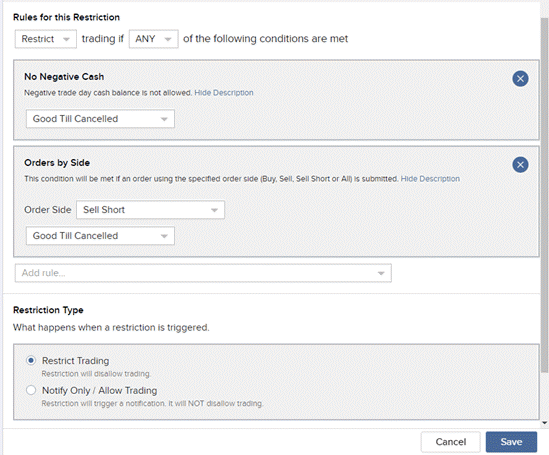
IBKR no longer offers peuso-margin accounts for non-IRA accounts. However, I really don't like using the cash account because there are some benefits of the margin account vs cash account: 1. No Reg T violation possible, no matter how frequently I trade. 2. No need to wait for 3 days to settle and I can sell a stock and immediately buy another one. 3. I can enroll in their enhanced yield program to lend out my stock to earn extra. However, I really don't like to accidentally borrow margin or sell short as I may have a fat finger and execute a wrong trade. I called their REP to ask what I can do now that they don't offer pseudo-margin accounts anymore. They said I can create a friend and family advisor account to manage my individual account, and in the adviser account, there is a pre-trade configuration page where I can setup trading restrictions like the following. Has anyone been using this feature? Is there any other rule I am missing to make sure my margin account won't actually be using margin?

-
My worst year relative to the benchmark was the year after my kid was born. I was stupid enough not to realize EITHER: 1) how much less time I was giving to important decisions, and 2) how poor my mental state and focus were when making decisions. I was like a drunk who doesn't know he can't drive. That one year negated several years of outperformance and just about capitulated me onto the indexing path. I had the same feeling in 2017 when my baby was born. I was sleeping 4 hours a night for many months and felt like a drunk. I have now switched to a technical heavy approach because in general it takes less time. I was lucky to make this decision around May, and was actively learning and liquidating all of my value positions, so I was not affected by the recent down turn. I ended up +10% this year mainly because of BXC and SMLR (4x and 3x).
-
It just blows my mind why someone would want to buy these funds.... These funds trade at NAV, but it really should trade at a discount to NAV. Let's say the fund's NAV is $100, but $50 of that NAV is capital gains, and I bought it at $100 per share. At the end of the year, it distributes $50 to me, and NAV drops to $50, so my share price drops to $50. Now i have to pay taxes on the $50 distribution to me, which could be, say, $20. So now I only have $80 in hand and just lost $20 in a few days by doing nothing!
-
I find it interesting that even some passive ETFs can have capital gains and distributions! https://us.spdrs.com/en/resources/capgain/ Hmm..... How could this happen to XNTK? Is that because they had to sell some stock because it is removed from the index? I see the ex date is 12/24. So if I buy it right after 12/24, then I won't get the distribution, but I'll still have to pay taxes on the capital gains for this year right?
-
Why do so many brokers start to offer free trades?
muscleman replied to muscleman's topic in General Discussion
Yeah. TDAM pushed hard to sell my margin account instead of cash account but I said no. They also call me almost every month to try to sell my some CDs until I said I am really upset and please don't call again on it. I plan to move back to IBKR next month. ::) -
I am surprised to see this 500 free trades offer today from schwab. https://www.schwab.com/public/schwab/active_trader/start_trading/500year_offer2.html I know BoA offers a lot of free trades per month, and Chase started doing that as well. Robinhood is always free for all trades, and now Schwab joined the party as well? It seems like getting more client's money so they can get more kick-backs from Citadel is the new way to do business. ::) Note that all these brokerage firms have close to 0 interest payment on the cash balance, which is probably another source of income for them. At the same time, Fido pays 1.8% for idle cash if you choose "Government Obligation" as the cash sweep vehicle, while IBKR pays 1.7% on your idle cash.
-
Yes, just like mutual funds, ETFs sometimes have to make distributions to shareholders. Information is given to you that tells you which portion is short-term and which is long-term. Thank you! In this case, what would be the reason for a manager to create an active ETF instead of a mutual fund? I remember Peter Lynch saying it is bad idea to buy any mutual funds near the end of the year, because investors won't get the distributions but have to bear the tax on the capital gain. Does the same apply for active ETF?
-
I am curious about active ETFs which try to beat the stock index. They will be actively buying and selling stocks and generate capital gains. What will happen to shareholders of this ETF? If capital gain is not distributed to shareholders for tax purposes but instead keep compounding in the fund, I double IRS would allow this to happen. But if it is distributed to shareholders, will shareholders be able to know what portion is long term gain and what portion is short term gain and get different tax rates accordingly?
-
How is a REIT shareholder taxed for US investors?
muscleman replied to muscleman's topic in General Discussion
You don't get K-1s from REITs. The experience for a US investor owning REITs is like that of owning any other "normal" business. The REIT itself generlaly just doesn't pay taxes as long as it follows IRS rules. Hmm.... Thank you for letting me know. I wish other MLPs are like this, where dividends are not taxed twice, and no K-1 headaches to worry about! Do you know if REITs tend to go up in a bear market like Utilities? I noticed a lot of REITs, Utilities, Gold miners going up lately. -
Over the past 10 years, I've seen two kinds of collapses. First is sky high valuation followed by disillusioned shareholders. Second is stock moving lower first, and value investors screaming bargain all the way down, while E continues to deteriorate. I think AAPL is in the second basket. The problem with valuation with P/E is that you have to be damn sure that E is going to go up, not down. AAPL is changing reporting standards. That's a tip off that the next few Es will be bad.
-
I put 85% of my portfolio into BIL today. This is the 3 month treasury bill ETF. I am not seeing a lot of opportunities right now, so I am patiently waiting and spending a lot of time researching. For people who bought AAPL thinking it is cheap, don't forget Cisco lost 90% in 2000 before it turns back up. AAPL changed its reporting metrics. This is a big red flag.
-
If he buys the REIT share, holds for a month, and sells the share, will he still have to file the K-1 for the earnings in this period, even though he probably hasn't received any distributions?