thepupil
-
Posts
5,004 -
Joined
-
Days Won
6
Content Type
Profiles
Forums
Events
Everything posted by thepupil
-
Performance of Buy Good Business Approach
thepupil replied to Packer16's topic in General Discussion
Yep, wasn't recommending it or anything but as far as an easy to put on and track "quality index" that has a real world track record, it's the best I can come up with. Maybe some vanguard funds too like Windsor or dividend appreciation could be considered. -
Performance of Buy Good Business Approach
thepupil replied to Packer16's topic in General Discussion
GMO Quality institutional mutual fund may be what you are looking for. It is actively managed, but it is oretty slow moving and its approach is based on ROE, leverage, margins, and stability of ROE and margins. It attempts to give exposure to the "quality" factor. -
The assets are related to the liabilities because the $80B or so of cash and short term high quality fixed income that berkshire keeps around is effectively to collateralize the float. Brooklyn investor speaks about it more eloquently than I can in the other links. Unless you think some of that $80B is excess capital and can be freed up (which may be the case, if so adjust for that), then shareholders don't effectively own that cash as it is required to run the business. Instead they own the spread between what that cash and fixed income earns and the cost to obtain it. Since that spread is not high enough to justify a value that effectively adds back the whole float, I think investments / share is inherently flawed.
-
Hi longinvestor, I think investment / share will overstate BRK IV http://www.cornerofberkshireandfairfax.ca/forum/berkshire-hathaway/i-hate-this-post/msg213620/#msg213620 http://brooklyninvestor.blogspot.com/2013/03/value-of-investments-per-share.html http://brooklyninvestor.blogspot.com/2011/12/so-what-is-berkshire-hathaway-really.html I'm confused by the concept of retained earning being a separate component of value. When you are valuing investments / share & the current estate of operating businesses, does not the value thereof include the PV of their reinvested earnings? Isn't an earnings multiple simply a shorthand DCF with an implied growth rate? The growth comes from reinvested retained earnings, right?
-
One scenario to consider if you are young and make decent money (or just know of a time in the future where you won't make a lot of dough) is doing regular 401k and then roth conversion in a low income year (such as grad school or when starting a business or traveling or something). a few of my friends have done regular while being single high income NYC finance or tech (no mortgage or wife to lower the tax rate) and then did or are planning on doing roth conversions in business school.
-
How to Buy Berkshire for Half Price...
thepupil replied to BargainValueHunter's topic in Berkshire Hathaway
Should be called "how to buy Berkshire and a bunch of blue chips at 20% discount to NAV with a 1.7% expense ratio that pretty much justifies the full discount assuming an 8% rate of return and no tax discount" -
No, it's because loans will be priced something like this 3mL+300 w/ a 100 bp libor floor. Because of the floor that loan would be charging 400 bps (100 bp floor + 300). When 3mL goes up from current level of 29 bps, this loan won't pay anymore until libor goes above 100.
-
For all the small Fund Managers out here...
thepupil replied to Palantir's topic in General Discussion
these guys can be a lot bigger. their avg market cap is $141B, and they own things like FFX, JPM, MSFT, JNJ, and VOD. And they are long only. Asset growth here is not an issue. Portfolio Characteristics5 Security % of Assets Fairfax Financial Holdings 5.7% JP Morgan Chase 5.4% Microsoft 5.3% Johnson & Johnson 5.3% Vodafone PLC 4.9% Past performance is not indicative of future results. Disclosures are included on page 2 of this presentation. EQR S&P 500 Price/Earnings* 14.4 27.7 Debt/Capital % 25 52 Avg Market Cap ($B) 141.0 133.6 Dividend Yield % 2.3 2.0 Avg Net Debt ($B)# 0.8 Alpha (10 yr) 4.72 Beta (10 yr) 0.73 R-Squared (10 yr) 0.75 *Price/Earnings: based on normalized -
I believe they have a lower P/B because of the lower growth opportunities plus the regulatory overhang. For better or worse, when you buy the megabanks you get big asset management, wealth management, and investment banking arms, so I think they are different animals. Obviously some of the regionals and community banks have division like this (PNC owning 20% of BLK comes to mind), but I'd argue it's to a lesser extent. When you go mega you get a more diversified business model less dependent on good old deposit taking and lending. Some may see this as a negative and others as a positive. All else equal I'd rather own JPM with JPAM and the I-Bank than Chase (I don't currently own), even with the inevitable, occasional London Whale fiasco or GS with GSAM and BAC with Merril etc.
-
if you really want to bet on deflation, or perhaps more precisely, bet on a decline in nominal interest rates, then go for the long term government bonds. You'll get the most duration for the buck. You'll also be subjecting yourself to very meager and most likely negative nominal and real returns should the desired scenario not occur, but if you want to make that bet there's no need to introduce other risks to the trade. Just go for the purest form of duration: long term government bonds
-
Trouble getting a margin account with Merrill Lynch
thepupil replied to FCharlie's topic in General Discussion
With the below margin rates which are incredibly uncompetitive relative to interactive brokers and others, there is no way that it is cheaper to have a margin account at ML, unless you aren't borrowing on margin. If you aren't borrowing on margin, then why have a margin account? I guess one scenario is where you want to be short uncovered options or spreads (this would require a margin account but not borrow cash at the margin rates), but still I can't imagine the Thundering Herd ever being cheaper or better than Interactive Brokers or fidelity. Re the credit card, just get a city double cash card and get 2% on everything for no annual fee (or if you go to Fido, they have a 2% Amex). Are you getting more cash back than 2% with the bonus? Also, ML's execution was terrible when I had them. I fill orders at Fido and IB that I just don't think would happen at Merrill Edge, but if you deal in only liquid stocks that probably doesn't matter. The ML Base Lending Rate (BLR) is 5.250%. Margin interest rates range from 4.500% - 8.625%. Loan amountMargin rateEffective rate $10,000,000+Base -0.7504.500 $5,000,000 - $9,999,999Base -0.500 4.750 $1,000,000 - $4,999,999Base 5.250 $500,000 - $999,999Base +0.625 5.875 $100,000 - $499,999Base +0.875 6.125 $25,000 - $99,999Base +2.250 7.500 Less than $25,000Base +3.375 8.625 -
What happened to this board?
thepupil replied to watsa_is_a_randian_hero's topic in General Discussion
Can you be more specific? I went through your last 100 post history and all stocks mentioned there have a lot of discussion. For example, yesterday, ItsAValueTrap asked if anyone was interested in AAMC/RESI. I explained why I was not, but no one else chimed in with an opinion. AAMC is down 85% from peak and RESI is at 77% of tangible book. Even though I have my issues and reservations with both, I would think someone else would at least have an opinion. I tried to get people to look at Forestar ( an owner of energy assets, timber, and lots of real estate that is down a lot at a decent discount to book and undergoing activism), but there didn't seem to be much traction. I personally find it compelling but am waiting for a little more clarity and progress to size it up. No one cares about ACAS, a BDC at 70% of book (75%) after adjusting for full dilution, it will split into parasite co and host co (asset manager and yield pig BDC) this year. No one cares about Tetragon, 50-60% of book (undiluted and diluted), 6% dividend, decent mix of assets, No one cares about Equity Commonwealth, cheap office REIT chaired by Sam Zell The reality is that several of these are either not spectacularly cheap, have shitty or greedy (or both) management, and there isn't a ton to discuss about them so my expectations should be low. I just think the 1/10 of posts on BH and SHLD (which i still read and sometimes contribute to the problem) should maybe make it to other ideas. I will say I often don't have much to say about small cap australian companies or this or that so it's not like I'm part of the solution. EDIT: And there are much better more interesting ideas posted by others that get little discussion, didn't mean to make this a personal rant -
What happened to this board?
thepupil replied to watsa_is_a_randian_hero's topic in General Discussion
I get frustrated with the lack of discussion on the stocks I post about and have interest in. My takeaway is they must not be good enough ideas or they need to be cheaper to be more interesting to people. -
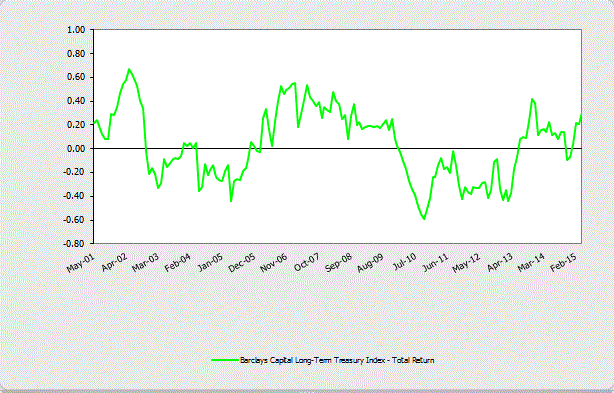
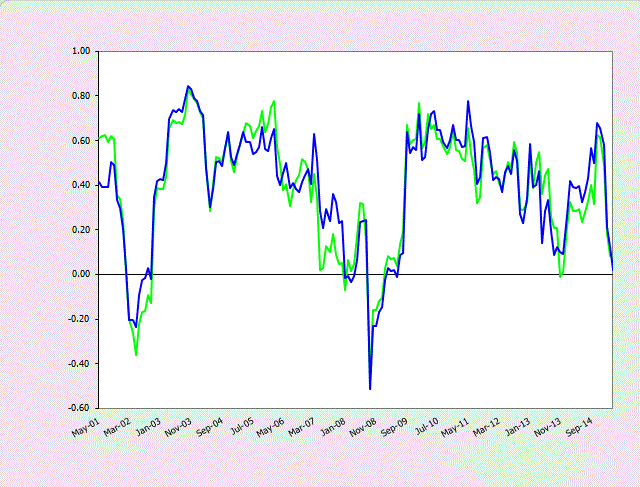
Ask and Ye Shall Receive. Interpret these however you will. In my opinion they aren't overly useful and it's easier to just look at what FFH owns and the bets they have on and how that might work out in a number of scenarios (which is what everyone here is already doing).

-
Green is rolling 12 month correlation to the S&p500, blue is to the All Country World index
-
Agreed. Vinod's quantitative approach would certainly miss an inflection point in the quality of the business and large chunky gains. I don't know Fairfax well but there does seem to be a lot of optionality and growth (and risk!) in the form of the the insurance businesses in emerging markets, being the GP of FIH, wholly owned businesses, distressed workouts, etc that would certainly be close to impossible to model in a spreadsheet. Also, to add a little bit of quantitative finance modern portfolio theory mumbo jumbo (otherwise known to some value investors as quasi-science bullshit) to the conversation, Fairfax does exhibit strong diversification benefits to a stock portfolio over time and has periods of very low or negative correlation to general markets. Fundamentally we know this because they have lots of hedged and made beaucoup money on the CDS contracts, but if I knew nothing about that and just looked at the monthly returns of the stock, I'd agree with those saying "I like FFH for its diversification benefits"
-
I actually think those are the worst forms of cash because they don't take advantage of being small. I am an individual looking to keep cash measured ok tens of thousands not tens of millions or billions. Therefore, I can use CD's and I-savings bonds to earn returns that are not only above those of cash but are also above those of most IG credit (and certainly on a risk adjusted basis). I buy $10K of I-bonds / yr so that the ones I bought a year ago become cash (you are locked in for the first year but may redeem thereafter for a small penalty ( I think it is 6 months interest). I do use leverage to keep my exposure up to reduce the opportunity cost of holding all those, so that kind of defeats the purpose but I am trying to build a substantial I-bond position and it takes time with the $10K limit) And if you need more than $10k / yr in cash, I suggest the next best thing is a 5 yr CD with a redemption penalty that allows you to get your money back any time. The GE one used to be 2.5% and had a 9 month penalty. So the way I looked at it was it had FDIC type credit risk, had a capped duration (the ability to redeem for a 1.8% penalty acts as a interest rate payer swaption that protects you) and paid more than intermediat term invesent grade credit which had more credit risk and duration of 5-6. EDIT: If you want to build an i-bond position without much opportunity cost you can do something like this: Instead of owning 300 shares of Berkshire($43,000), you could own $30K of i-bonds and 3 $110 Jan 2017 calls for $4000 / contract ($12K). you pay $40 per call and lose $5 of premium over 18 months, $3.33 / yr, so it cost you about 3% annualized in premium but you get a 24% OTM put and a call option on inflation. When I did this it was like 1.5% / yr which made it more attractive (and Berkshire was at $110 and I was buying $80 calls). But my point still stands, you don't have to sacrifice net exposure and have too much cash to build a nice i-bond position over time since leverage (either margin or non-recourse call option) can be used to replicate exposure. This is probably beyond the scope of the thread, but I just wanted to point that out since when I tell my friends of the joys of i-bonds (0% pretax real return with no duration or credit risk , woooohooooo!!!) they point to the long term opportunity cost of building such a position.
-
Vinod was calculating the rate of book value growth. His estimate is 5-12%, with a base case of, call it, 7%. His base case calls for stock market returns of 5% (not unreasonable by any measure). His base case says Fairfax will grow at a greater rate than the market and is therefore "worth" at least book to "the market". What it is worth to frommi or Jurgis or vinod is an entirely different story. What something is worth to the market under reasonable assumptions under today's conditions is different than what something is worth to any one of us with an XX% hurdle. My takeaway from Vinod's thorough analysis is in order to own FFH today, you either must have higher compounding rate expectations (like Gio does, not trying to argue with you Gio, I just know you expect greater things from FFH than 5 or 7%) or pretty low return requirements. I have no strong opinions either way and have never owned FFH.
-
all i have to add here is i got a 100% LTV, 5 yr @ 2% cash-out refi from my previously unencumbered 6 yr old 50K mile automobile from my credit union. No bank would have given me that. I asked them to price out various terms and 1- 5 yr all had the same rate of 1.99%, which I thought was odd. No varying it up for increased duration? (it got higher at 6 yrs and out but even 8 yr was something like 3%). the 5 yr treasury was like 1.2% when I took that puppy out (I recognize a 5 yr amortizing loan has a lower weighted average life than a bullet bond and so the comparison is not apples to apples). I would never keep my money there beyond that which was necessary to secure their below market terms (like $50). Credit unions are strange animals
-
-
it's cheaper for me to have fastest internet + basic cable + landline ($90 for the 3) than it is for me to have fastest internet.
-
ISTJ here, have gotten INTJ in past (was only 1% on the S this time). We did this at my office, practically everyone was INTJ. I am sure some of it is "real" but a lot of it is because people in the investment industry want to think of themselves as being analytical, rational, introverted, etc.
-
Operates Profitably...but true value is in the Real Estate owned
thepupil replied to Fat Pitch's topic in General Discussion
Pardee's timber is carried at $30mm, worth $136mm according to survey. See the thread on PDER; stock is off lately on declining coal royalties and falling oil and gas prices. All the earnings are from coal and natural gas royalties but a big portion of asst value is in the timber. -
Operates Profitably...but true value is in the Real Estate owned
thepupil replied to Fat Pitch's topic in General Discussion
For some reason Rick's Hospitality (RICK / formerly Rick's Cabaret) put a lot of effort into stock promotion. Not sure if they still do these but tgeir IR events on site took stock promotion to a whole new level! -
I only have Feb 1988 - today but in that time period 22 / 323 (6.8%) rolling 3 month periods experienced a >10% drop. Rolling short term puts makes you look like a genius if you happen to pull a Paul Tudor Jones and call a big short term drop. Otherwise, the pennypicker beats out the steamroller any day. In the words of my friend at an options market maker /trading firm "sell the preem, live the dream"