alwaysinvert
-
Posts
1,060 -
Joined
-
Last visited
-
Days Won
1
Content Type
Profiles
Forums
Events
Everything posted by alwaysinvert
-
I have these rolling now: Titan Overhaul Who Says Elephants Can't Dance Your Brain at Work How the Scots Invented the Modern World
-
What a Value Investor's Desk Looks Like!
alwaysinvert replied to Parsad's topic in General Discussion
Simply contact Investor Relations and request that a copy be mailed to your address! Well, I have done so on numerous occasions for US companies and companies from other countries, but I don't think they bother sending stuff abroad. And as I said most domestic ones have a no paper policy, which I think is fair enough, but it doesn't make my life easier :) -
What a Value Investor's Desk Looks Like!
alwaysinvert replied to Parsad's topic in General Discussion
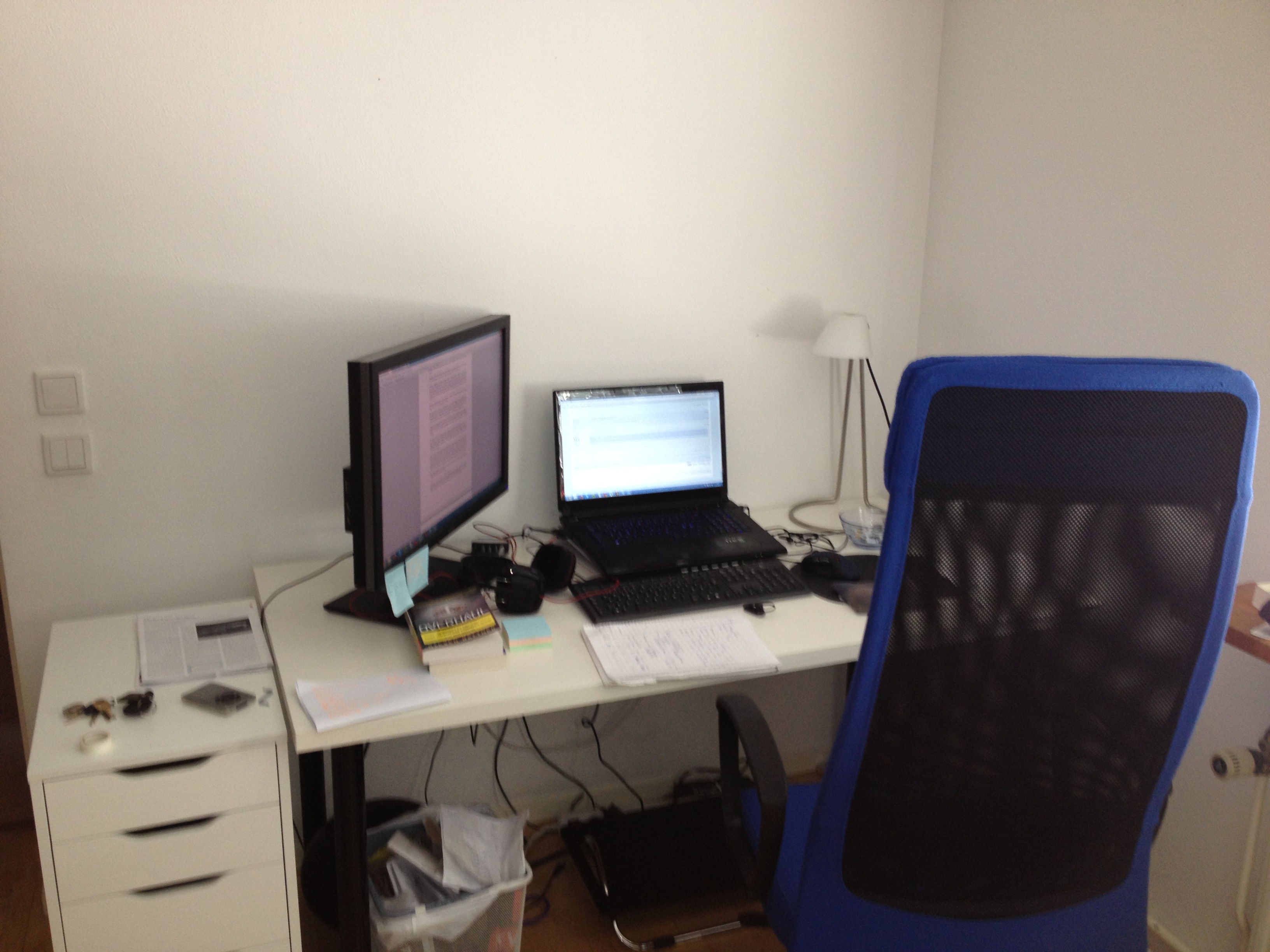
I'd love to be able to get my hands on annual reports on paper, but most companies here only publish online nowadays. So I do most of my report reading on the computer or on my ipad, which is a less effective way to do deep reading. Printing all that stuff isn't a viable option as far as I'm concerned. Just splashed out on a new chair because my back was killing me. Got it from Ikea, though, so I hope I'll get a value pass on that one. Here's my office corner (perhaps one day it'll be a corner office instead).
-
I don't think many economically minded people are against patents per se, it has been a great vehicle for achieving growth in the Western world. As usual I don't think it's much use going after individuals or companies for behaving 'immorally', when they are incentivized to do so. Rather the regulatory bodies should do something to prevent the rent-seeking behiaviour, because it's a huge drag on the economy. For example, the amount of patents issued in the US seems out of whack, so maybe the bar for what's patentable should be raised, if only to minimize litigation and let companies get on with their business.
-
This American Life on patent trolling: http://www.thisamericanlife.org/radio-archives/episode/496/when-patents-attack-part-two Mind-blowing.
-
Well, depends on what you are looking for. There are many horrible books that were written during the boom years to make a quick buck and even though they are much newer than Super System, they are not better. Mathematics of poker (Chen) and The theory of poker (Sklansky) are books that are more helpful in understanding the structure of the game, but just like with investing there's only so much a book can do in terms of helping your game. You need to have a hands-on approach to poker, thinking and calculating for yourself. And playing loads, obviously. The right framework is game theory, because it gives you a holistic view of the game, but to be able to use it properly you need to be properly ensconced in the game of choice. I can draw pretty good conclusions on the spot in no-limit texas from a game theory approach (non-borderline ones, at least - and much more is borderline than you think), but in 2-7 triple draw or fixed-limit omaha 8, I am almost as helpless as a complete amateur - because my knowledge of those particular games is very constricted. What is a good book on game theory that would be useful for investing? Idk, something by Edward Thorp maybe? Haven't read anything by him, though. The Signal and the Noise touches on some game theory and bayesian thinking and is a good read in my view. I quite liked The Success Equation, too, and even though it doesn't explicitly discuss game theory, it has some good stuff on a basic level about luck and correlation/causation, which may seem bland to some people but that I think is actually pretty deep and crucial. I've been told that Bruce Bueno de Mesquita has some great stuff too but I haven't read any books by him either. Of course, game theory only really works in closed systems with known variables. I'm not sure if there is a "Game Theory in Investing"-book out there. But maybe some smart guy should write it. Be aware that I don't really know game theory as in know the actual math behind it or anything. I just use it as a model to see if I can work out what's exploitable and what is not on a rough basis. In poker, that translates to looking at what kind of moves that would be clear dogs if playing against an optimal opponent (as opposed to trying to take advantage of a specific real-life opponent using a "read" based on a certain sample size, an approach that is far more open to biases - but if done right of course way more profitable). That can pretty often be done using high school maths.
-
Well, depends on what you are looking for. There are many horrible books that were written during the boom years to make a quick buck and even though they are much newer than Super System, they are not better. Mathematics of poker (Chen) and The theory of poker (Sklansky) are books that are more helpful in understanding the structure of the game, but just like with investing there's only so much a book can do in terms of helping your game. You need to have a hands-on approach to poker, thinking and calculating for yourself. And playing loads, obviously. The right framework is game theory, because it gives you a holistic view of the game, but to be able to use it properly you need to be properly ensconced in the game of choice. I can draw pretty good conclusions on the spot in no-limit texas from a game theory approach (non-borderline ones, at least - and much more is borderline than you think), but in 2-7 triple draw or fixed-limit omaha 8, I am almost as helpless as a complete amateur - because my knowledge of those particular games is very constricted.
-
As a former professional poker player I tend to think that the analogies between poker and investing often are a bit farfetched. Ignoring differences to stress similarities, like trying to fit a square plug into a round hole. I did like the blog post, though, and it made me think of analogies I hadn't quite considered. My key takeaway from playing poker that's highly applicable to investingr, however, is thinking of the counterfactual - what didn't happen but could have. I think even some seasoned value investors don't do this enough. Granted, it's harder in investing than in poker because it's much less calculable. I also want to add that while Super System may be a good book for getting a biography on a successful poker player and some insights on psychology, it's HUGELY outdated on the strategy side. This book was written before game theory entered the sphere of poker and some of the stuff in it on strategy is horrendous advice in today's game. While some poker players become good investors (like Charlie Munger), I don't think most do. All successful poker players have the handicapper's mindset, but only a few have patience - most are the exact opposite and crave action. That's why they were attracted to poker in the first place.
-
"Why Buy and Hold is an Inferior Strategy"
alwaysinvert replied to mikazo's topic in General Discussion
Thread should have been done here. Favorite holding period forever only means that 1) turnover only when necessary/beneficial 2) companies should be able to stand the long-term. It's a mental model/checklist item for BUYING and not some kind of life rule, as evidenced by Buffett's own portfolio turnover. -
The restaurant owner is signalling something towards all his employees and customers by hiring the security guard: "I care for your safety, I care for you". This may very well increase the operations of the business sufficiently (or avoid decreases, think what would have happened to employee morale and the reputation of the restaurant if the owner appeared to do nothing) to warrant the cost. This is not a straight up weighting of probabilitites and doing a cost-benefit analysis in a vacuum is not too helpful, and hiring a guard at the time when the valet is under emotional duress may very well not be due to some sort of immediacy bias on the owner's part.
-
Dividends are taxfree for owners with 10% or more, so there is quite a substantial misalignment of interest between larger and smaller shareholders when it comes to capital allocation. On the other hand, cap gains are also taxfree for those lucky few, so for savvy owners of that kind, with the right incentives, there shouldn't be a bias towards dividends. Problem is hardly any are savvy and even fewer are properly incentivized (most certainly not the Wallenbergs).
-
I got some good suggestions in this thread: http://www.cornerofberkshireandfairfax.ca/forum/general-discussion/analyzing-regional-banks/ I also liked this book: http://www.amazon.com/Analyzing-Investing-Community-Stocks-2005905835/dp/B0045LDM6E/ref=sr_1_1?ie=UTF8&qid=1364655521&sr=8-1&keywords=Investing+in+community+banks
-
I completely agree, when used correctly computers are great tools. I don't know why it would be hard to just turn off the monitor, he wouldn't see quotes or see newsflow. If he really wants to make sure he's clueless about his portfolio he should take my approach, get a full time job, then work from home with two little kids. In between conference calls and helping out my wife during meltdowns I'm unaware there's even a market. If someone came and told me some stock I owned dropped 50% while I was wrangling with a melting down toddler I'm not even sure it would register. I don't know why fat people don't get thin, they'd just need to eat less. While you jest it is true. If someone were fat and they reduced their caloric intake to 500 or 1000 calories a day they would lose weight, that's not up for dispute. This all boils down to self-control. Why do some people spend all day on Facebook, or Twitter or corner of ber….uh... Yes, but sometimes limiting your choices beforehand is the wiser choice. I know I' m not rational enough to always make the choices I actually want to make long-term
-
I completely agree, when used correctly computers are great tools. I don't know why it would be hard to just turn off the monitor, he wouldn't see quotes or see newsflow. If he really wants to make sure he's clueless about his portfolio he should take my approach, get a full time job, then work from home with two little kids. In between conference calls and helping out my wife during meltdowns I'm unaware there's even a market. If someone came and told me some stock I owned dropped 50% while I was wrangling with a melting down toddler I'm not even sure it would register. I don't know why fat people don't get thin, they'd just need to eat less.
-
Great video. Where did he get Buffett's return pre-partnership? I've never seen it stated anywhere explicitly before. Did he ask him personally?
-
Have you looked at Danish banks? I have some small positions there. Denmark to me is much easier to stomach than France and they could always decouple from the Euro. And the banks seem really cheap.
-
How much are you allocated in cash?
alwaysinvert replied to Mephistopheles's topic in General Discussion
I am quite enjoying the 'cool' days of aussie summer. Dreary weather according to the locals but at +20C I won't ever complain. Approaching 20% cash fast fwiw -
Thank you very much!
-
Does anyone know when the Q4 is coming? Will be interesting to see if he added any Dell during the quarter.
-
Sir Alex Ferguson - the value investor?
alwaysinvert replied to alwaysinvert's topic in General Discussion
Robin van Persie = The BNSF of football ;D -
List of Good Companies Regardless of Price
alwaysinvert replied to BG2008's topic in General Discussion
I'm not actually convinced that any facts about the crime rate make much of an impact on consumers' decisions about installing an alarm (or taking any other sort of defensive measure such as not allowing your kid to walk to school or buying a hand gun). The decisions get made based on the perception of risk rather than any objective measure of risk. In many cases, it's truly an irrational, emotional decision. Many of my friends and colleagues have monitored alarm systems that cost anywhere from $300-$500 annually. Unless your community has a demonstratively high break-and-enter rate, that's basically wasted money. Canada's national break-and-enter rate is about 700 per 100,000 annually, implying that on average there's a very small probability of your house being hit. If your house does get hit, most people have basically nothing of interest to the crack-head perpetrators (ie, may a small amount of cash, some booze, or a couple bits of electronics), so your losses to theft are likely going to be small in any case. And if your losses do actually amount to something significant due to accompanying vandalism, then you just make an insurance claim. So, in essence, every year my friends and colleagues are incurring a 100% probability of losing $300-500 to mitigate a 1% probability of losing a couple thousand bucks. Crime rate be damned! SJ Hear hear! I started writing a response trying to make this very point, only in a dodgier version. But it should be said that this is not just irrational money down the drain. The notion that someone has broken into your home is VERY disturbing to many people. Home alarms are in that way a pretty cheap way of feeling in control. $300-$500 seems to be very expensive systems to me, however. Very few people cancel their subscriptions after getting a home alarm. I have a (thus far) small position in a small firm that provides home alarms and their churn rates indicate a customer relationship of +20 years (they basically almost only lose customers when they move houses and not even always then because they can often incite the new owners to take over the subscription on the cheap) while needing about 4 years to get to breakeven for every new customer. Being the odd one out without a home alarm in an upper-middle class area may also garner a huge increase in burglary risk even if I haven't seen any statistics like that. People also feel very frustrated because these crimes have such a miniscule clearance rate and they basically never retrieve anything of what was stolen. The only way of protecting yourself if you feel that protection is high-priority is via getting your own protection. People just don't make cost-benefit analysis on these things. It's just a great business model. Sell the alarms and don't fuck up the service and you have great business for two decades. When the infrastructure is in place you can grow quite nicely only by adding a couple of people - not much new equipment needed. And people aren't all that price sensitive because they will have to pay an uninstallation fee if they want to change providers and they can't use the extra equipment that they have bought with any other company because they are incompatible. The lock-in effect seems much, much better than for satellite, internet and other such subscription services. -
History as it happens is interestiing. But history is almost never told as it happens and that's the danger of it. Complexities and messiness wither away, the loser's tale gets lost and later people interpret it with the eyes of another time with a different set of moral and scientific axioms and ideologies. It gets fitted into a nice narrative which suits a specific implicit or explicit agenda. This always fascinates me when I read a biography. Who told the author this and why? What's in the interest of the author? To write a readable story which sells (and in the case in which the author is hired or sanctioned by the biographee, optics matter even more) and not to give the historical truth. I think this is well illustrated in the fact that Newton's story of the falling apple is completely made up - about 20 years after he published his Principia Mathematica. And why? Because Newton realized that it was a great narrative and boy was he right.
-
You all did really well, but how many of you can now boast that your 2013 returns equal your 2012 returns? Seems I am the only one actually living by the adage of finding one-foot hurdles to step over :D
-
I have no problem with the thought of great concentration - it's just that those kinds of high-conviction bets don't seem to come as often to me as to some other people. I had my biggest position take a 50% drop last spring. It did make up all of that and then some in 2012 and I held throughout the ordeal despite deteriorated business prospects. But I was sweating for a bit. Even more so - I bought stock for my neurotic mother before hell broke loose. She has made 20% on the position in less than a year but I can assure you that for her it was definitely not worth the emotional toll it took. I guess I can see better what fund managers go through now.
-
+8%. First year of underperformance since starting up in 08. Made some blunders that I think I have learned from, but mostly I couldn't find all that many cheap stocks domestically, so that's why I have widened my search. It's a slower process finding good stocks abroad, though. I think this has been the year when I have made the furthest progress in thinking and process so it's not all bad. My CAGR since 08 is 17.6%. But considering how clueless I have been for most of that time you have to put the bulk of that overperformance down to luck. I'd be ecstatic if I could keep making those kinds of returns, obviously.